Apply for the OPF Scholarship in Pakistan: Rs 1,500 to Rs 5,000 a Month for Overseas Pakistanis' Children
OPF pays Rs 1,500 to Rs 5,000 a month to children and spouses of registered members. See the 60 per cent rule, the Rs 200,000 income limit and how to apply.
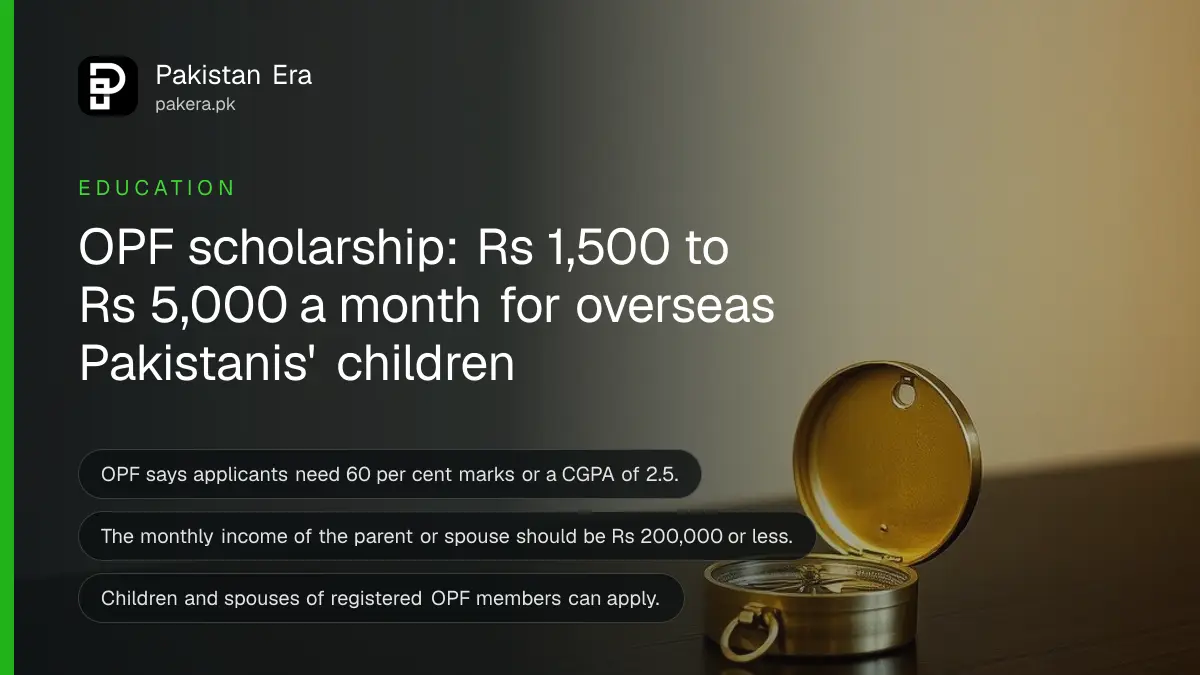
Short answer: The Overseas Pakistanis Foundation (OPF) pays a monthly scholarship to children and spouses of registered OPF members. The stipend runs from Rs 1,500 for an intermediate day scholar to Rs 5,000 for a boarder at Master's level. You need 60 per cent marks, or a CGPA of 2.5, and a household income of Rs 200,000 a month or less.
A father works in Jeddah and his daughter has just started an MBBS in Peshawar. Hostel fees run every month. OPF's scholarship is one of the few schemes written for exactly that family.
We read the OPF Scholarship page on 12 October 2026. The page states the rules and the amounts. It does not show an open round, a closing date or an application link, so we have not invented them. We explain below how to find the current notice.
Children and spouses of registered OPF members can apply
OPF says the scholarship is open to the children and spouses of overseas Pakistanis, as long as one parent, or the spouse, is a registered OPF member. Children of a deceased registered member are also eligible if the parent died within three years before the notice's last date.
Registration comes first. If you or your parent are not yet on the OPF rolls, getting an OPF membership card is the first step. OPF says the programme was revamped so students can apply regardless of their current semester or academic year.
The scholarship covers three levels of study
OPF lists intermediate or equivalent, graduation programmes such as MBBS, BDS and engineering, and Master's or MS programmes of 18 years of education. A student must be enrolled in one of these. The page does not list school-level classes.
| Level of study | Day scholar, monthly | Boarder, monthly |
|---|---|---|
| Intermediate | Rs 1,500 | Rs 3,000 |
| Graduation (BA, BSc) | Rs 2,500 (printed "25,00") | Rs 4,000 |
| Professional degree or course (BS, MBBS, engineering, B.Com, IT) | Rs 3,000 | Rs 4,500 (printed "45,00") |
| Master's or MS | Rs 3,000 | Rs 5,000 |
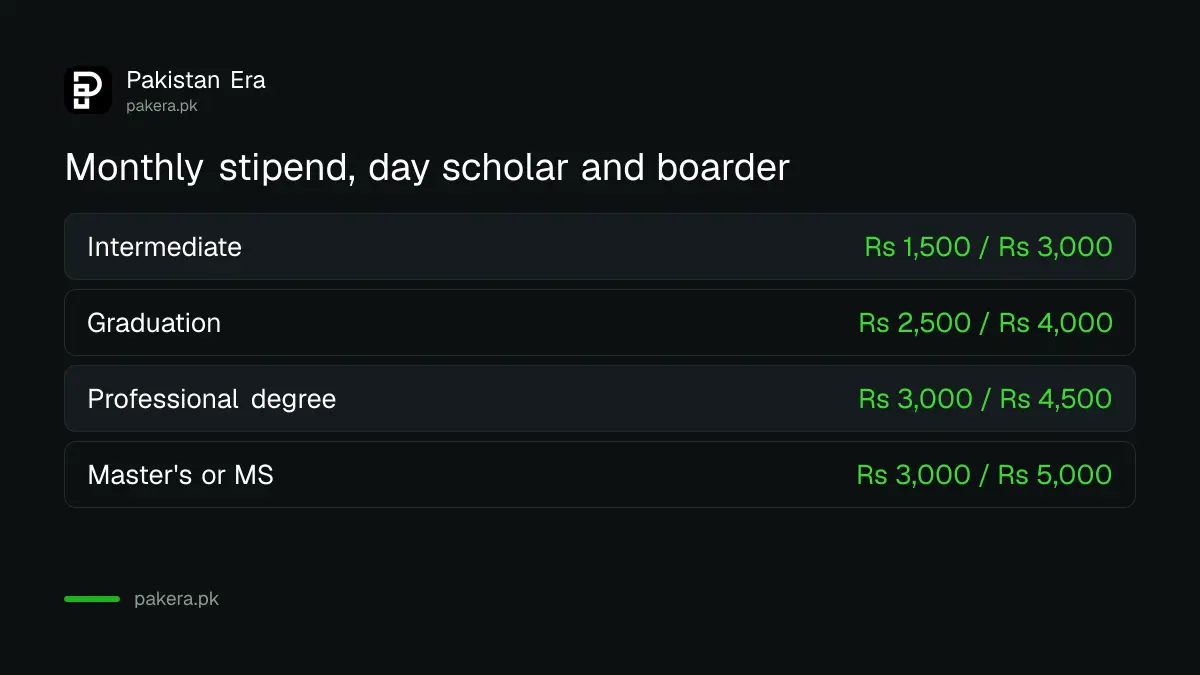
Two figures in OPF's table are printed with a misplaced comma, "25,00" and "45,00". We read them as Rs 2,500 and Rs 4,500 because they sit between Rs 1,500 and Rs 3,000, and between Rs 3,000 and Rs 5,000. OPF has not confirmed this, so check the amount on the notice.
Five conditions decide eligibility
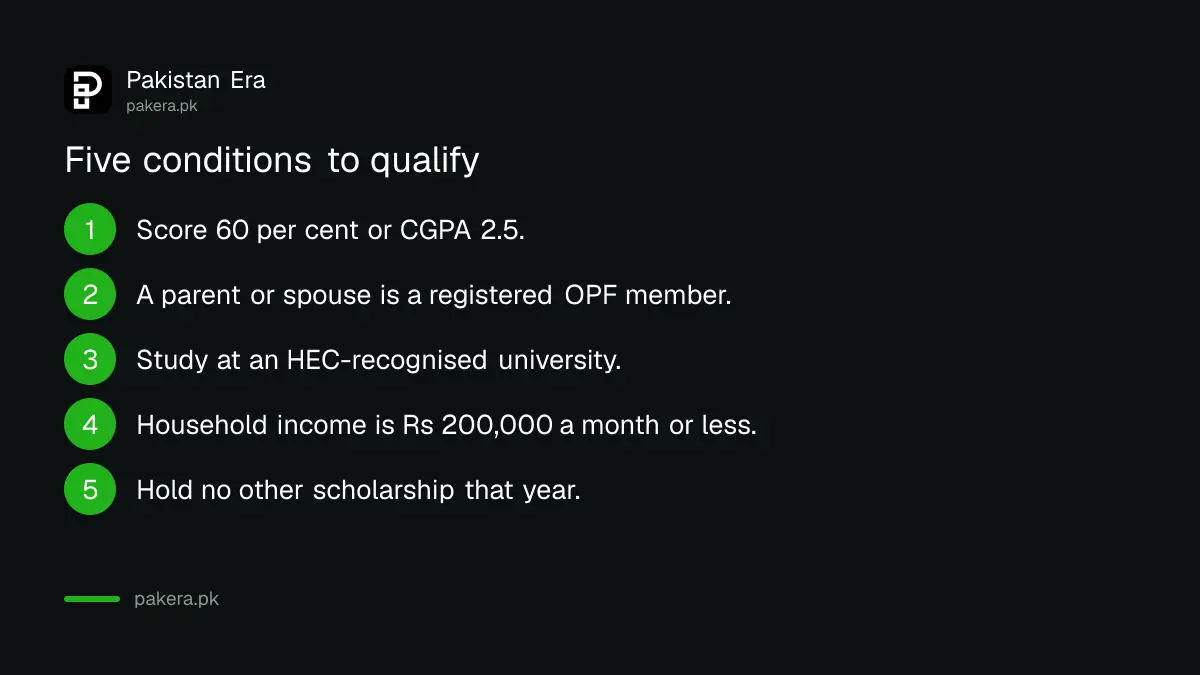
An applicant needs at least 60 per cent marks or a CGPA of 2.5 in the last exam, a parent or spouse who is a registered OPF member, household income of Rs 200,000 a month or less, and no other scholarship in the same year. The degree must come from an HEC-recognised university.
- At least 60 per cent marks, or CGPA 2.5, in the last SSC or HSSC exam, or in the last graduation or Master's.
- One parent, father or mother, is a registered OPF member.
- Or the applicant is the spouse of a registered OPF member.
- The monthly income of the parent or spouse is Rs 200,000 or less.
- The applicant receives no other scholarship in that academic year.
The last condition matters if you are also applying for a government or provincial grant. You may need to choose one. A different OPF benefit, reserved admission seats, is covered in the report on KMU OPF seats for overseas Pakistanis' children.
OPF advertises the application window, and this page does not
The page says the last date is set in the advertisement. It does not give the form, the closing date or the documents. So watch OPF's news page and its notices, and check the website of the university you attend, before you assume a round is open.
Keep these papers ready, because most scholarship forms ask for them. These are our suggestions, not OPF's published list:
- Your parent's OPF membership card and CNIC.
- Your last result card or transcript.
- Proof of enrolment in your current programme.
- Income proof for the household.
- Your own CNIC or B-Form.
The OPF contact line is 111-040-040. OPF's page also lists the email complaints@opf.org.pk for general queries.
Compare it with other OPF support for families
OPF also runs reserved seats and its own schools, and it gives financial aid after a death or disability. These are separate programmes with separate rules. The scholarship is the only one on the page we read that pays a monthly stipend to a student.
For a death or disability of the worker, read about claiming OPF financial aid. For a worker who has died abroad, the steps for bringing a body home through OPF include the free ambulance.
Common questions
How much is the OPF scholarship a month?
It runs from Rs 1,500 for an intermediate day scholar to Rs 5,000 for a Master's boarder. The exact amount depends on your level and on whether you live in a hostel.
Who can apply for the OPF scholarship?
Children and spouses of registered OPF members can apply. Children of a member who died within three years before the notice's last date can also apply.
What marks do I need?
At least 60 per cent, or a CGPA of 2.5, in your last SSC or HSSC exam, or in your last graduation or Master's from an HEC-recognised university.
What is the income limit?
The monthly income of the parent or spouse should be Rs 200,000 or less. OPF does not say on the page which income proof it accepts.
Can I take another scholarship at the same time?
No. OPF says the applicant must not receive any other scholarship during the academic year.
Is a round open now?
We could not see one. The page states the rules, and OPF sets the dates in an advertisement. Check OPF's notices for the current window.
How we verified this
What we checked, where we read it, and what we could not confirm.
We read the OPF Scholarship page at opf.org.pk on 12 October 2026. The page carries no date and no open round. Amounts and conditions are as OPF printed them. The document list above is ours, not OPF's.
About the author

Global Affairs & Political Economy Writer
Muhammad Hatim is a book lover who started writing because he enjoys it. At Pakistan Era he writes about international relations, geopolitics and the global economy, with a particular interest in South Asia and the forces behind current events.