AFP Cases in Pakistan, Week 42 2026: 43 Children With Sudden Weakness Checked for Polio, Meningitis Up to 38
Pakistan reported 43 suspected AFP cases in week 42 of 2026, NIH says: KP 25, Sindh 16. Meningitis rose from 29 to 38. What to do if a child suddenly goes weak.
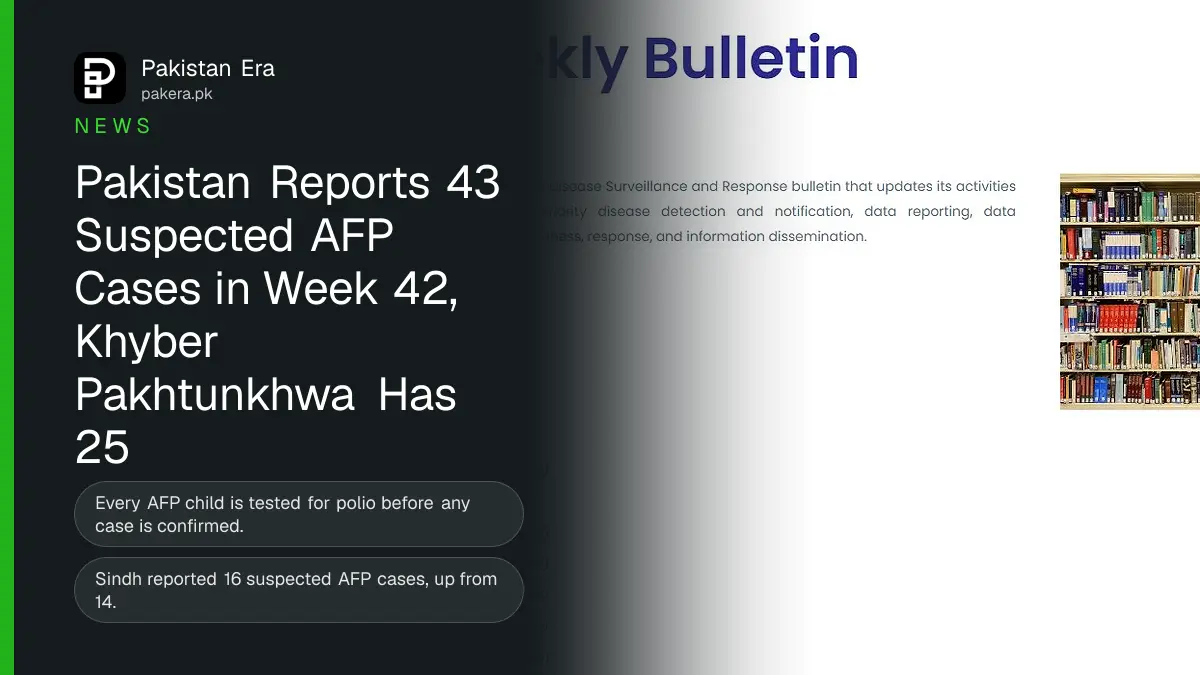
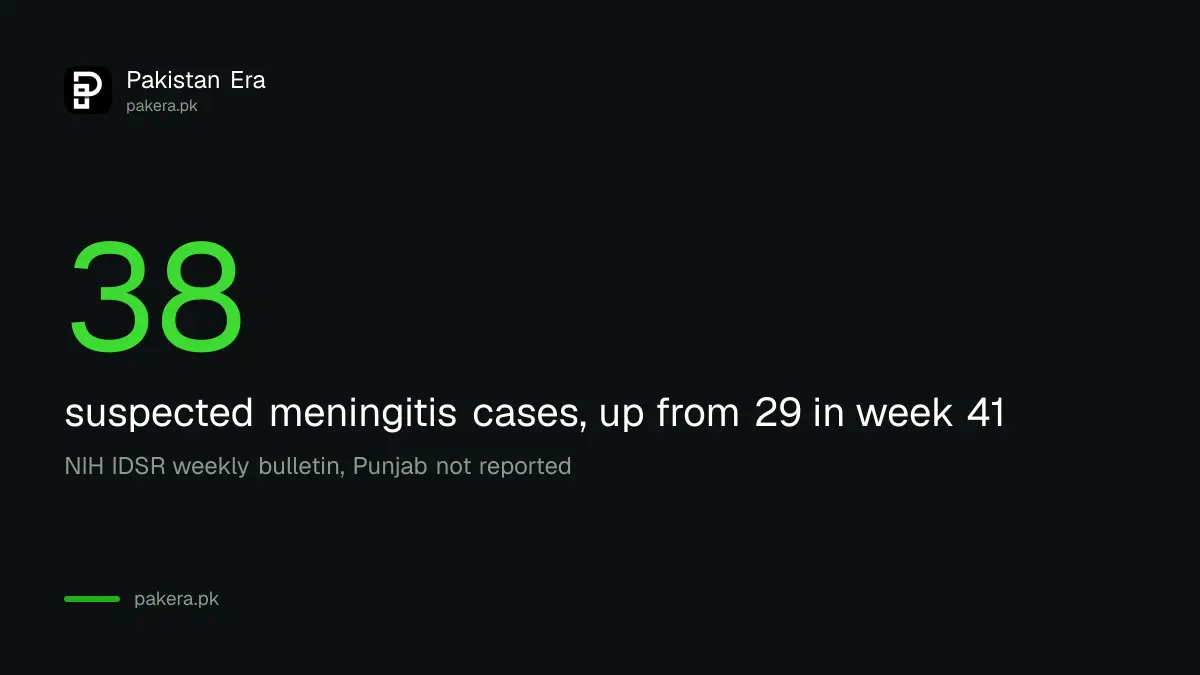
Pakistan reported 43 suspected cases of acute flaccid paralysis (AFP), the sudden limb weakness that is checked for polio, in week 42 of 2026, the National Institutes of Health (NIH) said in its weekly bulletin posted on 11 November 2026. Khyber Pakhtunkhwa had 25 and Sindh 16. Suspected meningitis rose from 29 to 38.
An AFP report is not a polio case. It is a child who suddenly could not move an arm or leg, whose stool samples are then tested for poliovirus. Reporting every such child is how Pakistan finds polio early. Below are the week 42 figures, how they compare with week 41, and what to do if your child suddenly goes weak.
AFP reports fell slightly to 43 in week 42
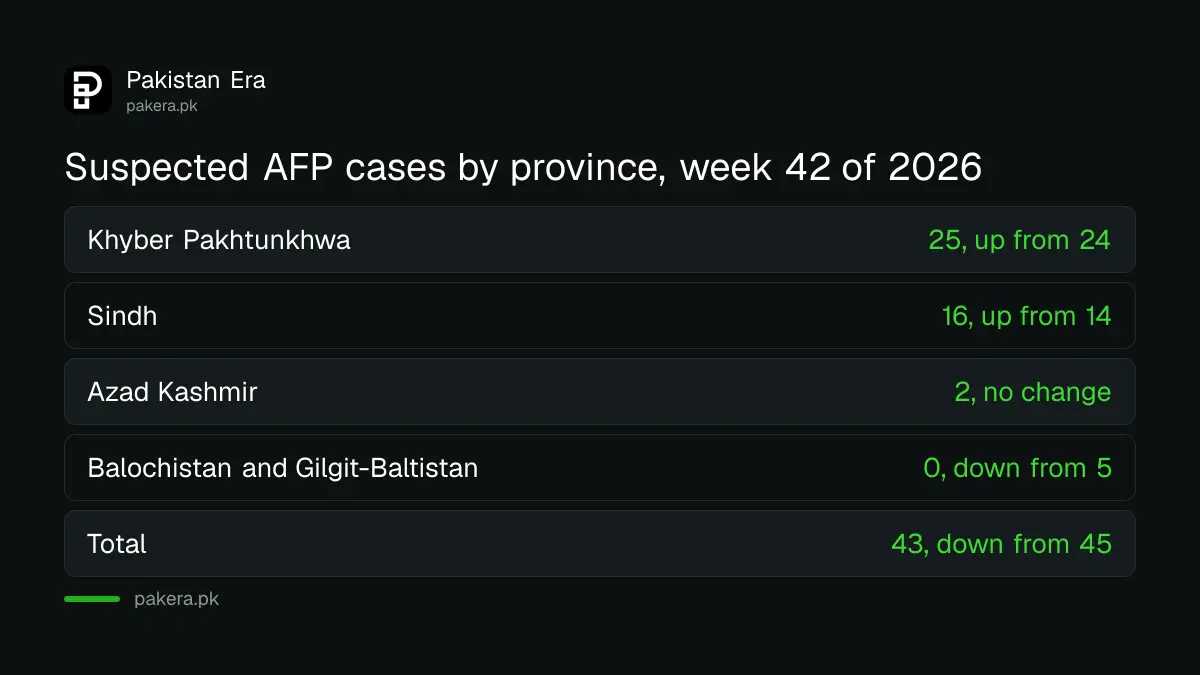
NIH counted 43 suspected AFP cases in week 42, against 45 in week 41. Khyber Pakhtunkhwa rose from 24 to 25 and Sindh from 14 to 16. Balochistan and Gilgit-Baltistan, which had 2 and 3 a week earlier, reported none. Azad Kashmir had 2 both weeks.
The bulletin says all of them "are suspected cases and need field verification". That means a surveillance officer visits the child, collects two stool samples and sends them to the lab. Only the lab result decides whether it was polio.
| Province or area | AFP, week 41 | AFP, week 42 |
|---|---|---|
| Khyber Pakhtunkhwa | 24 | 25 |
| Sindh | 14 | 16 |
| Azad Jammu and Kashmir | 2 | 2 |
| Balochistan | 2 | 0 |
| Gilgit-Baltistan | 3 | 0 |
| Islamabad | 0 | 0 |
| Punjab | not reported | not reported |
| Total | 45 | 43 |
Khyber Pakhtunkhwa and Sindh both list AFP among rising illnesses
The provincial notes in the bulletin say the same thing for both large provinces. Khyber Pakhtunkhwa's section lists AFP among the illnesses that "showed an increase in number", and so does Sindh's. Both add that the cases need field verification.
A small rise in AFP reports is not bad news on its own. A good surveillance system should find many AFP children every year, because other illnesses also cause sudden weakness. Fewer reports can mean that some children are being missed. The bulletin does not give districts for AFP.
For confirmed polio cases this year, see our polio cases in Pakistan 2026 page, which follows the national polio programme's own announcements.
Suspected meningitis rose to 38, with Sindh at 22
Meningitis is an infection of the lining around the brain and spine. It causes fever, a stiff neck, a bad headache and, in babies, a bulging soft spot on the head. It is an emergency.
NIH counted 38 suspected meningitis cases in week 42, up from 29. Sindh had 22, up from 16. Khyber Pakhtunkhwa had 11, up from 6, and Gilgit-Baltistan 5, up from 4. Azad Kashmir, which had 3 in week 41, reported none. Sindh's labs tested 17 samples for meningitis and found none positive.
| Province or area | Meningitis, week 41 | Meningitis, week 42 |
|---|---|---|
| Sindh | 16 | 22 |
| Khyber Pakhtunkhwa | 6 | 11 |
| Gilgit-Baltistan | 4 | 5 |
| Azad Jammu and Kashmir | 3 | 0 |
| Total | 29 | 38 |
What to do if your child suddenly cannot move an arm or leg
Sudden weakness or floppiness in a child under 15 must be reported, even if the child had all polio drops. The report is free and helps protect other children too.
- Take the child to the nearest government hospital or health centre the same day.
- Tell the doctor the weakness came on suddenly and say when it started.
- Call the polio helpline 1166 to report it if the hospital does not.
- Agree to the two stool samples the surveillance team will ask for, taken 24 to 48 hours apart.
- For fever with a stiff neck or a fit, treat it as an emergency and go straight to hospital.
Our guide to reporting a child's sudden weakness to 1166 explains each step, and our guide on polio drops when a child is sick answers a common worry.
How we read the week 42 bulletin, and where it trips readers up
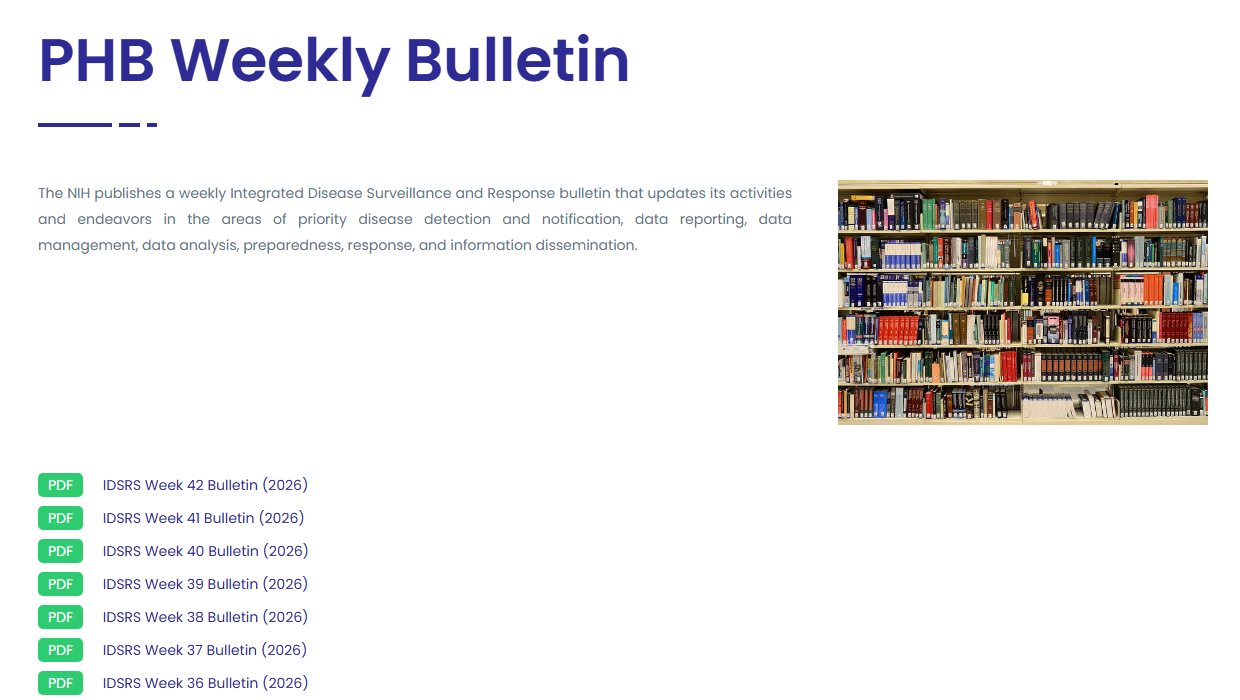
We opened the NIH weekly bulletin page on 12 November 2026. The week 42 file sits at the top of the list as a PDF of about 2.6 MB and 25 pages. The AFP and meningitis figures by province are in Table 1 on page 5, and the province notes that mention AFP sit under each district table on pages 7 to 11.
Two things slowed us down. Punjab's column reads NR, short for not reported, in every row, so the national total is not truly national. And the bulletin files are not named the same way each week: week 42 is 'Weekly Report-42-2026', but week 41 is 'IDSRS Weekly Report-41-2026-NA'. When we typed the week 41 address in the week 42 style, the site returned a web page instead of the PDF. Use the links on the list rather than guessing the address. Our guide to checking disease cases in your district from the NIH bulletin shows how to find your own district.
Common questions
How many AFP cases did Pakistan report in week 42 of 2026?
43 suspected cases: 25 in Khyber Pakhtunkhwa, 16 in Sindh and 2 in Azad Kashmir, according to the NIH bulletin posted on 11 November 2026.
Does an AFP case mean polio?
No. AFP is sudden weakness from any cause. Each case is tested, and only a lab result confirms polio.
Which districts had AFP cases?
The bulletin does not give districts for AFP, only provinces.
How many meningitis cases were reported in week 42?
38 suspected cases, up from 29. Sindh had 22 and Khyber Pakhtunkhwa 11.
What number do I call to report sudden weakness in a child?
The polio helpline, 1166, takes these reports.
How we verified this
What we checked, where we read it, and what we could not confirm.
We downloaded the NIH IDSR bulletins for weeks 41 and 42 of 2026 from the NIH weekly bulletin page on 12 November 2026 and read Table 1, Table 5 and the provincial notes. Punjab did not report. The bulletin does not say how many AFP samples tested positive for polio.
About the author
Public Services and Education Journalist
Fajr Riaz is a journalist and content writer at Pakistan Era, based in Lahore. She covers the questions people meet in everyday life in Pakistan: how a public service works, what a change in the rules means, and where to find a reliable answer.