Report Sudden Weakness in a Child's Arm or Leg in Pakistan: Call Polio Helpline 1166
Sudden floppy weakness in a child under 15 is AFP and must be tested for polio in Pakistan. See the signs, the 2 stool samples and how to report it on 1166.
Short answer: If a child under 15 suddenly cannot move an arm or leg properly, or a limb goes floppy, take them to a doctor or government hospital the same day and call the polio helpline 1166. Pakistan's polio programme calls this acute flaccid paralysis (AFP), and every case must be tested.
Most children with sudden weakness do not have polio. There are several other causes. But polio can only be ruled in or out by testing the child's stool, and the test works best in the first two weeks. Waiting a few days to see if it passes loses that time.
We read the polio programme's surveillance page, its contact page and the Global Polio Eradication Initiative's surveillance standards on 20 October 2026. We also checked the latest National Institute of Health (NIH) weekly bulletin. Here is what counts as AFP, what to do and what happens next.
Sudden weakness in any limb of a child under 15 counts as AFP
The polio programme defines acute flaccid paralysis as sudden paralysis or weakness in any part of the body of a child under 15. Acute means it comes on quickly. Flaccid means floppy, not stiff. One arm, one leg or both legs all count.
The programme treats each AFP case as a signal. It shows where polio could be circulating and which children it could reach. That is why it wants to hear about every case, not just the ones a doctor already suspects are polio.
| Sign | Is it AFP? |
|---|---|
| A leg suddenly goes floppy and the child cannot stand | Yes, report it |
| An arm hangs loose and the child cannot lift it | Yes, report it |
| Weakness in a child aged 14 | Yes, the age limit is under 15 |
| Stiff muscles after a fall, but normal strength | Not AFP, see a doctor for the injury |
| Weakness that came on slowly over many months | Not acute, but still see a doctor |
Report it the same day, because the stool test needs early samples
Global polio standards say every AFP case should be reported and tested within 48 hours of onset. Two stool samples are taken 24 to 48 hours apart. Poliovirus is found in the highest amounts in stool during the first two weeks after paralysis starts.
So the clock matters. If a family waits a week, the samples can still be taken, but the chance of a clear answer falls. A same-day visit gives the lab the best chance to confirm or rule out polio.
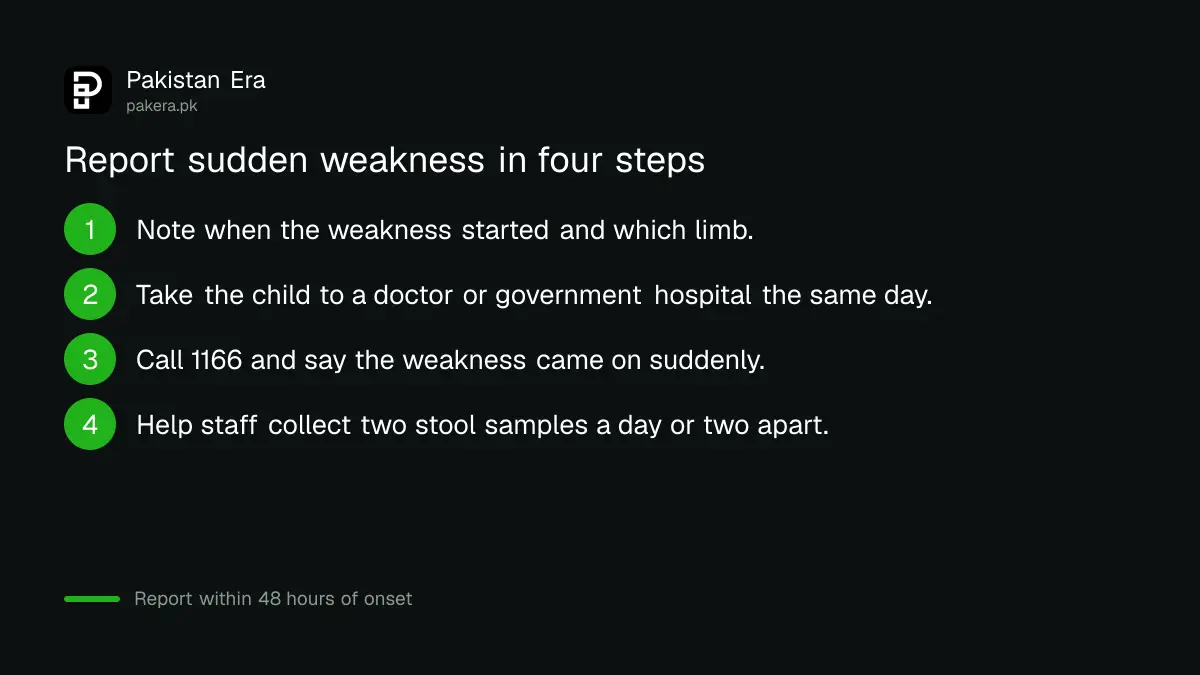
- Note the date and time the weakness started, and which arm or leg is affected.
- Take the child to the nearest government hospital, district health office or a doctor the same day.
- Say clearly that the weakness came on suddenly. Use the words "sudden weakness" or "AFP".
- Call the polio helpline 1166, or message 0346-7776546 on WhatsApp, and tell them where the child is.
- Bring the child's vaccination card, if you have it.
- If staff ask for stool samples, help them collect two, a day or two apart.
Treatment of the child comes first. Reporting AFP does not replace a doctor's care. It runs alongside it, so that the programme can test the samples while the doctor looks for the cause.
Samples go to the NIH laboratory in Islamabad
All stool samples from AFP cases in Pakistan are tested at the Regional Reference Laboratory for polio eradication at the NIH in Islamabad. If poliovirus is found, further tests trace its genetic family, which shows where the strain likely came from.
That genetic tracing is how the programme decides where to run extra vaccination rounds. It is the same lab that confirmed Pakistan's seventh polio case of 2026 in Karachi East on 19 October.
Pakistan started AFP surveillance in 1997 and gave it focused attention from 2000. The programme also tests sewage at 127 sites in 87 districts. Global polio standards note that sewage testing often finds the virus where no child has been paralysed.
Most AFP cases are not polio, and that is normal
AFP has several causes. Global polio standards name Guillain-Barré syndrome, transverse myelitis and nerve injury as examples, and say polio can be hard to tell apart from them early on. That is why the lab test, not a guess, decides.
The numbers show this. NIH's weekly bulletin for week 39 of 2026 counted 43 suspected AFP cases in one week: 22 in Khyber Pakhtunkhwa, 16 in Sindh, 3 in Gilgit-Baltistan, and one each in Islamabad and Azad Kashmir. Punjab's figure was not reported. Pakistan has confirmed seven polio cases in the whole year.
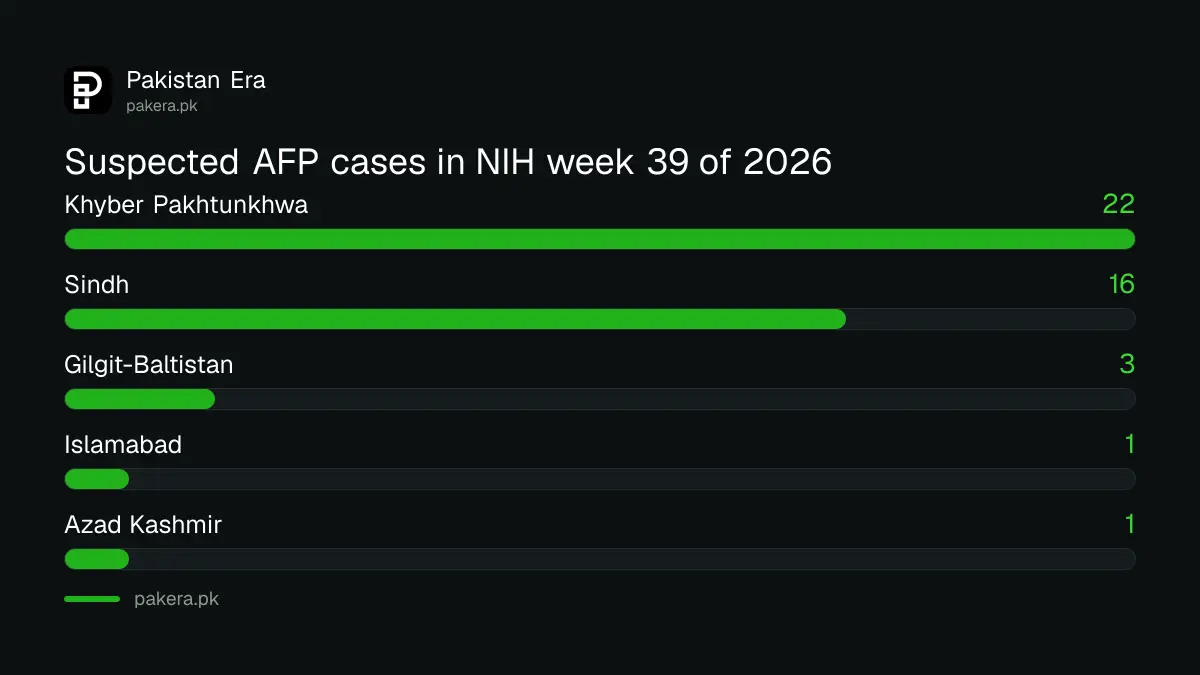
So dozens of children are reported each week, and very few turn out to have polio. Our page on AFP cases in week 38 has the week before, with 49 suspected cases. Reporting your child does not mean anyone thinks they have polio. It means the system is working.
Vaccination is still the only protection
Polio has no cure, the programme says, but vaccines prevent it, and children need repeated doses. A child who gets AFP from another cause still needs all routine doses and drops in every campaign round.
The next round runs from 2 to 8 November 2026 in 97 districts. Our free EPI vaccination schedule lists the routine doses from birth.
Common questions
What is AFP in polio?
AFP stands for acute flaccid paralysis. It is sudden, floppy weakness or paralysis in any part of the body of a child under 15. Every case is tested for polio.
Does AFP mean my child has polio?
No. Most AFP cases have other causes, such as Guillain-Barré syndrome. Only the stool test at the NIH lab can confirm polio.
Who do I call to report sudden weakness in a child?
Take the child to a doctor or government hospital the same day, and call the polio helpline 1166. You can also message 0346-7776546 on WhatsApp.
How many stool samples are needed for AFP?
Two, taken 24 to 48 hours apart. Global standards say testing should happen as soon as possible after the weakness starts.
Is there a charge for the polio test?
The programme's pages do not mention any charge for AFP testing. Ask at the hospital, and call 1166 if anyone asks you to pay for the polio samples.
Does AFP reporting cover adults?
No. The programme's definition covers children under 15. An adult with sudden weakness should still see a doctor urgently.
How we verified this
What we checked, where we read it, and what we could not confirm.
We read the polio programme's surveillance page and contact page, and the Global Polio Eradication Initiative's surveillance standards, on 20 October 2026. The week 39 counts are from NIH's weekly report, published on 16 October 2026. We could not find a published fee for AFP testing, or a list of which hospitals act as reporting sites, so we have not named any.
About the author
Public Services and Education Journalist
Fajr Riaz is a journalist and content writer at Pakistan Era, based in Lahore. She covers the questions people meet in everyday life in Pakistan: how a public service works, what a change in the rules means, and where to find a reliable answer.