Pakistan vs Sri Lanka Tri-Series Final Result: Pakistan Win by 3 Wickets, Fakhar Zaman 127
Pakistan beat Sri Lanka by 3 wickets in the tri-series final in Lahore on 31 October 2026, chasing 326 with Fakhar Zaman 127. See the scores and key stands.
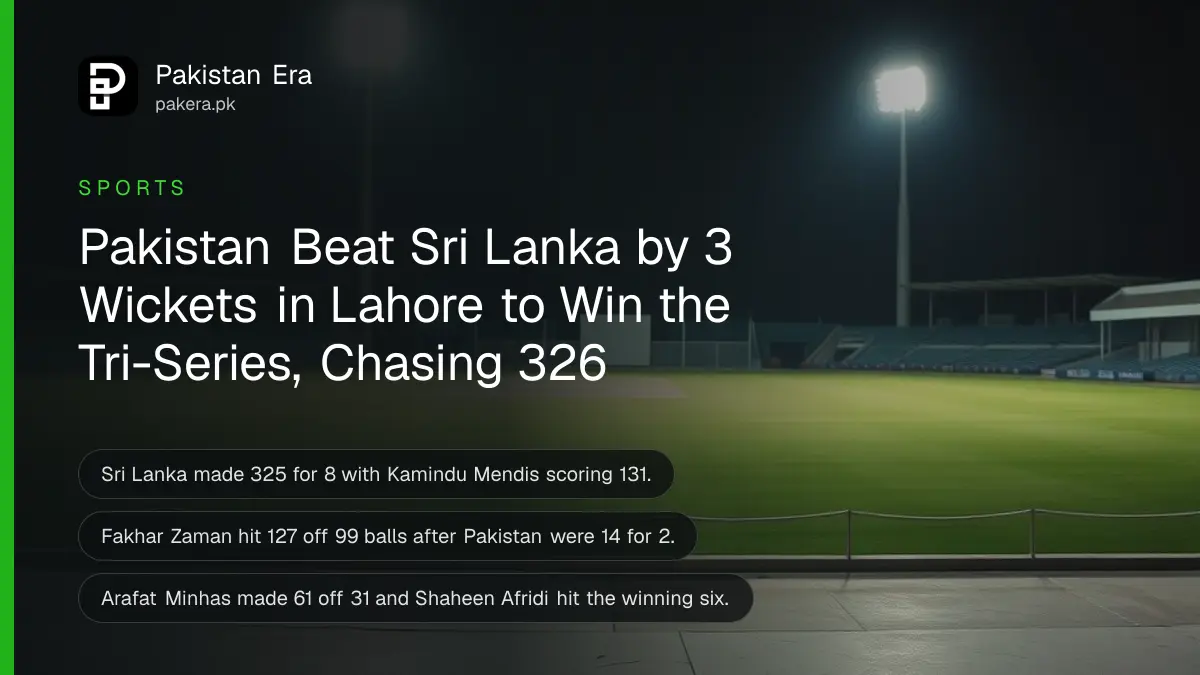
Pakistan beat Sri Lanka by 3 wickets to win the ODI tri-series final at Gaddafi Stadium, Lahore, on Saturday 31 October 2026. Sri Lanka made 325 for 8 in 50 overs, and Pakistan chased 326 to finish on 331 for 7 in 48.3 overs. Fakhar Zaman scored 127 off 99 balls, and captain Shaheen Afridi hit the winning six.
We read the match stories published by the International Cricket Council (ICC) and by Sri Lanka Cricket (SLC) on the night of the final. Both boards give the same scores and the same margin. The Pakistan Cricket Board (PCB) website refused our connection, so the details below come from those two official reports. Pakistan lost to the same opponents by 8 wickets four days earlier, so this was a clear turnaround.
Pakistan won the tri-series final by 3 wickets with 9 balls left
Pakistan won by 3 wickets on 31 October 2026. Sri Lanka scored 325 for 8, and Pakistan reached 331 for 7 in 48.3 overs. By our count that left 9 balls unused. It is Pakistan's tri-series title, won at home in Lahore.
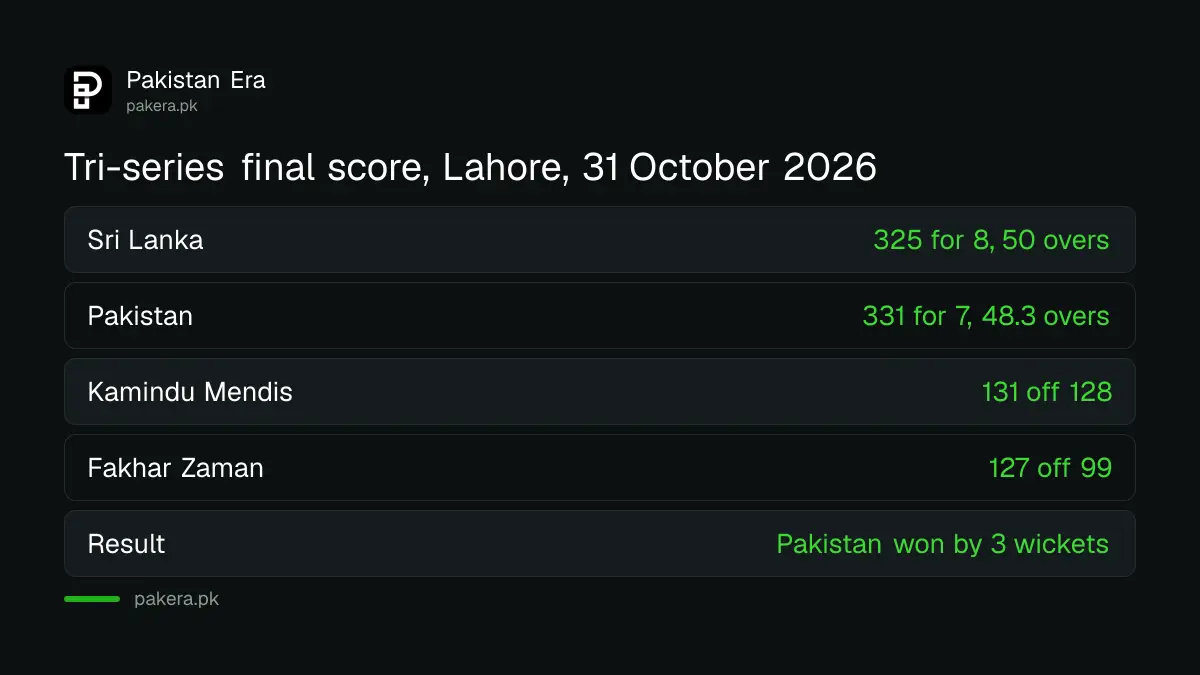
| Innings | Score | Top scorer | Next best |
|---|---|---|---|
| Sri Lanka | 325 for 8, 50 overs | Kamindu Mendis 131 off 128 | Pavan Rathnayake 77 off 65 |
| Pakistan | 331 for 7, 48.3 overs | Fakhar Zaman 127 off 99 | Saad Baig 74 off 75 |
| Result | Pakistan won by 3 wickets, Gaddafi Stadium, Lahore, 31 October 2026 | ||
The two boards disagree on one detail, the toss. The SLC report says Sri Lanka won the toss and chose to bat. The ICC story says Sri Lanka were put in to bat. We could not open the PCB scorecard to settle it, so we report both. Either way, Sri Lanka batted first. You can compare this with the build-up in our tri-series final preview, which had the squads and timings.
Kamindu Mendis made 131 as Sri Lanka reached 325 for 8
Kamindu Mendis scored 131 off 128 balls, his first ODI century according to Sri Lanka Cricket. Pavan Rathnayake added 77 off 65. Sri Lanka were 255 for 2 after 41 overs, then lost 6 wickets for 70 runs in the last 9 overs.
Kamindu opened with Avishka Fernando, and the pair put on 87 for the first wicket. Fernando made 38. Then Kamindu and Pavan added 146 for the third wicket, the biggest stand of the Sri Lankan innings. At 255 for 2, a total near 350 looked possible.
Pakistan's fast bowlers pulled it back. Shaheen Afridi dismissed Kamindu, and the SLC report says Haris Rauf and Naseem Shah also took wickets in that late spell. From 255 for 2, Sri Lanka added only 70 more runs. That collapse is the difference between a 350 target and a 326 one, and it probably decided the final.
- First wicket: 87 runs, Avishka Fernando and Kamindu Mendis.
- Third wicket: 146 runs, Kamindu Mendis and Pavan Rathnayake.
- Last 9 overs: 70 runs for 6 wickets.
Fakhar Zaman's 127 rescued Pakistan from 14 for 2
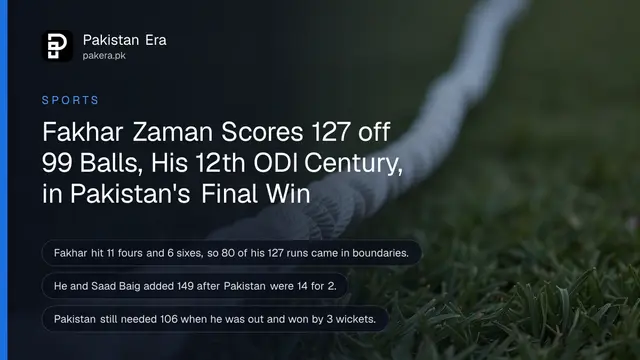
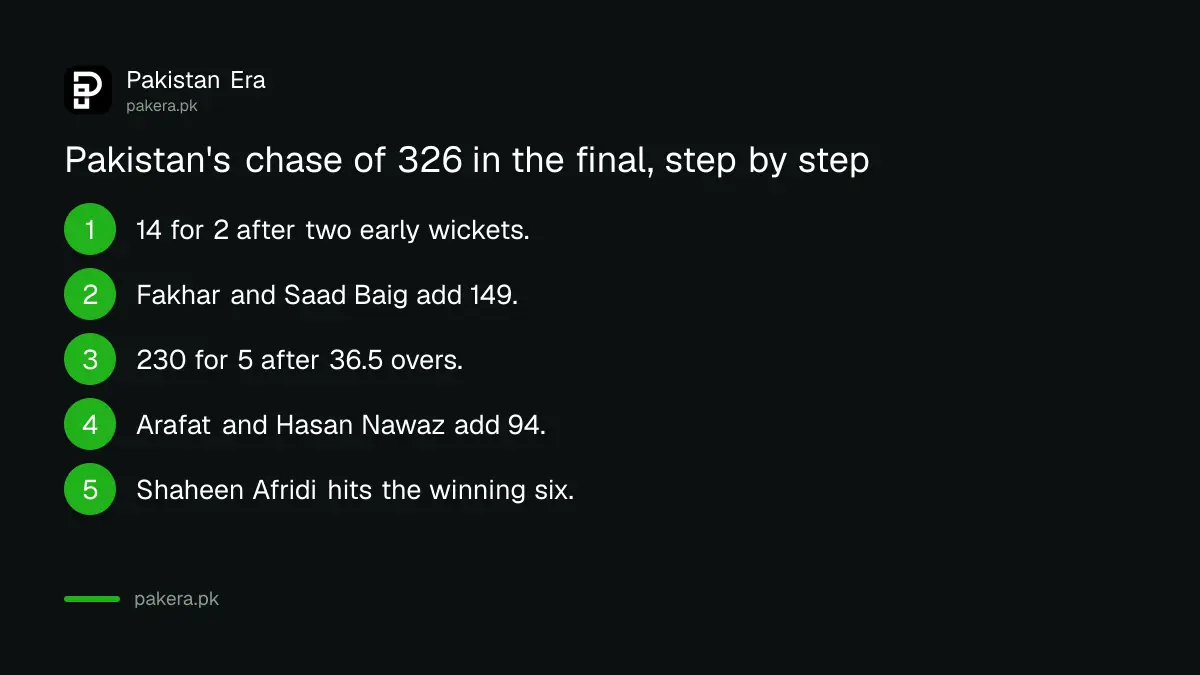
Pakistan were 14 for 2 after Dilshan Madushanka removed Maaz Sadaqat for 5 and Babar Azam for 0. Fakhar Zaman and Saad Baig then added 149 for the third wicket. Fakhar's 127 off 99 balls was his 12th ODI century, the ICC said.
Madushanka was the bowler who took 5 for 34 against Pakistan on 27 October, so the early wickets looked like a repeat. They were not. Fakhar hit 11 fours and 6 sixes. Saad Baig made 74 off 75, his first half-century in ODIs according to the ICC.
Both fell in the middle overs. The SLC report says Pakistan still needed 106 runs when Fakhar was out. The ICC story puts Pakistan at 230 for 5 after 36.5 overs, with both Baig and Fakhar gone. From there Pakistan needed 96 runs off 79 balls, by our count. There is a closer look at the knock in our report on Fakhar Zaman's 127.
Arafat Minhas hit 61 off 31 and Shaheen finished with a six
Arafat Minhas scored 61 off 31 balls with three fours and four sixes. He and Hasan Nawaz, who made 37 off 45, added 94 for the sixth wicket. Captain Shaheen Afridi ended the chase with a six in the 49th over.
That stand took Pakistan from 230 for 5 to about 324 for 6, which is our sum of the two official figures. One more wicket fell before the end, and Pakistan finished on 331 for 7. Arafat had already taken six wickets against England at Rawalpindi earlier in the series, so the final added a match-turning innings to his tournament.
- 14 for 2: Madushanka removes Maaz Sadaqat and Babar Azam with the new ball.
- Third wicket stand of 149: Fakhar Zaman and Saad Baig rebuild.
- 230 for 5 after 36.5 overs: both set batters are out, 96 still needed.
- Sixth wicket stand of 94: Arafat Minhas and Hasan Nawaz swing it back.
- 331 for 7 in 48.3 overs: Shaheen Afridi hits the winning six.
Pakistan lost once in five games on the way to the title
Pakistan won four of their five tri-series games. They beat Sri Lanka by 37 runs and England by 87 runs at Rawalpindi, England by one wicket in Lahore, and Sri Lanka in the final. Their one defeat was to Sri Lanka on 27 October.
The 27 October loss was heavy. Pakistan were bowled out for 110 and lost by 8 wickets, as our report on Sri Lanka's 8 wicket win set out. Four days later the same batting order scored 331. Pakistan had already qualified before that game, so it cost them nothing in the table. Every result and the final table sit in our list of tri-series 2026 results.
Sri Lanka can take positives too. Pavan Rathnayake ended the series as its leading run-scorer, the SLC report says. Their board's preview gave him 350 runs before the final, so his 77 takes him to 427 by our sum.
The Test series against Sri Lanka starts on 9 November
Pakistan and Sri Lanka now switch to Tests. The first Test is at Rawalpindi from 9 to 13 November, and the second at Gaddafi Stadium, Lahore, from 17 to 21 November. Both count for the ICC World Test Championship.
Sri Lanka Cricket's own release confirms the Test series starts on 9 November in Rawalpindi. The PCB's 14-player Pakistan Test squad was named on 24 October, with a three-day warm-up at the Islamabad Club from 4 to 6 November. What the series means for the table is in our look at Pakistan's next match.
Common questions
Who won the Pakistan vs Sri Lanka tri-series final?
Pakistan won by 3 wickets at Gaddafi Stadium, Lahore, on 31 October 2026. They chased 326 and finished on 331 for 7 in 48.3 overs.
Who scored a century in the tri-series final?
Two players did. Fakhar Zaman made 127 off 99 for Pakistan, and Kamindu Mendis made 131 off 128 for Sri Lanka.
Who won the toss in the final?
The reports differ. Sri Lanka Cricket says Sri Lanka won the toss and batted. The ICC says Sri Lanka were put in. Sri Lanka batted first either way.
Who hit the winning runs?
Captain Shaheen Afridi finished the chase with a six, according to the ICC match story.
Who was player of the match?
Neither official report we read named the player of the match or the player of the series. We will not guess.
When is Pakistan's next match?
Pakistan's Test squad has a warm-up from 4 to 6 November, then the first Test against Sri Lanka starts on 9 November in Rawalpindi.
How we verified this
What we checked, where we read it, and what we could not confirm.
Last checked 1 November 2026 at about 05:30 PKT. The scores, the century details and the 230 for 5 figure come from the ICC match story of 31 October 2026. The 255 for 2 after 41 overs, the 146 and 149 stands, the 94 sixth-wicket stand, the toss and the 106 runs still needed come from Sri Lanka Cricket's match report, published on 1 November 2026 in Sinhala, which we read and translated ourselves. The balls left, the 96 off 79 and the 427 runs are our own arithmetic. We could not open the PCB website or a full scorecard, so the bowling figures, the fall of each wicket and the awards are not shown.
About the author

Senior Writer, Public Services and Technology
Shahid joined us in 2024 as an author. He is a senior contributor to Pakistan's leading technology websites. He writes detailed articles, mostly covering his expertise in the latest tech, mobiles, apps, gadgets, and step-by-step guides. His ideology is to help people understand the latest trends and explain complex methods through very easy-to-understand guides.