Pakistan Credit Rating 2026: Moody's B3, S&P B and Fitch B-, Explained
Pakistan is rated B3 by Moody's, B by S&P and B- by Fitch in October 2026. See what each grade means, what Fitch says could move it, and how to check it.
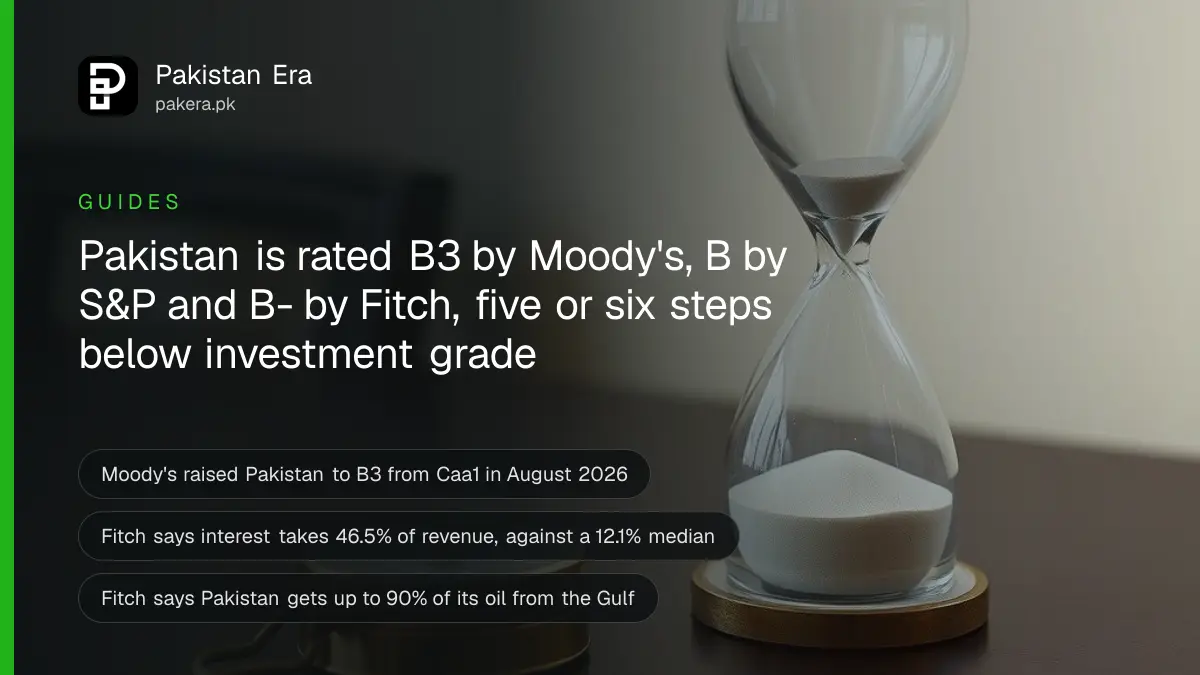
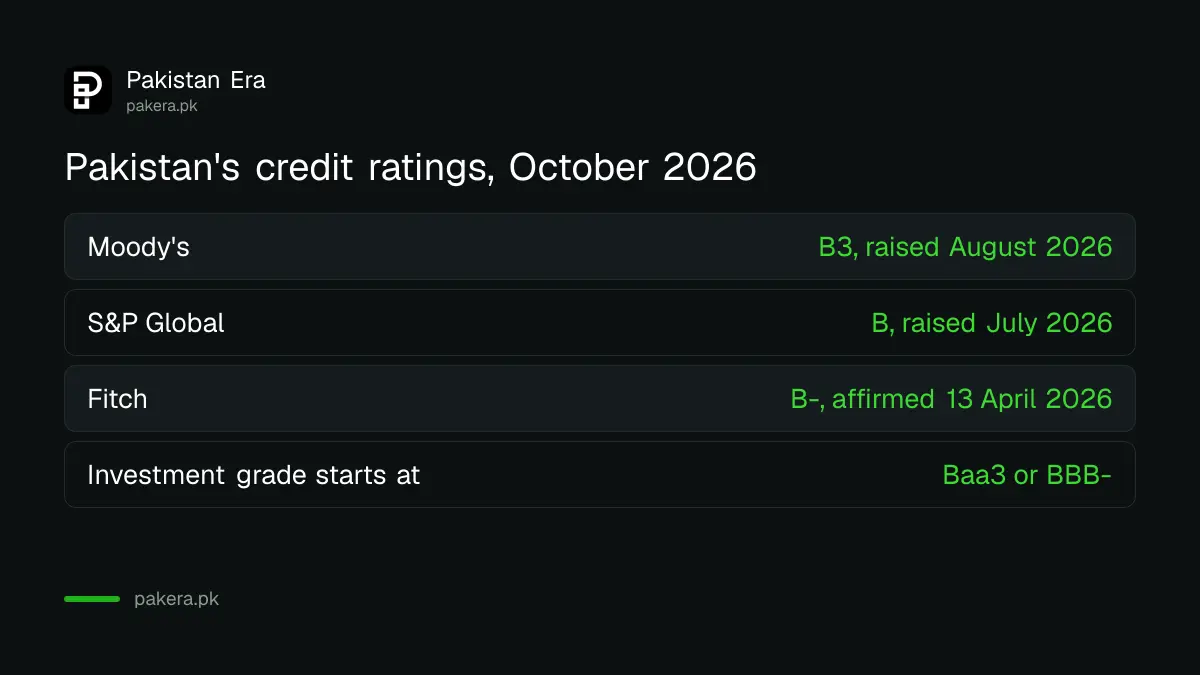
Pakistan's credit rating in October 2026 is B3 at Moody's, B at S&P and B- at Fitch. All three sit in the single B band, which is five or six steps below investment grade. S&P is one step above the other two.
A sovereign credit rating is a grade that tells foreign lenders how likely a government is to repay on time. It does not change your bank loan or your electricity bill directly. But it sets how much interest Pakistan pays when it borrows abroad, and that cost lands on the budget.
We read Fitch's own rating notes and its Pakistan page, and checked the Moody's and S&P moves against the World Bank's Pakistan overview and the Finance Ministry's press releases. Here is where Pakistan stands and what would move it.
Pakistan is rated B3, B and B- by the three agencies
Moody's raised Pakistan to B3 from Caa1 in August 2026. S&P raised it to B in July 2026. Fitch affirmed B- with a stable outlook on 13 April 2026, a level it first gave in April 2025.
| Agency | Rating | Last move | Steps below investment grade |
|---|---|---|---|
| Moody's | B3 | Raised from Caa1, August 2026 | 6 |
| S&P Global | B | Raised, July 2026 | 5 |
| Fitch | B- | Affirmed, stable outlook, 13 April 2026 | 6 |
Moody's uses a different alphabet, so B3 at Moody's means the same as B- at Fitch and S&P. Investment grade starts at Baa3 at Moody's and BBB- at the other two. Our count of steps is simple arithmetic on each agency's published scale.
We covered the details of the August move when the Moody's upgrade to B3 was announced.
Fitch says interest takes 46.5 per cent of revenue
Fitch's April review gives the clearest picture of why Pakistan is still rated low. It expected interest payments to take 46.5 per cent of government revenue, against a median of 12.1 per cent for B rated countries, and debt at 68.9 per cent of GDP.
Fitch also named the strengths. It said the IMF programme anchors the budget, and that dollar reserves rebuilt over the past year give a cushion against the Middle East war. It even noted that Pakistan's role as a ceasefire broker may bring some benefit.
| Measure (Fitch, April 2026) | Pakistan | Median for B rated countries |
|---|---|---|
| Government debt, FY26 | 68.9% of GDP | 51.3% of GDP |
| Interest as share of revenue | 46.5% | 12.1% |
| World Bank governance ranking | 18th percentile | Not given |
The Finance Ministry's own figures have improved since then. Its Annual Debt Review put public debt at 68.3 per cent of GDP at end June 2026. The full breakdown is in our reading of the Annual Debt Review for FY26.
Oil is the biggest risk Fitch sees
Fitch says Pakistan gets up to 90 per cent of its oil from the Gulf and has little storage. That makes the country highly exposed to the Middle East conflict and to shipping trouble in the Strait of Hormuz. A sharp fall in reserves is the risk it watches most.
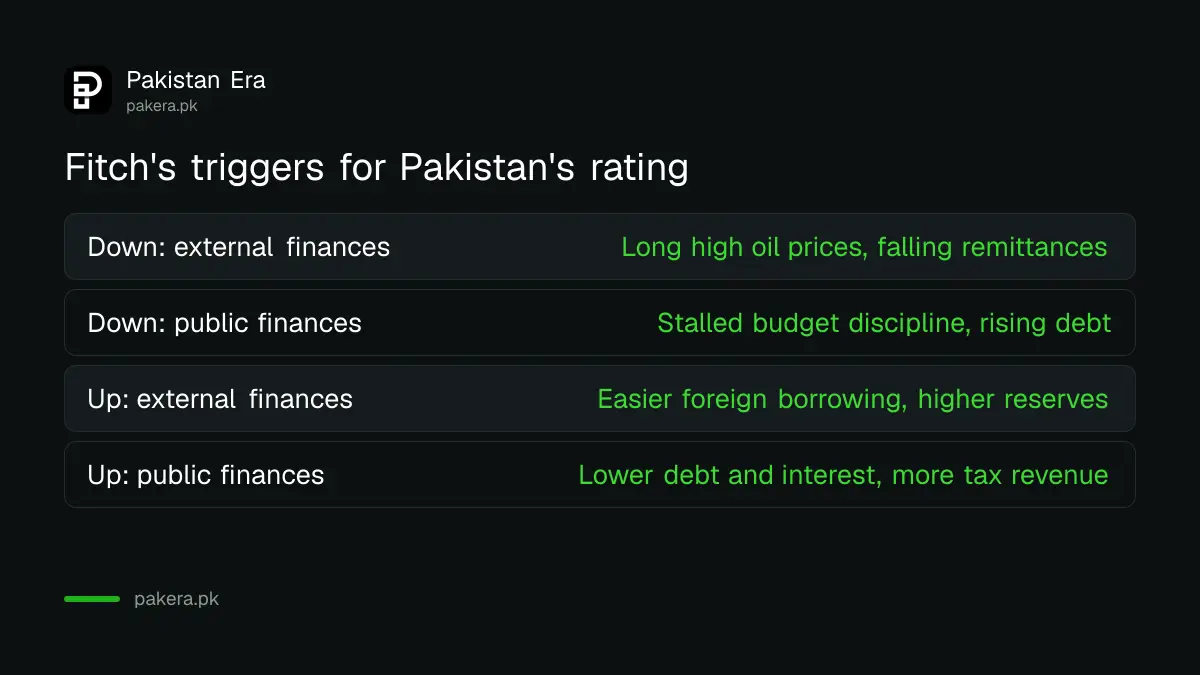
Fitch lists what could push the rating down. Long high oil prices or a sharp fall in remittances could hurt external finances. A stall in budget discipline that drives up debt would hurt too.
It also lists what could lift it: easier access to foreign borrowing, reserves recovering beyond its forecasts, and real falls in debt and interest costs, for example through lasting gains in tax revenue.
Better ratings already cut Pakistan's borrowing cost
The upgrades let Pakistan sell $3 billion of Eurobonds in September 2026. The new bond due 2032 pays 7.5 per cent a year, against 8.875 per cent on a bond due 2051 that Pakistan sold years ago. Fitch rated the new bonds B-.
Every percentage point matters at this scale. One point on $3 billion is $30 million a year. We list every bond and its rate in our page on Pakistan's Eurobonds.
For ordinary readers, the effect is slow and indirect. A cheaper foreign loan leaves a little more room in the budget, but it does not cut a car loan rate or petrol prices. Those follow the State Bank's policy rate and world oil prices.
You can check Pakistan's rating yourself in 3 steps
Each agency keeps a public page for Pakistan that shows the current rating and the date of the last action. Fitch's page is free to view. Moody's and S&P keep their full notes behind a login.
- Search the agency's website for "Pakistan" and open the sovereign entity page.
- Read the long-term foreign currency rating and its outlook.
- Check the date of the last rating action, then read that note for the reasons.
The Finance Ministry also announces upgrades in its press releases, usually the same day.
Common questions
What is Pakistan's credit rating now?
B3 at Moody's, B at S&P and B- at Fitch, as of 10 October 2026.
When did Moody's upgrade Pakistan?
In August 2026, from Caa1 to B3 with a stable outlook.
Is Pakistan investment grade?
No. Pakistan is five or six steps below investment grade, which starts at BBB- at Fitch and S&P and Baa3 at Moody's.
Does a credit rating upgrade lower petrol prices?
No, not directly. It lowers the interest Pakistan pays on foreign loans. Petrol prices follow world oil prices, the rupee and government levies.
Which agency rates Pakistan highest?
S&P, at B. Moody's B3 and Fitch B- are one step lower and mean the same level.
How we verified this
What we checked, where we read it, and what we could not confirm.
Last checked 10 October 2026, about 7:30 am PKT. We read the Fitch Ratings page for Pakistan, Fitch's rating note of 13 April 2026, the World Bank's Pakistan overview for the S&P and Moody's dates, and the Finance Ministry's press releases. We could not open Moody's or S&P's own notes, which need a login, so their outlooks and reasons are reported, not read at source.
About the author

Global Affairs & Political Economy Writer
Muhammad Hatim is a book lover who started writing because he enjoys it. At Pakistan Era he writes about international relations, geopolitics and the global economy, with a particular interest in South Asia and the forces behind current events.