Pakistan's August 2026 Inflation Was 11.1 Percent: Food Alone Added 4.9 Points
Pakistan inflation was 11.1 percent in August 2026. Food, housing and transport gave 8.2 points, food 4.9. See the base effect, core rate and the outlook ahead.
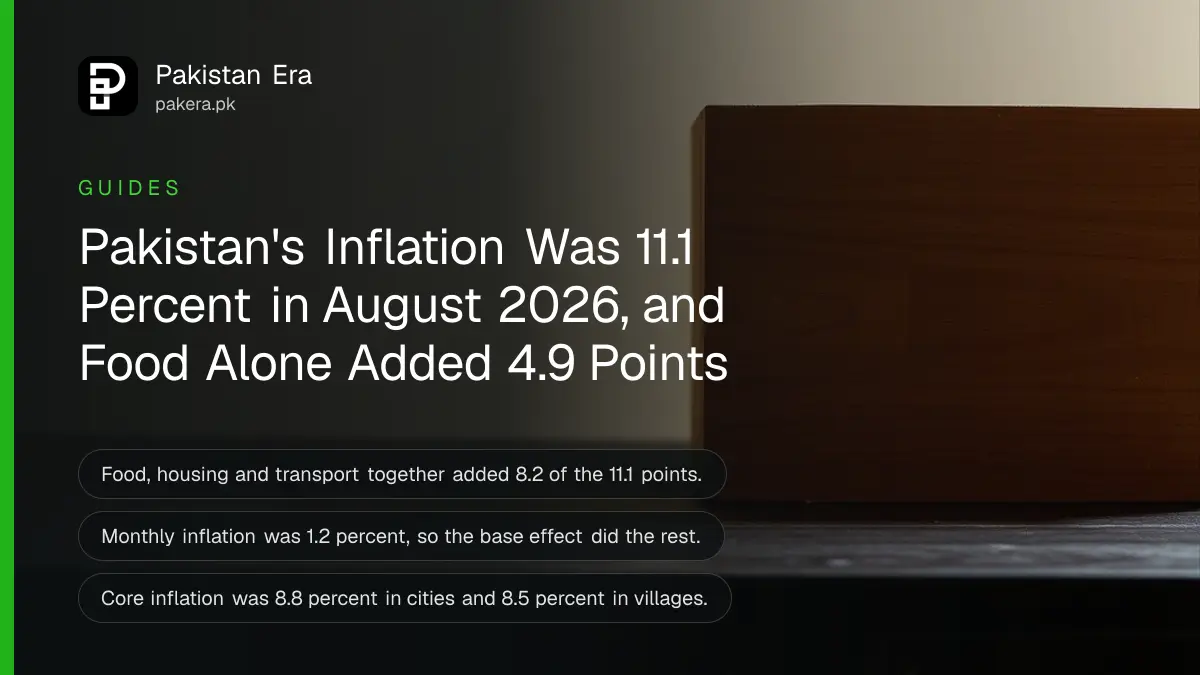
Pakistan's annual inflation rate was 11.1 percent in August 2026, up from 9.2 percent in July, and food alone accounted for 4.9 percentage points of it. Food, housing and utilities, and transport together added 8.2 points, about three quarters of the total, according to the Finance Division.
Inflation here means how much more prices are than a year earlier, measured by the consumer price index (CPI). We read the Finance Division's September 2026 update on 21 October 2026. For the later September reading, see our report on September 2026 inflation.
Annual inflation reached 11.1 percent, but prices rose 1.2 percent in the month
Prices rose 1.2 percent from July to August, the same pace as the month before. The jump in the annual rate, from 9.2 to 11.1 percent, mostly reflects the base effect: prices fell 0.6 percent in August 2025, so the comparison got harder.
The base effect means a low or negative month a year ago makes this year's rate look higher. A year earlier, in August 2025, annual inflation was only 3.1 percent.
Food added 4.9 points and three groups added 8.2
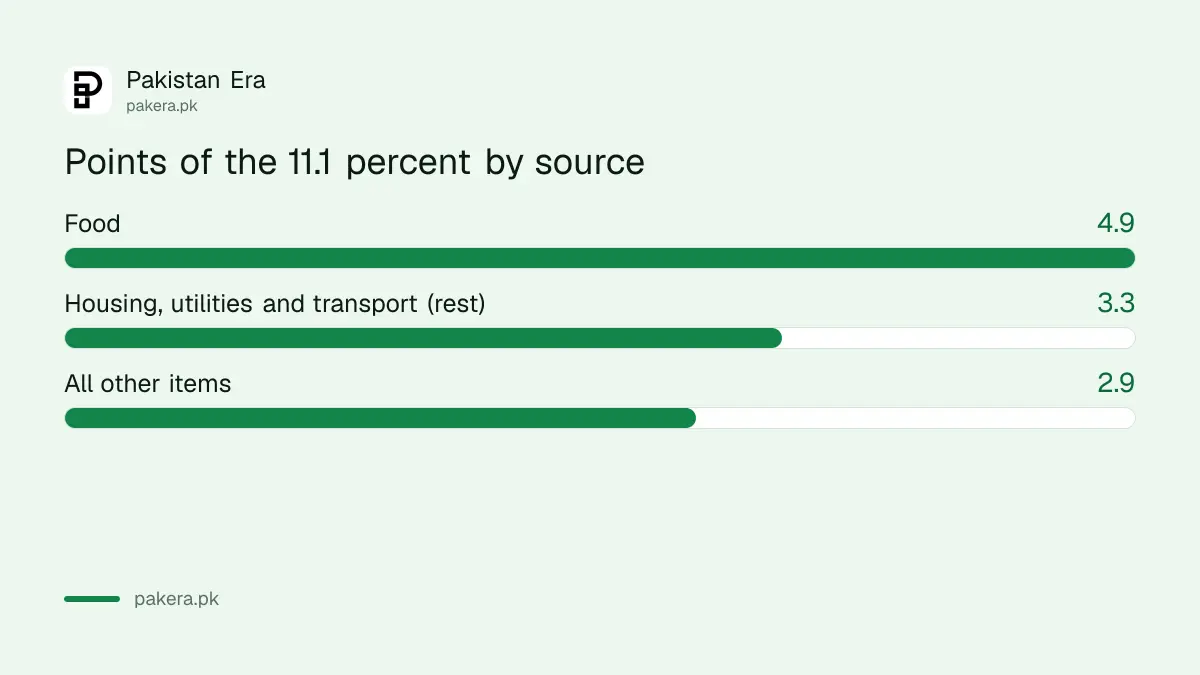
The update says pressures are concentrated in components most exposed to fuel costs. Food contributed 4.9 percentage points. With housing and utilities, and transport, the three groups gave 8.2 points. Everything else gave the remaining 2.9 points, our subtraction.
| Source of inflation, August 2026 | Points | Share of 11.1 |
|---|---|---|
| Food | 4.9 | 44 percent |
| Housing, utilities and transport | 3.3 | 30 percent |
| All other items | 2.9 | 26 percent |
| Headline inflation | 11.1 | 100 percent |
The 3.3 points for housing, utilities and transport is 8.2 minus 4.9. The update does not split those three further, so we do not either.
Core inflation was 8.8 percent in cities and 8.5 percent in villages
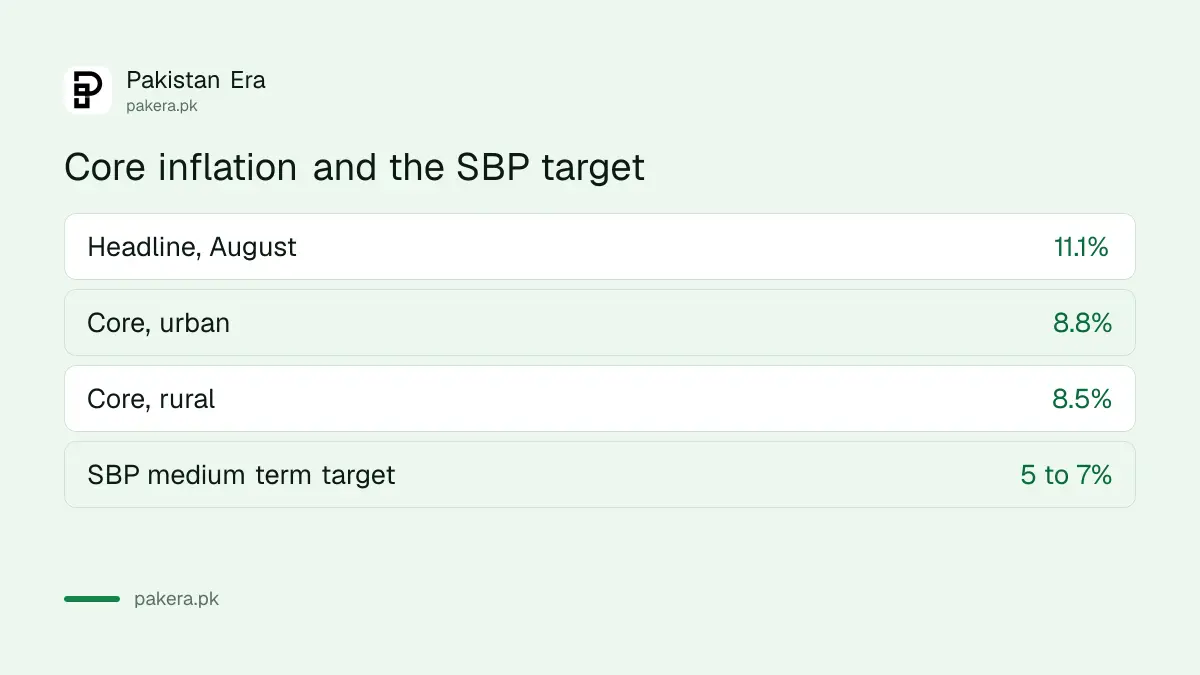
Core inflation leaves out the most volatile items, mainly food and energy. It was lower than headline at 8.8 percent in urban areas and 8.5 percent in rural areas. That tells us part of the rise comes from items that can swing back.
The Sensitive Price Indicator, which tracks weekly prices of essentials, rose 0.99 percent in the week to 24 September. The update calls this a continued but moderate rise. If you want to learn the difference between these measures, read our explainer on CPI, SPI, WPI and core inflation.
The Finance Division expected 10 to 11 percent for September
The update projected headline CPI in a range of 10 to 11 percent for September, with the path afterwards depending on international oil prices. The State Bank kept its policy rate at 11.5 percent on 14 September and aims to bring inflation back to 5 to 7 percent over the medium term.
The Finance Division says the priorities are to contain second-round effects, where higher fuel costs spread into other prices, and to protect households through targeted support.
Why July and August are not the same as the whole year
Annual inflation is measured against the same month a year earlier, so one hard comparison can lift the rate even when prices rise at a steady pace. That is exactly what happened in August 2026. The Finance Division is explicit that the sharper rise in the annual rate mainly reflects the comparison with the price decline of August 2025.
For a family, the monthly figure is closer to what the shop counter feels. A 1.2 percent rise in one month, if it repeated all year, would add up to far more than 11 percent. We do not say it will repeat, and the update expects the path to depend on oil. But it is a reason not to relax just because the annual number looks like it may ease.
The sharp swing from 3.1 percent to 11.1 percent in a year also shows how quickly oil costs reach food and transport in Pakistan. The Finance Division names food, housing and utilities, and transport as the three groups most exposed.
What a household can do with the number
An 11.1 percent rate means something costing Rs 1,000 a year ago costs about Rs 1,111 now. If your pay has not risen by about that much, you have lost buying power. Our page on the pay raise needed to match inflation shows how to work it out.
- Write down your monthly spending on food, rent and fuel.
- Multiply each by the rate for its group, if you know it, or by 11.1 percent if not.
- Add the results to see your extra monthly cost.
- Compare that with any raise, and check what your savings earn.
For your own basket, use the method to calculate your own inflation rate.
Common questions
What was Pakistan's inflation in August 2026?
It was 11.1 percent year on year, up from 9.2 percent in July, per the Finance Division update.
Why did the rate jump from July?
Monthly inflation stayed at 1.2 percent, but August 2025 had a 0.6 percent fall, so the annual comparison rose.
How much did food add?
Food added 4.9 percentage points, and food, housing and transport together added 8.2 points.
What is core inflation?
It leaves out volatile items like food and energy. It was 8.8 percent in cities and 8.5 percent in rural areas.
What is SBP's inflation target?
The medium term target is 5 to 7 percent, and the policy rate was 11.5 percent on 14 September.
How we verified this
What we checked, where we read it, and what we could not confirm.
On 21 October 2026 we read the Finance Division's Monthly Economic Update and Outlook for September 2026, listed on the Finance Division website, and the SBP press page for policy dates. We did not open the Pakistan Bureau of Statistics release itself, so the figures are as reported by the Finance Division. We could not verify the split between housing and transport.
About the author

Global Affairs & Political Economy Writer
Muhammad Hatim is a book lover who started writing because he enjoys it. At Pakistan Era he writes about international relations, geopolitics and the global economy, with a particular interest in South Asia and the forces behind current events.