Pakistan Inflation October 2026: Finance Division Expects 9.5% to 10.5%, and How Its Last 3 Forecasts Did
Pakistan's October 2026 inflation is expected at 9.5% to 10.5%, the Finance Division says. See how its last forecasts did, what drives prices and your savings.
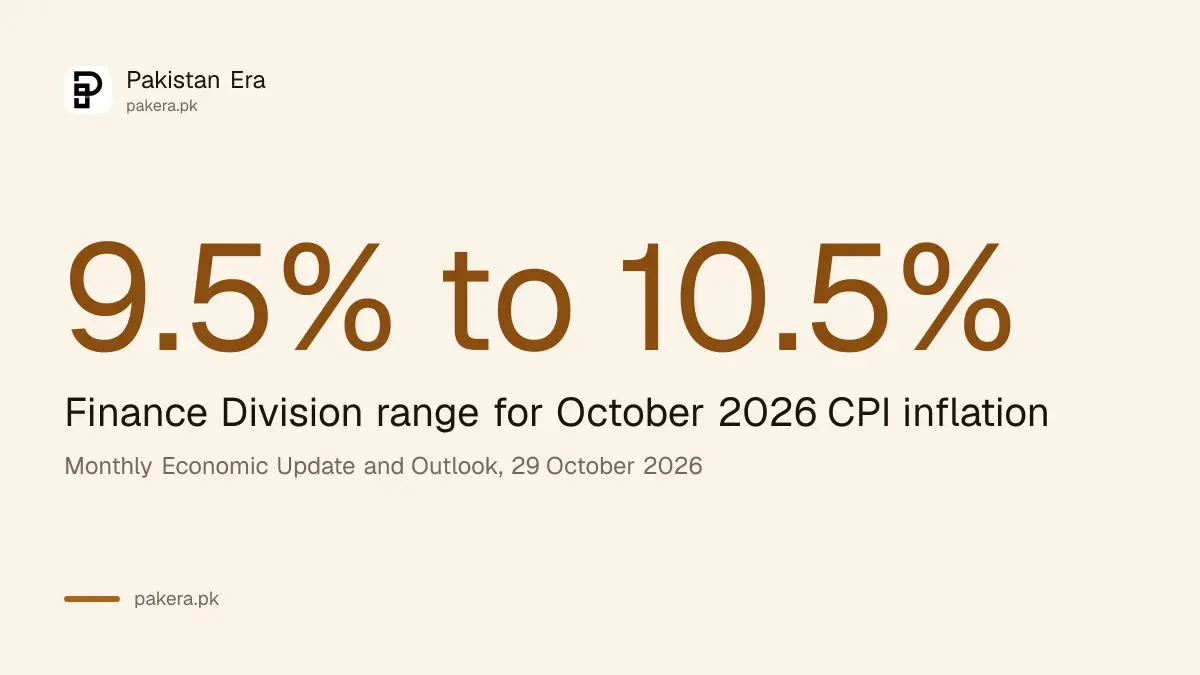
Pakistan's inflation for October 2026 is expected to be between 9.5% and 10.5%, the Finance Division says in its Monthly Economic Update and Outlook published on 29 October 2026. That would be close to, or slightly below, September's 10.3%.
The official October figure comes from the Pakistan Bureau of Statistics (PBS) in the first days of November. Until then, this forecast is the government's own best guess. We read the October report and the three before it on 30 October 2026, and checked how close each earlier forecast came to the real number. The forecast, its track record, the price trends behind it and what it means for your budget follow.
The Finance Division expects October inflation of 9.5% to 10.5%
The Finance Division's October 2026 outlook says headline inflation "is projected in the range of 9.5 to 10.5 percent for October 2026". It adds that the path after that depends on international energy prices, food supplies and base effects, meaning how high prices were in the same month last year.
Headline inflation means the yearly change in the consumer price index (CPI), the basket of goods and services an average household buys. A 10% rate means that basket costs about Rs 110 now for every Rs 100 it cost in October 2025.
The middle of the range, 10.0%, would be the lowest reading since July's 9.2%. The top of the range would only match September. So the government is not forecasting a rise, even after the State Bank raised its policy rate to 12% on 26 October, a move the same report says was made "to address rising inflationary risks".
The last three forecasts were close to the real figure
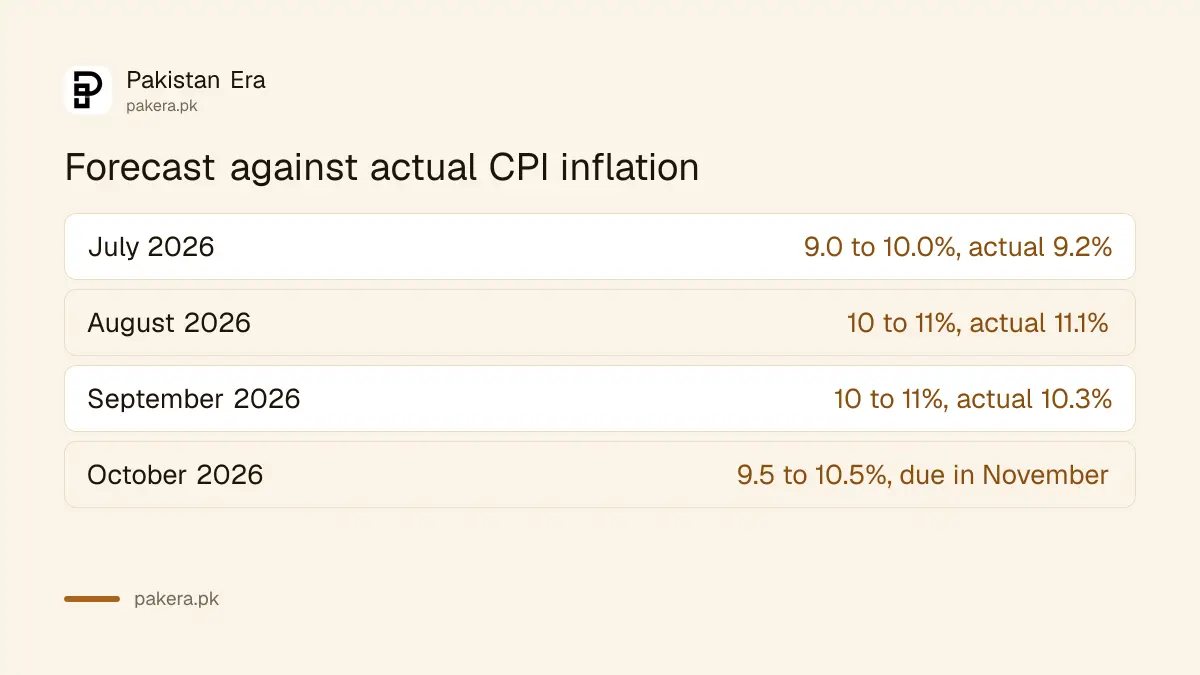
The Finance Division has given a monthly forecast in each of its last four reports. For July, August and September, the actual PBS figure landed inside the forecast range twice and just above it once. That is a useful track record, but it is a forecast, not a promise.
| Month | Finance Division forecast | Actual CPI inflation (PBS) | Result |
|---|---|---|---|
| July 2026 | 9.0% to 10.0% | 9.2% | Inside the range |
| August 2026 | 10% to 11% | 11.1% | 0.1 points above |
| September 2026 | 10% to 11% | 10.3% | Inside the range |
| October 2026 | 9.5% to 10.5% | Due in early November | n/a |
The September figure and what drove it are in our report on September 2026 inflation. The August breakdown, where food added 4.9 points, is in August's 11.1% reading.
Energy is still the main driver of inflation
The report says transport prices rose 27.4% over the year to September and housing, water, electricity, gas and fuel 12.4%, which it calls a sign of "the role of energy costs". Perishable food rose 11.8% and non-perishable food 7.6%. Brent crude averaged $116.8 a barrel in September, up 28.4% from August.
Weekly prices in October point both ways. The weekly Sensitive Price Indicator (SPI), which tracks 51 essentials, rose 0.65% in the week to 22 October and fell 0.35% in the week to 29 October. Its yearly rate was 11.32% on 29 October, higher than CPI, because it weighs fuel and food more heavily.
| Indicator | Latest figure | Period |
|---|---|---|
| CPI inflation, yearly | 10.3% | September 2026 |
| CPI inflation, average | 10.2% | July to September 2026 |
| Transport prices, yearly | +27.4% | September 2026 |
| Weekly SPI, yearly | 11.32% | Week to 29 October 2026 |
| SBP policy rate | 12% | From 27 October 2026 |
The report also points to better harvests. It puts rice at 10.2 million tonnes, up 1.8%, and says improved crop supplies "can help ease food price pressures". That is the main reason a forecast near 10% is plausible despite high oil prices.
What a 10% inflation rate means for your money
If October inflation lands at 10%, anything you hold that earns less than 10% a year after tax is losing value in real terms. A savings account paying 10% before a 15% tax deduction earns 8.5% after tax, which is below inflation. Rs 100,000 kept in such an account would buy about 1.4% less a year from now.
Twelve-month Treasury bills cleared at 12.89% at the 28 October auction, and most National Savings schemes pay between about 11% and 13% at the rates set from 21 October. Those beat a 10% inflation rate before tax. After tax, the margin shrinks. Our savings versus inflation check works through this with your own numbers.
For wages, the same logic applies. A salary raise below the inflation rate is a cut in what your pay can buy. These steps help you plan around the forecast.
- Take the forecast midpoint, 10%, as a working figure for the year ahead.
- Compare your savings rate after tax with it, not the headline rate.
- Check whether your monthly bills, mainly fuel, power and food, are rising faster than 10%.
- Recheck when PBS publishes the real October figure in early November.
- Recheck again after the next SBP decision on 14 December 2026.
Common questions
What will Pakistan's inflation be in October 2026?
The Finance Division expects 9.5% to 10.5%. The actual figure comes from PBS in the first days of November 2026.
When does PBS publish October 2026 inflation?
PBS usually posts the monthly CPI on the first working day of the next month. September's figure came on 1 October 2026.
What was inflation in September 2026?
CPI inflation was 10.3% in September 2026, down from 11.1% in August, according to PBS.
How accurate are the Finance Division's forecasts?
For July and September 2026 the real figure fell inside the forecast range. For August it came in 0.1 points above the top.
Why did the SBP raise rates if inflation is easing?
The Finance Division's report says the rise was meant to address inflation risks from the Middle East conflict and high global energy prices. A rate decision looks ahead, not just at last month.
How we verified this
What we checked, where we read it, and what we could not confirm.
We read the Finance Division's Monthly Economic Update and Outlook for October 2026, listed as 29 October 2026 on its press releases page, and the July, August and September 2026 editions, on 30 October 2026. Actual CPI figures for July, August and September are as quoted in those reports and from PBS for September. The SPI figures come from PBS releases for the weeks to 22 and 29 October. The savings arithmetic is ours and ignores Zakat and fees. The October CPI figure did not exist when we checked.
About the author

Global Affairs & Political Economy Writer
Muhammad Hatim is a book lover who started writing because he enjoys it. At Pakistan Era he writes about international relations, geopolitics and the global economy, with a particular interest in South Asia and the forces behind current events.