Pakistan Visa Categories Explained: Which of the 11 Fits Your Trip
Pakistan visa categories explained: DGIP merged 18 types into 11. Match a tourist, business, work, study, medical or family trip to the right one first.
Short answer: Pakistan now has 11 visa categories, merged from 18. They are tourist, visa in your inbox, family visit, business, work, study, religious tourism, official, NGO, medical and other. Pick the one that matches why you travel. Applying under the wrong category means the wrong document list.
A Pakistani host in Faisalabad wants to invite a friend from Germany. He opens the visa page and sees a long list of names. He is not sure whether the friend is a tourist, a business visitor or something else. This page sorts that out.
We read the Directorate General of Immigration and Passports (DGIP) visa categories page on 13 October 2026. It shows a last modified date of 14 September 2026. The page lists the 18 old categories and the 11 new ones, and it explains each in turn.
Eleven categories replaced eighteen
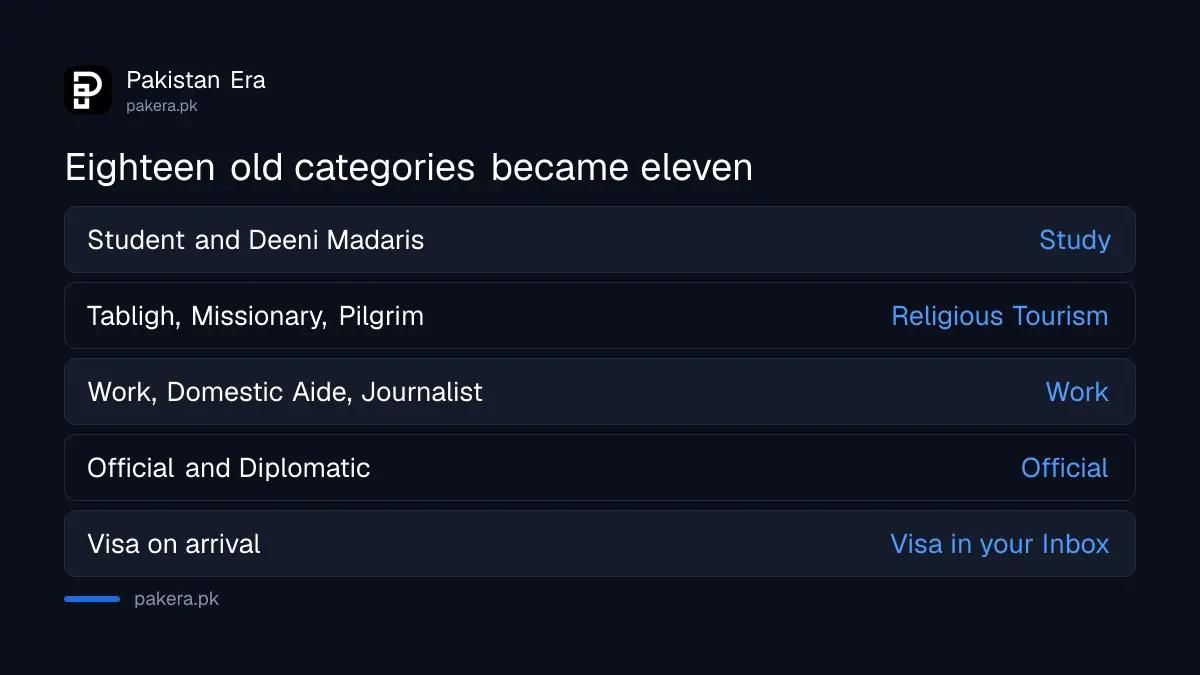
DGIP says the current 18 visa categories have been clubbed into 11. Some old names now sit as sub-categories. Student and Deeni Madaris visas became one Study category. Tabligh, Missionary and Pilgrim visas became Religious Tourism. Work now includes domestic aide and journalist visas.
Medical visa is listed as new. The phrase "visa on arrival" in the old policy is rephrased as "Visa in your Inbox". The applicant applies online from home, gets an electronic authorisation and shows it at immigration to get the stamp.
Match your reason for travel to the category
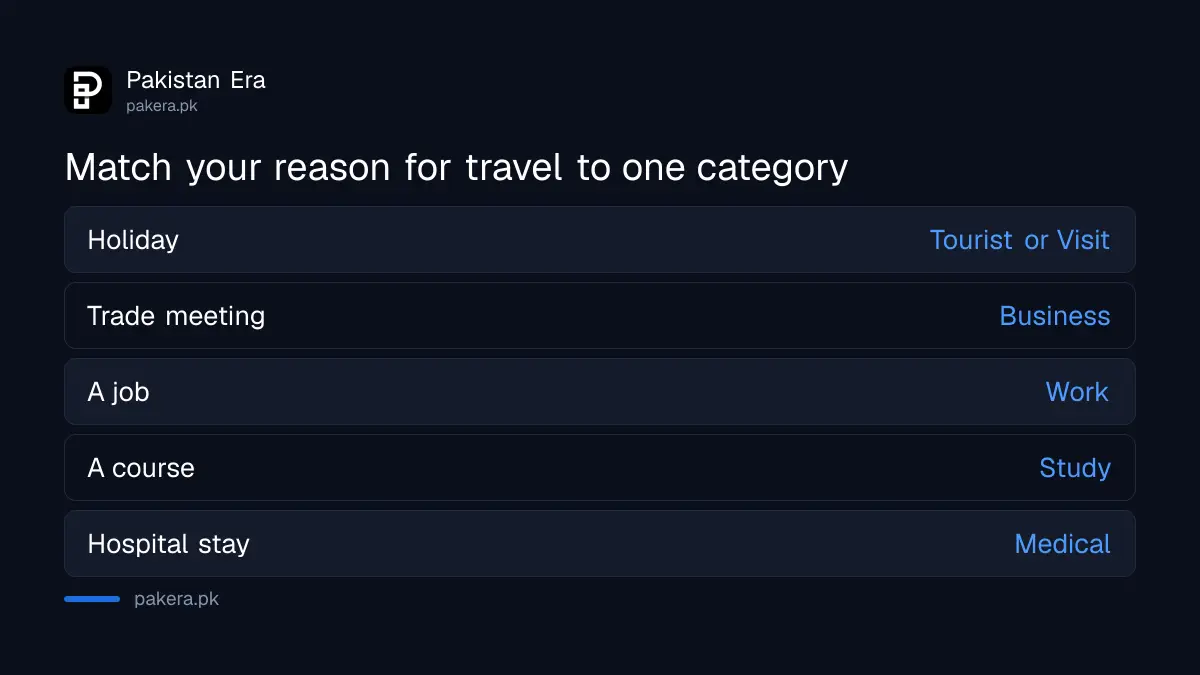
Choose the category by the main purpose of the trip. A holiday is Tourist or Visit. A trade meeting is Business. A job is Work. A course is Study. A hospital stay is Medical. A visit to relatives of Pakistan origin is Family Visit. The table below pairs each purpose with its category and the main fact DGIP prints.
| Category | For whom | Main fact on the DGIP page |
|---|---|---|
| Tourist or Visit | Holiday visitors | 3 months, double entry, 190 List A countries |
| Visa in your Inbox | Tourist or business, online | Electronic authorisation, shown at immigration |
| Family Visit | Pakistan-origin foreigners and spouses | 5 years validity, 1 year stay |
| Business | Businessmen | 5 years for 96 listed countries, 24 hours |
| Work | Work, domestic aide, journalist | Entry work visa up to 3 months, 48 hours |
| Study | Students, Deeni Madaris | NOC and security clearance first |
| Religious Tourism | Tabligh, missionary, pilgrim | Pilgrim visa a fortnight |
| Medical | Patients, family, attendants | 48 hours or 30 days |
Official, NGO and other visas follow separate rules
Official and diplomatic visas are handled by the Ministry of Foreign Affairs, with gratis visas for accredited staff. NGO and INGO visas depend on whether the organisation is registered with the Government of Pakistan. Embassies can grant a short NGO visa of one month, and long visas need prior clearance from the Ministry of Interior.
The page leaves a final category called Other, with no change. Visitors from North Korea are decided by the Ministry of Foreign Affairs under the sanctions rules. Most readers will never need these, but a host who works with an NGO should know the registration condition before sending an invitation.
Where you apply also matters
DGIP says foreign nationals can only apply for a Pakistan visa from their country of origin or from the place of their legal permanent residence. Third country applications are decided only by the Ambassador, High Commissioner or head of mission. A person on a short visit to a third country should not expect a quick answer.
For a tourist visa, DGIP says missions should process applications in 7 to 10 working days. Fees follow a reciprocal rule: Pakistan charges the nationality what that country charges Pakistanis. The fee page is dated October 2023, so ask the mission for today's figure.
Choose and apply in five steps
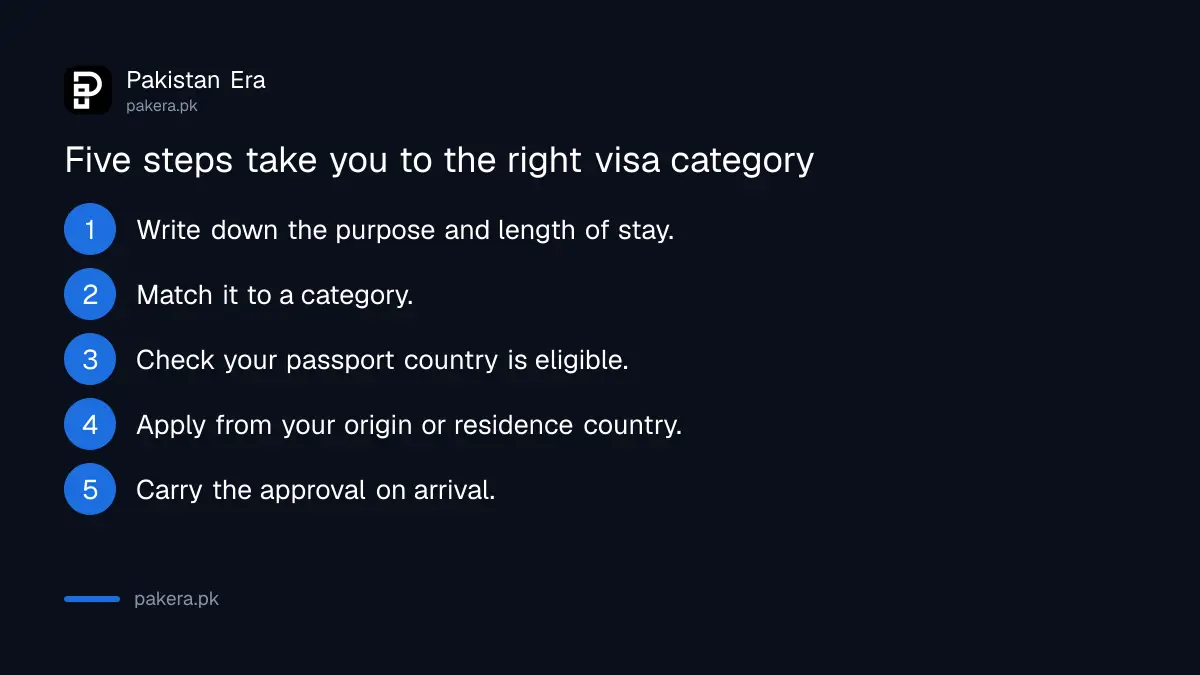
Work out the category before you open any form. The steps below are our summary of the DGIP pages, so confirm each detail with the mission or the online visa portal.
- Write down the main purpose of the trip and the length of stay.
- Match the purpose to a category in the table above.
- Check that your passport country is eligible for that category.
- Apply from your country of origin or legal residence, online or at the mission.
- Keep the approval and carry it with your passport on arrival.
Related guides for each route
For a holiday, follow the steps in the guide to the Pakistan e-visa for foreign visitors. For relatives of Pakistan origin, see the family visit visa. For jobs, read how a foreign national gets a work visa in Pakistan.
A household that wants to hire a foreign maid can read the foreign domestic worker visa page. If the visitor overstays, the charges are listed in the note on the overstay surcharge for foreigners.
Common questions
How many visa categories does Pakistan have?
Eleven, according to DGIP, merged from 18 earlier categories.
Is visa on arrival still a category?
DGIP rephrased it as "Visa in your Inbox". You apply online first, then show the authorisation at immigration.
Where is the journalist visa now?
Under Work, together with the domestic aide visa.
Can I apply for a Pakistan visa from any country?
No. DGIP says apply from your country of origin or legal permanent residence. Third country cases go to the head of mission.
Which category is new?
Medical visa is marked as new in the merger table.
How we verified this
What we checked, where we read it, and what we could not confirm.
Last checked on 13 October 2026. We read the DGIP visa categories page and its fee page, which was last modified in October 2023. The online visa portal refused automated requests, so we did not test it.
About the author

Public Services and Education Journalist
Fajr Riaz is a journalist and content writer at Pakistan Era, based in Lahore. She covers the questions people meet in everyday life in Pakistan: how a public service works, what a change in the rules means, and where to find a reliable answer.