How to Register a Patent in Pakistan
Public disclosure anywhere in the world before filing ends novelty. The four tests an invention must pass, and the one narrow exception.
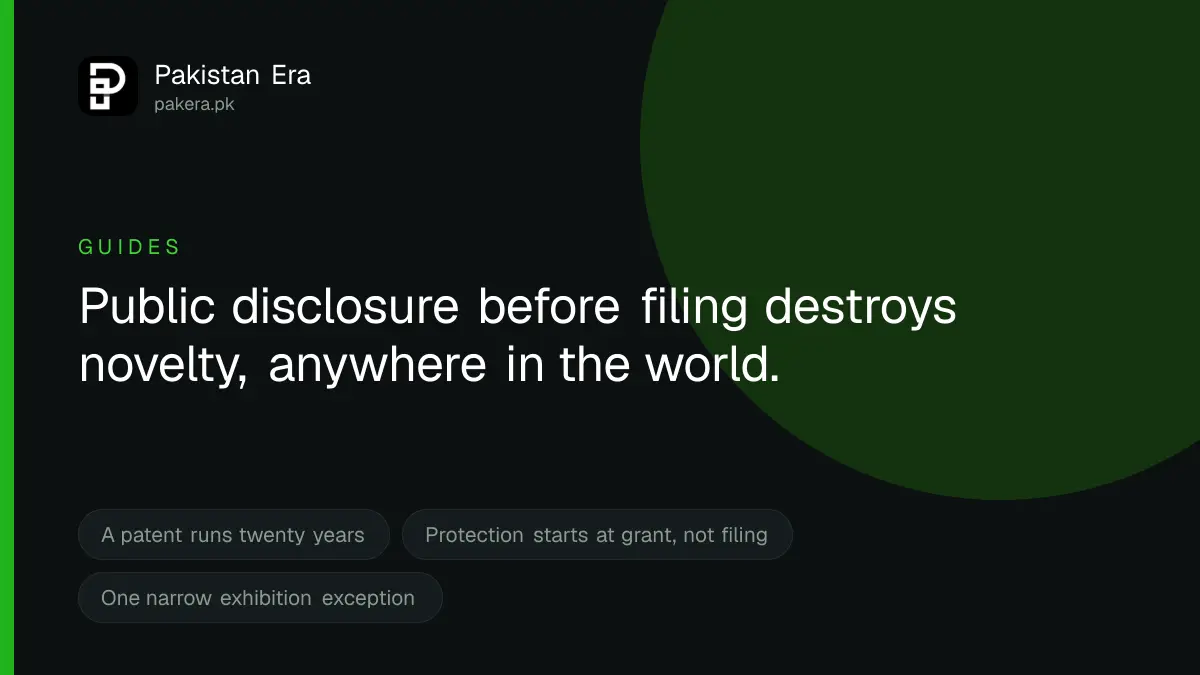
Showing your invention to the public before you file destroys your right to patent it, anywhere in the world. That is the mistake that ends most Pakistani patent applications before they start.
There is one narrow exception, and it is worth knowing: an official international exhibition, within twelve months before you file.
We read this on the Intellectual Property Organisation of Pakistan's own site at ipo.gov.pk on 4 September 2026.
What a patent gives you
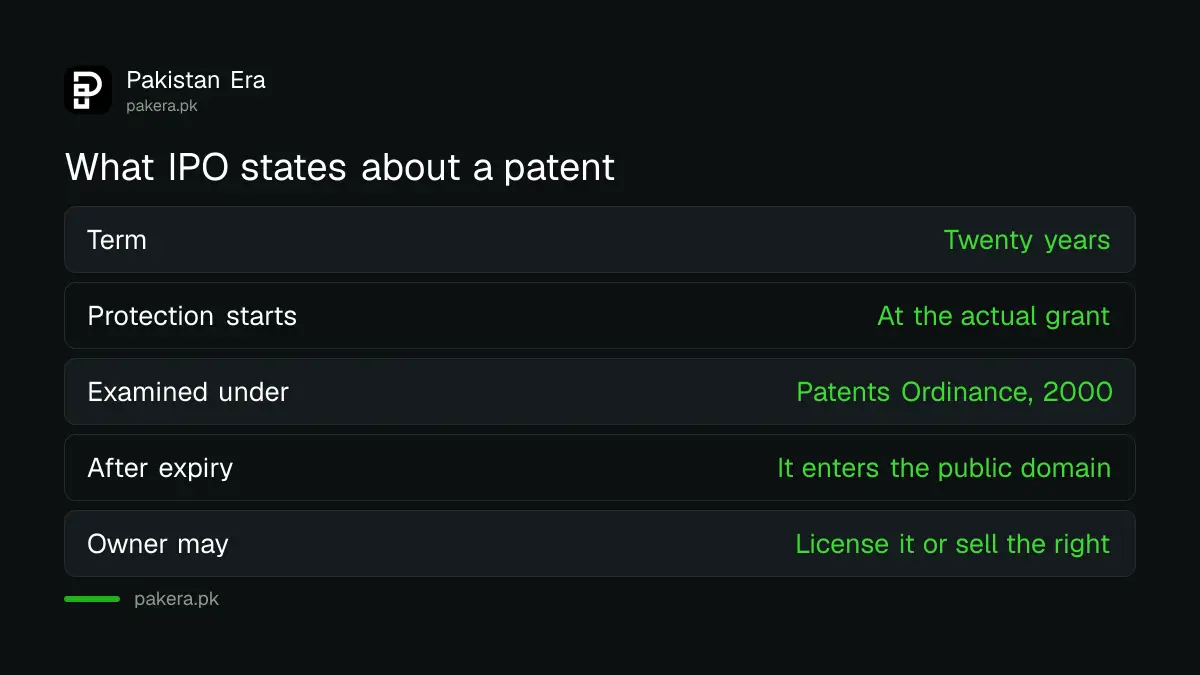
IPO describes a patent as the grant of exclusive rights for an invention to make, use and sell it for a limited period of twenty years.
| Point | What IPO states |
|---|---|
| Term | Twenty years |
| What it does | Excludes others from making, using or selling the invention |
| When protection starts | Not until the actual grant of a patent |
| Examined under | The Patents Ordinance, 2000 and its Rules |
| After expiry | The invention enters the public domain |
The line about protection not starting until grant is easily missed. Filing an application is not protection. Until the patent is granted you hold an application, and people sometimes act as though the two are the same thing.
The four tests an invention must pass
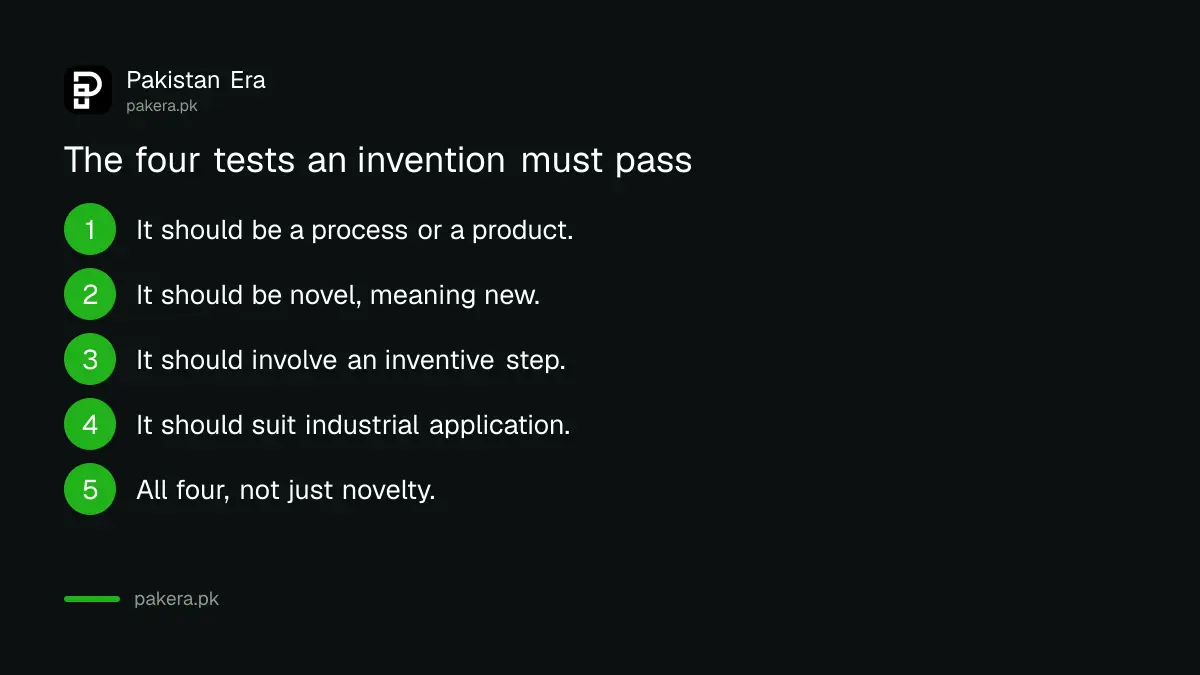
IPO lists four characteristics an invention needs.
- It should be a process or a product.
- It should be novel, meaning new.
- It should involve an inventive step.
- It should be capable of industrial application.
A product means a substance, article, apparatus or machine. A process means an art, process, method or manner of new manufacture of a product. An invention can be a new and useful improvement of either.
Novelty is the one that catches people
IPO defines novelty against what it calls the state of the art, and the wording is broad.
The state of the art comprises everything disclosed to the public anywhere in the world, by publication in tangible form or by oral disclosure, by use or in any other way, before the filing date or the priority date of the application.
Read that again. Anywhere in the world, and in any other way. IPO states plainly that public use or knowledge of an invention anywhere in the world before the date of application would prejudice the novelty of the invention, and advises that publication should be avoided before applying.
So a product launch, a trade fair stall, a demonstration video, a crowdfunding page or a conference talk can all end the possibility of a patent. The inventor is usually the one who destroyed it, without knowing.
The exhibition exception
There is one carve out, and it is narrow.
IPO states that disclosure of a patentable invention in respect of goods does not constitute state of the art if the article is exhibited at an official or officially recognised international exhibition within twelve months preceding the date of filing of the application.
Two conditions do the work there. The exhibition has to be official or officially recognised and international, and the filing has to follow within twelve months. A local trade show or a private demonstration is not covered, and neither is an exhibition thirteen months ago.
Inventive step is a higher bar than new
An invention involves an inventive step if it has not been obvious to a person skilled in the art before the date of the application.
IPO puts it bluntly. A patent for a new use of a known contrivance, without additional ingenuity in overcoming fresh difficulties, is not an invention. If the new use involves no ingenuity and is analogous in manner and purpose to the old use, there is no invention. There must be a substantive change, improvement or addition over the prior art.
That is why a small variation on something already sold rarely succeeds, even when nobody has done exactly that variation before.
Why the system works this way
IPO sets out the bargain openly, and understanding it helps you write a better application.
The monopoly is granted in exchange for disclosure of the invention. The public interest is that industrial techniques improve, and that improvements are disclosed rather than kept secret. You get a limited monopoly; the public eventually gets the knowledge.
A patent owner can license others to use the invention on agreed terms, or sell the right outright to a new owner. Once the patent expires, protection ends and the invention becomes available for others to exploit commercially.
Where a patent is not the right tool
Patents protect inventions. They do not protect a name, a logo, a book, a piece of software's code as such, or the look of a product.
A brand name or logo is a trademark, covered in our guide to registering a trademark in Pakistan. Written, musical and artistic work is copyright, covered in our guide to copyright registration. The appearance of a product is an industrial design, which IPO registers under a separate ordinance.
Choosing the wrong one wastes both the fee and the time, and the time can matter more, because of the novelty rule above.
Common questions
How long does a patent last in Pakistan?
IPO states twenty years, with protection starting at the actual grant rather than at filing.
Can I patent something I have already shown publicly?
Public disclosure anywhere in the world before filing prejudices novelty. The only stated exception is an official or officially recognised international exhibition within twelve months before filing.
What can be patented?
A process or product that is novel, involves an inventive step and is capable of industrial application.
Is a small improvement patentable?
Only if it is not obvious to a person skilled in the art. A new use of a known thing without ingenuity is not an invention.
Which law applies?
Applications are examined under the Patents Ordinance, 2000 and the Rules made under it.
What happens when it expires?
Protection ends and the invention enters the public domain.
How we verified this
What we checked, where we read it, and what we could not confirm.
Last checked 4 September 2026. We read the patent introduction published by the Intellectual Property Organisation of Pakistan at ipo.gov.pk on that date. The description of a patent as the grant of exclusive rights to make, use and sell an invention for a limited period of twenty years, the statement that patent protection does not start until the actual grant, the examination of applications under the Patents Ordinance, 2000 and its Rules, the four characteristics of a patentable invention, the definitions of product and process, the definition of novelty against the state of the art comprising everything disclosed to the public anywhere in the world by publication in tangible form, oral disclosure, use or any other way before the filing or priority date, the warning that public use or knowledge anywhere in the world before the application would prejudice novelty, the exception for an article exhibited at an official or officially recognised international exhibition within twelve months preceding the date of filing, the definition of inventive step as not obvious to a person skilled in the art, the explanation that a new use of a known contrivance without additional ingenuity is not an invention, the disclosure bargain underlying the system, and the licensing, assignment and expiry positions, are all taken from that page. We did not read the Patents Ordinance, 2000 itself, and no fee, timeline or form number is quoted here. Confirm the current fee and procedure with IPO-Pakistan before filing. Nothing here is legal advice.
About the author

Senior Writer, Public Services and Technology
Shahid joined us in 2024 as an author. He is a senior contributor to Pakistan's leading technology websites. He writes detailed articles, mostly covering his expertise in the latest tech, mobiles, apps, gadgets, and step-by-step guides. His ideology is to help people understand the latest trends and explain complex methods through very easy-to-understand guides.