Get Free Thalassaemia Treatment at Pakistan Bait-ul-Mal's Islamabad Centre: Documents and Form
Pakistan Bait-ul-Mal's F-9 Park centre in Islamabad gives free transfusions, chelation and tests to thalassaemia patients. See the documents and the form.
Short answer: Pakistan Bait-ul-Mal runs a free Pakistan Thalassaemia Centre in F-9 Park, Islamabad. To register, take the patient's medical reports and the original CNIC to the centre, plus a B-Form if the patient is a child. Staff fill in the forms with you and give you an application number. The Bait-ul-Mal helpline is 0800-66666.
A child with thalassaemia major needs blood every few weeks for life. The transfusions are only part of the bill. Iron builds up from all that blood, so the child also needs chelation medicine and regular ferritin, liver and kidney tests. For a poor family, the monthly cost is often what breaks them.
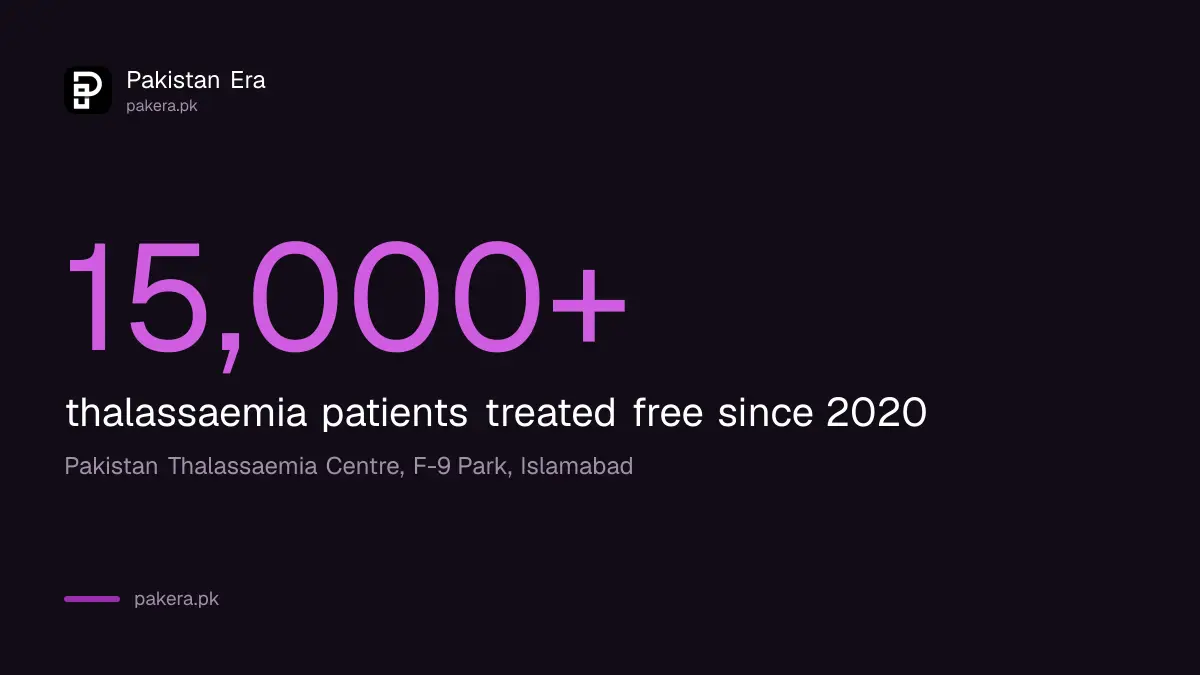
Pakistan Bait-ul-Mal, or PBM, is the federal welfare body for the poor. Its projects page, which we read on 20 October 2026, says Pakistan has around 100,000 registered thalassaemia patients and about 5,000 new cases a year. It also says the centre has treated more than 15,000 patients since 2020, completely free of cost.
The F-9 Park centre gives transfusions, chelation and tests free
The Pakistan Thalassaemia Centre in F-9 Park, Islamabad, provides blood transfusions, iron chelation and diagnostic tests such as ferritin, liver function and kidney function tests, free of charge. Bait-ul-Mal set it up with a pharmaceutical partner, Novartis, according to its projects page.
| Service listed by Bait-ul-Mal | Cost to the family |
|---|---|
| Blood transfusion | Free |
| Iron chelation | Free |
| Ferritin test | Free |
| Liver function test (LFT) | Free |
| Kidney function test (RFT) | Free |
Iron chelation means medicine that pulls extra iron out of the body. Without it, iron from repeated transfusions damages the heart and liver. That is why a centre that covers chelation, not only blood, is worth the trip.
The projects page does not give opening hours, a direct phone number for the centre, or a waiting time. Call the helpline before you travel, especially from outside Islamabad.
Who Bait-ul-Mal treats at the thalassaemia centre
The centre is open to poor and destitute patients, orphans, widows and infirm people, according to Bait-ul-Mal. Eligibility is confirmed from medical documents. You apply with the patient's CNIC, or a NADRA receipt if the card is still being made.
The thalassaemia centre has its own form, separate from Bait-ul-Mal's general medical help. That general scheme has a written income ceiling of Rs 74,000 a month and excludes government employees and their families. The projects page does not state the same limits for the thalassaemia centre, so do not rule yourself out on the income line alone.
- Patients diagnosed with thalassaemia who need regular treatment.
- Poor and destitute families, orphans, widows and infirm people.
- Children, with a B-Form in place of a CNIC.
- Adults, with the original CNIC or a NADRA receipt.
No B-Form yet for your child? Get one first, because the centre asks for it. The steps are in the NADRA B-Form registration process.
How to register a patient at the Pakistan Thalassaemia Centre
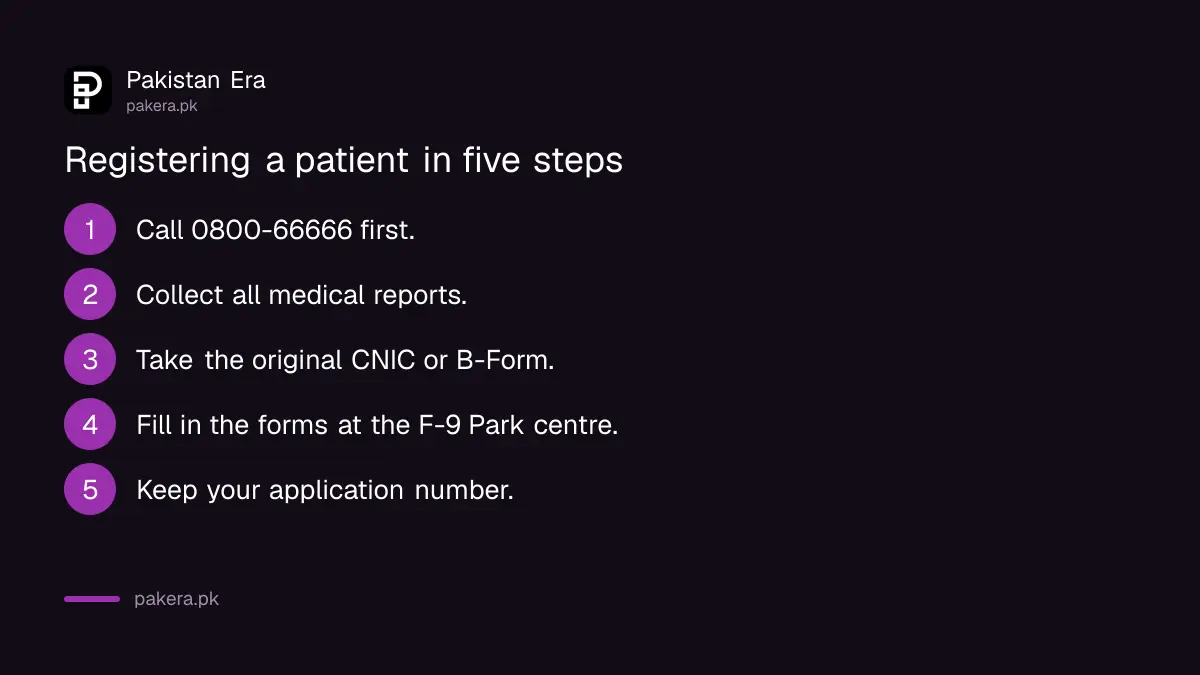
Go to the centre with the patient's medical reports and original CNIC, or the child's B-Form. Staff at the centre complete the required forms with you. When the papers are complete, ask for your application number, because Bait-ul-Mal says you will need it later.
- Call the Bait-ul-Mal helpline, 0800-66666, to check the centre is taking new patients that day.
- Collect every medical report, including the diagnosis and the latest blood test results.
- Take the patient's original CNIC, or the child's B-Form and a parent's CNIC.
- Visit the centre in F-9 Park, Islamabad, and complete the forms with the staff.
- Get your application number and write it down somewhere safe.
You can also download the form, called Annex-A, from the Forms page of pbm.gov.pk and fill it in before you go. It saves time at the counter.
The Annex-A form asks about your whole household
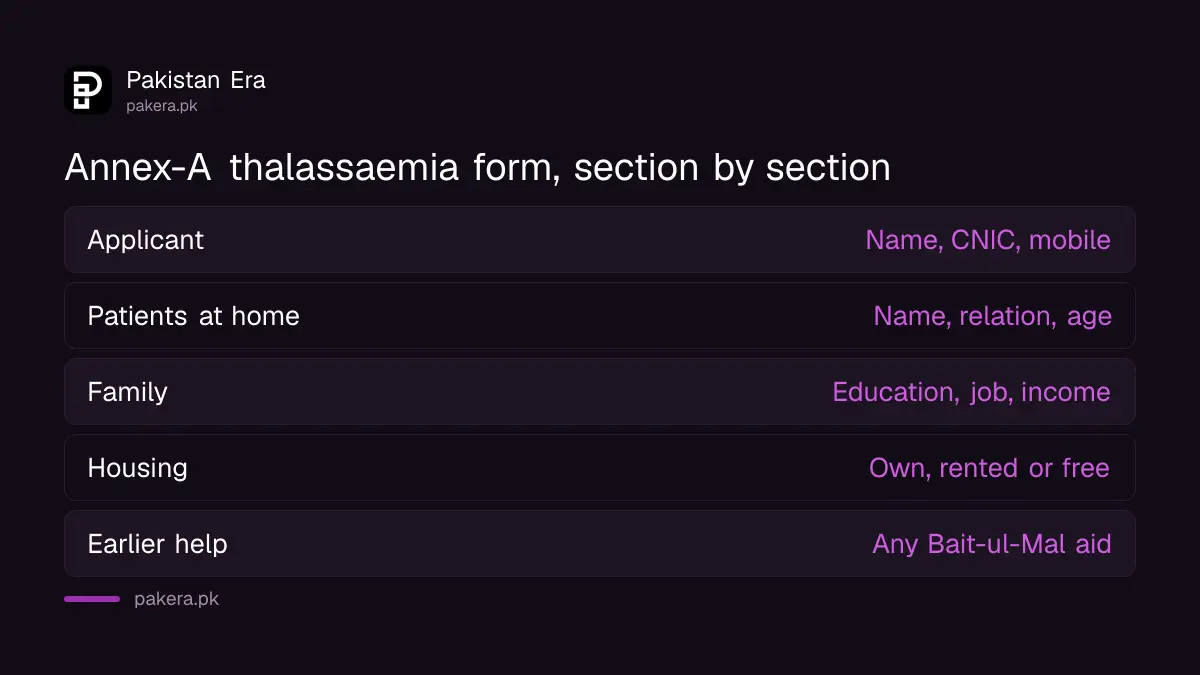
The thalassaemia form asks for the applicant's name, parent's name, CNIC, phone, permanent and current address, every thalassaemia patient in the home, and each family member's education, job and income. It also asks about your house, any earlier Bait-ul-Mal help and total monthly income.
| Section of the form | What to have ready |
|---|---|
| Applicant details | Name, father's or mother's name, CNIC, mobile number |
| Address | Permanent and current address |
| Patients in the home | Name, relation and age of each thalassaemia patient |
| Family members | Education, occupation and monthly income of each |
| Housing | Own, rented or free, and the rent if any |
| Earlier help | Any assistance already received from Bait-ul-Mal |
| Declaration | Signature or thumb impression |
Fill it honestly. The form ends with a declaration that the details are true, and that the application may be rejected if verification finds otherwise. If the household's income is irregular, write what you earn in a normal month.
Track the case and find help outside Islamabad
Bait-ul-Mal has an online case tracker at mis.pbm.gov.pk/track for its applications. Use your CNIC and the number you were given. For patients far from Islamabad, provincial programmes and charities run centres closer to home, and the Sehat Card may cover hospital treatment.
Tracking works the same way as for Bait-ul-Mal's other schemes, explained in tracking a Bait-ul-Mal application. For surgery or other illnesses, the wider Bait-ul-Mal medical assistance releases funds on a government hospital's recommendation, up to Rs 1 million.
Province by province options, including screening before marriage, are set out in free thalassemia treatment and screening by province. Travel to Islamabad every few weeks is hard for many families, and that is a real limit of a single national centre.
Common questions
Is treatment at the Bait-ul-Mal thalassaemia centre free?
Yes. Bait-ul-Mal says transfusions, chelation and tests at the F-9 Park centre are completely free of cost.
Where is the Pakistan Thalassaemia Centre?
In F-9 Park, Islamabad. Bait-ul-Mal does not publish a fuller address or hours on its projects page, so call 0800-66666 first.
What documents do I need?
The patient's medical reports and original CNIC, or a B-Form for a child. Staff help you complete the forms.
Is there an income limit?
Bait-ul-Mal's general medical help has a Rs 74,000 monthly income ceiling. The thalassaemia centre's page names poor, destitute, orphan, widow and infirm patients but gives no figure.
Can patients from other provinces register?
The page does not limit it to Islamabad residents. Patients must still travel to F-9 Park for treatment.
How do I check my application later?
Keep the application number the centre gives you and use the Bait-ul-Mal case tracker or helpline.
How we verified this
What we checked, where we read it, and what we could not confirm.
Last checked 20 October 2026. We read the Pakistan Thalassaemia Centre section, the general medical assistance section and the Forms page on the Pakistan Bait-ul-Mal projects page on 20 October 2026. We also read the centre's Urdu requirements sheet and its Annex-A form, both images on pbm.gov.pk. The 0800-66666 helpline is from the Bait-ul-Mal home page. We did not visit or call the centre, so we could not confirm hours, waiting time or whether new patients are being taken now.
About the author
Public Services and Education Journalist
Fajr Riaz is a journalist and content writer at Pakistan Era, based in Lahore. She covers the questions people meet in everyday life in Pakistan: how a public service works, what a change in the rules means, and where to find a reliable answer.