Plan Winter and Summer Green Fodder and a Silage Pit in Punjab
Punjab lists berseem, lucerne and oats for winter and corn, millet and mott grass for summer. See the one month silage pit steps and where to get cuttings.

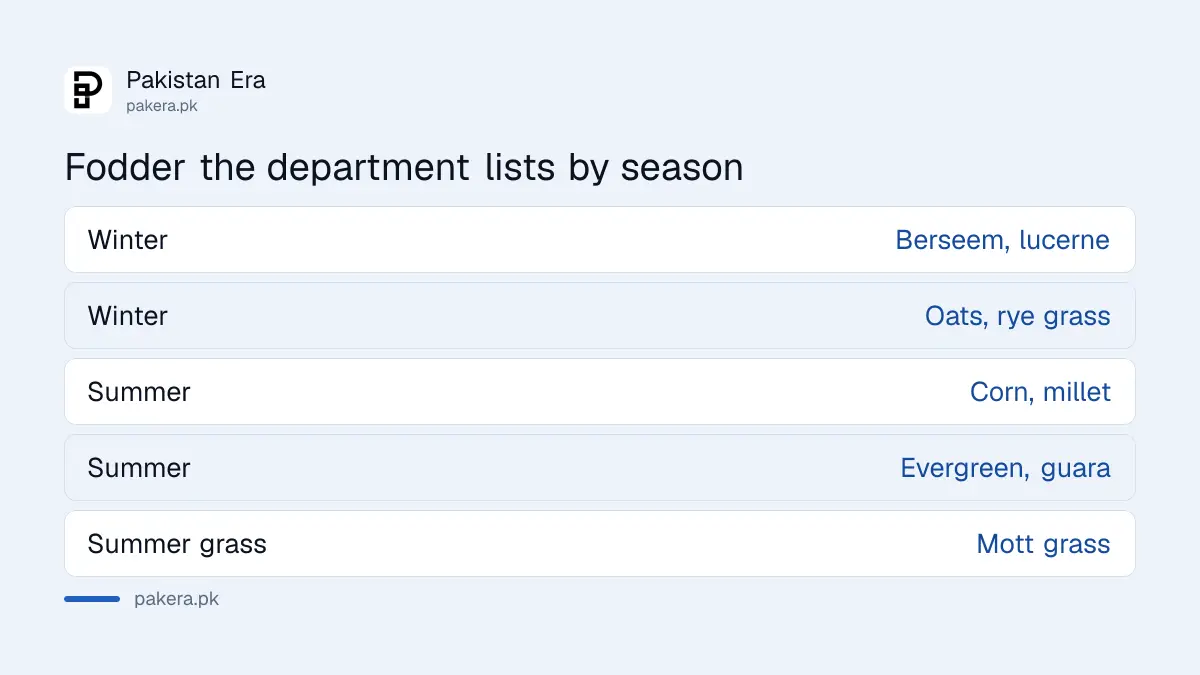
Punjab's Livestock Department lists berseem, lucerne, oats and rye grass as winter fodder, and corn, millet, mott grass, guara and evergreen as summer fodder. For silage, it says to cut green fodder when it starts to flower, press it into a pit, keep it airtight for a month and then feed it.
We read the department's FAQs page at livestock.punjab.gov.pk on 21 October 2026. The crop lists and silage steps are the department's. The area example and the silage plan are our arithmetic. The page gives no seed rates, so we give none.
Winter fodder is berseem, lucerne, oats and rye grass
The department names four winter crops and two mixtures: berseem, lucerne, oats, rye grass, berseem with oats, and berseem with rye grass. Berseem is a clover, rich in protein. Oats and rye grass add bulk and can be mixed with it.
| Season | Fodder the department lists |
|---|---|
| Winter | Berseem, lucerne, oats, rye grass, berseem with oats, berseem with rye grass |
| Summer | Corn, millet, evergreen, mott grass, guara |
October is the winter sowing season. The Khyber Pakhtunkhwa sowing dates and seed rates are a useful reference for the crop itself, but they are for another province. For Punjab, ask your local livestock or agriculture office for the date in your district.
A milking animal needs about 10 per cent of her weight in green fodder
The department says a lactating animal should get green fodder equal to 10 per cent of her live weight each day. That is the number to plan the field by. Ten buffaloes of 500 kg need 500 kg of green fodder a day, or about 15 tonnes a month.
That monthly total is our multiplication, and it ignores waste and sheep, goats and calves. It shows why a small kanal plot is not enough for a herd. Ask the extension office what yield per acre to expect from berseem in your area, because the department's FAQ does not say.
The feed arithmetic for milk is in the guide on wanda and green fodder for milking animals.
Silage keeps fodder for the gap months
The department says to cut the fodder when it begins to flower, cut it into small pieces, press it into a pit, keep it closed for a month without air, and then feed it. It adds that silage can be stored for a long time.
Silage is fodder that ferments without air and stays good for months. It helps when green fodder is short. The page does not name the crop, the pit size or the pressing method, so ask the vet for these.
- Pick the crop and wait until it begins to flower.
- Cut it into small pieces.
- Press the pieces tightly into a pit.
- Close the pit so no air enters.
- Open it after a month and feed the animals.

Get mott grass cuttings from two named places
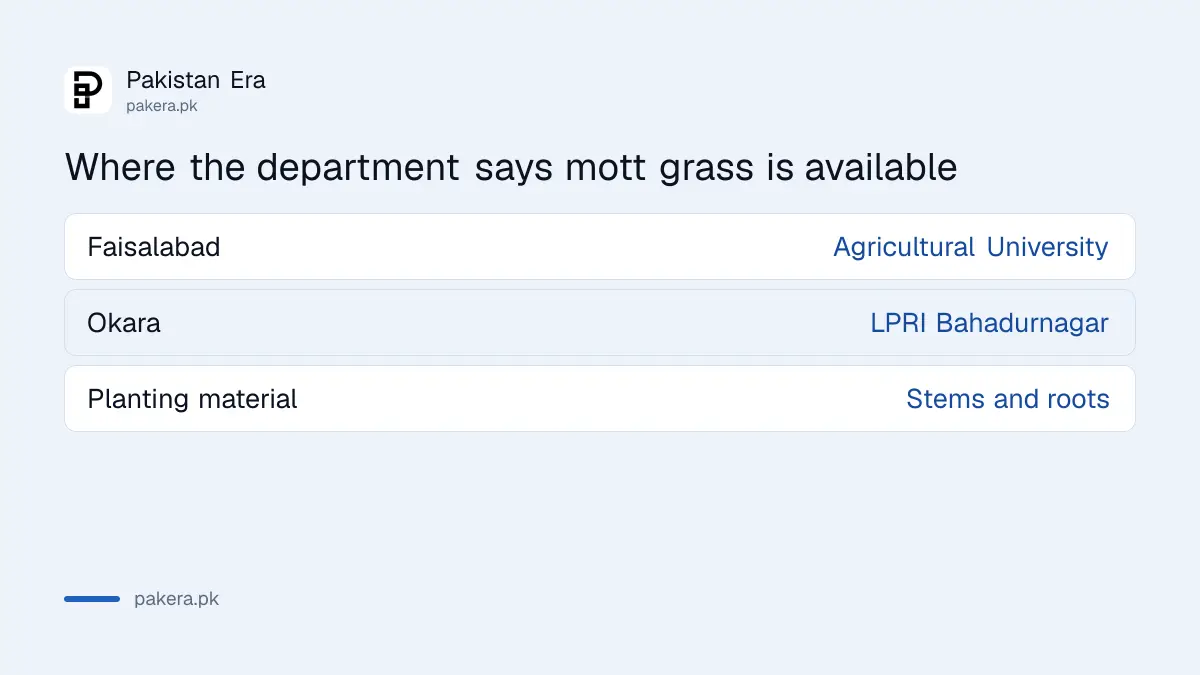
The department says mott grass stems and roots are available at the Agricultural University Faisalabad and at LPRI Bahadurnagar, Okara. Mott grass is a summer fodder on the department's list, and the department speaks of stems and roots, so it is planted from cuttings, not seed.
Call before you travel. The page does not give prices, stock or opening days. The farmer awareness page also lists material on Napier, Rai and exotic grasses, but it is images only, and we could not read the details.
Check weather and soil before sowing
A fodder field fails in a cold snap or poor soil. The free PMD farm weather advisory gives a forecast by tehsil. A soil test is the other check, and the soil testing guide for Punjab shows how.
The department lists a booklet on winter and summer fodder among its printed literature, and says its local veterinary officers hold a Farmers' Day every month. Ask for the fodder booklet at the centre and attend the next Farmers' Day to see what is practised in your tehsil.
Plan the year in two halves. Sow the winter crop now, decide where the summer crop will go, and mark a pit site for silage before the spring flush of fodder. A plan on paper beats a rush in a dry month.
Split the land by season. Keep one plot for winter berseem and oats, and another for summer corn or mott grass, so the soil is used well and you do not run short of green feed in the gap between crops. Silage covers that gap, which is why the pit is worth digging before the busy season starts. Write down the sowing date and cutting date of each plot, so next year you can repeat what worked and change what did not.
Common questions about fodder and silage
Which fodder is best in winter?
The department lists berseem, lucerne, oats and rye grass, and mixes of berseem with oats or rye grass. It does not rank them.
Which fodder grows in summer?
Corn, millet, evergreen, mott grass and guara.
How long should silage stay in the pit?
One month closed, then feed, says the department.
When do I cut fodder for silage?
When it begins to flower.
Where do I get mott grass cuttings?
At the Agricultural University Faisalabad and LPRI Bahadurnagar, Okara.
How much green fodder per animal each day?
For a lactating animal, 10 per cent of her live weight.
How we verified this
What we checked, where we read it, and what we could not confirm.
Last checked 21 October 2026. We read the Punjab Livestock and Dairy Development Department's FAQs page and its farmer awareness page. We did not find seed rates, sowing dates, yields, pit sizes or the stock and price of cuttings. The 15 tonne figure is our arithmetic. We did not visit either institution.
About the author

Global Affairs & Political Economy Writer
Muhammad Hatim is a book lover who started writing because he enjoys it. At Pakistan Era he writes about international relations, geopolitics and the global economy, with a particular interest in South Asia and the forces behind current events.