How to Get a Protection Order Against Domestic Violence in Balochistan: Hearing in 3 Days, Decision in 30
Get a domestic violence protection order in Balochistan from the Sub Divisional Magistrate: hearing in 3 days, decision in 30, jail and Rs 100,000 on breach.
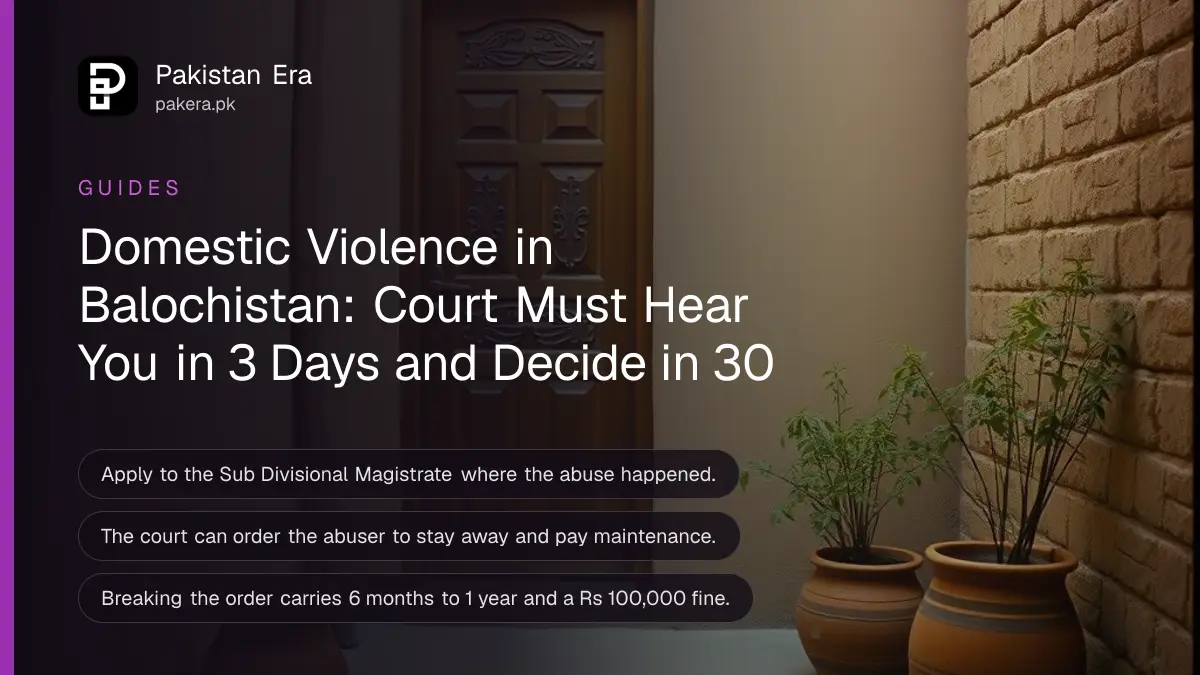
In Balochistan, a person facing domestic violence can apply to the court of the Sub Divisional Magistrate for a protection order under the Balochistan Domestic Violence (Prevention and Protection) Act 2014. The first hearing must be within 3 days, and the case must be decided within 30 days. The court can also order the abuser out of the house, order money for expenses and maintenance, and give temporary custody of children.
If you are in danger right now, call the police on 15 first. The steps below are for getting a court order that lasts. Breaking that order is a crime with at least six months in jail and a fine of at least Rs 100,000, paid to the victim.
The Act protects women, children, men and domestic workers
The 2014 Act covers any woman, child, man or vulnerable person who lives, or has lived, in a household with the abuser. That includes a wife, a daughter, an elderly parent, a disabled relative, and a domestic servant who works in the home. It applies across Balochistan except the tribal areas.
The law calls the person who suffers abuse the "aggrieved person", and the abuser the "accused". A household relationship can come from blood, marriage, adoption, employment or domestic help, or from living together as a joint family. A child means anyone under 18, including an adopted, step or foster child.
Domestic violence under section 4 is wider than beating. It includes:
- Physical abuse, assault, hurt and criminal force.
- Threats, insults, ridicule and threats of false cases.
- Sexual abuse of any kind.
- Economic abuse, such as cutting off money for household needs or denying maintenance.
- Stalking, harassment and entering your home without consent.
- Wrongful confinement, damage to your property and abandonment.
Apply to the Sub Divisional Magistrate where the abuse happened
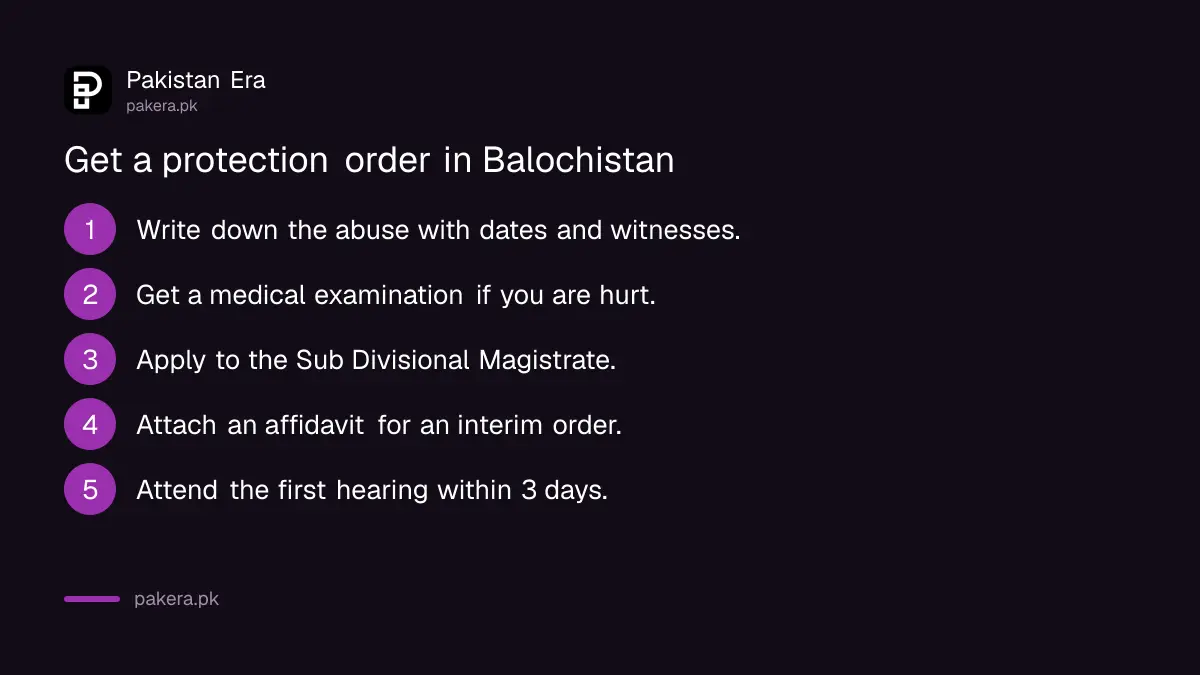
You, or someone you authorise in writing, file an application at the court of the Sub Divisional Magistrate with first class powers, in the area where the abuse took place. The court must fix the first hearing within three days and decide the application within thirty days.
- Write down what happened, with dates, places and the names of any witnesses.
- Get a medical examination if you are injured, and keep the report.
- Prepare the application to the court of the Sub Divisional Magistrate, stating the relief you want.
- Attach an affidavit describing the abuse, so the court can pass an interim order at once.
- File it, note the first hearing date, which must be within three days, and attend.
- Collect copies of every order. The court also sends copies to the local police station.
A Protection Officer appointed by the government can file the application for you if you ask. The officer can also arrange legal aid, a medical examination and a safe place to stay. Registered service providers, such as shelters and legal aid groups, can record the incident and help in the same way.
If you need a free lawyer, the district legal empowerment committees can pay one, as explained in free legal aid in Sindh and Balochistan.
The court can order protection, residence, money and custody
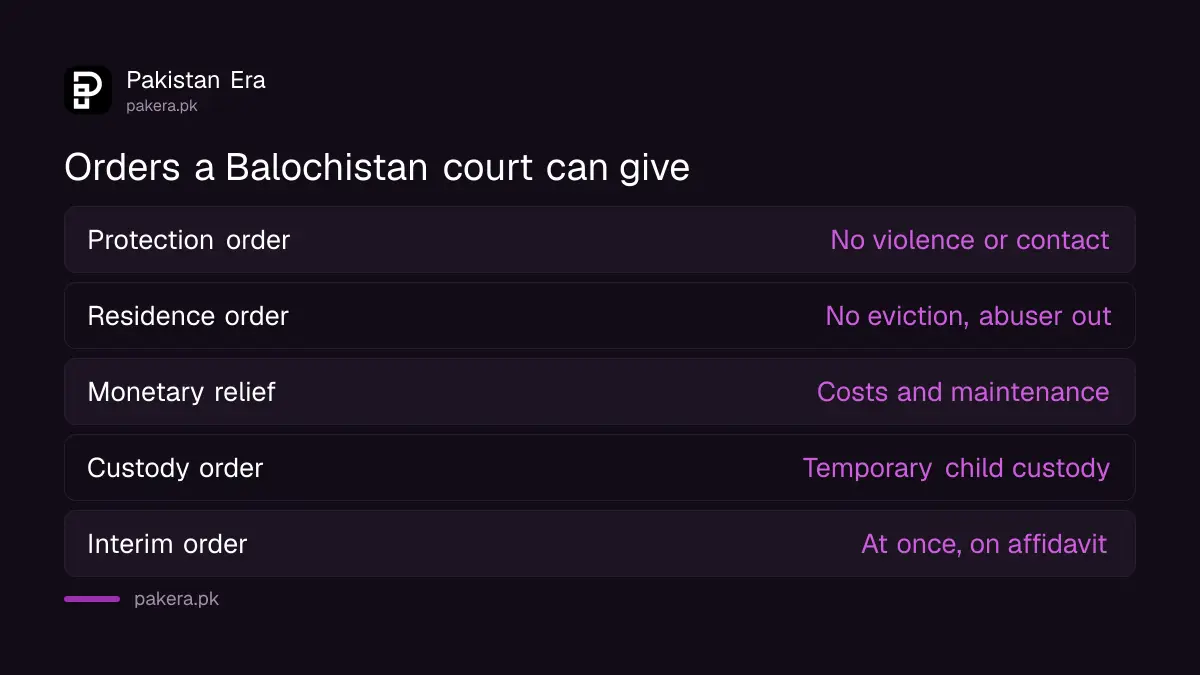
The Act gives the court four kinds of order. It can bar the abuser from any further abuse or contact. It can stop the abuser from throwing you out of the house. It can order money for your losses and maintenance. And it can give temporary custody of a child.
| Order | Section | What it can do |
|---|---|---|
| Protection order | 8(1) | Bar violence, contact by phone or message, and visits to your work or a child's school |
| Residence order | 8(2) | Stop the abuser from evicting you, keep the abuser out, or make the abuser pay rent for another home |
| Monetary relief | 9 | Lost earnings, medical costs, damaged property, and maintenance for you and your children |
| Custody order | 10 | Temporary custody of a child, with no visits by the abuser where child sexual abuse is shown |
| Interim order | 11 | Any of the above at once, on your affidavit, before the full hearing |
Section 7 says you cannot be evicted from the shared household without your consent, whether or not you own any part of it. The court can also tell the police to protect you, make the abuser sign a bond, and order the return of your property and valuables. If the abuser does not pay, the court can order the employer to pay you straight from the abuser's salary.
The residence and eviction rules do not apply where the relationship is only one of employment or domestic help. A domestic worker can still get a protection order and money for losses.
Breaking a protection order means at least 6 months in jail
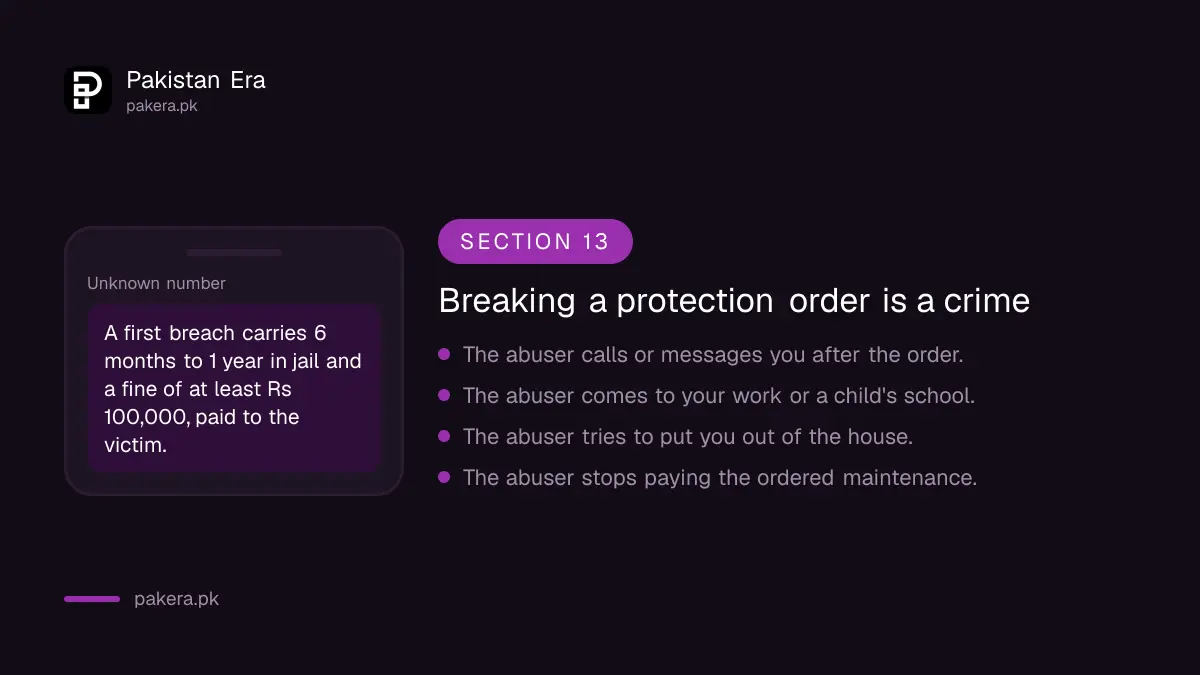
Breaking a protection order, or an interim order, is a crime under section 13. A first breach carries six months to one year in jail and a fine of at least Rs 100,000. A second or later breach carries one to two years and a fine of at least Rs 200,000. The fine goes to the victim.
| Breach | Jail | Fine |
|---|---|---|
| First breach | 6 months to 1 year | At least Rs 100,000, paid to the victim |
| Second or later breach | 1 to 2 years | At least Rs 200,000, paid to the victim |
| False complaint | Up to 6 months, simple | Up to Rs 50,000, or both |
A breach is cognizable, so the police can arrest without a warrant. It is non-bailable and compoundable, which means the victim can agree to settle it. If the abuser breaks the order, call 15, show the police your copy, and ask them to register the case. An appeal against a breach conviction goes to the Sessions Court within 30 days, and must be decided within 60 days.
The order lasts until you ask for it to end
A protection order stays in force until the aggrieved person applies to discharge it. A residence order lasts until the court changes it. Either side can ask the court to change an order if circumstances change, and you can apply again even if an earlier request was refused.
The court can also send the abuser for counselling with a service provider. If it does, the next hearing must be within 30 days. Counselling is in addition to the order, not a replacement for it. Orders under sections 8, 9 and 10 can be challenged through revision under the Code of Criminal Procedure.
Women in other provinces use their own laws. The process in Sindh is set out in getting a protection order in Sindh. For harassment at work in Balochistan, the route is the Balochistan ombudsperson, not this Act.
Common questions
Which court hears domestic violence cases in Balochistan?
The court of the Sub Divisional Magistrate with first class powers, in the area where the abuse took place, under section 2 and section 5 of the 2014 Act.
How fast does the court act?
The first hearing must be within three days of the application, and the whole application must be decided within thirty days. An interim order can be passed on your affidavit before that.
Can someone else apply for me?
Yes. Any person you authorise in writing can apply, and a Protection Officer can apply on your request.
Can a man apply for a protection order in Balochistan?
Yes. The Act covers any woman, child, man or vulnerable person in a domestic relationship with the abuser.
Can the court make my husband pay maintenance?
Yes. Section 9 lets the court order maintenance for you and your children, on top of any family court maintenance order, plus medical costs and lost earnings.
Can the abuser be arrested for breaking the order?
Yes. A breach is cognizable and non-bailable, with six months to one year in jail and a fine of at least Rs 100,000 for a first breach.
How we verified this
What we checked and where we read it.
Last checked 14 November 2026. We read the Balochistan Domestic Violence (Prevention and Protection) Act 2014 (Balochistan Act VII of 2014), passed on 1 February 2014 and published in the Balochistan Gazette on 12 February 2014, from the Government of Balochistan website. Sections 2, 4 to 13, 18, 19, 21, 25 and 26 are used above. The Balochistan Social Welfare department lists an amended version of the Act; its link opened a web page rather than the PDF, so the details above about the Protection Officer and Protection Committees stay general. This page explains the law and is not legal advice.
About the author

Tax, Bills and Technology Writer
Ali Akhtar is a young and curious voice here at Pakistan Era. He is currently pursuing his A-Levels and has a growing interest in Pakistan’s changing industrial landscape and educational trends. Ali likes to write in a way that helps him explain and explore the world around him. His writing reflects the perspective of the new generation navigating the evolving trends of Pakistan where technology, youth innovation, and shifting opportunities are reshaping the country’s future.