Punjab Decides to Block Fake Online Shopping Websites, Urges Cash on Delivery
Punjab decided on 8 October 2026 to block fake online shopping websites in the province. See what is confirmed, how to spot a fake shop and what to do next.
Short answer: Punjab's Enforcement Department decided on Wednesday 8 October 2026 to block the IP addresses of fake online shopping companies inside Punjab and to take legal action against them. The meeting, chaired by Director General Enforcement Imran Qureshi, also pushed for payment on delivery and a safer delivery system for online buyers.
An IP address is the numeric address of a website's server. Blocking it means people in Punjab could not open that site at all.
No list of blocked sites or start date has been published. Until there is one, the safest protection is still your own. We read the Punjab government's statement on the meeting and set out what it does and does not change for shoppers.
Punjab decided to block fake shopping websites inside the province
The Enforcement Department decided to block the IP addresses of fake companies within Punjab's territorial limits, to stop online fraud. The decision was announced in a statement from the Punjab information department on 8 October 2026.
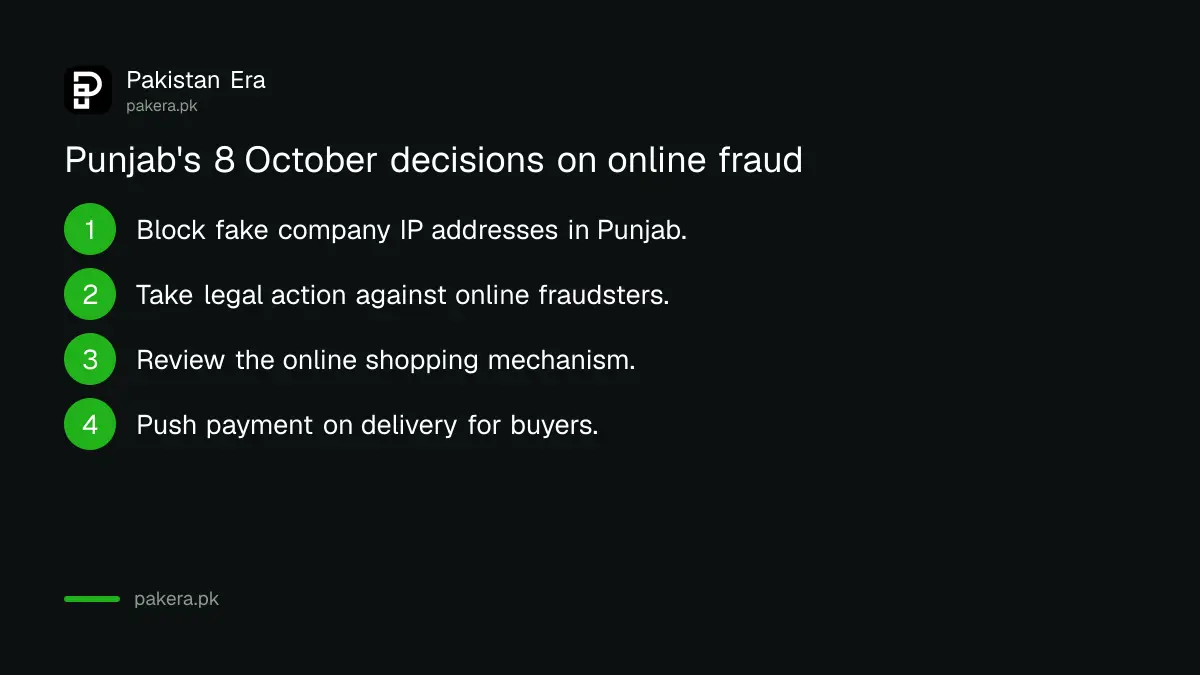
The meeting covered four things, according to that statement:
| Decision or direction | What it means |
|---|---|
| Block IP addresses of fake companies in Punjab | Fake shopping sites would not open in the province |
| Legal action against companies involved in online fraud | Cases against the people behind them |
| Changes to the online shopping mechanism | Proposed, details not published |
| Emphasis on payment on delivery | Pay when the parcel reaches you, not before |
The statement says concern was raised over "the increasing trend of online fraud committed through fake companies created on websites". It did not give a number of complaints or name any site.
A provincial block depends on the federal regulator
Blocking websites in Pakistan is normally done through the Pakistan Telecommunication Authority (PTA), a federal regulator, because internet providers take their orders from it. The Punjab statement does not say how the block will work or whether PTA is involved.
So read this as a decision of intent, not a working block. Three things are still missing:
- A list of the fake companies or websites.
- The legal route and the agency that will carry out the block.
- A date from which the block applies.
Fraudsters also change website addresses quickly. A block on one address does little if the same shop reopens under a new name the next week. That is why the payment on delivery advice matters more for buyers today.
How to spot a fake online shop before you pay
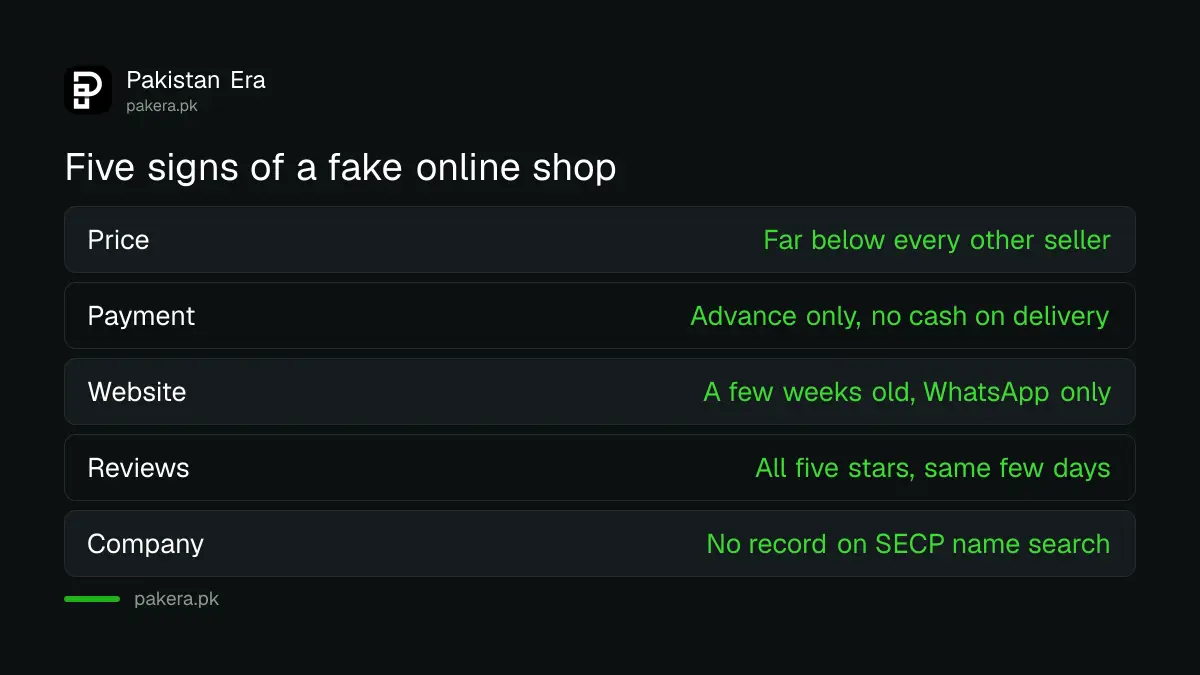
Most fake shops follow the same pattern: very low prices, an advance payment demand and no way to reach a real person. Check these before you pay anything.
- The price is far below every other seller. A phone or air fryer at half price is the most common bait.
- The shop wants an advance by bank transfer, mobile wallet or Raast, and refuses cash on delivery.
- The website or page is a few weeks old and has only one contact, usually a WhatsApp number.
- Reviews are all five stars, posted on the same few days, with no photos.
- The company name is not on the Securities and Exchange Commission of Pakistan (SECP) register. You can search it free on the SECP name search.
None of these proves fraud alone. Two or three together should stop you.
What to do if a fake website has already taken your money
Speed matters most. A bank can sometimes stop a transfer if you report it within hours, not days.
- Call your bank or wallet helpline at once and report the transaction as fraud.
- Take screenshots of the website, the chat, the payment and the seller's number.
- Report the crime to the National Cyber Crime Investigation Agency (NCCIA), the federal body for online fraud.
- Follow up with the bank in writing and keep the complaint number.
The bank's duties, including when it must refund you, are set out in our explainer on how to get a refund after online banking fraud. The bank's deadlines to reply are in our note on bank fraud complaint deadlines. The steps to file with the federal agency are in our walkthrough on how to report cybercrime to NCCIA.
If the seller is a real business that sent a faulty or wrong product, that is a consumer dispute, not fraud. Punjab's consumer courts handle it, as our walkthrough on filing a consumer court complaint shows.
What happens next
Watch for a published list of blocked sites, and for any rule that changes how online sellers in Punjab must take payment. The statement mentioned "proposed changes to the online shopping mechanism" but gave no detail.
The same meeting also agreed on better security for enforcement teams during market raids, with closer police coordination. That part is about price and market enforcement, not online shopping.
Common questions
Is Punjab blocking fake shopping websites?
It decided to on 8 October 2026. No list of sites or start date has been published, so no block is in force that we could confirm.
Who decided to block fake online shopping companies?
A meeting of Punjab's Enforcement Department chaired by Director General Enforcement Imran Qureshi, according to the Punjab government statement.
Is cash on delivery safer?
Yes, for most buyers. You pay only when the parcel arrives, and you can check the box before handing over cash where the courier allows it.
Where do I report an online shopping scam in Pakistan?
Report it to your bank or wallet first, then to the National Cyber Crime Investigation Agency. Keep screenshots of everything.
Can I check if an online shop is a registered company?
Yes. Search the company name free on the SECP name search. A missing record is a warning, but a registered name alone does not prove the shop is honest.
How we verified this
What we checked, where we read it, and what we could not confirm.
Last checked on 10 October 2026 at about 20:30 PKT. We read the Punjab government statement of 8 October 2026 on the Punjab Directorate General Public Relations website and opened the SECP name search. No list of blocked websites had been published when we checked.
About the author

Senior Writer, Public Services and Technology
Shahid joined us in 2024 as an author. He is a senior contributor to Pakistan's leading technology websites. He writes detailed articles, mostly covering his expertise in the latest tech, mobiles, apps, gadgets, and step-by-step guides. His ideology is to help people understand the latest trends and explain complex methods through very easy-to-understand guides.