Free Liver, Kidney and Bone Marrow Transplant in Punjab: CM Transplant Program, PHOTA Rule and 36 Hospitals
Punjab's CM Transplant Program covers liver, kidney, bone marrow and cornea transplants and cochlear implants for PHOTA-registered patients. 36 hospitals.
Punjab's Chief Minister's Special Initiative for Transplant Program pays for liver, kidney and bone marrow transplants, corneal transplants and cochlear implants free of cost. Only patients registered with PHOTA, the Punjab Human Organ Transplantation Authority, are eligible. Liver, kidney and bone marrow patients also get one year of free medicines after the operation. Helpline: 0800-07542.
The Punjab Health Initiative Management Company (PHIMC) runs the programme. Its counter shows 3,410 patients treated so far. The list of hospitals has 36 names, from PKLI and Jinnah Hospital in Lahore to the Multan Institute of Kidney Diseases and Allied Hospital in Faisalabad.
Transplants carry legal rules as well as medical ones. Organ sale is a crime, and the PHOTA registration step exists to keep every transplant legal and ethical. This page explains the five treatments, the PHOTA rule, the hospital list and the first steps.
Five treatments are covered free
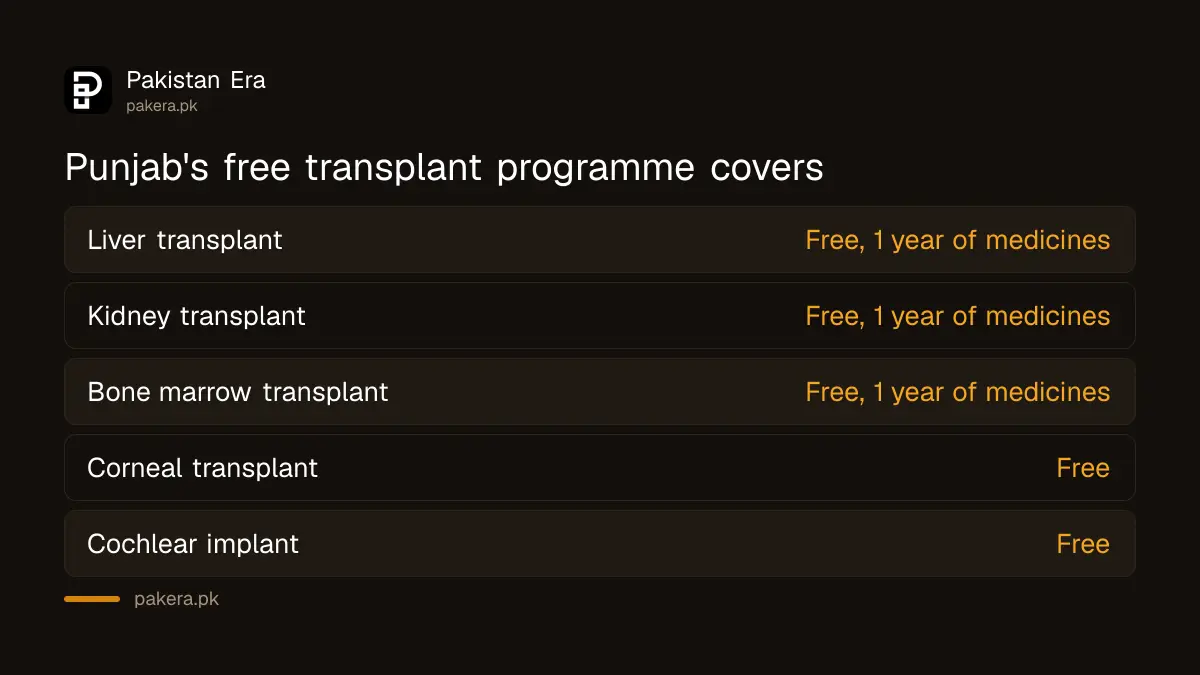
PHIMC lists five priorities: liver transplant, kidney transplant, bone marrow transplant, corneal transplant and cochlear implants. A cornea is the clear front layer of the eye. A cochlear implant is a small electronic device placed in the ear that helps some deaf people hear.
| Treatment | Who it helps | Free medicines after |
|---|---|---|
| Liver transplant | Liver failure, often after hepatitis B or C | One year |
| Kidney transplant | End-stage kidney failure | One year |
| Bone marrow transplant | Blood cancers and some blood disorders | One year |
| Corneal transplant | Vision loss from corneal disease | Not stated |
| Cochlear implant | Severe hearing loss | Not stated |
The free medicines matter. After a liver, kidney or bone marrow transplant, patients take anti-rejection medicines that stop the body attacking the new organ or marrow. PHIMC says it gives these free for one year so treatment is not interrupted.
PHOTA registration is the eligibility rule
PHIMC says only patients registered with the Punjab Human Organ Transplantation Authority (PHOTA) are eligible for transplant treatment under the programme. The registration is there to make sure each transplant is legal, ethical and meets medical standards. Without it, the programme does not pay.
In practice, the transplant hospital's team starts this process with you. Ask the transplant coordinator which PHOTA forms they need from the patient and, for a living donor, from the donor.
If anyone offers a paid kidney, a "donor arranged for money" or a transplant outside the listed hospitals, do not accept. Report it. Our page on reporting an illegal organ transplant in Punjab gives PHOTA's 1109 helpline and the steps.
How to start, step by step
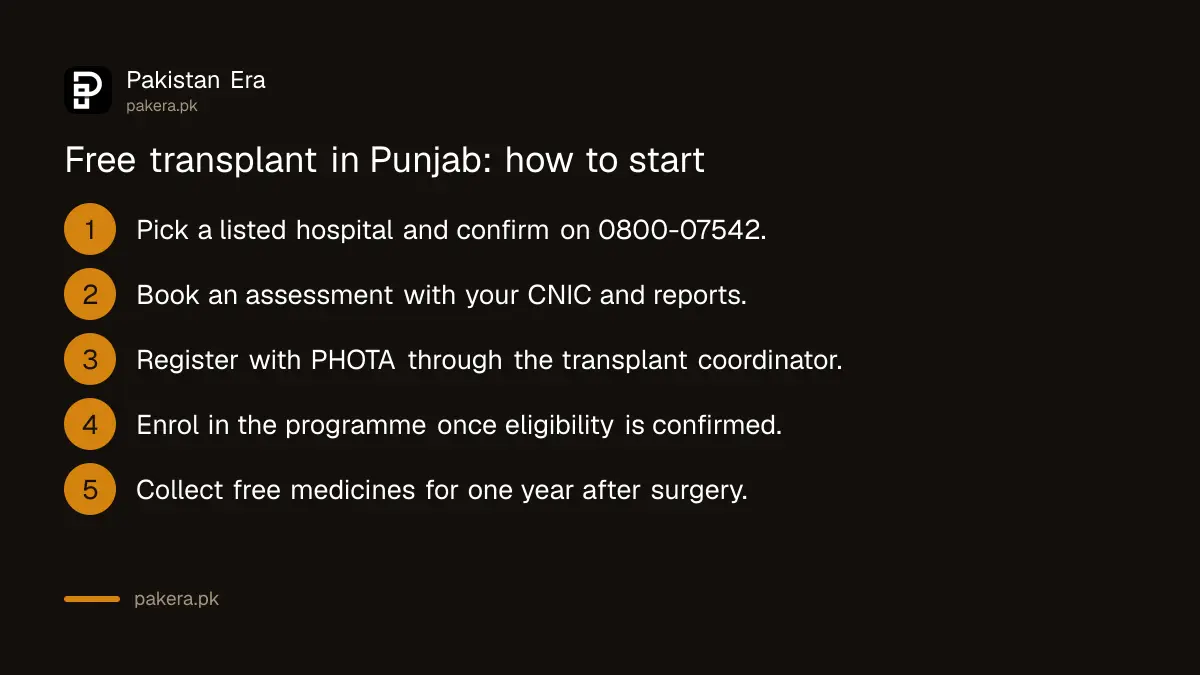
Start at a listed hospital that offers the transplant you need. The specialist assesses the patient, the hospital's transplant team handles PHOTA registration, and PHIMC's programme then covers the operation. Keep your CNIC and all reports together from the first visit.
- Pick a hospital from the list below that offers your treatment. Call 0800-07542 to confirm the service.
- Book an assessment with the transplant or specialist team. Carry the patient's CNIC or B-Form and all reports.
- Complete PHOTA registration through the hospital's transplant coordinator, and ask what the donor must bring.
- Enrol in the programme once the hospital confirms eligibility.
- After the operation, collect your free medicines for one year if you had a liver, kidney or bone marrow transplant.
The 36 hospitals on the transplant list
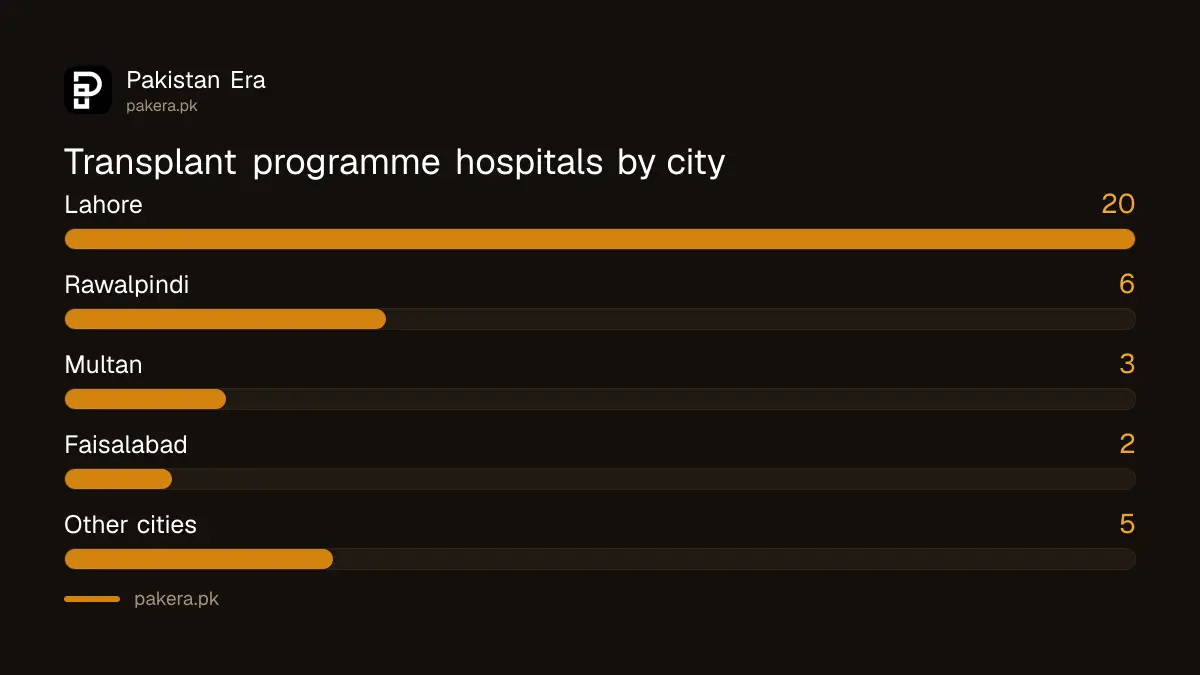
PHIMC's list names 36 hospitals in 9 cities, 9 public and 27 private. Lahore has 20 of them, including PKLI, Jinnah, Shaikh Zayed, Lahore General and the Children's Hospital. The list has columns for kidney, liver, bone marrow, cochlear and corneal services, so ask which ones each hospital provides.
| City | Hospitals on the list |
|---|---|
| Lahore (20) | Public: PKLI, Jinnah, Shaikh Zayed, Lahore General, Children's Hospital and University of Child Health Sciences. Private: Hameed Latif, Adil, Bahria Mohlanwal, Bahria Orchard, Doctors Hospital, Farooq DHA, Integrated Medical Care, Ihsan Mumtaz, National Hospital, National Institute of Blood Diseases and Bone Marrow Transplant, Omar Hospital, Sharif Medical City, Surgimed, Sardar Eye Trust, University of Lahore Teaching Hospital |
| Rawalpindi (6) | Al-Shifa Trust Eye Hospital, Bahria International Phase-8, Safari Hospital, Farooq Hospital Bahria Golf City, Pathwel Center (Pakistan Thalassaemia Welfare Society), Al-Khidmat Raazi |
| Multan (3) | Multan Institute of Kidney Diseases (public), Mukhtiar A Sheikh Memorial Welfare, Buch International |
| Faisalabad (2) | Allied-I Hospital (public), Mujahid Hospital |
| Other cities | Bahawal Victoria, Bahawalpur (public); Sahiwal Teaching Hospital (public); Doctors Hospital, Gujrat; Shahida Islam Medical Complex, Lodhran; Imran Idrees, Sialkot |
Eye hospitals on the list, such as Al-Shifa Trust and Sardar Eye Trust, are there for corneal transplants. The National Institute of Blood Diseases and the Pathwel Center are there for bone marrow work. Children who need a cochlear implant may also qualify for Bait-ul-Mal's free cochlear implant scheme.
Other help for kidney and liver patients
A transplant is not the first step for most kidney patients. Many need dialysis while they wait, and Punjab pays for that separately under the CM dialysis programme. Our page on free dialysis in Pakistan covers that scheme, SIUT and Indus.
For transplant care outside Punjab's programme, or for patients from other provinces, SIUT in Karachi and PKLI in Lahore run their own free or subsidised services. See kidney and liver transplant care at SIUT and PKLI. For complaints about this programme, call 0800-07542, open 24 hours, or WhatsApp 0333-6756390 from Monday to Saturday, 8 am to 11 pm.
Common questions
Is kidney transplant free in Punjab?
Yes, under the Chief Minister's Special Initiative for Transplant Program, for patients registered with PHOTA. Liver, bone marrow and corneal transplants and cochlear implants are covered too.
What is PHOTA registration?
Registration with the Punjab Human Organ Transplantation Authority. PHIMC says only PHOTA-registered patients are eligible, to keep transplants legal, ethical and safe.
Are medicines free after a transplant?
PHIMC says liver, kidney and bone marrow transplant patients get free post-treatment medicines for one year.
Which hospitals do liver transplants under the programme?
PHIMC's list includes PKLI in Lahore among 36 hospitals, but it does not say which hospital offers which transplant in text form. Call 0800-07542 to confirm the liver service.
Can I buy a kidney from a donor?
No. Buying or selling organs is illegal in Pakistan. Report any such offer to PHOTA on 1109.
How we verified this
What we checked and where we read it.
Last checked 15 November 2026. The five treatments, the PHOTA eligibility rule, the one year of free medicines and the helplines come from PHIMC's Chief Minister's Special Initiative for Transplant Program page and its overview PDF. The 36 hospitals come from PHIMC's list of empanelled hospitals under the programme. That list has service columns for kidney, liver, bone marrow, cochlear and corneal care, but the per-hospital marks do not come through in the PDF text, so we do not assign services to hospitals. The patient count of 3,410 is from the PHIMC home page.
About the author

Public Services and Education Journalist
Fajr Riaz is a journalist and content writer at Pakistan Era, based in Lahore. She covers the questions people meet in everyday life in Pakistan: how a public service works, what a change in the rules means, and where to find a reliable answer.