Your Rights When a Magistrate Records Your Statement in Pakistan
A Magistrate must warn you before recording a confession under section 164 and be sure it is voluntary. See who records it, what you may ask and what to check.
A Magistrate can record your statement or confession under section 164 of the Code of Criminal Procedure, but before taking a confession he must tell you that you do not have to make one and that it can be used against you. He may record it only if he believes it is voluntary.
Police sometimes take a person to a Magistrate to "record a statement". That moment decides whether your words become evidence. We read section 164 and section 364 of the Code of Criminal Procedure, 1898, on 21 October 2026. What you say to police during questioning is a different matter, covered in the guide on being questioned by police as a witness.
Only a Magistrate who is not a police officer can record it
Section 164(1) lets any Magistrate of the first class, or a Magistrate of the second class specially empowered by the Provincial Government, record a statement or confession made during an investigation or afterwards, before the inquiry or trial begins. He must not be a police officer.
The Explanation adds that this Magistrate need not have jurisdiction over the case. So you may be taken to a court in another town. A statement under this section is made to a judicial officer, not to the police, and that is why it carries weight.
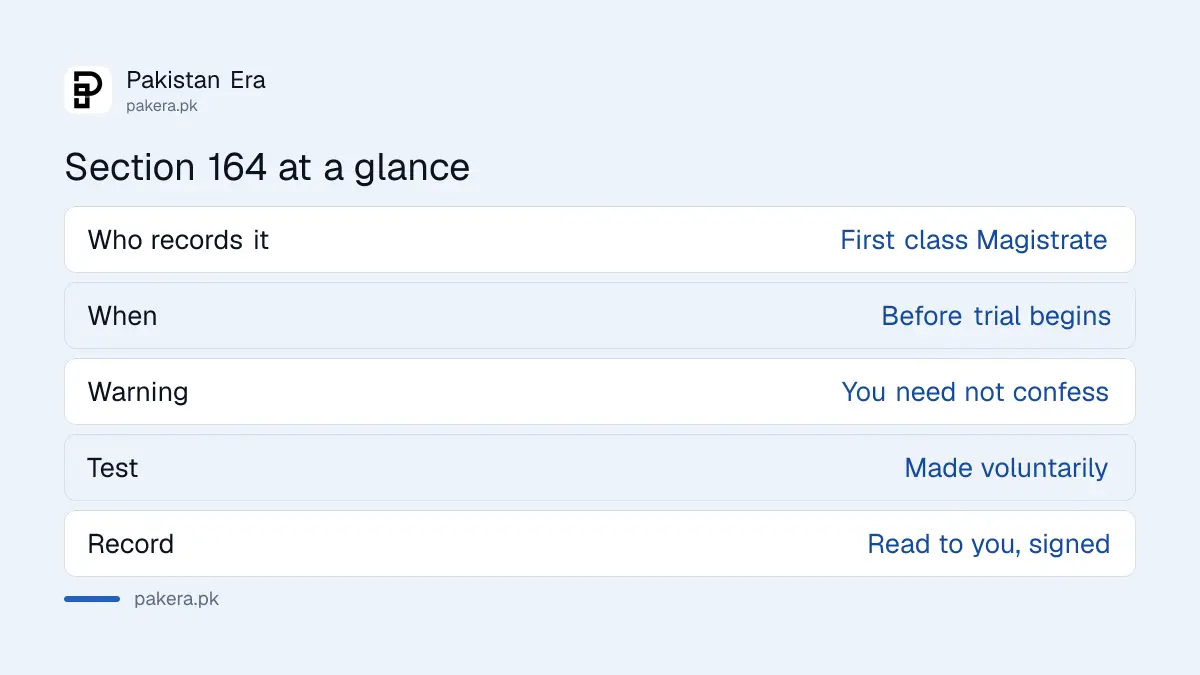
| Point | What section 164 says |
|---|---|
| Who records it | First class Magistrate, or empowered second class |
| When | During investigation, or after it and before trial starts |
| Warning before a confession | You need not confess, and it can be used as evidence |
| Test for acceptance | Magistrate must believe it was made voluntarily |
| How it is written | Recorded and signed under section 364 |
| Witness statements | May be recorded in the accused's presence, with cross-examination |
The Magistrate must warn you before recording a confession
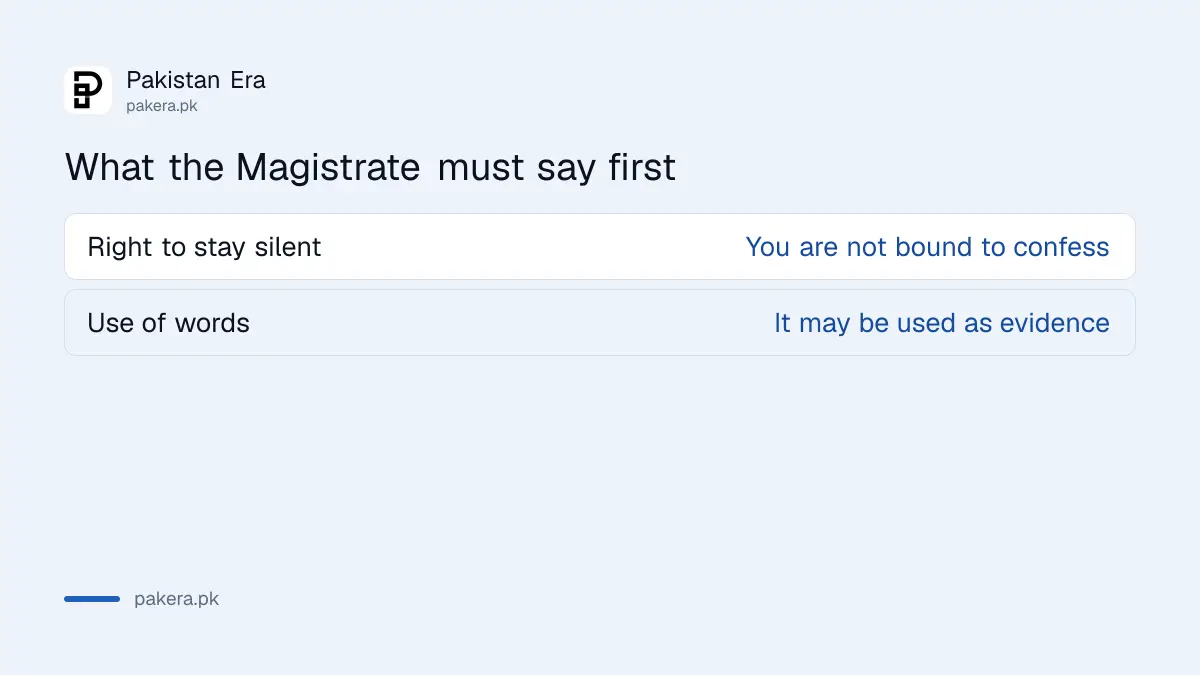
Section 164(3) requires him to explain, before recording a confession, that you are not bound to make one and that if you do, it may be used as evidence against you. He must also question you and have reason to believe the confession is voluntary.
He then writes a memorandum at the foot of the record, in the form the Code sets out. It says he explained the warning, believes the confession was voluntary, took it in his presence and hearing, read it over to you and that you admitted it is correct.
You may ask what is being written and correct it
Section 364 says the whole examination must be recorded in full, in the language in which you are examined, with every question and answer. The record is shown or read to you, or interpreted if you do not understand the language. You may explain or add to your answers.
When it matches what you say is the truth, you and the Magistrate sign it. The Magistrate certifies under his own hand that it was taken in his presence and hearing. Read it before you sign, and ask for corrections. We did not find a rule in the Code that gives you time to think before the recording. Courts may have views on that, and we did not read them.
A witness statement can be recorded with the accused present
Section 164(1-A) says a statement may be recorded in the presence of the accused, who must then be given an opportunity of cross-examining the witness making it. This applies to witness statements, not to confessions.
If you are a witness, your statement under section 164 goes to the Magistrate who will try or inquire into the case. It can later be put against you if you change your account, so state only what you saw. A person called as a witness can also ask a lawyer to explain the document first.
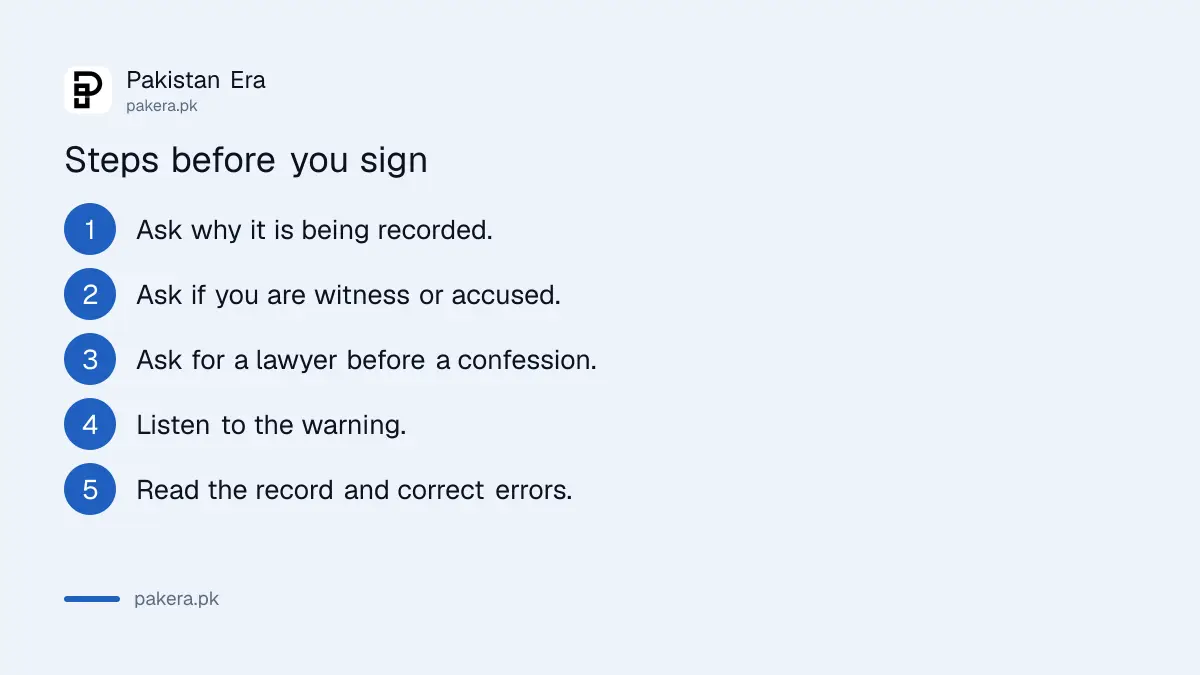
- Ask the police or the Magistrate why the statement is being recorded.
- Ask whether you are being treated as a witness or as an accused.
- If you are the accused, ask to speak to a lawyer before any confession.
- Listen to the warning. Say plainly if you are being pressed.
- Read the record, or have it read to you, and correct errors.
- Ask for a copy, and sign only what is true.
If you were pressed or hurt, say so before the Magistrate signs
The Magistrate can record a confession only if he has reason to believe it was voluntary. If police pressed you, tell him in plain words, and ask that your complaint be written down. A lawyer can then challenge the confession at trial.
Our guide to your rights when arrested in Pakistan lists what to ask for at each stage. If you need a lawyer you cannot pay for, see free legal aid in Punjab.
Common questions
Is a section 164 statement the same as a police statement?
No. It is recorded by a Magistrate, who must not be a police officer, and follows the safeguards in sections 164 and 364.
Can I refuse to confess?
Yes. Section 164(3) requires the Magistrate to tell you that you are not bound to make a confession.
Can I take it back later?
The Code does not say. Whether a retraction is accepted is a question for the trial court, and we did not read case law.
Do I need a lawyer present?
The section we read does not require one. You can ask for one, and a Magistrate decides how to proceed.
Can a woman or child be recorded this way?
Section 164 does not exclude them. Other sections protect women and children in other ways, and we did not read them for this page.
How we verified this
What we checked, where we read it, and what we could not confirm.
Last checked 21 October 2026. We read sections 164 and 364 of the Code of Criminal Procedure, 1898, in the Pakistan Code PDF marked as last amended on 16 February 2017, from a copy saved earlier this week. The Pakistan Code portal did not open for us on the day, so later amendments are unchecked. We did not read court rulings on voluntariness or retraction.
About the author

Senior Writer, Public Services and Technology
Shahid joined us in 2024 as an author. He is a senior contributor to Pakistan's leading technology websites. He writes detailed articles, mostly covering his expertise in the latest tech, mobiles, apps, gadgets, and step-by-step guides. His ideology is to help people understand the latest trends and explain complex methods through very easy-to-understand guides.