Regular Income Certificate Profit Rate History: Every Change to 21 October 2026 in Pakistan (Full List)
Regular Income Certificates pay Rs 1,010 a month per lakh (12.12%) from 21 October 2026. See every RIC rate change since 2024, the 2026 low and after-tax pay.
Regular Income Certificates (RIC) from National Savings pay Rs 1,010 a month on every Rs 100,000 (12.12% a year) from 21 October 2026, up from Rs 980 earlier in October. The rate changed eight times in 2026, from a low of Rs 830 a month between January and May. Below is every RIC rate change since 2024, the highs and lows since 2020, and what each means after tax.
We downloaded National Savings' RIC rate history file on 1 November 2026. Its heading reads "rates applied during these dates", and it lists each period from January 2020 with the monthly profit on Rs 100,000 and the yearly rate.
The RIC rate is Rs 1,010 a month per lakh from 21 October 2026
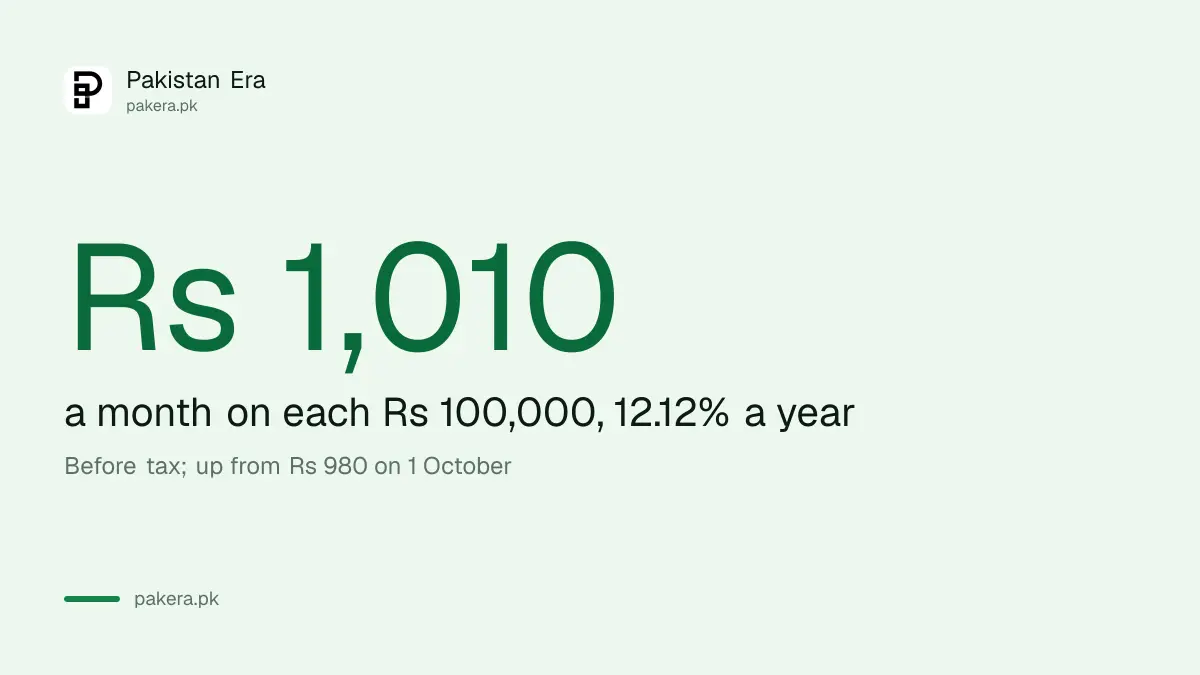
From 21 October 2026, a Regular Income Certificate pays Rs 1,010 a month on each Rs 100,000, which is 12.12% a year. From 1 to 20 October it paid Rs 980 (11.76%). So the latest change added Rs 30 a month per lakh.
Unlike Behbood, RIC is open to anyone, and the profit is paid every month. National Savings' rate card says the profit is subject to withholding tax of 15% for filers and 30% for non-filers. The full set of current scheme rates is in National Savings rates from 21 October 2026.
Every RIC rate change since 2024: the full list
The table covers each period in the file from December 2023, newest first. The profit is per Rs 100,000 per month, before tax.
| From | To | Monthly profit per Rs 100,000 | Rate a year |
|---|---|---|---|
| 21 Oct 2026 | Till date | Rs 1,010 | 12.12% |
| 1 Oct 2026 | 20 Oct 2026 | Rs 980 | 11.76% |
| 4 Sep 2026 | 30 Sep 2026 | Rs 930 | 11.16% |
| 18 Jul 2026 | 3 Sep 2026 | Rs 960 | 11.52% |
| 10 Jun 2026 | 17 Jul 2026 | Rs 1,020 | 12.24% |
| 26 May 2026 | 9 Jun 2026 | Rs 985 | 11.82% |
| 23 Jan 2026 | 25 May 2026 | Rs 830 | 9.96% |
| 5 Jan 2026 | 22 Jan 2026 | Rs 880 | 10.56% |
| 4 Nov 2025 | 4 Jan 2026 | Rs 910 | 10.92% |
| 21 Aug 2025 | 3 Nov 2025 | Rs 900 | 10.80% |
| 28 Jul 2025 | 20 Aug 2025 | Rs 890 | 10.68% |
| 27 Jun 2025 | 27 Jul 2025 | Rs 930 | 11.16% |
| 19 May 2025 | 26 Jun 2025 | Rs 960 | 11.52% |
| 22 Apr 2025 | 18 May 2025 | Rs 970 | 11.64% |
| 14 Feb 2025 | 21 Apr 2025 | Rs 979 | 11.74% |
| 31 Jan 2025 | 13 Feb 2025 | Rs 990 | 11.88% |
| 10 Dec 2024 | 30 Jan 2025 | Rs 1,000 | 12.00% |
| 4 Nov 2024 | 9 Dec 2024 | Rs 1,010 | 12.10% |
| 25 Sep 2024 | 3 Nov 2024 | Rs 1,060 | 12.72% |
| 14 May 2024 | 11 Sep 2024 | Rs 1,220 | 14.64% |
The file prints 12.10% for the November 2024 period, where Rs 1,010 a month works out to 12.12%. We show the file's figure as printed.
RIC fell to Rs 830 in early 2026, then jumped Rs 155 in May
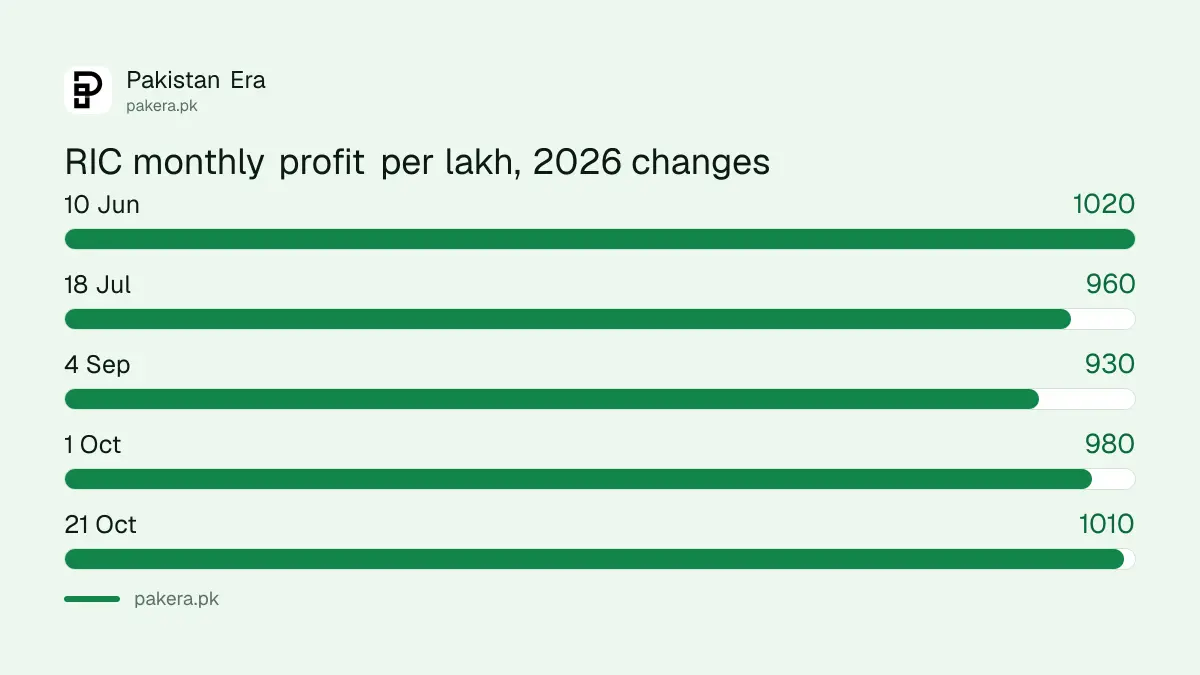
The year started with two cuts. RIC went to Rs 880 on 5 January and to Rs 830 (9.96%) on 23 January, its lowest level since December 2021. It stayed there for four months.
On 26 May 2026 it jumped to Rs 985, a rise of Rs 155 a month per lakh, and to Rs 1,020 on 10 June. It then slipped to Rs 930 by September before rising twice in October. Those moves are our reading of the file; National Savings does not explain them.
The highest RIC rate since 2020 was 16.08% in late 2023
The file starts on 1 January 2020 at Rs 880 a month. The lowest point was Rs 620 (7.44%) in June 2020. The highest was Rs 1,340 (16.08%), from 30 October to 18 December 2023.
| Moment | Monthly profit per Rs 100,000 | Rate a year |
|---|---|---|
| January 2020 (start of the file) | Rs 880 | 10.56% |
| June 2020 (lowest) | Rs 620 | 7.44% |
| October to December 2023 (highest) | Rs 1,340 | 16.08% |
| 23 January to 25 May 2026 (2026 low) | Rs 830 | 9.96% |
| From 21 October 2026 | Rs 1,010 | 12.12% |
What Rs 10 lakh in RIC pays after tax
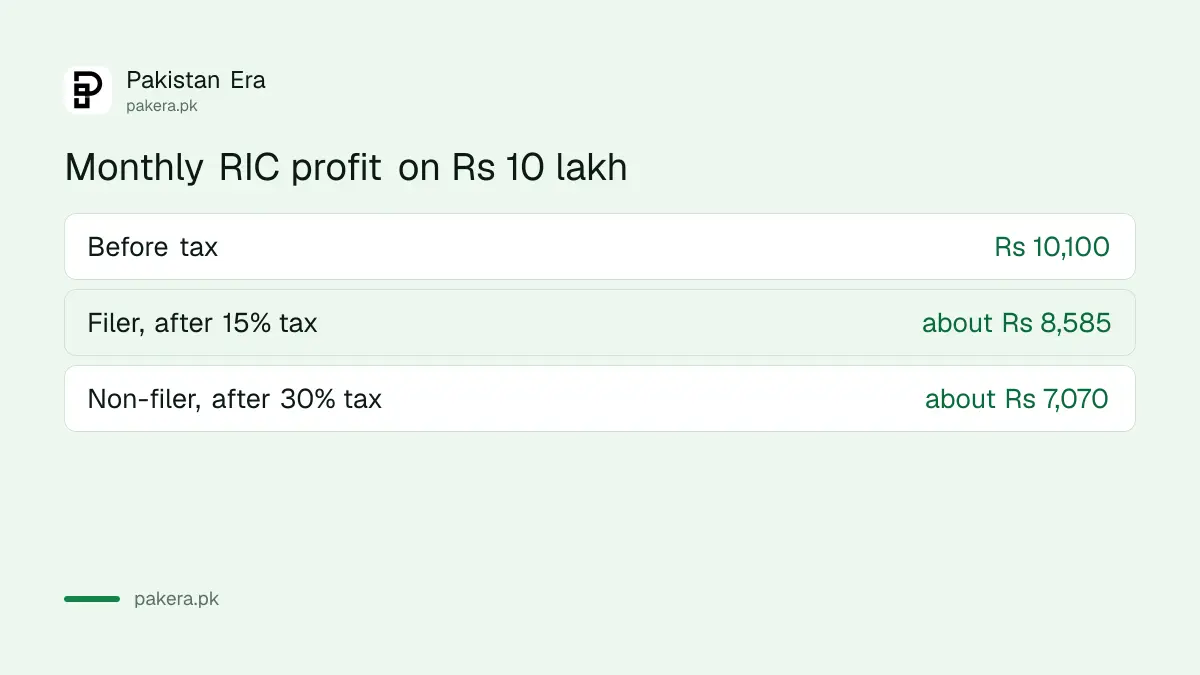
On Rs 1,000,000, RIC pays Rs 10,100 a month before tax from 21 October 2026. After 15% withholding tax for a filer, that is about Rs 8,585. A non-filer, taxed at 30%, gets about Rs 7,070. These are our arithmetic from the rate card's tax rates.
Behbood pays more, Rs 1,080 per lakh, but only widows, senior citizens and disabled people can buy it. For everyone else, RIC is the main monthly-income certificate. How to buy one is set out in buying Regular Income Certificates, and the rules for cashing out early are in encashing National Savings certificates early.
How to check the RIC rate yourself
Both the current card and the history file are on the National Savings website.
- Open the National Savings latest profit rates page.
- Read the Regular Income Certificate box on the rate card for today's rate.
- Click "Regular Income Certificate Historical Profit Rates" for the PDF history.
- Find the period that covers the date you care about.
- Multiply the per-lakh profit by your amount in lakh, then take off tax.
Common questions
What is the Regular Income Certificate profit rate today?
Rs 1,010 a month on each Rs 100,000, or 12.12% a year, from 21 October 2026.
How many times did the RIC rate change in 2026?
Eight times: 5 January, 23 January, 26 May, 10 June, 18 July, 4 September, 1 October and 21 October.
What was the lowest RIC rate in 2026?
Rs 830 a month per lakh (9.96%), from 23 January to 25 May 2026.
Is tax deducted from RIC profit?
Yes. The rate card says withholding tax applies: 15% for filers and 30% for non-filers.
Is RIC better than Behbood?
Behbood pays Rs 70 more per lakh each month, but only certain groups can buy it. Anyone can buy RIC.
Does the history file show the rate for my profit date?
Yes. The file is headed "rates applied during these dates", so find the period that contains your profit date.
How we verified this
What we checked, where we read it, and what we could not confirm.
Last checked 1 November 2026. Every rate and period comes from National Savings' Regular Income Certificate history file (RIC_211026.pdf) and its rate card dated 21 October 2026, both downloaded from savings.gov.pk on 1 November 2026. The after-tax figures and the size of each change are our arithmetic. The file's 12.10% for November 2024 does not match its Rs 1,010 profit, and we have shown it as printed. National Savings gives no reasons for rate changes.
About the author

Global Affairs & Political Economy Writer
Muhammad Hatim is a book lover who started writing because he enjoys it. At Pakistan Era he writes about international relations, geopolitics and the global economy, with a particular interest in South Asia and the forces behind current events.