How to Report Unsafe Food to the Punjab Food Authority
Every food business needs a licence, a graded premises must display its certificate, and unsafe food causing injury carries three years.
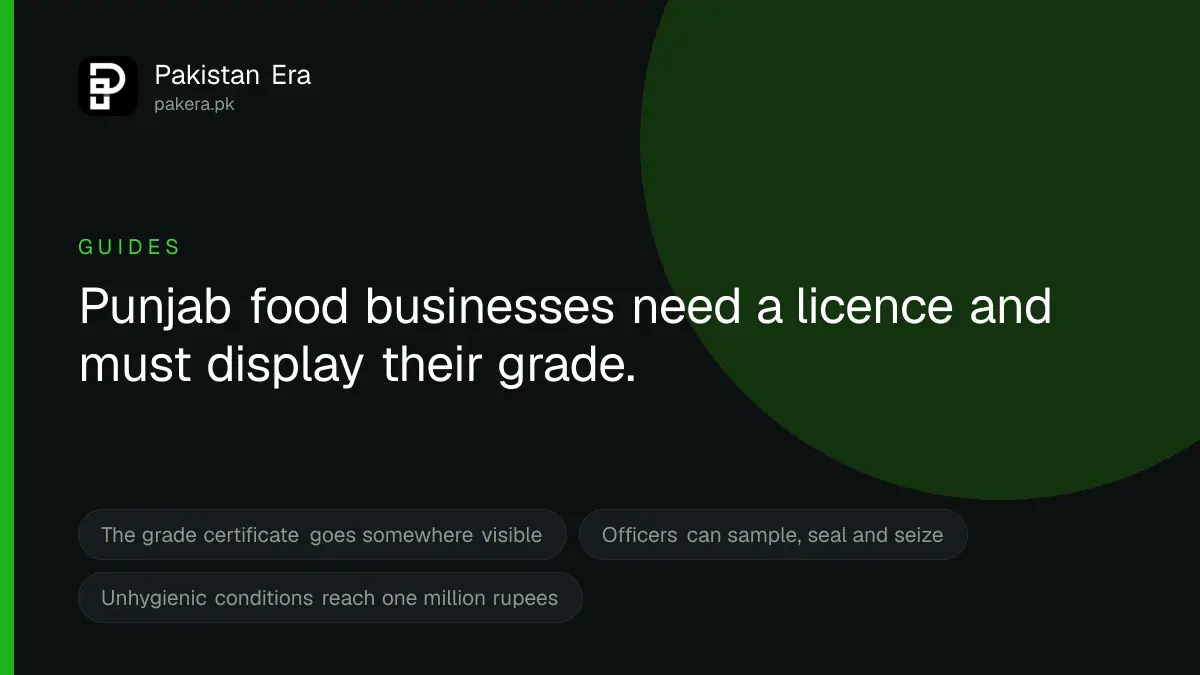
Every food business in Punjab needs a licence, and a graded premises must display its category certificate where you can see it. If unsafe food injures someone the sentence runs to three years, and if it kills someone it runs to life.
To make the complaint itself by phone, WhatsApp or the PFA app, the numbers and steps are in Punjab Food Authority complaint: call 1223, WhatsApp or use the PFA app.
Those are the numbers in the Punjab Food Authority Act 2011, as amended in 2016. They are far heavier than the fines people assume a food inspector can impose.
We read the Act on 6 September 2026 in the text published by the Law and Parliamentary Affairs Department, Government of the Punjab.
What the offences carry
| Offence | Punishment in the Act |
|---|---|
| Selling adulterated food | One to six months, fine one hundred thousand to one million rupees |
| Substandard or misbranded food | One to six months, fine one hundred thousand to one million rupees |
| Unsafe food causing injury | Three months to three years, same fine range |
| Unsafe food causing death | Ten years to life, fine two to three million rupees |
| Unhygienic conditions | Three days to six months, fine twenty thousand to one million rupees |
| No licence | Three days to one year, fine ten thousand to five hundred thousand rupees |
Large scale manufacturing of adulterated food, at or above the quantities in the Schedule, carries six months to five years and a fine of five hundred thousand to two million rupees.
The certificate on the wall
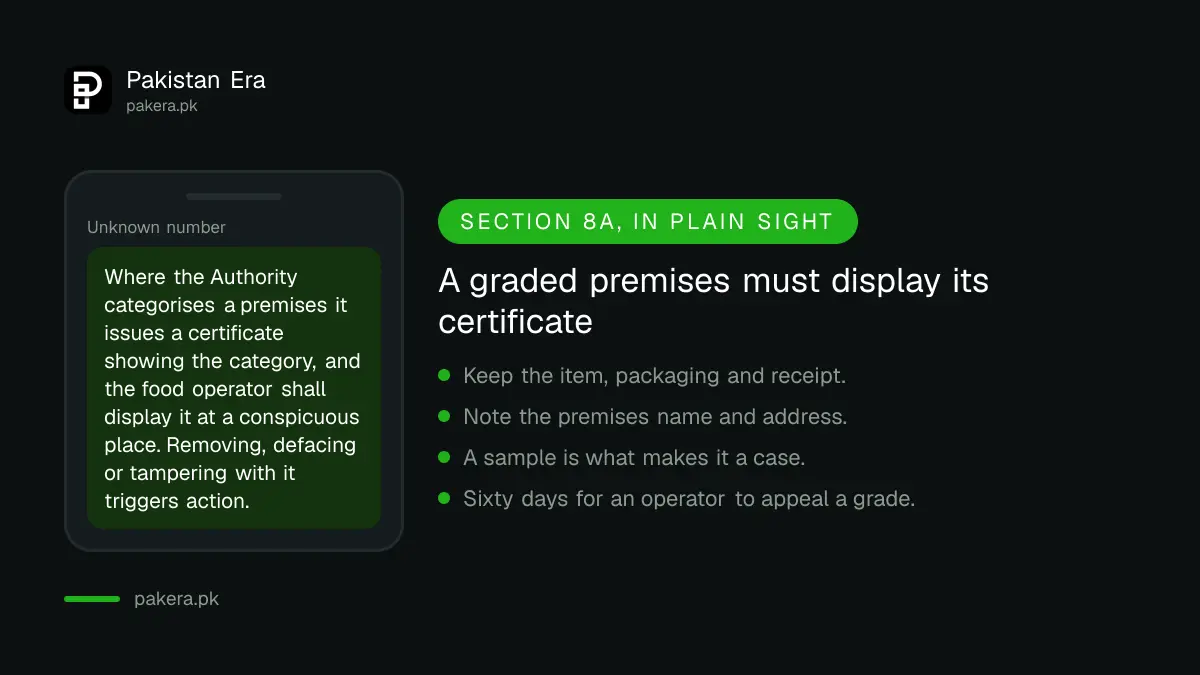
Section 8A is the part a customer can use without any process at all.
The Food Authority may categorise a premises against objective criteria based on how far it meets the standards, and may revise those categories periodically. Where a premises has been categorised, the Authority issues a certificate showing the category, and the food operator shall display that certificate at a conspicuous place on the premises.
So the certificate is not decoration and it is not optional for a graded place. If a food operator removes it, tampers with it, defaces or mutilates it, the Authority may act against them.
A food operator who disagrees with the category has sixty days to appeal to the notified Appellate Authority. Which means a missing certificate is not evidence of an appeal in progress. It is a thing to ask about.
What a Food Safety Officer can do
Section 13 lists the powers, and they are wide enough that a complaint has somewhere to go.
An officer may take a sample of any food intended for sale or already sold. Seize food, apparatus or utensils that appear to contravene the law. Enter or seal any premises where food is prepared, preserved, packaged, stored, conveyed, distributed or sold. Open and examine any package believed to contain food. Examine books and documents and take copies. Demand the identity card, business registration certificate or licence. Mark, seal, weigh, count or measure food or appliances. And search and seize a vehicle carrying food.
After a seizure the officer must prepare a statement describing what was taken and give a copy to the person it was taken from, or post it to them if they were absent.
Improvement notice, then closure
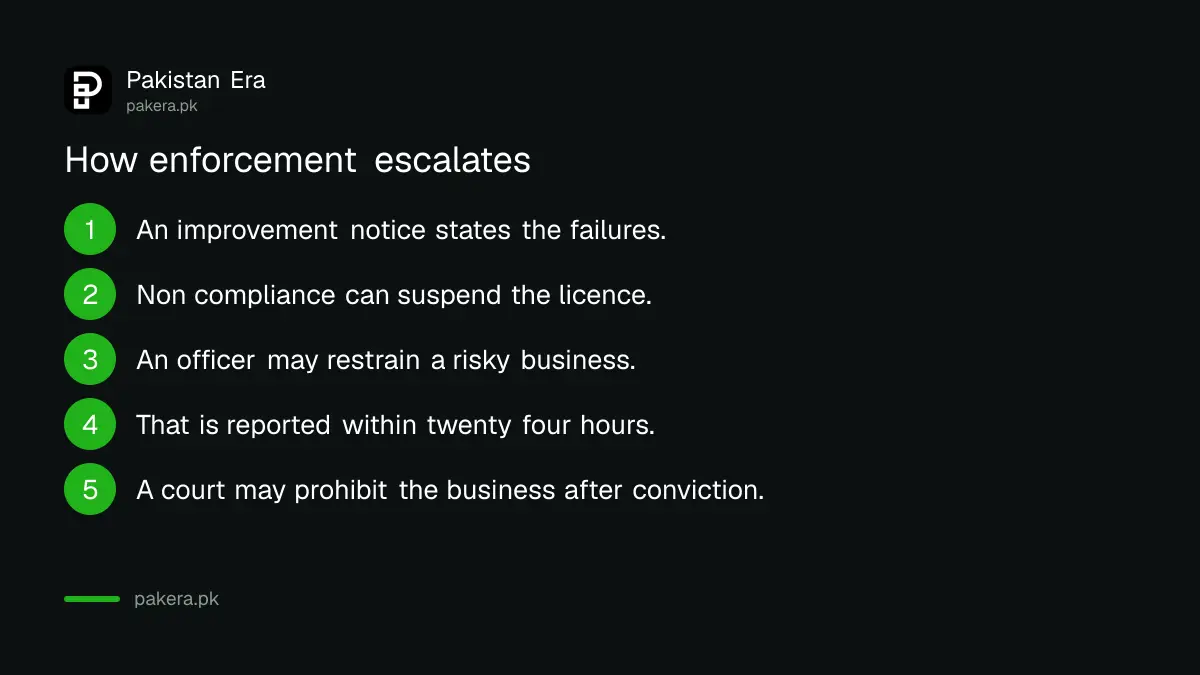
The Act does not jump straight to prosecution. Section 16 lets an officer serve an improvement notice stating the grounds, the failures, and the measures needed to comply. If the operator does not comply in time, the Authority may cancel or suspend the licence.
Section 18 covers the urgent case. If a Food Safety Officer is satisfied a health risk condition exists, he may serve notice and restrain the business, with or without conditions or a stated period, recording reasons in writing. He must report that action to the Food Authority within twenty four hours, and the Authority may confirm, modify or set the order aside.
Section 17 applies after a conviction. Where the court is satisfied a health risk exists, it may prohibit the use of a process, treatment, premises or equipment, or prohibit the operator from running the food business at all.
How to make the complaint useful
- Note the name and full address of the premises, not just the area.
- Photograph the category certificate, or its absence, and the licence if displayed.
- Keep the receipt, the packaging and the label, because labelling is its own offence.
- Note the date and time you bought or ate, and what happened afterwards.
- Keep any medical record, since injury and death change the sentencing range.
Keeping the item matters more than describing it. Section 13 gives the officer the power to sample and seize, and a sample is what turns a complaint into a case.
Our guide to the receipt rules for Punjab restaurants covers the invoicing side of the same premises, and our guide to taking a shop to consumer court covers the separate civil route for getting money back.
Labels, advertising and licences
Section 15 says a person shall not use any place for food business except under the prescribed registration or licence, and section 32 sets the punishment at three days to one year with a fine of ten thousand to five hundred thousand rupees.
False advertisement and false labelling are separate sections rather than variations of the same offence, and making a false or misleading statement to the Authority or to a Food Safety Officer is punishable in its own right under section 30.
Obstructing a Food Safety Officer is also an offence. So is failing to comply with a direction the Authority has given.
Our guide to food vouchers on Umrah packages covers a different food related consumer question.
Common questions
Does a restaurant in Punjab need a licence?
Yes. Section 15 requires registration or a licence for any place used for food business.
Must a restaurant display its grade?
Where the Authority has categorised the premises, the operator must display the category certificate at a conspicuous place.
What is the punishment for selling adulterated food?
One to six months imprisonment and a fine of one hundred thousand to one million rupees.
What if unsafe food kills someone?
Imprisonment of not less than ten years and up to life, with a fine of two to three million rupees.
Can a food business be shut immediately?
Yes. A Food Safety Officer may restrain the business where a health risk condition exists, reporting to the Authority within twenty four hours.
What should I keep before complaining?
The item and its packaging, the receipt, the premises name and address, the date and time, and any medical record.
How we verified this
What we checked, where we read it, and what we could not confirm.
Last checked 6 September 2026. We downloaded the Punjab Food Authority Act 2011 from the Punjab Code portal at punjablaws.punjab.gov.pk, in the text published by the Law and Parliamentary Affairs Department, Government of the Punjab, and read it. Section 8A on categorisation of premises, issue of a category certificate, the duty to display it at a conspicuous place, action where it is removed or defaced, and a sixty day appeal; section 13 listing the powers of a Food Safety Officer including sampling, seizure, entry and sealing, examination of packages and documents, and search and seizure of vehicles, together with the duty to give a statement of what was seized; section 15 requiring registration or a licence; section 16 on improvement notices and cancellation or suspension of a licence; section 17 on prohibition orders after conviction; section 18 on emergency restraint with a twenty four hour report to the Authority; section 22 setting one to six months and a fine of one hundred thousand to one million rupees for selling adulterated food; section 22A setting six months to five years and a fine of five hundred thousand to two million rupees for large scale manufacture at or above the Schedule quantities; section 23 on substandard or misbranded food; section 24 setting the three ranges for unsafe food, including ten years to life and a fine of two to three million rupees where it results in death; section 28 on unhygienic or unsanitary conditions; section 30 on false information; and section 32 on business without a licence, are all taken from that text. Several of these sections were substituted or inserted by the Punjab Food Authority (Amendment) Act 2016, published in the Punjab Gazette (Extraordinary) dated 6 February 2016. Food safety is a provincial subject and this is the Punjab Act, so check the law that applies where you live. Nothing here is legal advice.
About the author

Public Services and Education Journalist
Fajr Riaz is a journalist and content writer at Pakistan Era, based in Lahore. She covers the questions people meet in everyday life in Pakistan: how a public service works, what a change in the rules means, and where to find a reliable answer.