Umrah From Pakistan Now Includes a Mandatory Food Voucher, Added to the Visa Bill
Saudi Arabia is adding about 20 riyals a day for meals to Umrah visas from Pakistan. What it covers, when it starts, and the package impact.
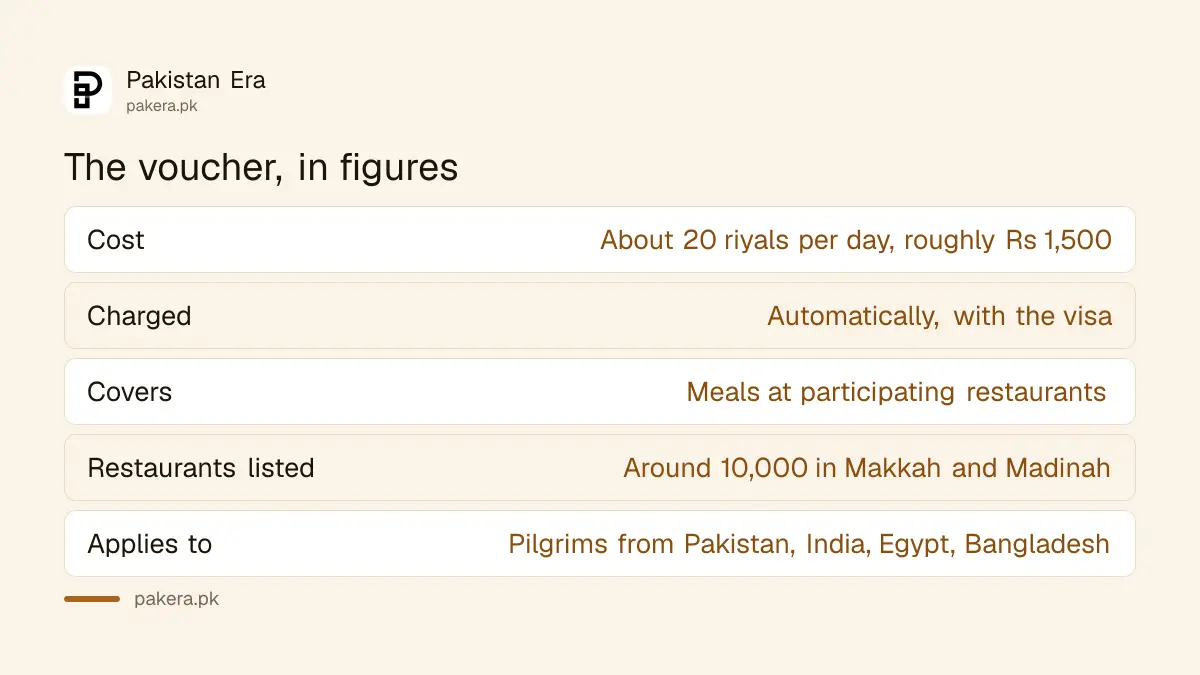
Umrah from Pakistan is getting a new line on the bill. Saudi Arabia is introducing mandatory food vouchers for pilgrims from Pakistan, India, Egypt and Bangladesh, at around 20 riyals per day, added automatically to the cost of the visa.
At the time of writing that is roughly Rs 1,500 a day. The change takes effect from 1 Rabi ul Awwal, which falls later this month subject to the moon sighting, and travel agents are already repricing packages around it.
What the voucher is
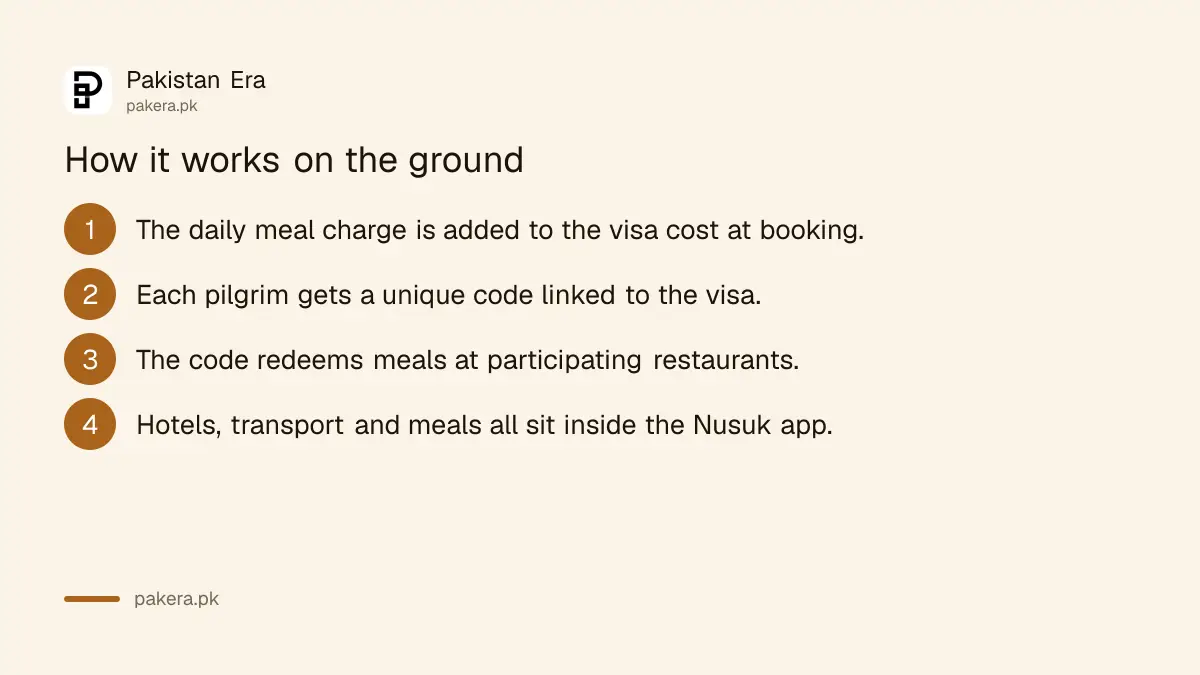
Each pilgrim receives a unique code linked to their visa. The code redeems meals at participating restaurants, of which around 10,000 are listed across Makkah and Madinah, and the whole arrangement sits inside the Nusuk app alongside hotel bookings and transport.
The stated reasons are standardising food service for pilgrims, improving quality, and squeezing out unregistered providers. That last one is the operative clause: this is as much a regulation of the informal food economy around the holy sites as it is a service for the pilgrim.
What it does to the cost of a trip
Our arithmetic on the stated figures, not an official quote:
| Trip | Voucher cost, about |
|---|---|
| 10 days, one pilgrim | 200 riyals, roughly Rs 15,000 |
| 14 days, one pilgrim | 280 riyals, roughly Rs 21,000 |
| 10 days, family of four | 800 riyals, roughly Rs 60,000 |
Two things to notice before deciding how to feel about it. First, this is not entirely new money: pilgrims already eat, and for those who would have eaten at mid range restaurants anyway, the voucher partly replaces spending rather than adding to it. Second, for the pilgrims it lands hardest on, the ones who travel on the thinnest budgets and eat from the informal stalls the scheme is designed to squeeze, it is genuinely additional cost, charged upfront, in the visa, with no opt out.
That is the honest tension in this policy and no amount of service language dissolves it.
What to do if you are booking now
- Ask the agent whether the quote includes the voucher. Packages priced before the change will be repriced, and the difference should be the voucher, not the voucher plus a margin on it.
- Count your days. The charge is per day, so trip length now has a direct meal cost attached at booking time rather than at the restaurant.
- Get Nusuk working before you fly. The code, the participating restaurants and the rest of the trip's services live in the app, and the departure lounge is a bad place to discover a login problem.
- Keep the visa-linked code private. It is redeemable value tied to your identity, which makes it exactly the kind of thing the scams we cover keep evolving toward.
If the pilgrimage you are planning is Hajj rather than Umrah, the structural news is separate and bigger: the new four year Hajj policy covers booking a year with ten per cent down. The visa side for either trip is in our Saudi visa guide, and the passport that has to be valid first is covered in passport tracking and the application guide.
Why these four countries
The scheme applies to pilgrims from Pakistan, India, Egypt and Bangladesh, and it is worth being unsentimental about why that list and not another. These are the four largest sources of budget pilgrims, the travellers most likely to eat outside the registered restaurant economy, and therefore the market the unregistered food providers actually serve. Regulating the vendors by regulating their customers' wallets is the design, and the country list tells you whose spending was being missed.
Whether the voucher rate buys a day's food in Makkah at current prices is the question pilgrims will answer with their feet, and the early trips after 1 Rabi ul Awwal will settle it. If 20 riyals covers less than a day of modest eating near the Haram, the voucher becomes a floor on spending rather than a substitute for it, and that is the number to watch in the first reviews.
The direction this is heading
Read this alongside the four year Hajj policy and a pattern is visible: the pilgrimage economy is being moved, piece by piece, onto registered rails, with the app as the enforcement layer. Vouchers instead of cash at stalls, registered operators instead of informal ones, everything reconciled against a visa.
For pilgrims that means more predictable service and less room to be cheated, and also less room to economise informally, which was never cheating. Expect more of the trip to become bundled and mandatory over time, because that is the direction every announcement in this series points.
Questions readers are asking
How much is the Umrah food voucher?
About 20 Saudi riyals per day, roughly Rs 1,500 at current rates, added automatically to the visa cost for pilgrims from Pakistan, India, Egypt and Bangladesh.
When does it start?
From 1 Rabi ul Awwal, which falls later this month subject to the moon sighting. Bookings made around the changeover should confirm with the agent which regime applies.
Can I opt out and eat where I like?
No. The charge is mandatory and collected with the visa. You can still eat anywhere, but the voucher money is spent whether you redeem it or not, which is the practical meaning of mandatory.
Where does the voucher work?
At participating restaurants, around 10,000 across Makkah and Madinah, redeemed with a unique code linked to your visa through the Nusuk app.
Does this apply to Hajj too?
This announcement covers Umrah pilgrims. Hajj packages already bundle meals differently, and the current Hajj changes are covered in our guide to the 2027 to 2030 policy.
Will Umrah packages get more expensive?
By roughly the voucher amount per day, yes, and agents are already repricing. The thing to check on any quote is that the increase matches the voucher rather than exceeding it.
About the author

Public Services and Education Journalist
Fajr Riaz is a journalist and content writer at Pakistan Era, based in Lahore. She covers the questions people meet in everyday life in Pakistan: how a public service works, what a change in the rules means, and where to find a reliable answer.