How to Reschedule an Overdue SME Loan in Pakistan: SBP's 10% Cash and Six Month Rule
SBP lets banks reschedule an overdue SME loan. Pay 10% in cash and keep the new terms six months, or pay 35% at once. See the steps and credit report effect.
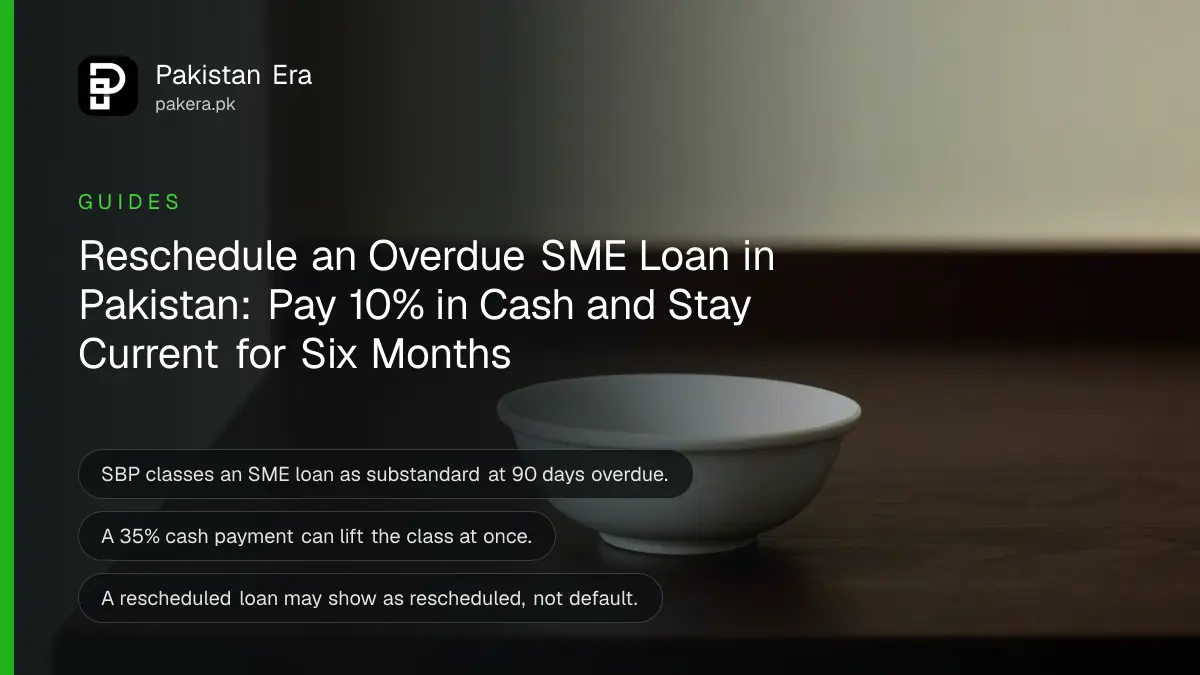
If your small business loan is overdue, SBP's SME rules let your bank reschedule or restructure it. The loan only comes out of the "classified" category after you pay at least 10% of what you owe in cash and keep the new terms for six months, or pay 35% in cash. Your credit report may show "rescheduled" instead of "default", and the bank may not use the rescheduling to refuse you fresh credit.
Late payments hit small shops and workshops in a few bad months, and the bank's letters do not explain what happens next. We read the State Bank of Pakistan's Prudential Regulations for SME Financing, updated on 16 July 2026, on 21 October 2026. Regulation R-18 covers rescheduling and Annexure I covers overdue loans. Everything below comes from that document unless we say otherwise.
An SME loan is classified after 90 days overdue, and income is frozen
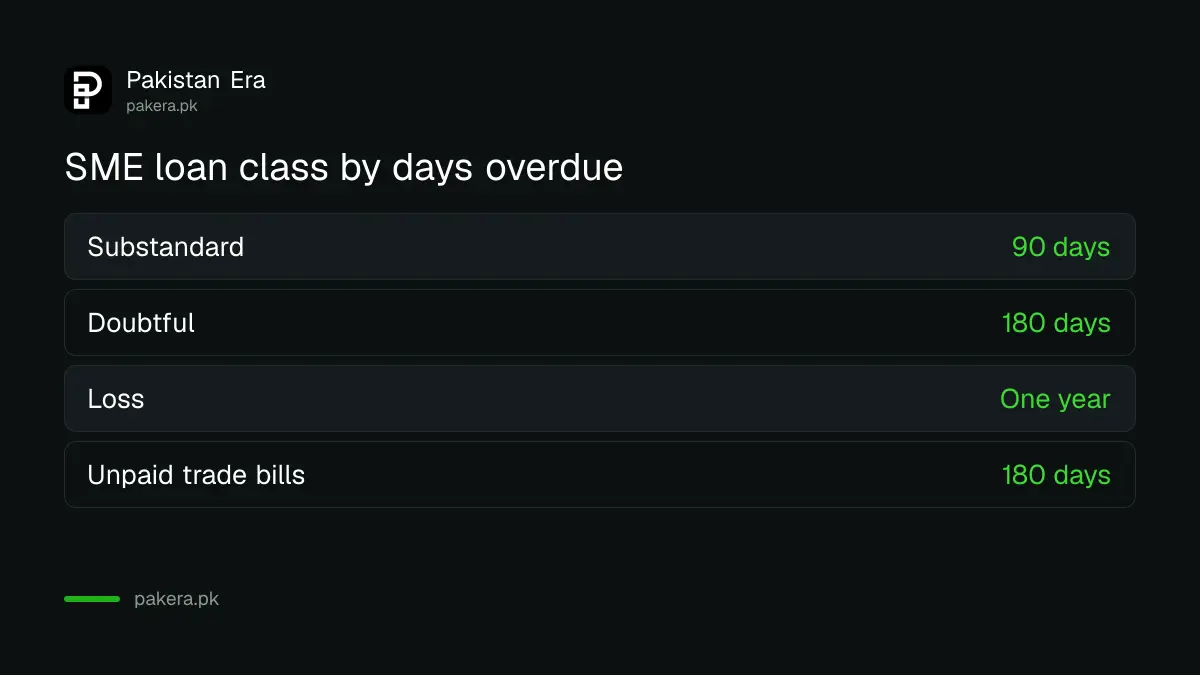
A bank must classify an SME loan as substandard once mark-up or principal is 90 days or more overdue, as doubtful at 180 days and as loss at one year. Unpaid mark-up then goes to a memorandum account instead of the bank's income.
This is a bank accounting step. It is not a court case, and the debt does not vanish at any stage. The bank also has to hold provisions against the loan, which gives it a reason to want a deal. Import or export trade bills that stay unpaid 180 days past the due date are classed as loss.
| Days overdue | Class | Provision rate on the unsecured part |
|---|---|---|
| 90 days or more | Substandard | 25% |
| 180 days or more | Doubtful | 50% |
| One year or more | Loss | 100% |
The provision applies to the balance left after the bank deducts liquid assets and a forced sale value of the collateral. That is the bank's internal arithmetic. For you, the useful part is the calendar: the earlier you talk to the bank, the more options you keep.
Rescheduling needs a bank policy, and it cannot be used only to hide an overdue loan
SBP lets a bank reschedule or restructure a problem SME loan under its own board-approved policy. The rule adds that rescheduling must not be done simply to avoid classification. The bank must also look at any working capital request on merit, based on whether your business is viable.
So the bank has to see a business that can pay, not just a borrower who is late. Bring numbers: a cash-flow sheet, recent bank statements and your sales for the last twelve months. The free SMEDA loan repayment calculators can help you build a realistic instalment before you walk in.
Ten percent cash and six months of on-time payment can lift the classification
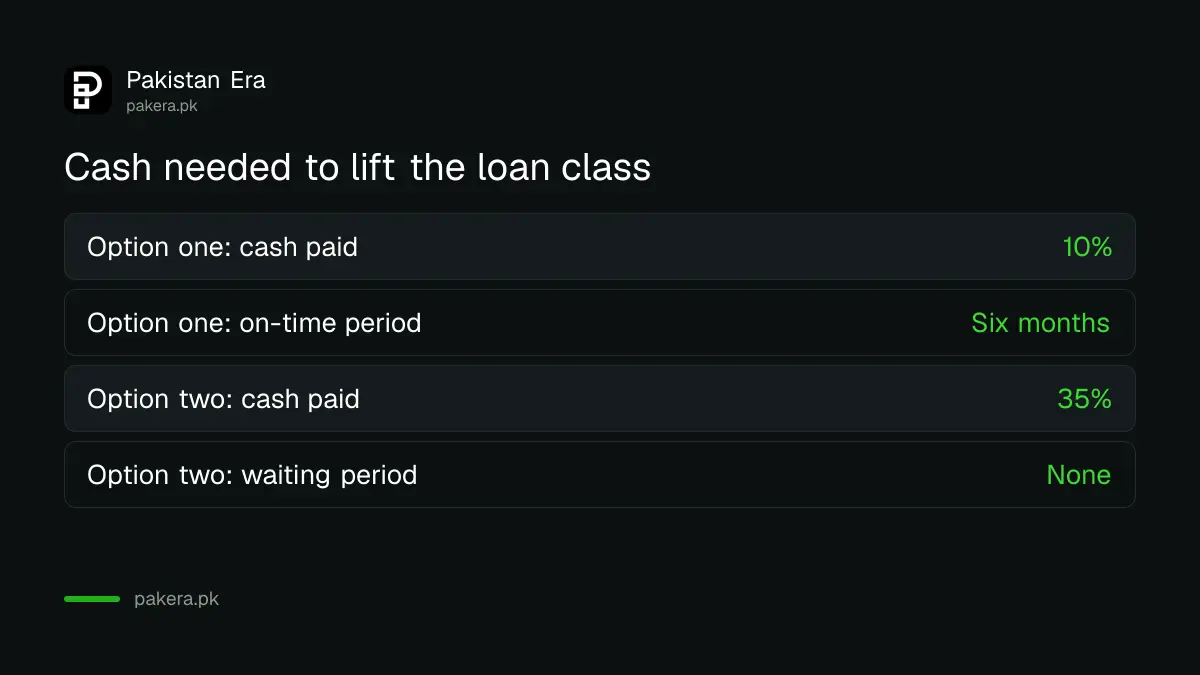
Under R-18, a rescheduled non-performing loan keeps its classified status unless at least 10% of the outstanding amount is recovered in cash and the new terms are met for at least six months, not counting any grace period. If 35% is paid in cash, the category can change at once.
Take an example with round numbers. If you owe Rs 4,000,000 in principal and mark-up, 10% is Rs 400,000 in cash. A 35% payment would be Rs 1,400,000. These sums are our arithmetic from SBP's percentages, not a bank offer. The 35% rule applies if you pay it when the agreement is signed or at any time before the six months end.
- Write to the branch and ask for rescheduling or restructuring, giving the reason for the delay.
- Ask for the bank's rescheduling policy and the exact cash payment it wants.
- Check the new instalment against your monthly sales before you sign.
- Pay the cash portion and keep the receipt.
- Pay every new instalment on time for six months.
Your credit report can show rescheduled instead of default
SBP says rescheduled or restructured loans may be reported to the credit bureau as "rescheduled/restructured" instead of "default". It also says rescheduling must not stop you from getting fresh credit or a higher limit, though the bank can watch any new loan separately.
That wording helps, but it does not force a bank to lend. Banks still check the credit report before any renewal or restructuring, and they can lend to a borrower with overdue history if they write the reason in the approval form. To see what your own record says, use the steps in the Tasdeeq and eCIB credit report check.
A second default puts the loan back in its old class
If you default again after the loan was declassified, SBP says the loan returns to the same category it held at the time of rescheduling. Mark-up the bank had already taken into income is reversed. The bank may also downgrade it further on its own judgement.
Treat the six months as a test, not a finish line. A single missed instalment after declassification can undo the whole arrangement, so set a standing instruction from your account on the due date.
Complain through Sunwai if the bank stalls or ignores you
The SME rules require every bank to run an SME helpline and a digital complaint system with tracking, and to follow SBP's complaint framework, including the Sunwai portal. If the branch does not reply, file a complaint and keep the number.
The route is in the Sunwai complaint portal steps. If the bank harasses you with visits, the rules on recovery agent conduct apply too. For the wider limits on SME loans, the SME loan guide lists how banks set them.
Common questions
Does rescheduling remove my default from the credit report?
No rule says it removes history. SBP says the loan may be shown as rescheduled or restructured instead of default, which is a different label from a plain default.
Can the bank refuse to reschedule?
Yes. SBP says banks "may" reschedule under their own policy. It does not give a borrower a right to demand it, so make a written request and keep the reply.
What counts as restructuring versus rescheduling?
SBP's SME rules use both words together. In practice, rescheduling moves dates and restructuring changes terms. The SME document does not define them separately, so ask the bank which one it is offering.
Is the 35% rule on principal only?
No. SBP's text says 35% of the outstanding loan amount, which for SMEs means principal plus mark-up. Ask the bank to show the figure it uses.
When does the 90 days start counting?
It counts from the due date of the overdue mark-up or principal, not from the date the bank sent a notice.
How we verified this
What we checked, where we read it, and what we could not confirm.
We read SBP's Prudential Regulations for SME Financing (updated 16 July 2026) and SBP's circular on the SME definition (SH&SFD Circular No. 03 of 2026) on sbp.org.pk on 21 October 2026. We did not read any bank's own rescheduling policy, so the cash amount and approval time at your bank may differ. We could not confirm how long a credit bureau keeps a "rescheduled" label. The document's footnote about digital application forms carries an unclear date, so we did not rely on it.
About the author

Public Services and Education Journalist
Fajr Riaz is a journalist and content writer at Pakistan Era, based in Lahore. She covers the questions people meet in everyday life in Pakistan: how a public service works, what a change in the rules means, and where to find a reliable answer.