Saudi Arabia Working Hours and Overtime Pay: 9 Hours a Day, Plus 50%, for Pakistani Workers
Saudi Labor Law caps work at 9 hours a day and 45 a week, with 7 hours in Ramadan. See the break, rest day and overtime rules and how to check your own pay.
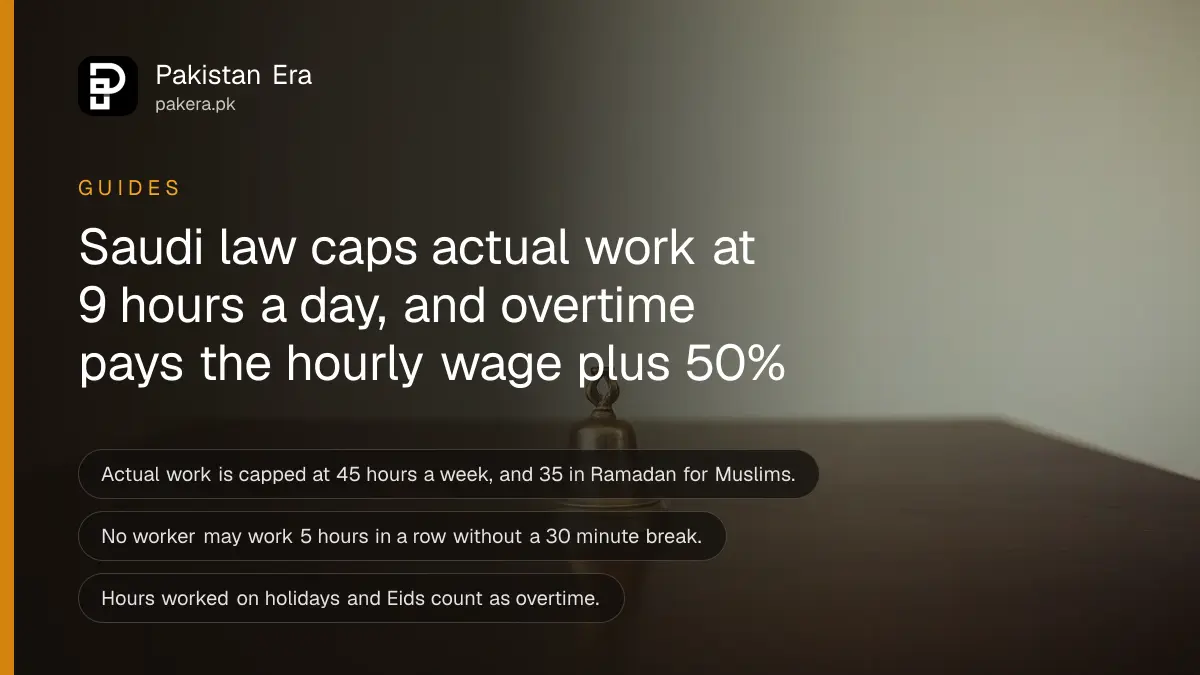
Short answer: The Saudi Labor Law text on the HRSD website limits actual work to 9 hours a day or 45 hours a week, and to 7 hours a day or 35 hours a week for Muslims in Ramadan. Overtime is paid at the hourly wage plus 50% of the basic wage. Hours worked on holidays and Eids count as overtime.
A Pakistani worker in a Saudi company often hears "everyone does 12 hours here." Sometimes that is the contract. Sometimes it is just habit. We read Articles 98 to 108 of the Labor Law on the website of the Ministry of Human Resources and Social Development (HRSD) to see what the limits actually are.
A warning on the text. The English file on HRSD's site is the 2005 version, Royal Decree M/51. The law was reported to be amended in February 2025, and we could not open an official amended text. Figures below are from the text we read. Check your contract and Qiwa record before you rely on a number.
Actual work is capped at 9 hours a day or 45 hours a week
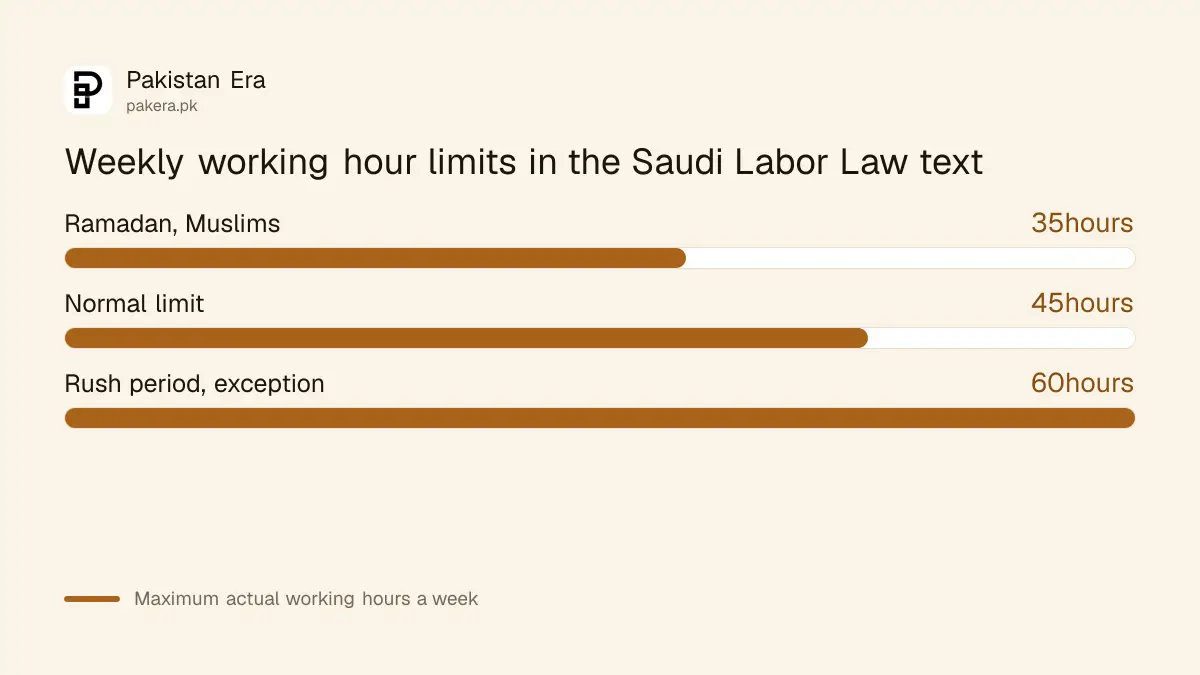
Article 98 says a worker may not actually work more than nine hours a day if the employer counts by the day, or more than 45 hours a week if the employer counts by the week. In Ramadan, Muslims work at most seven hours a day or 35 hours a week.
The word "actually" matters. Breaks for rest, prayer and meals are not counted as work, as Article 102 explains. So a nine hour working day can mean ten or more hours between arriving and leaving.
| Rule | Daily limit | Weekly limit | Article |
|---|---|---|---|
| Normal limit | 9 hours | 45 hours | 98 |
| Muslims in Ramadan | 7 hours | 35 hours | 98 |
| Some jobs, work not continuous | Up to 10 hours | Set by Minister | 99 |
| Hazardous or harmful jobs | Down to 8 hours | Set by Minister | 99 |
| Rush periods, exceptions | 10 hours at most | 60 hours at most | 106 |
Breaks are fixed: no more than 5 hours without 30 minutes
Article 101 says no worker may work more than five consecutive hours without a break of at least thirty minutes. The breaks are for rest, prayer and meals. The worker may not stay at the workplace for more than 12 hours a day.
Article 102 adds that break time is not working time and the worker is not under the employer's authority during it. The employer cannot require you to stay at your post in that period. Article 103 allows the Minister to name jobs that run without breaks for technical reasons. Even then, breaks are scheduled inside working hours.
If your shift is 6 am to 6 pm with no break, ask what the written schedule says. The 12 hour presence limit is the one most easily checked.
Overtime is the hourly wage plus 50% of the basic wage
Article 107 says the employer shall pay for overtime an additional amount equal to the hourly wage plus 50% of the worker's basic wage. If the firm uses weekly hours, hours above the weekly limit are overtime. All hours worked on holidays and Eids are overtime.
Read that sentence closely. The law adds an amount equal to the hourly wage, plus 50% of the basic wage. The text does not give a rate per hour in rupees or riyals. The exact hourly figure depends on how the Regulations calculate the hourly wage, and we did not read that part.
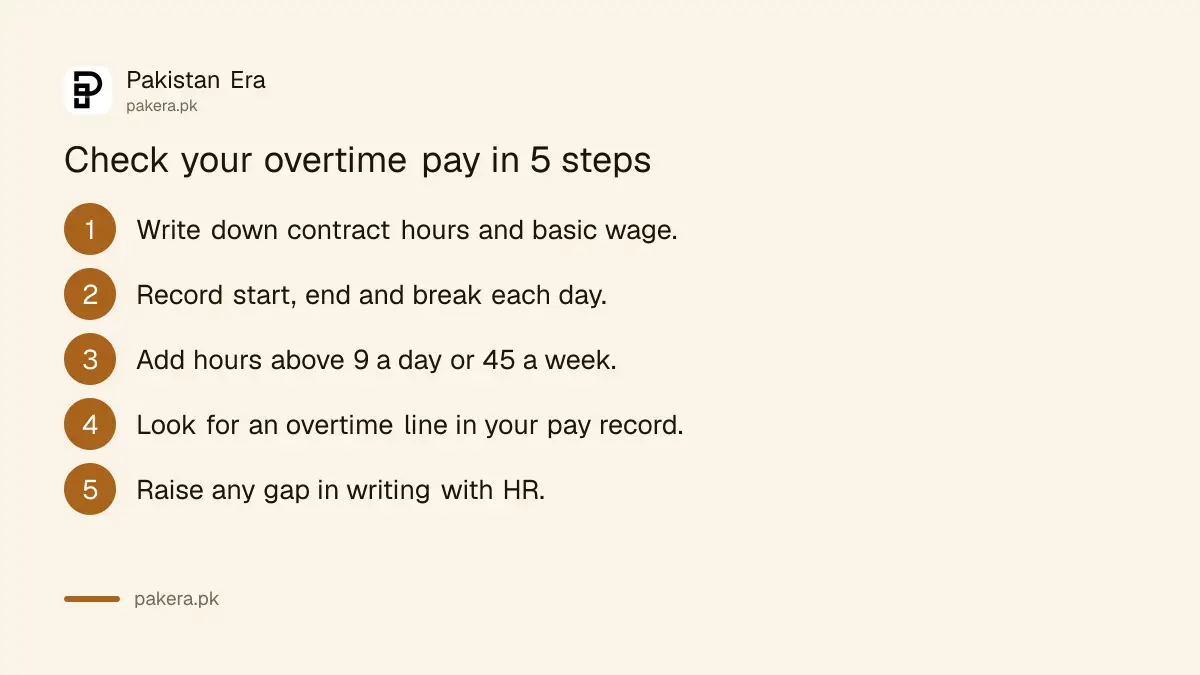
So the safe habit is to record your own hours. Note the date, start time, end time and the break. Do it in a notebook or your phone.
- Write down your contract hours and your basic wage.
- Record each day's start, end and break times for one month.
- Add up the hours above nine a day or 45 a week.
- Check that your payslip or bank deposit shows an overtime line.
- If it does not, raise it in writing with your HR department.
Workers get two rest days a week, one of them Friday
In the text we read, Article 104 gives a worker two rest days a week with full pay, one of which is Friday. An employer may substitute another day for Friday for some workers after notifying the labour office, and must allow religious duties.
Article 105 allows consolidated rest in remote areas or continuous operations, up to eight weeks, with the Ministry's approval and the workers' agreement. Article 106 lets an employer go past the limits for inventory, closing accounts, accident prevention or unusual pressure. Even then, work may not exceed 10 hours a day or 60 hours a week.
Article 108 removes the daily limit for a few groups. These are senior managers with authority over workers, preparatory or supplementary work, work that is intermittent by nature, and guards and janitors, excluding civil security guards. The Regulations define the exact jobs.
Keep your own record and raise it in the right order
If the hours or pay do not match, start with your employer in writing, then the labour office, and then your embassy's community welfare section. Our guide to Pakistan embassy contacts in Saudi Arabia lists the numbers we verified.
For rules at home, we also explain overtime and working hours in Pakistan. They differ from the Saudi rules, so do not mix them. If a dispute ends in a dismissal, read what notice and compensation a Saudi employer owes.
Common questions
How many hours can a Saudi employer make me work in a day?
No more than nine actual hours a day or 45 hours a week under Article 98. Special jobs may be set at 10 hours, and rush periods may reach 10 hours a day or 60 a week.
What are the Ramadan working hours?
For Muslims, the limit is seven hours a day or 35 hours a week in Ramadan. Article 98 sets this limit, and it applies to actual working hours.
How is Saudi overtime calculated?
The employer pays the hourly wage plus 50% of the basic wage for each overtime hour, under Article 107. The Regulations set how the hourly wage is worked out.
Is work on Eid or a holiday overtime?
Yes. Article 107 says all working hours performed during holidays and Eids are deemed overtime hours, paid at the overtime rate.
Do I have to stay at work during my break?
No. Article 102 says break periods are not working hours and the employer shall not require the worker to remain at the workplace during them.
Did the 2025 amendments change these hours?
Reports say the Labor Law was amended in February 2025. We could not open an official amended text, so confirm hours and rest days against your contract and HRSD before acting.
How we verified this
What we checked, where we read it, and what we could not confirm.
Checked on 11 October 2026. We read Articles 98 to 108 of the Saudi Labor Law English text on the HRSD website (hrsd.gov.sa, file dated February 2023, Royal Decree M/51 of 2005). We did not read the implementing Regulations or an amended text. Your own contract may give better terms.
About the author

Global Affairs & Political Economy Writer
Muhammad Hatim is a book lover who started writing because he enjoys it. At Pakistan Era he writes about international relations, geopolitics and the global economy, with a particular interest in South Asia and the forces behind current events.