Pakistan's Broad Money Fell 4.82% From July to September 2026 as Government Borrowing From Banks Dropped
Pakistan's M2 money supply fell 4.82% from July to 25 September 2026, the SBP says, as the government cut bank borrowing by Rs 2,995 billion. See the figures.
Short answer: Pakistan's broad money supply (M2) fell by Rs 2,241.7 billion, or 4.82 per cent, between 1 July and 25 September 2026, the State Bank of Pakistan (SBP) says. A year earlier it fell 3.87 per cent. The main driver was the government's net repayment to the banking system, which came to Rs 2,994.7 billion.
M2 is the broadest everyday count of rupees in the economy. It adds cash in people's hands to what sits in bank accounts. A fall sounds alarming, but last year showed a dip in the same weeks too. This year's dip is bigger, and the SBP's weekly table shows where it came from.
M2 fell 4.82 per cent in the first twelve weeks of FY27
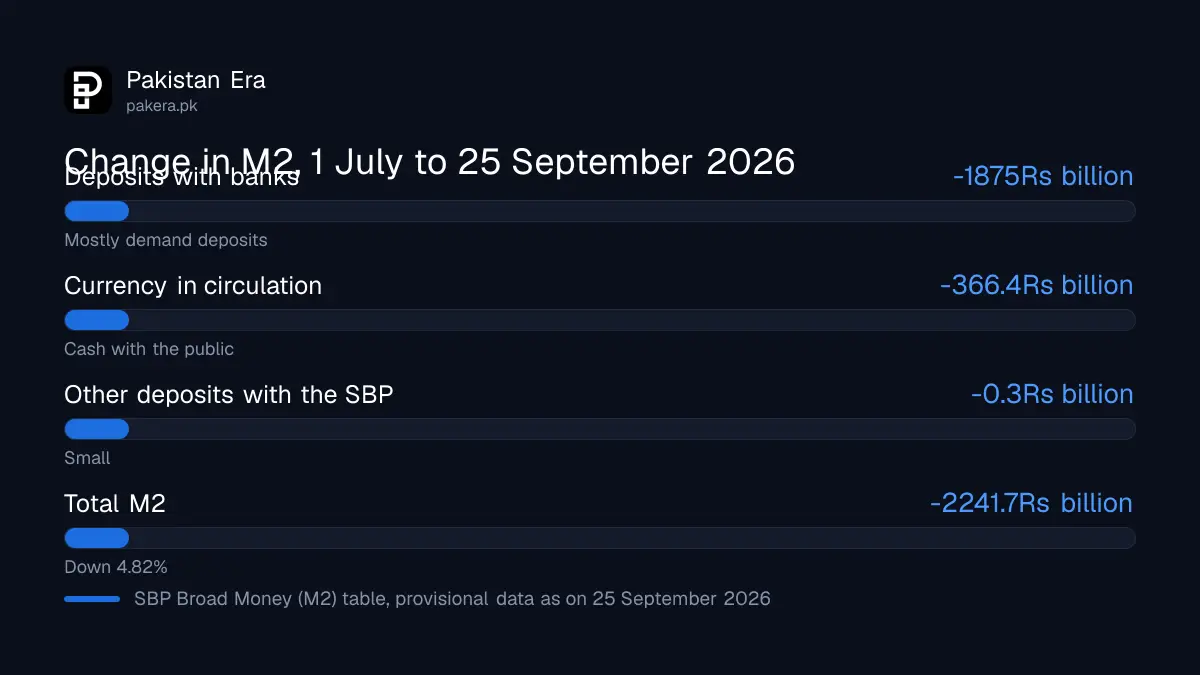
M2 stood at Rs 46,460.1 billion at the end of June 2026. By 25 September it had fallen by Rs 2,241.7 billion. Currency in circulation fell Rs 366.4 billion and deposits with banks fell Rs 1,875.0 billion. Demand deposits, the money in current and ordinary accounts, did most of the falling.
| Component | 1 July to 26 Sep 2025 (Rs billion) | 1 July to 25 Sep 2026 (Rs billion) |
|---|---|---|
| Currency in circulation | -87.7 | -366.4 |
| Deposits with banks | -1,466.8 | -1,875.0 |
| Other deposits with the SBP | -13.6 | -0.3 |
| Broad money (M2) | -1,568.1 | -2,241.7 |
The Finance Division's own September update gave a similar picture earlier, with a 5.3 per cent fall to 11 September. Our summary of that update has the wider context.
For scale, M2 grew 14.70 per cent in the whole of FY26, adding Rs 5,953.8 billion. So the twelve weeks of FY27 have already given back about two fifths of that gain, by our arithmetic. The SBP prints the same table every week, so you can watch whether the fall deepens or reverses.
Net government borrowing from the banking system fell Rs 2,994.7 billion
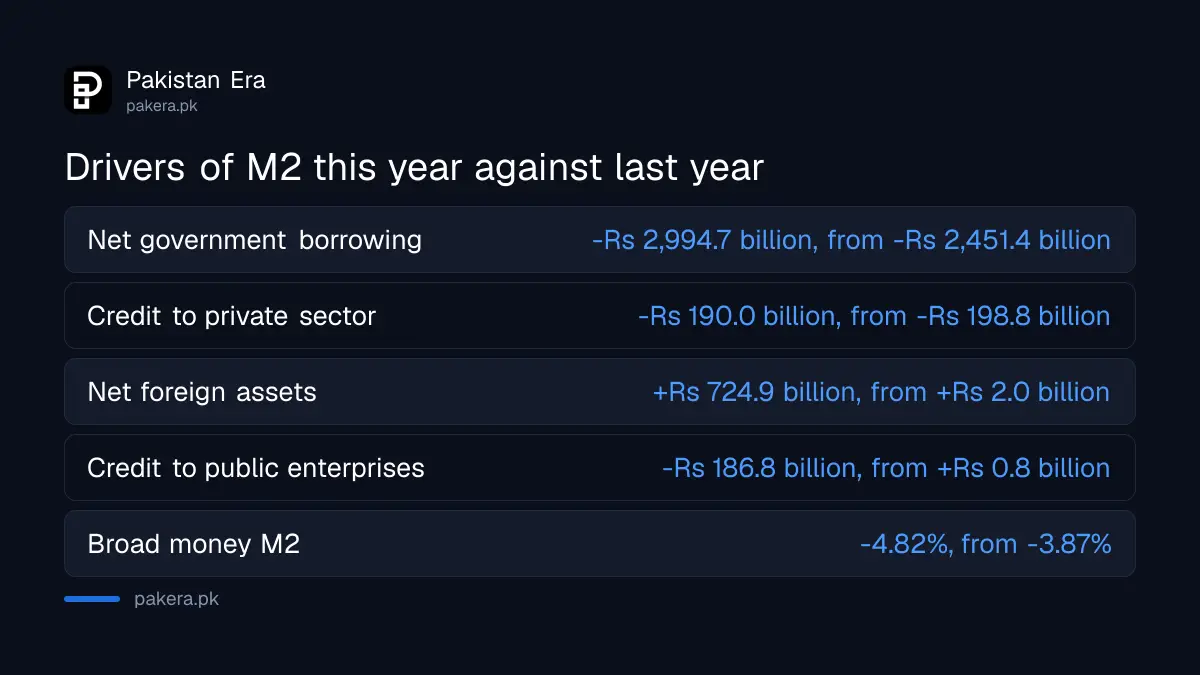
The largest single change in the SBP's table is on the government side. Net borrowing by the government sector from the banking system fell Rs 2,994.7 billion. Of that, Rs 2,902.5 billion was less borrowing from scheduled banks and Rs 62.2 billion from the SBP. A year earlier the fall was Rs 2,451.4 billion.
The SBP counts government borrowing net of government deposits. So a fall means the government repaid debt, built up deposits, or both. Government deposits are not part of M2, so money that moves into them leaves the money supply. The table does not give a reason. Our note on central government debt in August shows domestic debt fell Rs 684 billion over June and August.
Private sector credit fell Rs 190.0 billion, slightly less than last year
Credit to the private sector fell Rs 190.0 billion in the same period, against a fall of Rs 198.8 billion a year earlier. Conventional banking branches saw a fall of Rs 121.7 billion and Islamic banks Rs 130.3 billion, while Islamic banking branches of conventional banks added Rs 62.0 billion.
The stock of private sector credit was Rs 11,412.0 billion at the end of June, and it grew Rs 1,463.3 billion in FY26. The Finance Division ties the fall to seasonal repayment of working capital and commodity loans. If you borrow, the question that matters to you is the price of money, which our guide to how the policy rate changes your loan instalment explains.
Foreign assets rose Rs 724.9 billion while credit to public enterprises fell
The banking system's net foreign assets rose Rs 724.9 billion, against only Rs 2.0 billion a year earlier. The SBP's own foreign assets rose Rs 1,123.5 billion, while commercial banks' fell Rs 398.6 billion. Credit to public sector enterprises fell Rs 186.8 billion, compared with a rise of Rs 0.8 billion a year earlier.
- Net foreign assets: up Rs 724.9 billion.
- Net government sector borrowing: down Rs 2,994.7 billion.
- Credit to private sector: down Rs 190.0 billion.
- Credit to public sector enterprises: down Rs 186.8 billion.
- Credit to non-bank financial institutions: up Rs 118.8 billion.
A falling M2 is not a forecast for prices or rates
One quarter of weekly data does not predict inflation, interest rates or the exchange rate. The SBP's table also warns that the figures are provisional and based on weekly returns of scheduled banks. The Monetary Policy Committee has the next word, and our report on its September hold shows how it weighed the risks.

Common questions
What is M2 in Pakistan?
It is currency in circulation plus other deposits with the SBP and deposits with banks, so it counts the rupees held by the public and businesses.
How much did M2 fall in 2026-27 so far?
It fell Rs 2,241.7 billion, or 4.82 per cent, from 1 July to 25 September 2026.
Is a fall in M2 bad?
Not by itself. The same weeks last year also showed a fall, and the SBP's table does not call this one a problem.
Why did government borrowing from banks fall?
The table shows it fell Rs 2,994.7 billion but does not give a reason, so we do not guess one.
Where do I find the table?
On the SBP website under Economic Data, as "Broad Money (M2)". It is updated every week.
How we verified this
What we checked, where we read it, and what we could not confirm.
Last checked on 11 October 2026. We read the State Bank of Pakistan's "Broad Money (M2)" table, provisional data on monetary aggregates as on 25 September 2026, listed on its Economic Data page as updated weekly on 5 October 2026. The 5.3 per cent fall to 11 September comes from the Finance Division's Monthly Economic Update for September 2026. Conversions to billions and differences between years are our arithmetic.
About the author

Global Affairs & Political Economy Writer
Muhammad Hatim is a book lover who started writing because he enjoys it. At Pakistan Era he writes about international relations, geopolitics and the global economy, with a particular interest in South Asia and the forces behind current events.