Shanaka 97 and Liyanage 61 Not Out Finish Sri Lanka's 430 Chase Against England in Rawalpindi
Dasun Shanaka hit 97 off 50 with eight sixes and Janith Liyanage 61 not out off 27 as Sri Lanka chased 430 at Rawalpindi on 22 October 2026. See the finish.
Short answer: Dasun Shanaka hit 97 off 50 balls with eight sixes, and Janith Liyanage made 61 not out off 27 balls, as Sri Lanka chased 430 against England at Rawalpindi on 22 October 2026. Liyanage hit a six off the penultimate ball to finish with one ball left.
Sri Lanka won by 2 wickets on 430 for 8 in 49.5 overs. The hundred from Pavan Rathnayake set the base, as our page on Rathnayake's 130 explains. This page covers the part after the third wicket, when the target was still large. The figures come from the International Cricket Council (ICC) match story and a full match report read on 22 October. The Pakistan Cricket Board (PCB) scorecard would not load.
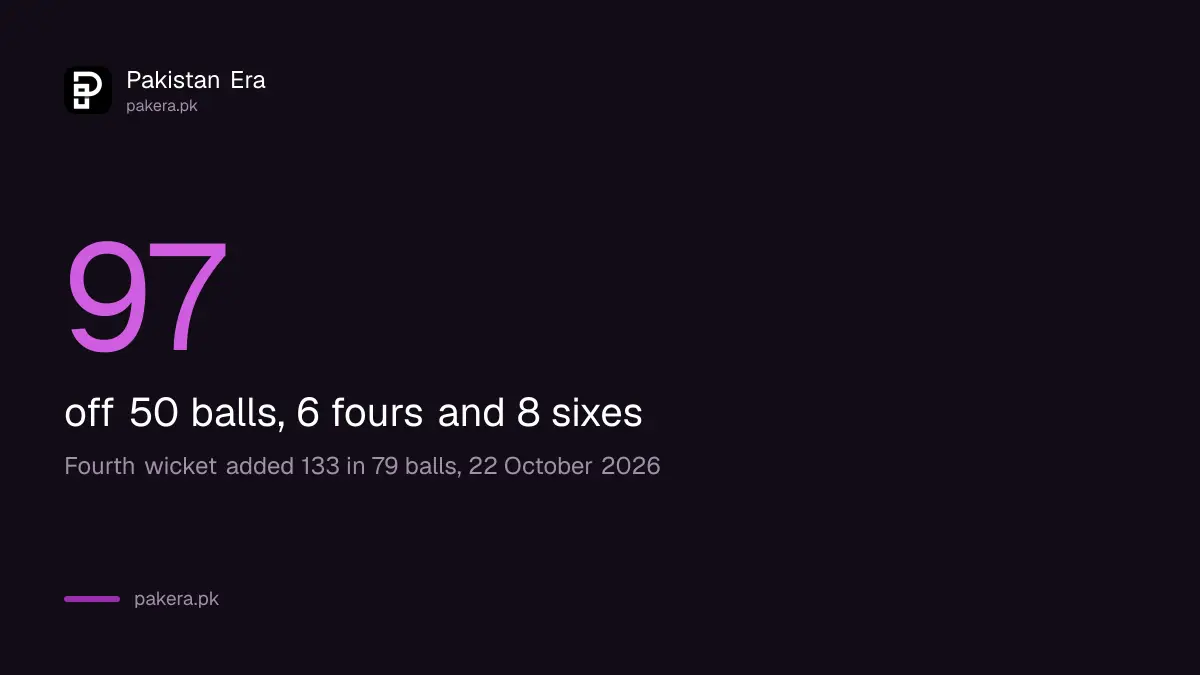
Shanaka scored 97 off 50 balls with 8 sixes
Shanaka made 97 off 50 balls with six fours and eight sixes. That is 14 boundaries, worth 72 runs, plus 25 from other shots. His strike rate was 194. He missed a hundred by three runs, just as Avishka Fernando did earlier.
| Batter | Runs | Balls | Fours | Sixes |
|---|---|---|---|---|
| Dasun Shanaka | 97 | 50 | 6 | 8 |
| Janith Liyanage | 61 not out | 27 | 7 | 3 |
The boundary runs are our arithmetic: six fours are 24, eight sixes are 48, and together they are 72. For Liyanage, seven fours are 28 and three sixes are 18, which is 46.
The fourth wicket added 133 in 79 balls
The fourth wicket put on 133 in 79 balls, a rate of about 10.1 an over by our sum. Shanaka scored most of those runs. The stand moved Sri Lanka from a hard chase to one that was close, and it came when England had seemed in control.
Before it, Rathnayake and Avishka Fernando had added 166 for the third wicket. England's bowlers had few places to go after that.
Liyanage made 61 not out off 27 balls
Liyanage scored 61 not out off 27 balls with seven fours and three sixes, a strike rate of 225.9. He was at the crease at the end. A match report says he hit a six off the penultimate ball to win it.
Sri Lanka finished on 430 for 8 in 49.5 overs. Winning on the fifth ball of the last over is what "one ball to spare" means here. England's Josh Tongue took 3 for 79, and Sam Curran took 2 for 103 in 9 overs.
Reports differ on the very last overs
One report says Tongue bowled two batters in successive balls late in the chase, but the ICC story and the match report we read do not say that. We have left out ball-by-ball detail and only used what both sources agree on.
Another report gave Liyanage's score as 55 not out in one line and 61 not out in the scorecard. We use 61, which the scorecard and the match report both give. The official PCB scorecard would settle both points.
Why the last ball mattered
Sri Lanka won with one ball left, so the margin was thin. If Liyanage had missed the six off the penultimate ball, the match would have gone to the last ball with a few runs needed. Chases at this level are often decided by a single shot.
For England the loss is hard to take. They scored 429 for 4, more than they have scored in the series so far, and still lost. Their captain will have to explain why the bowlers could not defend a total of that size. We have no quote, so we do not offer one.
What it means for the next match
Sri Lanka move to 2 points. They face Pakistan on 27 October in Lahore. Our page on the table after 22 October has all three teams, and the Sri Lanka final scenarios list each result.
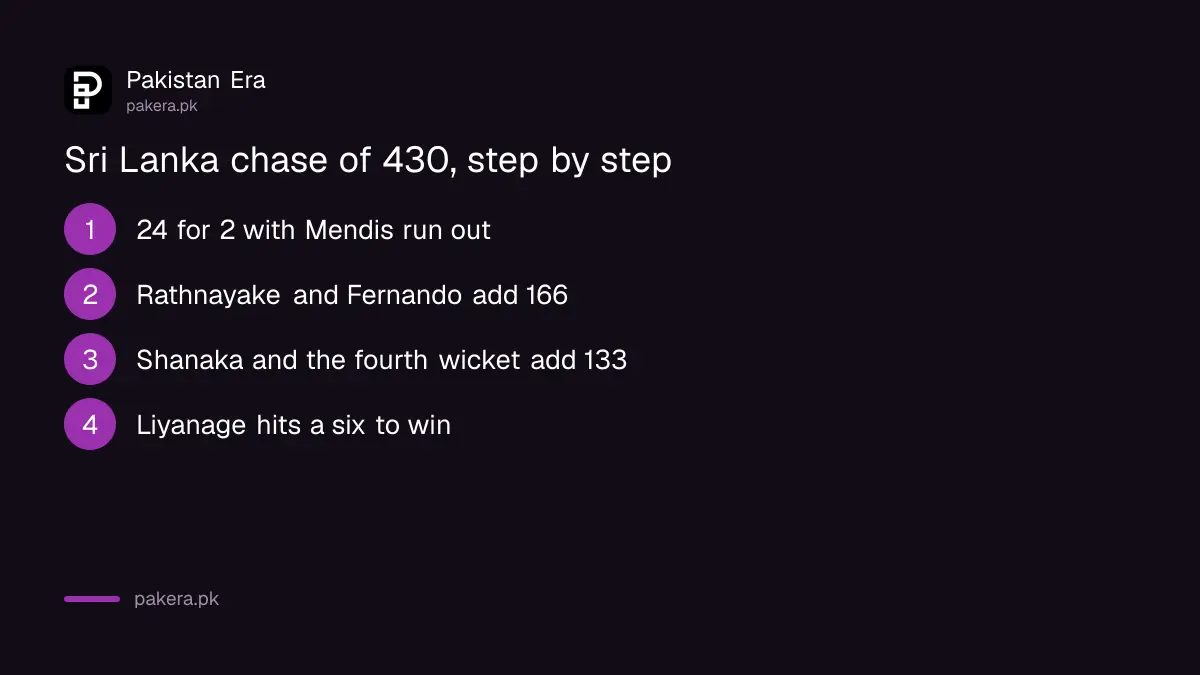
- Rathnayake and Fernando add 166.
- Shanaka scores 97 off 50 with the fourth wicket adding 133.
- Liyanage scores 61 not out off 27.
- Sri Lanka win with one ball left.
How to read a finishing innings
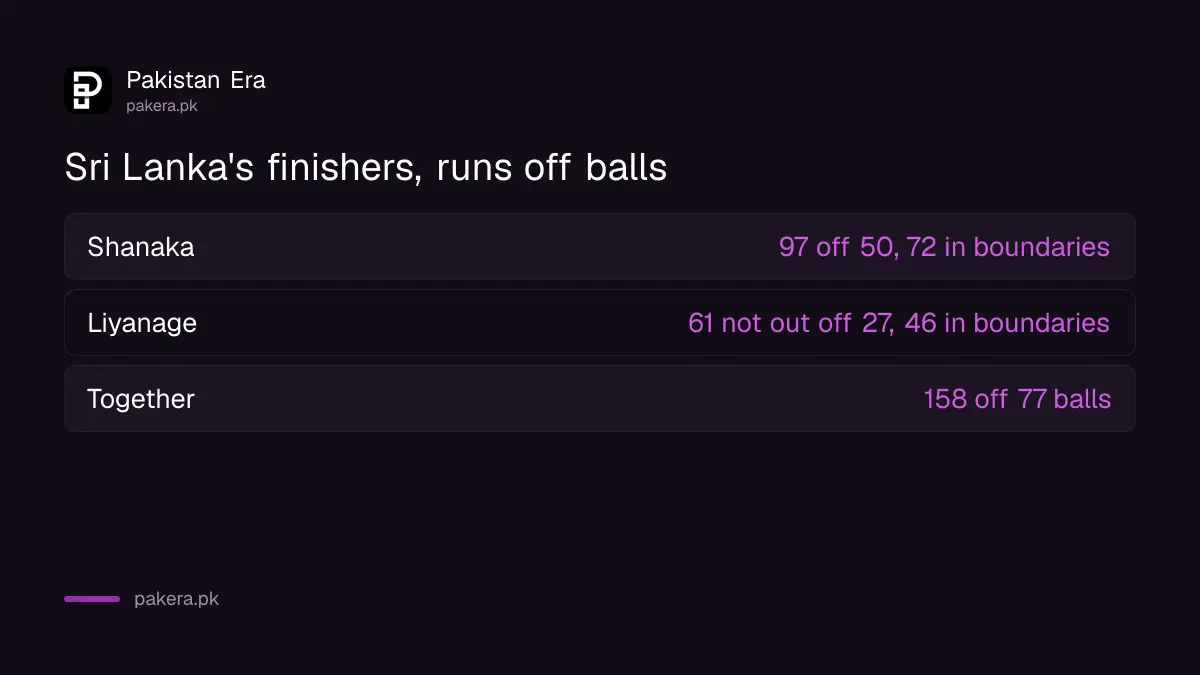
Shanaka and Liyanage together scored 158 runs off 77 balls, by our sum of 97 plus 61 and 50 plus 27. That is more than two runs a ball. In a chase of 430, this is what turns a hard target into a possible one.
The strike rates were 194 for Shanaka and 225.9 for Liyanage, so each ball they faced was worth about two runs. Boundaries did most of the work: 72 of Shanaka's 97 and 46 of Liyanage's 61 came in fours and sixes.
The lesson for readers is to look at balls as well as runs. A 97 off 50 balls and a 97 off 83 balls are not the same innings. The slower one, by Avishka Fernando, built the platform. The faster one used it.
England's bowlers also paid a price. Sam Curran's nine overs went for 103, a rate of 11.4 an over by our sum. When a bowler is hit at that rate, a captain has to find overs elsewhere, and that can leave the last overs short of options.
Common questions
How many sixes did Shanaka hit?
Eight, in 97 off 50 balls, as reported.
Who hit the winning runs?
Janith Liyanage, with a six off the penultimate ball, as reported.
What was Liyanage's score?
61 not out off 27 balls.
How big was the fourth wicket stand?
133 in 79 balls, as reported.
How many overs did Sri Lanka take?
49.5 overs, with one ball to spare.
Where are the remaining matches?
In Lahore. See the tri-series schedule.
How we verified this
What we checked, where we read it, and what we could not confirm.
On 22 October 2026 we read the ICC match story and a published match report. We could not open the PCB scorecard on pcb.com.pk. Boundary runs, strike rates and the stand rate are our own arithmetic from reported figures.
About the author

Tax, Bills and Technology Writer
Ali Akhtar is a young and curious voice here at Pakistan Era. He is currently pursuing his A-Levels and has a growing interest in Pakistan’s changing industrial landscape and educational trends. Ali likes to write in a way that helps him explain and explore the world around him. His writing reflects the perspective of the new generation navigating the evolving trends of Pakistan where technology, youth innovation, and shifting opportunities are reshaping the country’s future.