Sindh Agriculture University Tandojam Admission 2027: Apply by 30 October, Entry Test 8 November
Sindh Agriculture University Tandojam closes applications on 30 October 2026, test 8 November. See every programme, the 50% rule, the Rs 3,000 fee and steps.
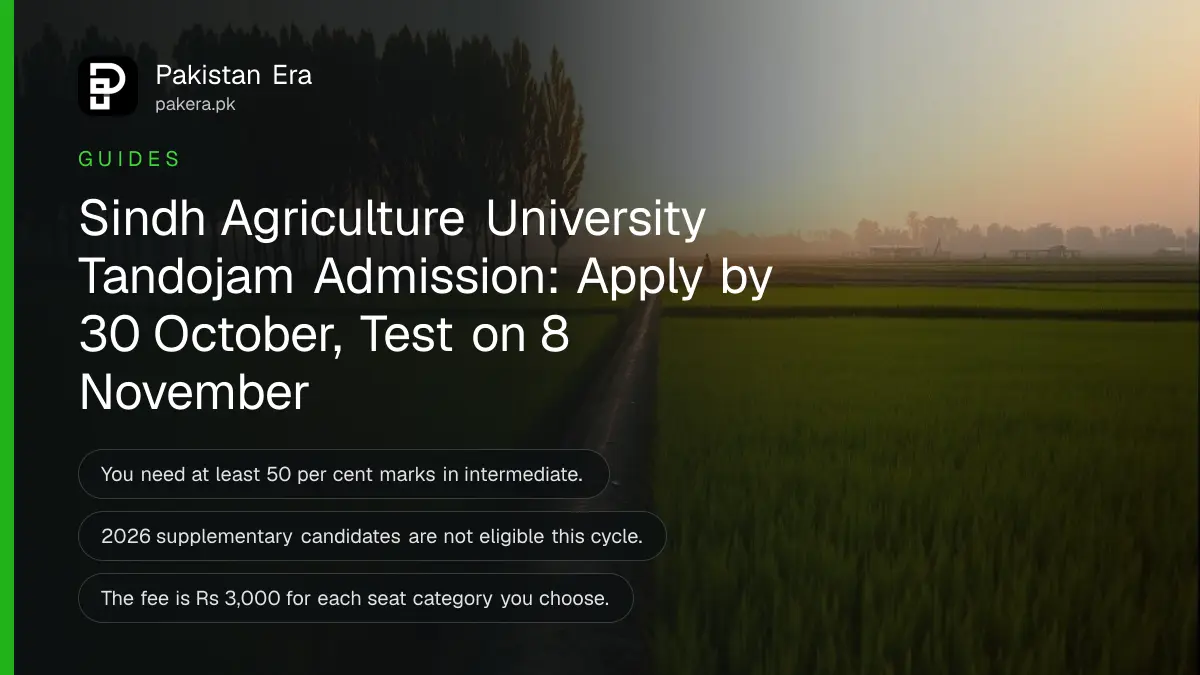
Sindh Agriculture University (SAU), Tandojam, closes online applications for its undergraduate programmes on 30 October 2026, and the pre-admission entry test is on 8 November 2026 at Hyderabad and Sukkur. You apply at applyonline.sau.edu.pk and pay a Rs 3,000 non-refundable processing fee for each seat category you choose, through an HBL challan.
That leaves less than a week. Below is every programme on offer, the 50 per cent eligibility rule and the supplementary-exam catch that rules some students out, how to pay, and what to do on test day. We read SAU's admissions page and its official advertisement on 24 October 2026.
Apply by 30 October 2026, the entry test is on 8 November
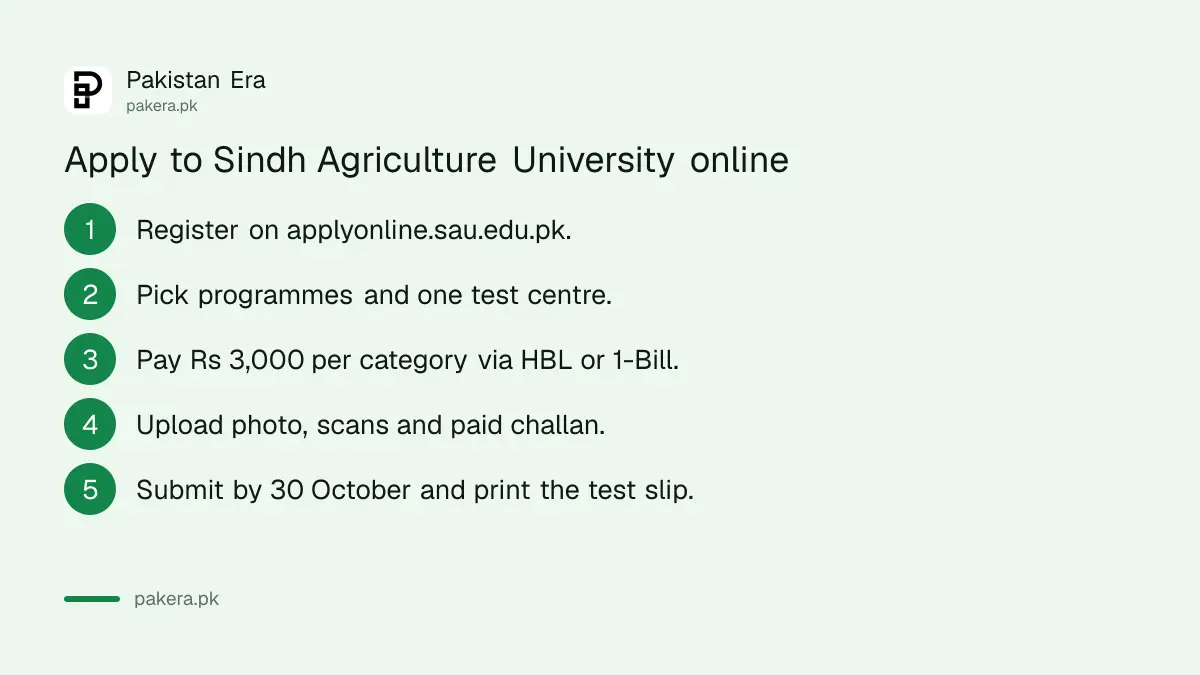
SAU's admissions page lists three dates: applications started on 15 September 2026, the last date to apply is 30 October 2026, and the pre-admission entry test is on 8 November 2026. The advertisement names Hyderabad and Sukkur as the two test venues.
The advertisement calls this intake "Academic Session 2027", while the admissions page heading says "Academic Year 2026-27". They describe the same intake, whose classes run into 2027. Do not wait for a separate 2027 notice; this is it.
You choose one test centre when you apply, and the advertisement says no one will be allowed to sit the test anywhere other than their selected centre.
You need 50 per cent in intermediate, and supplementary 2026 does not count
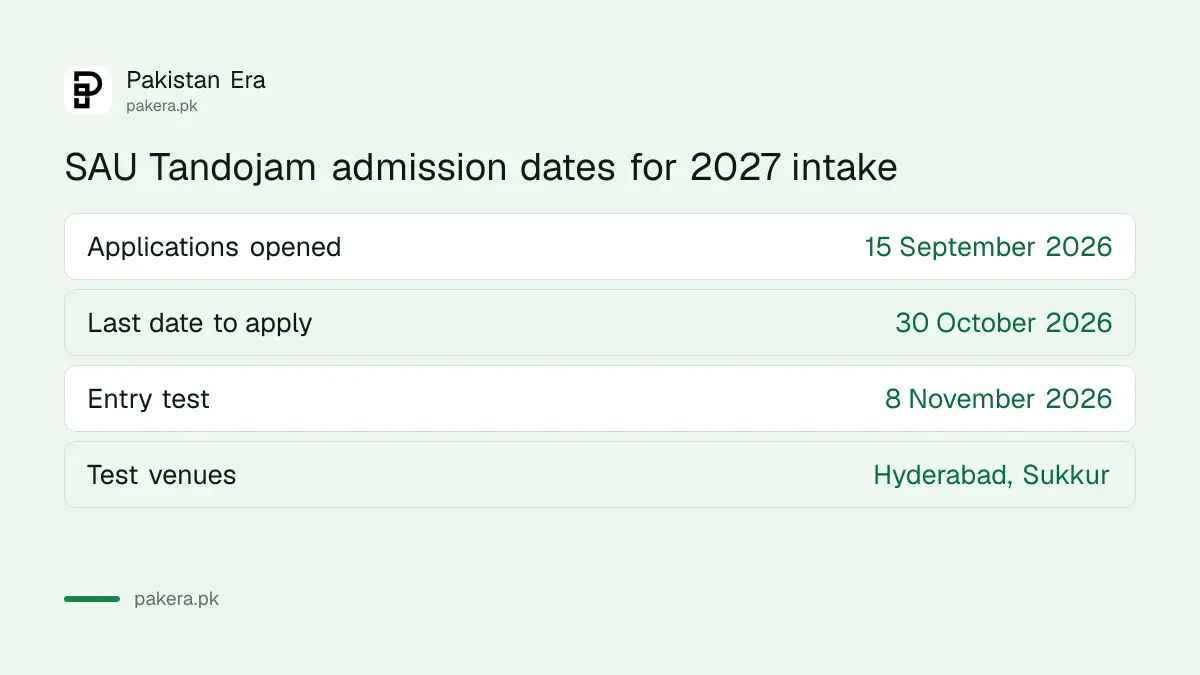
The minimum is intermediate, or an equivalent, with at least 50 per cent marks in the annual examination of 2026 or earlier, back to 2024. Candidates who are appearing in or passed the 2026 supplementary exam are not eligible, but those who passed supplementary exams in 2025 or 2024 are considered.
That supplementary rule is the one that catches people. If you failed a paper in 2026 and cleared it in the supplementary round, SAU's advertisement says you cannot apply this cycle.
| Programme group | Qualification accepted | Minimum marks | Passing years accepted |
|---|---|---|---|
| Most undergraduate programmes | Intermediate in pre-medical, pre-engineering, pre-computer or general science, commerce, arts or FA/FSc, or equivalent | 50% | Annual 2026 or earlier, up to 2024 |
| BS Fisheries and Aquaculture, BS Dairy Technology, BS Environmental Science, BS Agro-Industrial Engineering and Technology | Intermediate in any of those groups, or a Diploma of Associate Engineering | 50% | Annual 2026 or earlier, up to 2022 |
| BS Computing programmes | HSSC pre-medical, pre-engineering, pre-computer or general science, ICS or commerce, or A level of 12 years, or IBCC equivalent | 50% | Annual 2026 or earlier, up to 2024 |
Candidates from outside Sindh apply against reserved seats through their nominating agency where such seats exist. A direct application from another province is considered under the self-finance scheme. If your qualification is O and A level or foreign, get the IBCC equivalence certificate before you apply, because the 50 per cent rule is applied to the equivalent marks.
SAU offers DVM, B.Sc (Agri) Hons, engineering, food science and computing
The main campus at Tandojam offers Doctor of Veterinary Medicine (five years, ten semesters) and four-year programmes across agriculture, engineering, food science and IT. The Khairpur College of Agriculture and Management Sciences offers five more programmes. Umerkot campus admissions will be advertised separately.
- Animal Husbandry and Veterinary Sciences: DVM; BS Dairy Technology; BS Poultry Sciences; BS Fisheries and Aquaculture.
- Crop Production, Crop Protection and Agricultural Social Sciences: B.Sc. (Agri) Hons in each faculty; BS English Language and Literature.
- Agricultural Engineering and Technology: B.E. (Agri); BS Environmental Science; BS Agro-Industrial Engineering and Technology.
- Institute of Food Science and Technology: B.Sc. Food Science and Technology; B.Sc. Human Nutrition and Dietetics.
- Information Technology Centre: BS Information Technology; BS Computer Science; BS Software Engineering.
- Khairpur College of Agriculture and Management Sciences: B.E. (Agri); B.Sc. (Agri) Hons; B.Sc. (Hons) Food Science and Technology; BS Software Engineering; BS English (Language and Literature).
The advertisement also says seats are reserved for religious minorities and for persons with disabilities.
Pay Rs 3,000 per category through an HBL challan or 1-Bill
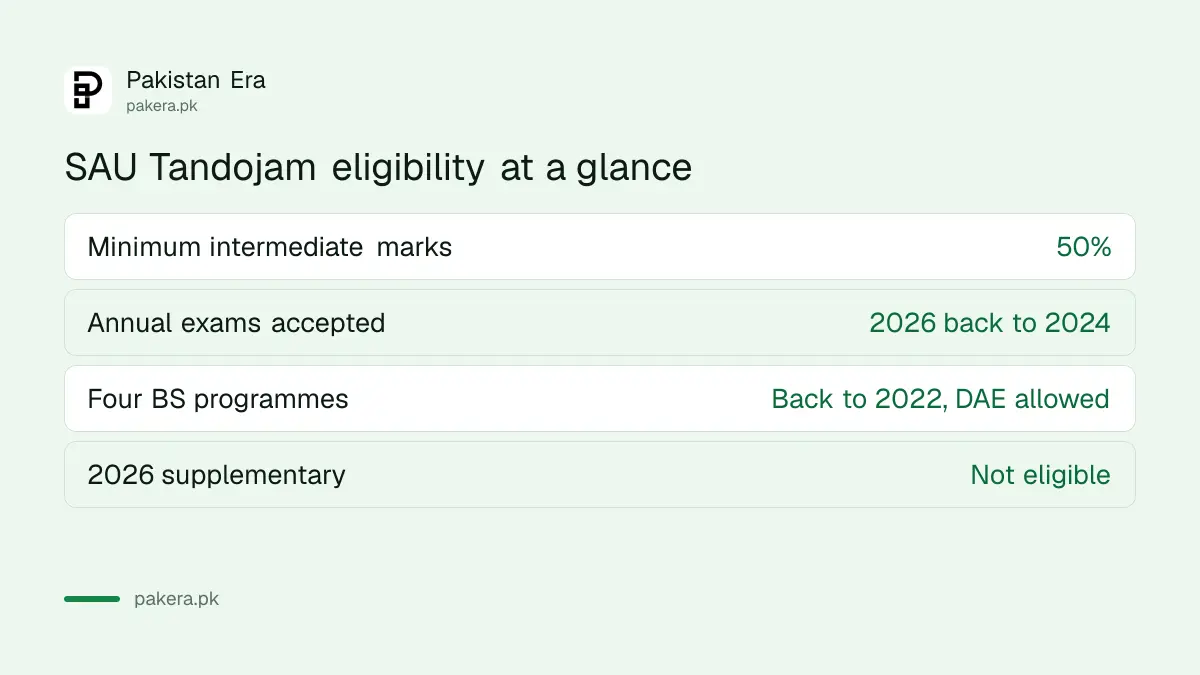
The advertisement says each selected seat, category or quota needs a separate non-refundable fee of Rs 3,000. You pay it through the challan generated against SAU's Habib Bank Limited account, at any HBL branch, or through 1-Bill on banking apps, JazzCash, Easypaisa, other mobile wallets and ATMs.
The advertisement also says no other payment method is accepted, and names fund transfers and credit or debit cards as examples. A direct bank transfer to the account number is not the same as paying the challan, so use the 1-Bill or challan route only.
- Register on applyonline.sau.edu.pk with a valid CNIC, email address, mobile number and WhatsApp number.
- Fill every field marked with an asterisk and choose your programmes and one test centre.
- Generate the challan and pay Rs 3,000 for each seat category, at HBL or through 1-Bill.
- Upload a passport-size photo with a white background, colour scans of your documents at 100 dpi, and the paid challan or payment receipt.
- Review the form and submit it before 30 October 2026.
- Download the entry test slip from your student account when it is issued and bring it, with your CNIC or B-Form, on 8 November.
Passing the entry test does not guarantee a seat
SAU's admissions page says appearing in or passing the pre-admission test does not guarantee eligibility for admission. Eligibility is decided after the university checks your documents, and seats then go by merit across the district-wise and category-wise lists.
The admissions page also lists interview schedules and a provisional merit list. The merit list linked there is labelled 2025-26, so treat those items as last year's until SAU posts new ones for this intake. The test slip is sent by email and SMS to eligible candidates, so keep the mobile number you registered active.
Applying to more than one Sindh university this season is sensible. The Sindh University merit list for 2027 starts on 10 November, and the SALU Khairpur first merit list is already out with a 5 November fee deadline.
Common questions
What is the last date to apply to Sindh Agriculture University Tandojam?
30 October 2026, according to SAU's admissions page and advertisement.
When is the SAU Tandojam entry test?
8 November 2026, at Hyderabad and Sukkur. You choose one of the two when you apply.
What is the SAU application fee?
Rs 3,000, non-refundable, for each seat, category or quota you select, paid through an HBL challan or 1-Bill.
Can I apply to SAU with 2026 supplementary marks?
No. The advertisement says candidates of the 2026 supplementary exam are not eligible. Supplementary passes from 2025 and 2024 are considered.
What marks do I need for SAU admission?
At least 50 per cent in intermediate or an equivalent qualification, in the annual exam of 2026 or earlier within the accepted years.
How do I contact SAU admissions?
The advertisement lists office phone 022-3405184, WhatsApp 0315-2892017 and the email directoradmissionsup@sau.edu.pk.
How we verified this
What we checked, where we read it, and what we could not confirm.
We read SAU's admissions page and downloaded the official Admissions Open advertisement it links, on 24 October 2026. The advertisement is an image, which we read directly. Neither gives the number of seats per programme, the tuition fee, or the result date of the entry test. The seat and fee breakup links on the admissions page did not open a document when we tried them.
About the author

Public Services and Education Journalist
Fajr Riaz is a journalist and content writer at Pakistan Era, based in Lahore. She covers the questions people meet in everyday life in Pakistan: how a public service works, what a change in the rules means, and where to find a reliable answer.