How to Register a Food Product With the Sindh Food Authority: FPRC and Label Certificate Steps
Register a packaged food product with the Sindh Food Authority: site licence first, eight documents, a fee at Sindh Bank, then the FPRC and label certificate.
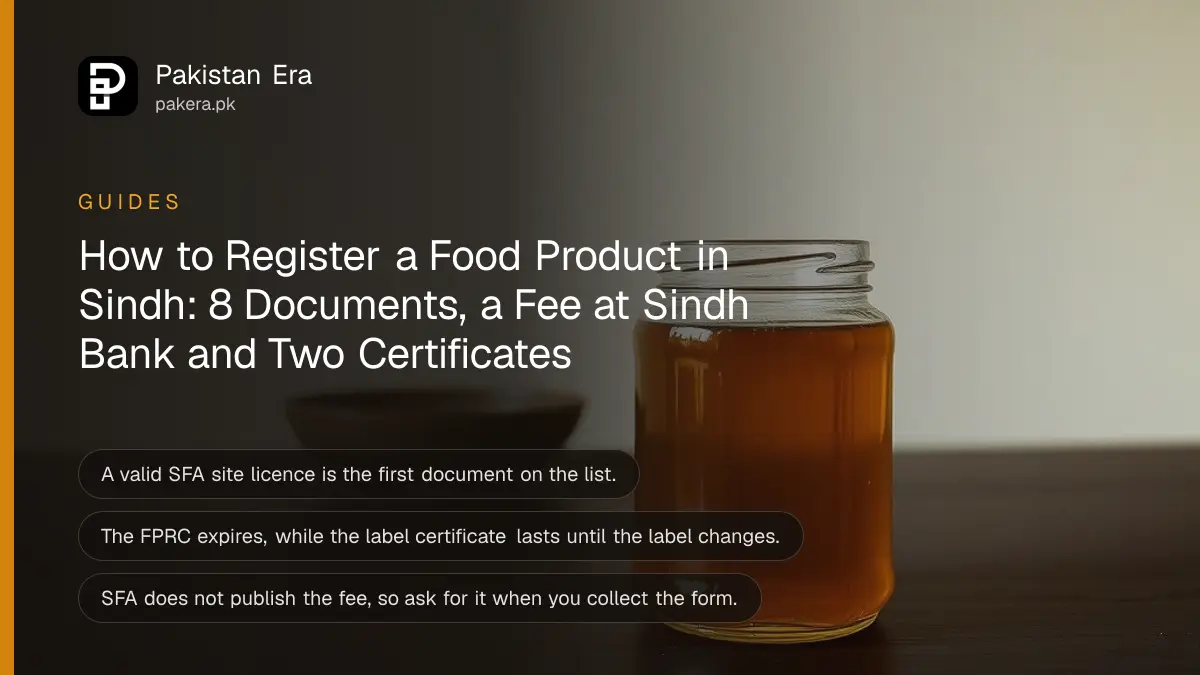
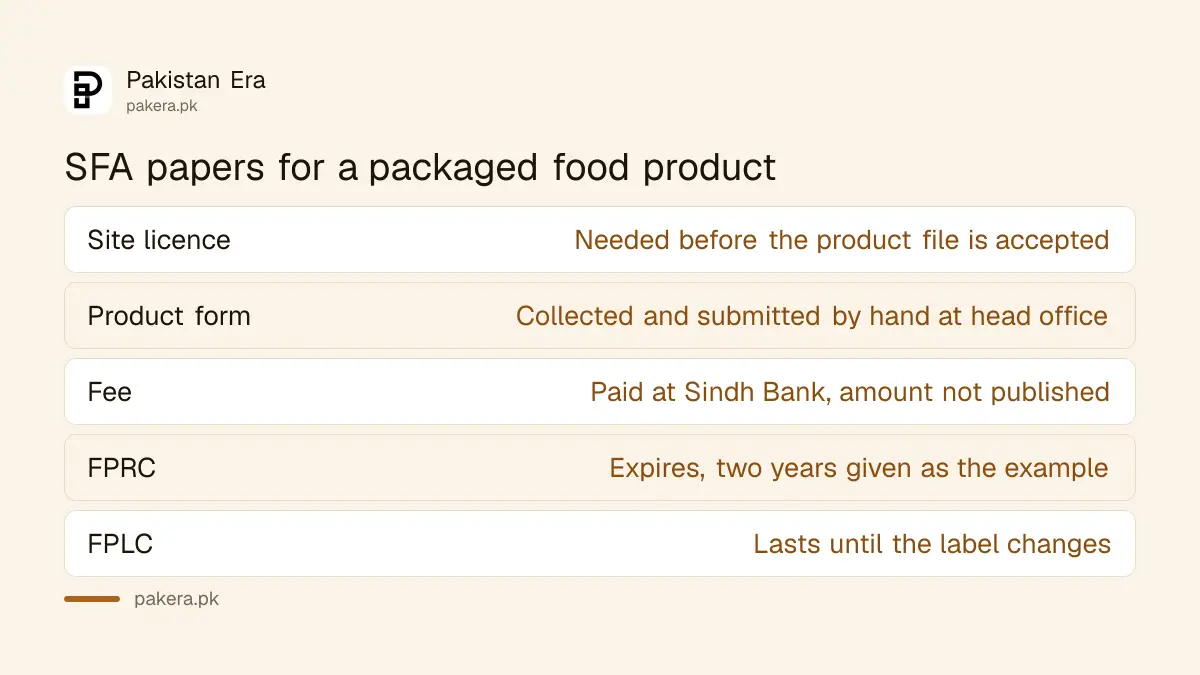
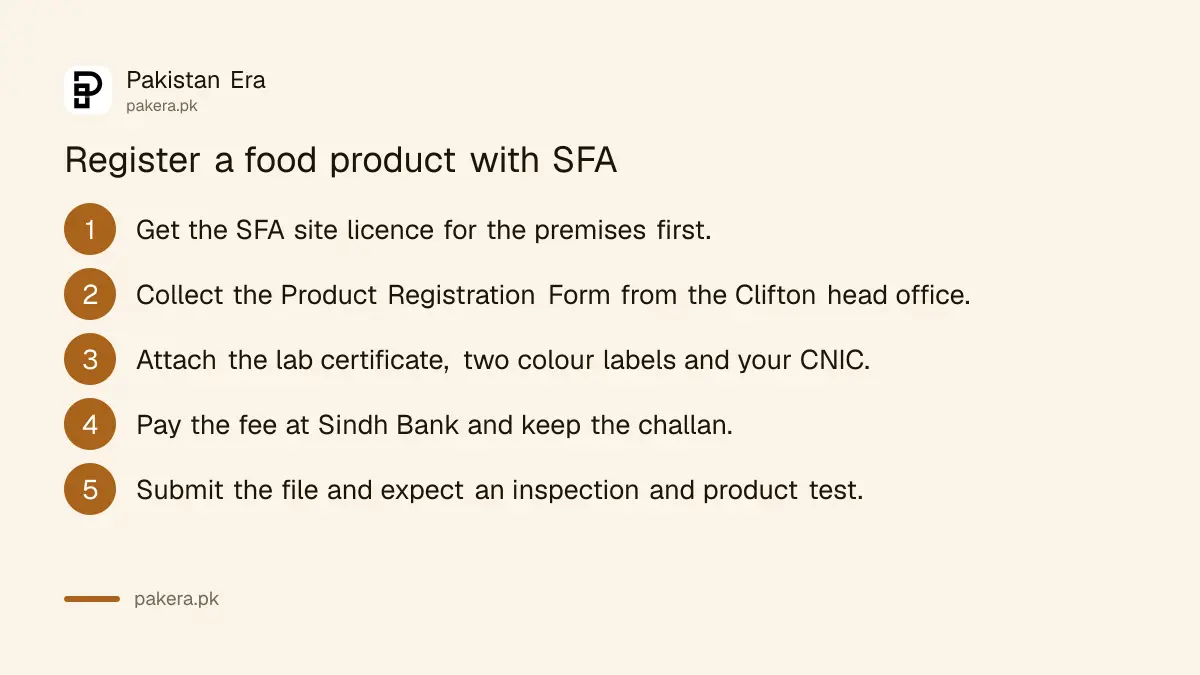
To register a packaged food product in Sindh, you need a valid Sindh Food Authority (SFA) site licence first, then a Product Registration Form from the Product Registration Wing at the head office in Clifton, a lab certificate of analysis, two colour copies of the label, and a fee paid at Sindh Bank. SFA issues two papers: a Food Product Registration Certificate (FPRC), which expires and must be renewed, and a Food Product Labelling Certificate (FPLC), which lasts until the label changes.
We read the SFA product registration page and its two process documents on 19 October 2026. The fee amount is not published anywhere on the site, and the step sheet says the processing time may vary. Both are said plainly below rather than guessed. The business licence that comes first is a separate application, covered in the guide on how to get a Sindh Food Authority licence.
Registration needs a valid SFA site licence first
The first document on SFA's list is a valid site licence issued by SFA. That is the food business licence for the premises where the product is made or packed. Without it, the Product Registration Wing will not take the file. So a new manufacturer applies for the business licence, waits for it, and only then starts product registration.
SFA's process chart says its registration team will contact or visit food businesses and guide them on product registration. In practice that means an inspector may raise it during a routine licence visit. Do not wait for that. A product on the shelf without registration can be confiscated, and SFA's FAQ says unsafe products may be seized along with fines and closure for operating without a licence.
SFA lists eight documents for the file
The step sheet names eight documents, three of them conditional. The certificate of analysis has to come from a pre-qualified laboratory, which means a lab SFA accepts, not any private lab. Ask the Product Registration Wing for the current list when you collect the form.
| Document | Required | Note |
|---|---|---|
| Valid site licence issued by SFA | Always | The business licence for the premises |
| CNIC of the representative or contact person | Always | Copy |
| Sample labels or artwork | Always | Two colour copies |
| Certificate of analysis of the product | Always | From a pre-qualified laboratory |
| Fee payment receipt | Always | Sindh Bank challan copy |
| PSQCA licence or registration certificate | If available | Federal standards body |
| Halal certification | If applicable | Meat, gelatine and similar products |
| Proof of trade mark registration | If applicable | For a branded product |
The PSQCA paper is listed as optional, but for the products the federal body licenses compulsorily, such as cooking oil, ghee, bottled water and packaged milk, you will need it anyway. Which products those are is in the guide on how to check a PSQCA licence. Halal certification for a food business is a separate process, set out in the guide on how to apply for halal certification.
The ten steps from form to certificate
SFA's step-by-step sheet runs from collecting the form to renewal. The form is filled in by hand, and the file is submitted in person at the head office. There is no online product registration portal, while the business licence page does carry an online application link.
- Collect the Product Registration Form from the Product Registration Wing at SFA head office, D-66, Block 2, Clifton, Karachi. Make sure it is the latest version.
- Fill in the form by hand with the product formula, label and other details asked for.
- Attach the documents in the table above.
- Deposit the registration fee at a designated Sindh Bank branch and keep the challan copy.
- Submit the form, documents and fee receipt at the SFA office.
- Expect an inspection of the manufacturing facility against good manufacturing practice, if SFA requires one.
- Wait while SFA reviews the file. It may ask for more information or samples.
- Expect product testing. SFA says test results are shared with the applicant.
- Collect the Food Product Registration Certificate and the Food Product Labelling Certificate if approved.
- Apply for renewal before the FPRC expires, following the same procedure.
The FPRC runs for a set period, the label certificate for life
SFA's sheet says the FPRC will be valid for a specified period, and gives two years as its example. It does not say that every certificate gets two years, so read the date printed on yours. The FPLC is issued for the product's lifetime and stays valid until the labelling changes. A new flavour, a new pack size with different label text, or a reworded ingredient list means a fresh label approval.
The label application follows a parallel track inside SFA. The labelling team checks the file, the Technical Wing examines the label against Sindh food law, and the Director of the Labelling Wing puts it to the Director General for approval. The approval comes as a letter. Keep both papers with the business licence, because inspectors ask for all three.
What SFA does not publish: the fee and the processing time
The product registration page, the step sheet and the FAQ give no rupee figure for the registration fee. The sheet says only to deposit it at a designated Sindh Bank. The FAQ, which covers business licences rather than products, says the exact fee can be checked on the site or at the office, and the site does not carry it. Ask for the fee when you collect the form and get it in writing on the challan.
Processing time is also open. The step sheet says the time frame may vary, and the FAQ's two to four weeks applies to business licences, not products. Lab testing and a facility inspection sit inside the product timeline, so a product with a clean certificate of analysis and a recently inspected plant will move faster than one that needs both.
How the file moves inside SFA
SFA's process chart shows nine stages. The registration team guides the business, the business applies on the prescribed form, the Product Registration Wing scrutinises the documents, samples go to a lab for testing and scientific analysis, the lab reports and documents go to the Technical Wing for verification, the Technical Wing forwards the case to the Director FPR, the Director puts it to the Director General for approval or rejection, and on approval the product is registered and a certificate issued.
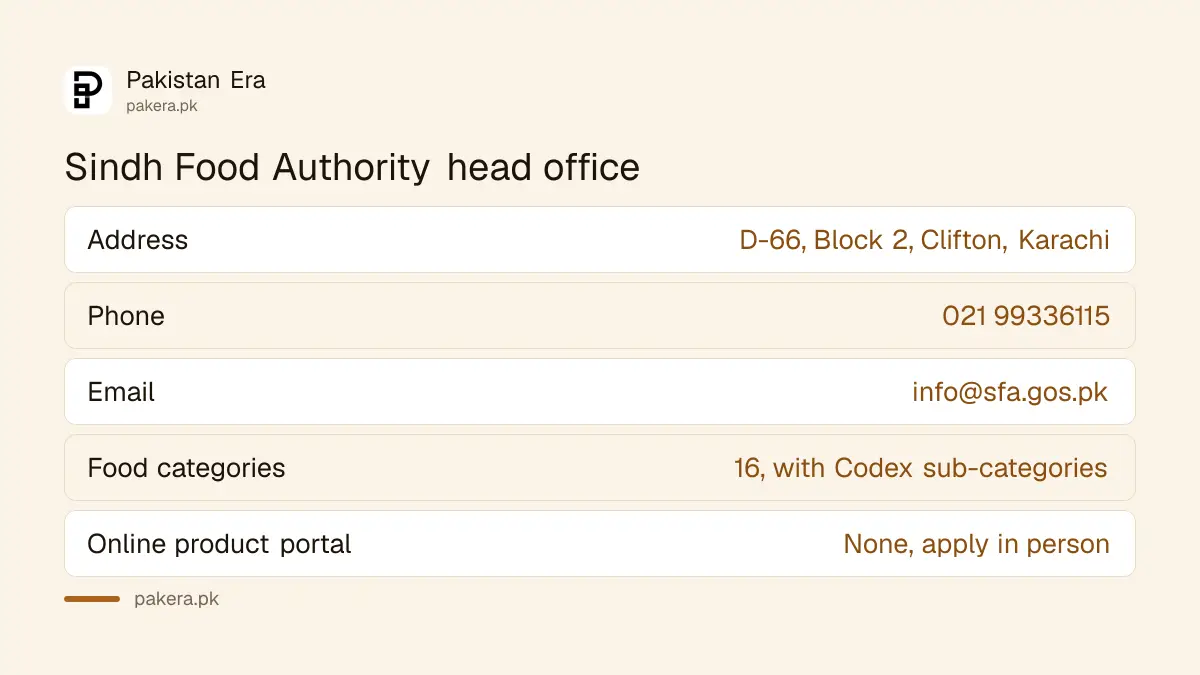
Products are grouped into 16 categories, from dairy and fats through confectionery, cereals, bakery, meat, fish, eggs, sweeteners, spices and sauces, special nutritional foods, beverages, ready-to-eat savouries and prepared foods, each with sub-categories under the Codex system. Your product must be placed in the right one on the form. The categories list is a download on the registration page.
Questions go to the head office on 021 99336115 or info@sfa.gos.pk. Complaints about an unregistered or unsafe product already on sale go through the routes in the guide on how to report unsafe food in Sindh.
Common questions about SFA product registration
Do I need a business licence before registering a product?
Yes. A valid SFA site licence is the first document on the list, and the Product Registration Wing will not take the file without it.
How much does product registration cost?
SFA does not publish the fee. The step sheet says to deposit it at a designated Sindh Bank. Ask for the amount when you collect the form.
How long is the certificate valid?
The FPRC is valid for a specified period, with two years given as the example on SFA's sheet. The label certificate lasts until the label changes.
Can I apply online?
No. The form is collected and submitted in person at the head office in Clifton, Karachi. Only the business licence has an online portal.
What lab can issue the certificate of analysis?
A pre-qualified laboratory, meaning one SFA accepts. Ask the Product Registration Wing for the current list before you pay for testing.
Does a Punjab registration count in Sindh?
No. Food is a provincial subject. Punjab's authority has its own licence and rules, set out in the guide to the Punjab Food Authority licence, and Sindh requires its own registration.
How we verified this
What we checked, where we read it, and what we could not confirm.
Last checked 19 October 2026. The document list, the ten steps, the Sindh Bank payment, the FPRC and FPLC validity and the renewal rule come from SFA's step-by-step procedure and its registration and labelling process chart, both linked from the SFA product registration page, which also gave the office address, phone and email. The 16 categories are from the categories PDF on the same page. The confiscation and closure wording is from the SFA FAQ page. We could not verify the fee amount, the processing time or the list of pre-qualified laboratories, because SFA does not publish them.
About the author

Tax, Bills and Technology Writer
Ali Akhtar is a young and curious voice here at Pakistan Era. He is currently pursuing his A-Levels and has a growing interest in Pakistan’s changing industrial landscape and educational trends. Ali likes to write in a way that helps him explain and explore the world around him. His writing reflects the perspective of the new generation navigating the evolving trends of Pakistan where technology, youth innovation, and shifting opportunities are reshaping the country’s future.