SPSC CCE-2026 Answer Key Out for 28 November Screening Test: All 4 Paper Types, 66 Marks to Pass
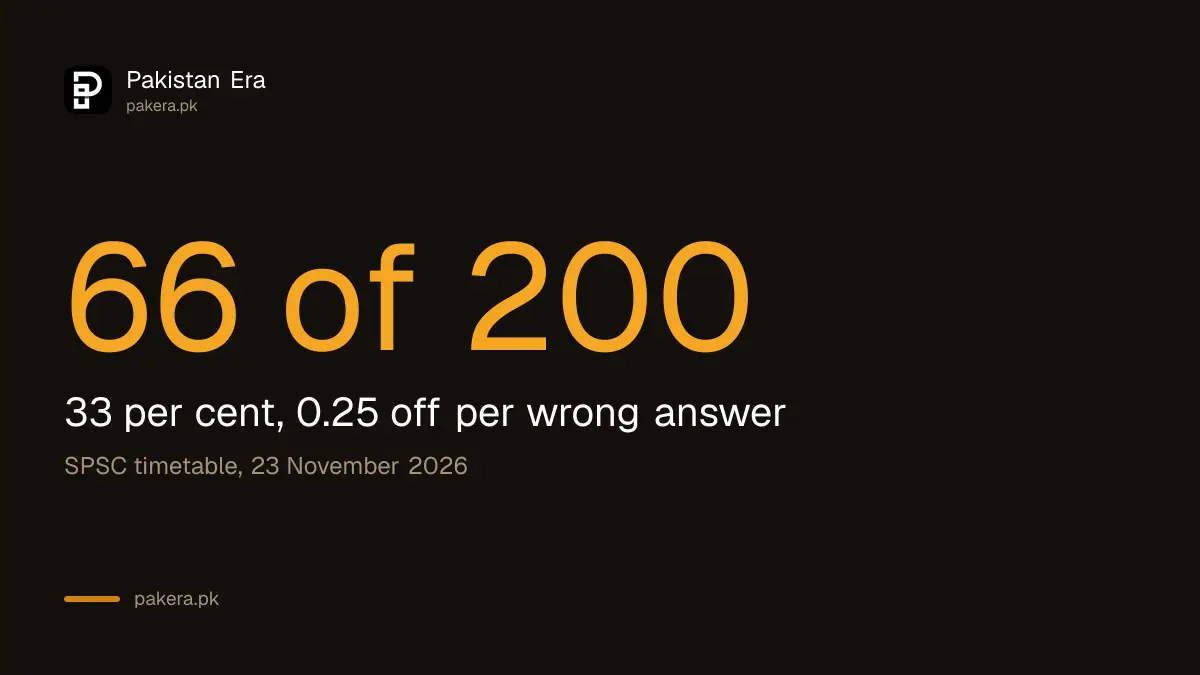
SPSC released the CCE-2026 screening test answer key on 28 November 2026 for paper types A, B, C and D. Pass mark 66 of 200, 0.25 off per wrong answer.
Short answer: The Sindh Public Service Commission (SPSC) put the answer key for the CCE-2026 screening test on its website on 28 November 2026, the same day as the test. There are four keys, one for each paper type, A, B, C and D. To pass you need 66 marks out of 200, and every wrong answer cuts 0.25 of a mark. If you attempted all 200 questions, you need at least 93 right.
The test was held on Saturday 28 November from 10:00 am to 1:20 pm in Hyderabad, Karachi, Sukkur and Larkano. SPSC's timetable allotted roll numbers to 23,950 candidates for the test. All four answer keys are copied in full below, so you can mark your own sheet now.
SPSC released four CCE-2026 answer keys on 28 November
The SPSC answer key for the CCE-2026 screening test came out on 28 November 2026 under "Answer Keys" on spsc.gov.pk. It is one PDF of four pages, one page for each paper type. The Controller of Examinations signed every page on 28 November.
The paper type is printed on your question booklet and you should also have marked it on your answer sheet. Use only the key for your own paper type. The questions are the same in every booklet, but the order changes, so question 1 in paper A is not question 1 in paper B. Using the wrong key will give you a score that means nothing.
| Detail | CCE-2026 screening test |
|---|---|
| Date | Saturday 28 November 2026 |
| Time | 10:00 am to 1:20 pm (200 minutes) |
| Questions | 200 MCQs, 1 mark each |
| Negative marking | 0.25 for each wrong answer |
| Pass mark | 33 per cent, 66 marks |
| Paper types | A, B, C and D |
| Answer key released | 28 November 2026 |
| Claims against the key | By 8:00 pm on 29 November 2026 |
The answer keys for paper types A, B, C and D
The tables below copy the official SPSC answer key for each paper type. Each row covers 25 questions, and the letters are in groups of five to make counting easier. So "BDABD" for questions 1 to 5 means question 1 is B, question 2 is D, and so on.
Paper type A
| Questions | Answers, in groups of five |
|---|---|
| 1 to 25 | BDABD BABDC BCCBC ABACB BCABC |
| 26 to 50 | DAAAC CCBDD ADCDA DACCD BCCDB |
| 51 to 75 | DBBBC BBBAD DCABC CDDCC BACAA |
| 76 to 100 | BBDAC ACDBD ACCCD DACBD ABDBC |
| 101 to 125 | BDBDD BACCA DBCDD BCAAB CCCBB |
| 126 to 150 | CBCBB BBCBB DCDBB BCBCB CCDBD |
| 151 to 175 | DDDDC DBCDD CBBDC DDBDD CACCB |
| 176 to 200 | DABBB CACCB CDCCB ADBCB ACBDB |
Paper type B
| Questions | Answers, in groups of five |
|---|---|
| 1 to 25 | BDBDD BACCA DBCDD BCAAB CCCBB |
| 26 to 50 | CBCBB BBCBB DCDBB BCBCB CCDBD |
| 51 to 75 | DDDDC DBCDD CBBDC DDBDD CACCB |
| 76 to 100 | DABBB CACCB CDCCB ADBCB ACBDB |
| 101 to 125 | BDABD BABDC BCCBC ABACB BCABC |
| 126 to 150 | DAAAC CCBDD ADCDA DACCD BCCDB |
| 151 to 175 | DBBBC BBBAD DCABC CDDCC BACAA |
| 176 to 200 | BBDAC ACDBD ACCCD DACBD ABDBC |
Paper type C
| Questions | Answers, in groups of five |
|---|---|
| 1 to 25 | BDBCA BCBDA BCCDC BCCAC BBBAD |
| 26 to 50 | BCCAC DDBDD CDBBC DDCBD CDDDD |
| 51 to 75 | DBDCC BCBCB BBDCD BBCBB BBCBC |
| 76 to 100 | BBCCC BAACB DDCBD ACCAB DDBDB |
| 101 to 125 | CBDBA DBCAD DCCCA DBDCA CADBB |
| 126 to 150 | AACAB CCDDC CBACD DABBB CBBBD |
| 151 to 175 | BDCCB DCCAD ADCDA DDBCC CAAAD |
| 176 to 200 | CBACB BCABA CBCCB CDBAB DBADB |
Paper type D
| Questions | Answers, in groups of five |
|---|---|
| 1 to 25 | DBBBC BBBAD DCABC CDDCC BACAA |
| 26 to 50 | BBDAC ACDBD ACCCD DACBD ABDBC |
| 51 to 75 | BDBDD BACCA DBCDD BCAAB CCCBB |
| 76 to 100 | CBCBB BBCBB DCDBB BCBCB CCDBD |
| 101 to 125 | DDDDC DBCDD CBBDC DDBDD CACCB |
| 126 to 150 | DABBB CACCB CDCCB ADBCB ACBDB |
| 151 to 175 | BDABD BABDC BCCBC ABACB BCABC |
| 176 to 200 | DAAAC CCBDD ADCDA DACCD BCCDB |
If the scan on the SPSC website and this copy ever differ, the SPSC PDF is the official record. Check any answer you plan to challenge against the PDF itself.
You need 93 right answers if you attempted all 200
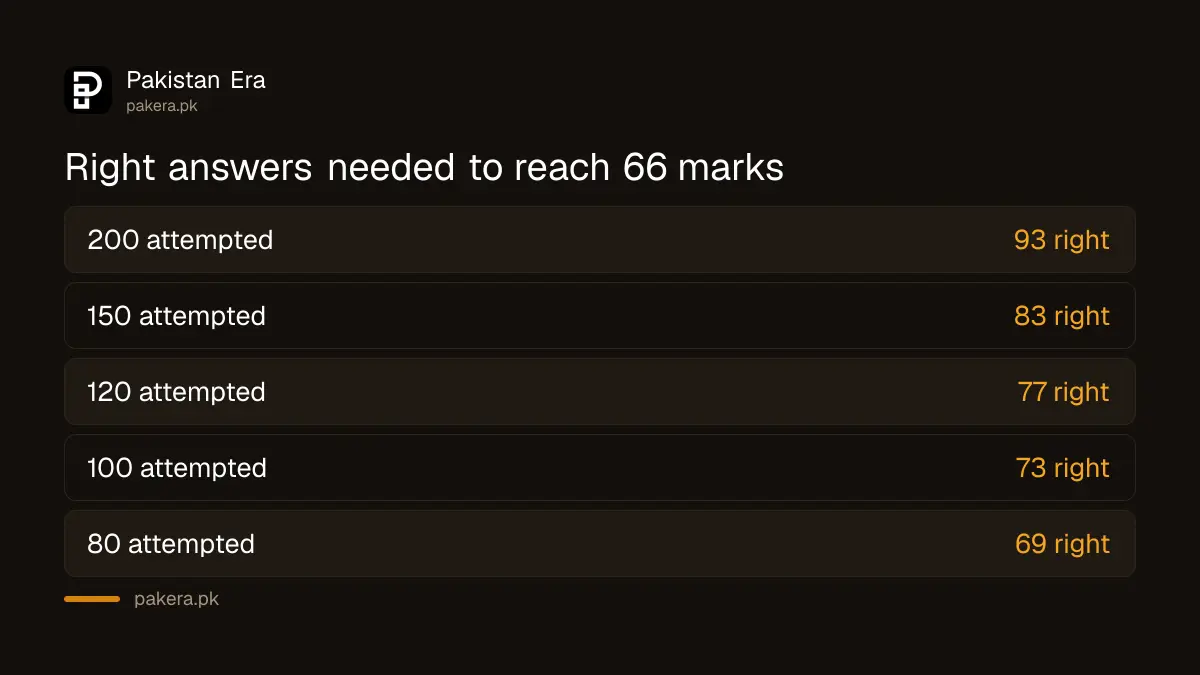
Your score is the number of right answers minus a quarter of the number of wrong answers. Blank questions cost nothing. With 66 needed, a candidate who answered all 200 questions must get at least 93 right, because 93 minus 26.75 leaves 66.25.
Work out your own score in three steps.
- Mark each answer on your carbon copy or question booklet against the key for your paper type. Count the right answers.
- Count the wrong answers. Do not count the questions you left blank.
- Take the right answers and subtract the wrong answers divided by 4. A result of 66 or more is a pass on SPSC's stated threshold.
The fewer questions you attempted, the fewer right answers you need, because there are fewer wrong ones to subtract. Our own working for some common cases is below.
| Questions attempted | Right answers needed | Score at that point |
|---|---|---|
| 200 | 93 | 93 minus 26.75 = 66.25 |
| 180 | 89 | 89 minus 22.75 = 66.25 |
| 150 | 83 | 83 minus 16.75 = 66.25 |
| 120 | 77 | 77 minus 10.75 = 66.25 |
| 100 | 73 | 73 minus 6.75 = 66.25 |
| 80 | 69 | 69 minus 2.75 = 66.25 |
A score near 66 is not safe yet. SPSC can change an answer after it reviews claims, and one changed answer moves your score by 1.25 marks either way. The pass mark and negative marking were set in the Sindh Gazette of 23 October 2026, as we explained in the report on the CCE-2026 screening test date.
Claims against a wrong answer close at 8 pm on 29 November
SPSC asks candidates who think an answer in the key is wrong to send their claim by 8:00 pm on Sunday 29 November 2026. Claims go to the Controller of Examinations at the SPSC head office in Hyderabad, or by email to Controller@spsc.gov.pk.
The notice gives no form and no fee. A clear claim is easier to check, so put these in one short email or letter:
- Your name, roll number and CNIC number.
- Your paper type, A, B, C or D.
- The question number in your paper type and the answer in the key.
- The answer you think is right, with the source: a textbook page, an official document or the article number of the Constitution.
One claim per question keeps it simple. Do not send claims about questions you only found hard. SPSC reviews whether the key is wrong, not whether a question was fair.
23,950 candidates were given roll numbers in four cities
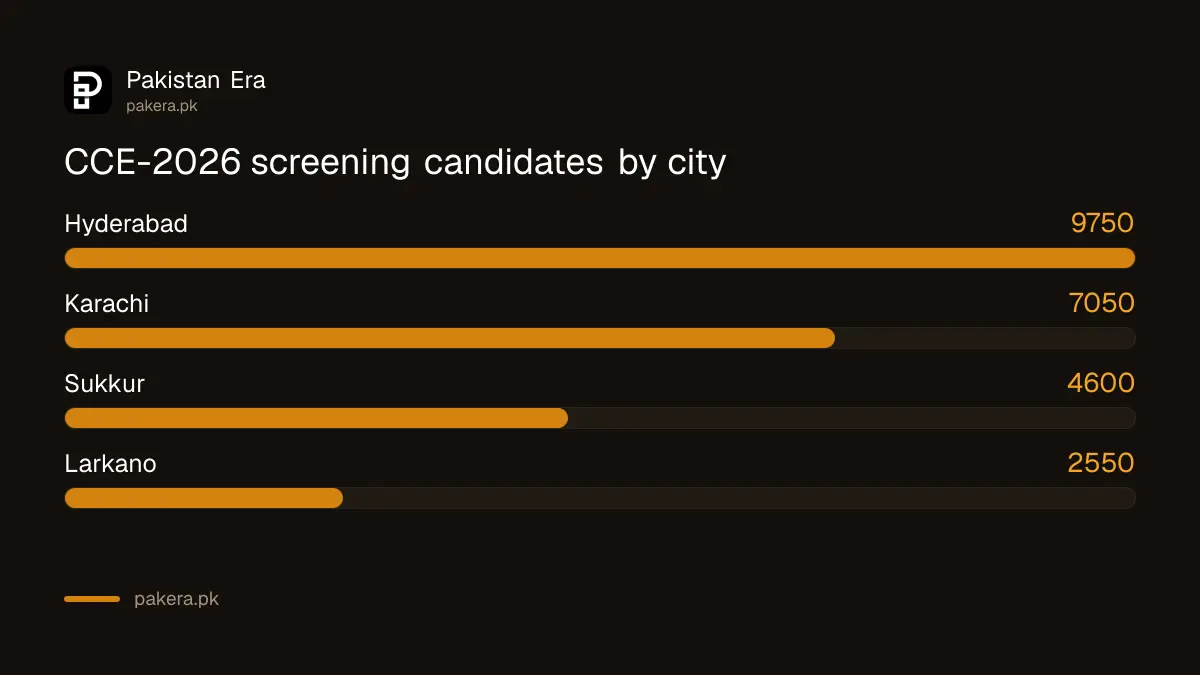
SPSC's timetable for the test, dated 23 November 2026, lists 23,950 candidates. Hyderabad had the most, in two zones at the same school. The reporting time everywhere was 8:00 am.
| City | Centre | Roll numbers | Candidates |
|---|---|---|---|
| Hyderabad, Zone I | Public School, Latifabad Unit 3 | 400001 to 406000 | 6,000 |
| Hyderabad, Zone II | Public School, Latifabad Unit 3 | 406001 to 409750 | 3,750 |
| Karachi | Ground of D.J. Sindh Government Science College, PIDC | 409751 to 416800 | 7,050 |
| Sukkur | IBA Public School, Military Road | 416801 to 421400 | 4,600 |
| Larkano | Government Pilot Higher Secondary School, VIP Road | 421401 to 423950 | 2,550 |
| Total | 23,950 |
The roll number on your admission slip tells you which city list you belong to. You will need it again when the result is out.
The screening test only opens the door to the written exam
The screening test decides who goes on to the written part of CCE-2026. SPSC has not yet given a date for the screening result. For CCE-2025, the screening test was on 6 June 2026, and the answer key came out the same day, as it did this time.
While you wait, get your papers in order. Candidates often fall out on documents, not marks. Check that your domicile and PRC follow the SPSC domicile and PRC rules, and that your date of birth matches your matric certificate. When the result is out, the steps to find your roll number are in the walk-through on checking an SPSC result.
Keep your admission slip and question booklet safe. Never pay anyone who offers to "fix" your screening marks. SPSC can disqualify candidates for canvassing, and nobody outside the Commission can change a score.
Common questions
Where is the SPSC CCE-2026 answer key?
On the SPSC website, under "Answer Keys", in the entry dated 28 November 2026. It is one PDF with four pages, one for each paper type. All four keys are also copied above.
What is the passing mark for the CCE-2026 screening test?
33 per cent, which is 66 marks out of 200. SPSC's timetable for the test says so, and the rule is in the Sindh Gazette of 23 October 2026.
Is there negative marking in the SPSC screening test?
Yes. Each wrong answer cuts 0.25 of a mark. A blank answer cuts nothing. Four wrong answers cancel one right answer.
How do I know my paper type?
It is printed on your question booklet as A, B, C or D. You also marked it on your answer sheet. Use only the key for that type.
When will the SPSC CCE-2026 screening result come out?
SPSC has not announced a date. The result will be posted on the SPSC website under written results, after claims against the key are reviewed.
Can I still send a claim after 8 pm on 29 November?
The SPSC notice sets 8:00 pm on 29 November 2026 as the deadline. It does not mention late claims.
How we verified this
What we checked and where we read it.
We read the SPSC answer key PDF, the CCE-2026 screening timetable and the "Answer Keys" page on the Sindh Public Service Commission website on 29 November 2026. The four keys were copied from the signed PDF dated 28 November 2026. Papers B and D carry the same answers as paper A in a shifted order, which let us check our copy of A, B and D letter by letter; paper C has its own order. The centres, roll numbers and candidate numbers come from SPSC timetable No. PSC/EXAM(C.S)/2026/253 dated 23 November 2026, also on spsc.gov.pk. The score table is our own arithmetic from SPSC's rule of 1 mark per right answer and 0.25 off per wrong answer.
Free on WhatsApp
Get the next change first on WhatsApp
Price changes, new rules and deadlines that affect your money, in a few short posts a day.
Follow Pakera on WhatsAppOther followers cannot see your number.
About the author

Public Services and Education Journalist
Fajr Riaz is a journalist and content writer at Pakistan Era, based in Lahore. She covers the questions people meet in everyday life in Pakistan: how a public service works, what a change in the rules means, and where to find a reliable answer.