Standard Chartered Schedule of Charges July to December 2026: IBFT, ATM, Debit Card and Branch Fees in Pakistan (Full List)
Standard Chartered Pakistan charges July to December 2026: IBFT free to Rs 25,000, Rs 35 at 1-Link ATMs, Rs 3,500 Classic card, Rs 150 branch fee. See all fees.
Standard Chartered Pakistan's schedule of charges for July to December 2026 makes IBFT free up to Rs 25,000 a month, then charges 0.1% or Rs 200, whichever is lower. Cash at another bank's 1-Link ATM costs Rs 35, the Classic debit card Rs 3,500 a year, and a cheque book Rs 24 a leaf on most accounts. The charge most customers miss is Rs 150 on each branch transaction when the account's average balance is below the bank's threshold.
We read Standard Chartered's full English conventional schedule for 1 July to 31 December 2026, published as a PDF on its website, on 31 October 2026. Below are the retail fees: transfers, ATMs, debit cards, cheques, SMS, branch transactions, minimum balance charges and breaking a term deposit.
Standard Chartered IBFT is free up to Rs 25,000 a month
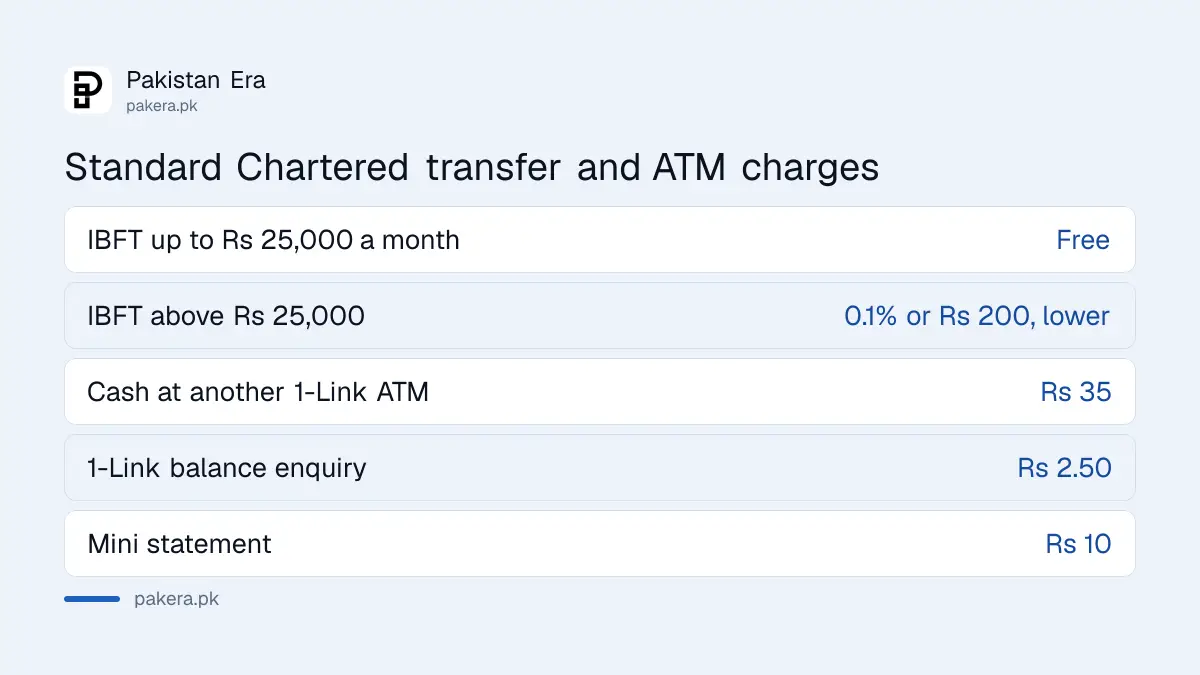
Transfers to other banks are free until you send Rs 25,000 in a month. After that, each IBFT costs 0.1% of the amount or Rs 200, whichever is lower. The rule appears more than once in the retail pages of the schedule.
| Transfer or ATM use | Standard Chartered charge |
|---|---|
| IBFT, monthly total up to Rs 25,000 | Free |
| IBFT above Rs 25,000 in the month | 0.1% or Rs 200, whichever is lower |
| Cash at another bank's 1-Link ATM | Rs 35 a withdrawal |
| Balance enquiry at a 1-Link ATM | Rs 2.50 |
| Balance enquiry at an ATM abroad | Rs 300 |
| Mini statement | Rs 10 |
| Direct debit bill payment | Rs 100 a month for each registered bill |
A Rs 100,000 transfer after the free limit costs Rs 100, and anything above Rs 200,000 pays the Rs 200 cap. That is our arithmetic on the bank's rule. The same limit applies at most banks, as set out in IBFT charges at Pakistani banks.
Branch transactions cost Rs 150 below the balance threshold
Standard Chartered charges Rs 150 on every over the counter transaction if your current account's monthly average is below Rs 300,000 or your savings account's below Rs 500,000. Transactions at your own parent branch are free, the schedule says.
This is the line that surprises people. Deposit cash at a branch across town and you pay Rs 150 each time. The fix is simple: use your home branch, an ATM, or the SC Mobile app. Branch requests made through the app are cheaper too, because the bank waives its charges on pay orders, maintenance and balance certificates, tax certificates and statements requested in SC Mobile.
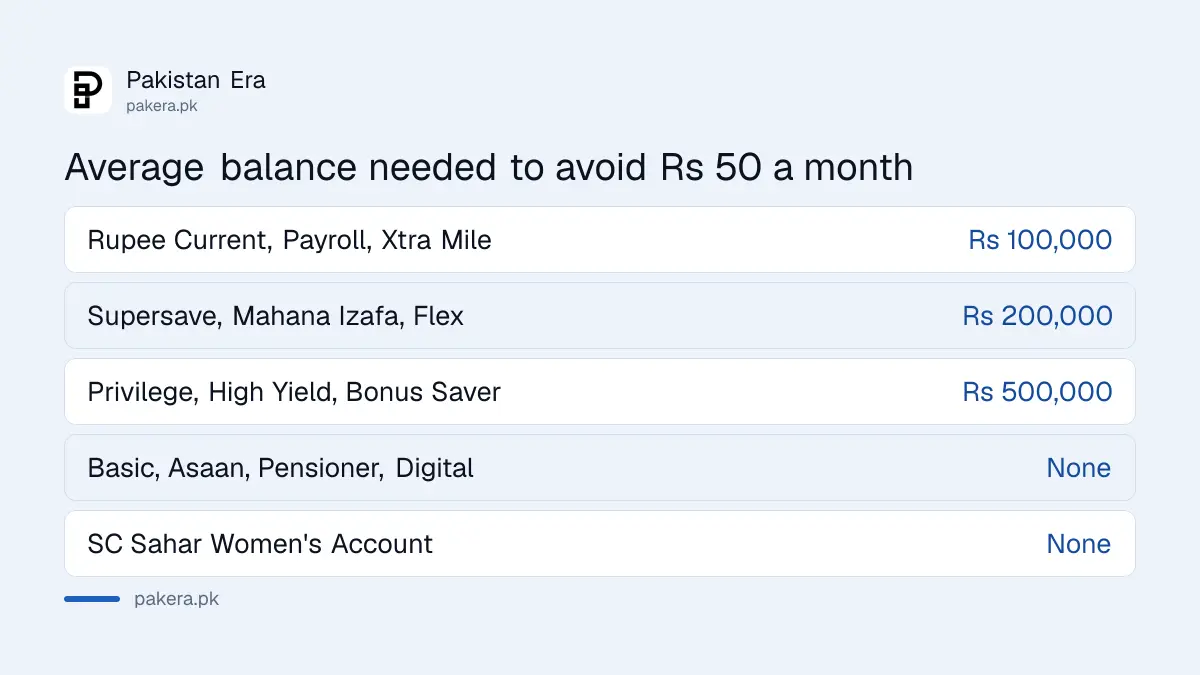
Premium accounts also carry a minimum balance charge of Rs 50 a month when the average falls below the requirement. That covers the Rupee Current, Xtra Mile and Payroll accounts at Rs 100,000, and Supersave, Mahana Izafa, Flex and 6 Monthly Savings at Rs 200,000. Privilege, High Yield and Bonus Saver need Rs 500,000. Basic, Asaan, Pensioner, Digital, Roshan Digital and SC Sahar accounts have no minimum balance.
Standard Chartered debit cards cost Rs 2,800 to Rs 18,500 a year
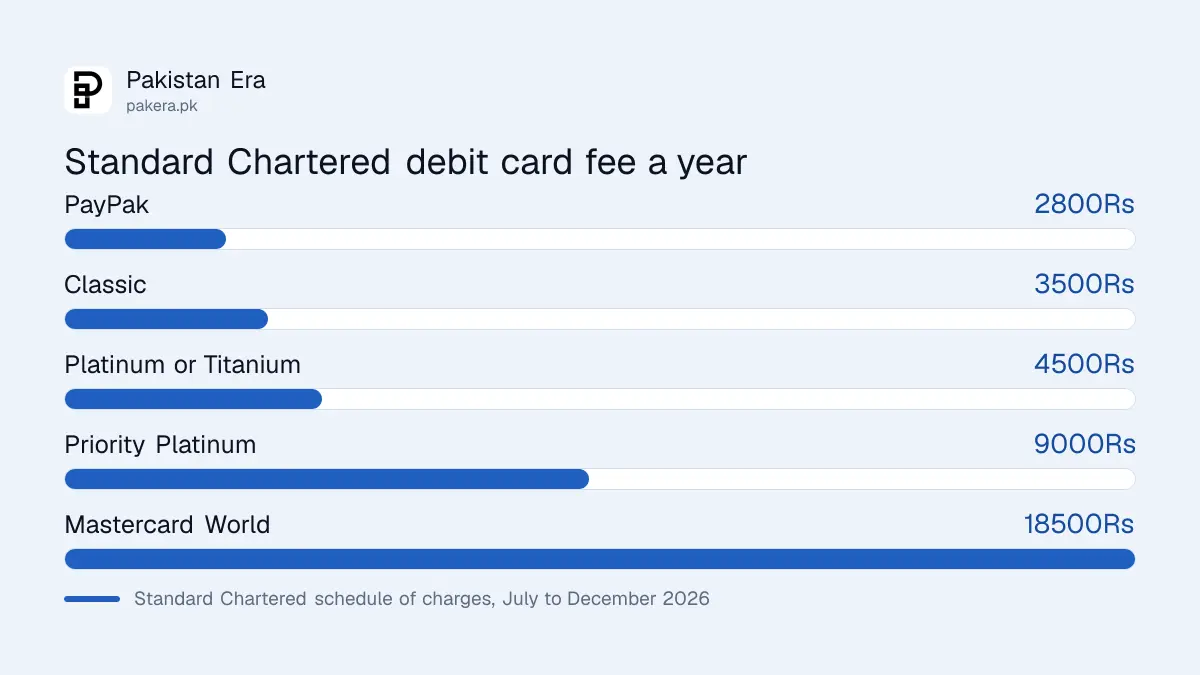
The PayPak debit card costs Rs 2,800 a year, Classic Rs 3,500, Platinum or Titanium Rs 4,500, Priority Platinum Rs 9,000 and Mastercard World Rs 18,500. Replacing any rupee card costs Rs 1,800. The foreign currency debit card costs USD 50 a year.
| Debit card | Annual or issuance fee | Replacement |
|---|---|---|
| PayPak | Rs 2,800 | Rs 1,800 |
| Classic | Rs 3,500 | Rs 1,800 |
| Platinum or Titanium | Rs 4,500 | Rs 1,800 |
| Priority Platinum | Rs 9,000 | Rs 1,800 |
| Mastercard World | Rs 18,500 | Rs 1,800 |
| Foreign currency card | USD 50 | USD 5 |
The SC Sahar Women's Account gets its debit card and cheque book free. Spending abroad on any card carries a spread of up to 8% on international shops, airlines and ATMs, and up to 6% on QR payments, well above the 4% that Al Baraka lists for its cards in its own July to December schedule. If you travel, check the rate on your statement after the first purchase. For credit cards, see Standard Chartered credit card activation and bill payment.
Cheques, statements and SMS alerts at Standard Chartered
A cheque book costs Rs 24 a leaf on most accounts, Rs 10 on Pensioner and Asaan accounts and Rs 100 on the Digital Account. A returned cheque costs Rs 1,000 on a savings account. SMS alerts on branch transactions cost Rs 250 a month.
| Service | Standard Chartered charge |
|---|---|
| Cheque book, most accounts | Rs 24 a leaf |
| Cheque book, Pensioner and Asaan | Rs 10 a leaf |
| Cheque book, Digital Account | Rs 100 a leaf |
| Stop payment, up to 5 leaves | Rs 500 |
| Stop payment, over 5 leaves | Rs 1,000 |
| Your cheque returned, savings account | Rs 1,000 inward, Rs 150 outward |
| Your cheque returned, current account | Rs 550 inward, Rs 50 outward |
| Duplicate statement | Rs 30 |
| Balance confirmation certificate | Rs 300 |
| SMS alerts on branch transactions | Rs 250 a month |
Two lines stand out. A bounced cheque from a savings account costs Rs 1,000, nearly double the current account charge. And the Rs 100 a leaf on the Digital Account makes a 25 leaf book Rs 2,500, our arithmetic, so order cheques only if you need them. No service charges are deducted from dormant or unclaimed accounts under the schedule. The general fee picture is in bank charges you can avoid.
Breaking a Standard Chartered term deposit early
On early encashment of a rupee term deposit, the bank adjusts profit by 2% flat on the principal, but not below the State Bank's minimum floor rate. It may also recover a market cost for the remaining period. An advance profit deposit returns only the principal.
- Ask the branch for the exact profit adjustment on your deposit before you sign the encashment request.
- Check whether a market cost for the remaining days applies. The schedule ties it to the PKRV rate, a government bond benchmark.
- If profit was paid in advance, expect it to be taken back from your principal.
- Compare the result with simply waiting to maturity.
- Keep the encashment advice for your records.
Standard Chartered's minimum savings rate rose to 10% from 1 May 2026, according to its rate circular. The policy rate went up again on 26 October 2026, as covered in the SBP rate rise to 12%. For help with any charge, call 111 002 002 with the city code 021, 042 or 051.
Common questions
What are Standard Chartered IBFT charges in Pakistan?
Free up to Rs 25,000 a month. Above that, 0.1% of the amount or Rs 200, whichever is lower.
How much is the Standard Chartered debit card annual fee?
Rs 2,800 for PayPak, Rs 3,500 for Classic, Rs 4,500 for Platinum or Titanium, Rs 9,000 for Priority Platinum and Rs 18,500 for Mastercard World.
Why did Standard Chartered charge me Rs 150?
Most likely a branch transaction away from your parent branch while your average balance was below Rs 300,000 on current or Rs 500,000 on savings.
What is the Standard Chartered cheque book charge?
Rs 24 a leaf on most accounts, Rs 10 on Pensioner and Asaan accounts, Rs 100 on the Digital Account. SC Sahar is free.
What is the Standard Chartered helpline in Pakistan?
111 002 002, with 021, 042 or 051 in front depending on your city.
How we verified this
What we checked, where we read it, and what we could not confirm.
We read Standard Chartered Pakistan's download centre and its conventional schedule of charges for July to December 2026 on 31 October 2026, along with its May 2026 savings rate circular. Two-column pages were checked against the PDF's raw text, and one row on online bill payments was left out because its figure could not be matched with confidence. Saadiq, the bank's Islamic arm, has a separate schedule. Rupee examples are our arithmetic.
About the author

Tax, Bills and Technology Writer
Ali Akhtar is a young and curious voice here at Pakistan Era. He is currently pursuing his A-Levels and has a growing interest in Pakistan’s changing industrial landscape and educational trends. Ali likes to write in a way that helps him explain and explore the world around him. His writing reflects the perspective of the new generation navigating the evolving trends of Pakistan where technology, youth innovation, and shifting opportunities are reshaping the country’s future.