How to Stop a Standing Instruction or Auto-Debit in Pakistan
Want to stop a standing instruction or auto-debit in Pakistan? SBP rules say tell your bank 3 business days before the date, on a recorded call or in writing.
To stop a standing instruction or auto-debit in Pakistan, tell your bank at least three business days before the next payment date, either on its recorded helpline after it verifies you, or in writing. That three day rule is in the State Bank of Pakistan's Electronic Fund Transfers Regulations, and the bank must stop the transfer once you notify it properly.
A standing instruction is an order you gave your bank to send money on a fixed date, every month or every year. Rent, a relative's allowance, a committee payment and a savings transfer are common examples. SBP calls these "preauthorized transfers", meaning transfers you authorised in advance. We read the SBP regulations so you know what your bank owes you when you want one to end.

The three business day rule from SBP
SBP's Electronic Fund Transfers Regulations say banks shall stop a preauthorized transfer if you tell them on a recorded line, after identity checks, or in writing, at least three business days before the scheduled date. Notice given later may not stop that month's payment.
Business days are working days, so weekends and bank holidays do not count. If your rent transfer runs on the 5th and the 5th is a Monday, count back three working days. The safe deadline is the Tuesday before, not the Friday. Our page on bank timings and holidays helps if a holiday falls in that window.
The same SBP regulations say banks may only set up a preauthorized transfer at your request after checking it is really you, and must tell you by SMS or email each time one runs.
| SBP rule | What it means for you |
|---|---|
| Set up only on your request, after verification | Nobody else can add one to your account |
| SMS or email each time it runs | Watch for these alerts to spot old instructions |
| Stop on a recorded call or in writing | Use the helpline or a signed letter, not a branch chat |
| At least three business days before the date | Give notice early to stop the next payment |
| Errors resolved within ten business days | If it runs after you stopped it, complain |
How to stop a standing instruction step by step
Find the instruction details first, then cancel it on a recorded call or in writing, and keep proof. A written request with a dated receipt is the strongest evidence. Then check your next statement to make sure no payment went out on the date.
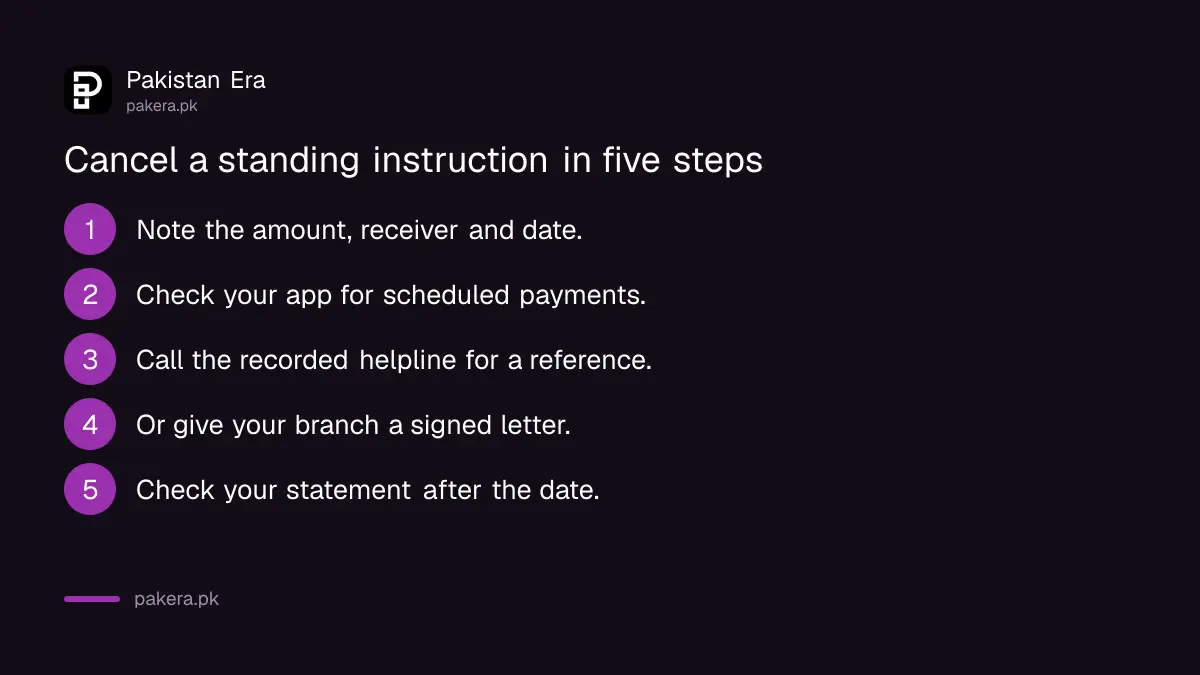
- Find the details. Note the amount, the receiving account and the date it runs. Your past SMS alerts or bank statement will show them.
- Check your app first. Some banking apps list scheduled or recurring payments that you can delete yourself. If you cancel there, take a screenshot.
- Or call the helpline. The call is recorded. Ask the agent to cancel the instruction, and ask for a complaint or request number.
- Or write to your branch. Give a signed letter with your account number, the instruction details and the date. Ask the branch to stamp your copy.
- Check after the date. Look at your statement after the next scheduled date. Nothing should have gone out.
A short letter is enough. Write: "Please cancel the standing instruction on my account [number] for Rs [amount] to [receiver], which runs on [date] each month, with effect from today." Sign it as you signed your account opening form.
Payments the SBP rule does not cover
The SBP Electronic Fund Transfers Regulations exclude customer to merchant payments for goods and services. So a subscription charged to your card, or a bill paid to a company, follows different terms. Cancel those with the company as well as your bank.
- Card subscriptions. Streaming, app and software charges are taken by the merchant from your card. Cancel inside the service first. For app store charges, see cancelling a Google Play subscription.
- Loan instalments. Stopping the debit does not end the loan. Missed instalments can be reported to your credit record. Speak to the lender first.
- Insurance premiums. If you stop a premium debit, the policy may lapse. Ask the insurer what happens before you cancel.
- Utility auto-pay. The bill still has to be paid. Set up another way to pay before you cancel.
Your bank must still take your request seriously in these cases. A written request is your proof if the charges keep coming.
If money still leaves your account after you stopped it
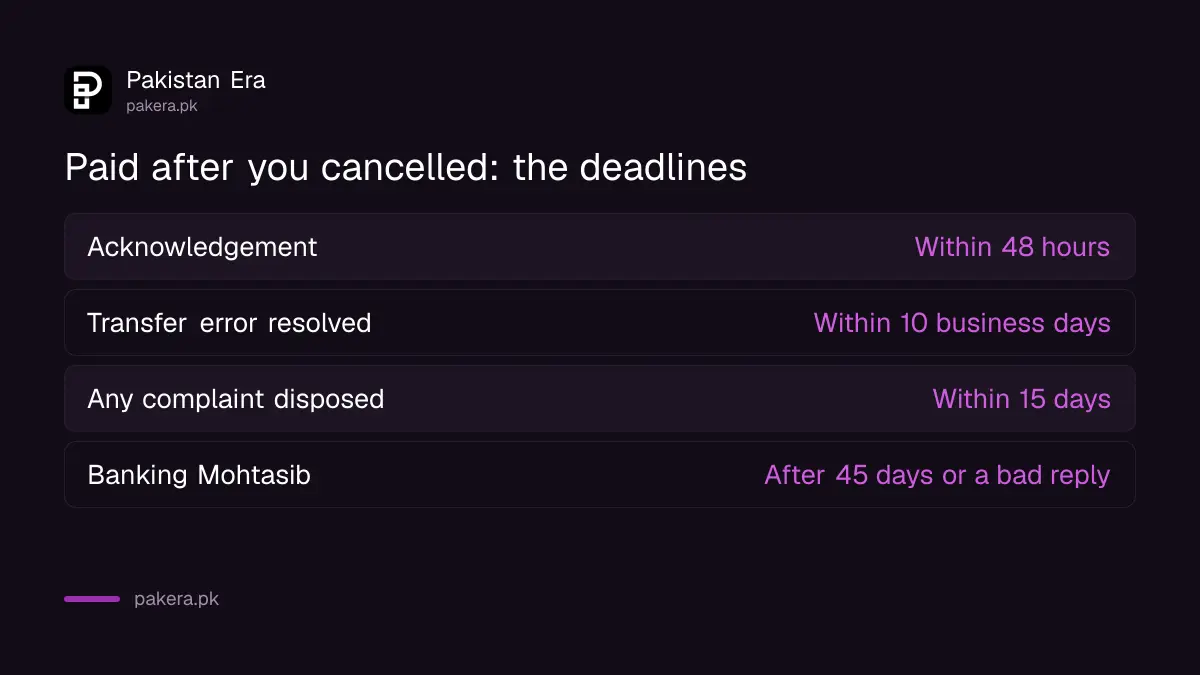
Complain to your bank in writing straight away and quote your cancellation proof. SBP rules give banks ten business days to resolve a transfer error, and its complaint rules say any complaint must be disposed of within 15 days. The Banking Mohtasib comes next.
Under SBP's complaint handling rules your bank must acknowledge the complaint within 48 hours. If it refuses to refund a payment it should have stopped, or does not reply within 45 days, take the case to the Banking Mohtasib with your letter or request number. If you never set up the payment at all, treat it as an unauthorised transaction instead, because the rules there are stricter.
Keep a record of every instruction you set up
Most people forget their standing instructions, then find an old payment still running years later. Keep a simple list of every one you set up, with its date and amount, and review your statement once every three months.
Check closely before you close an account or move banks. A standing instruction normally ends when the account closes, but a payment due in the meantime may still go out. Cancel it first, then close the account. Some banks list a fee for setting up or cancelling a standing instruction among their bank charges, so check its schedule of charges before you ask.
If you are leaving the bank altogether, stop every standing instruction first, then follow the steps to close a bank account properly.
Common questions
How many days before should I cancel a standing instruction?
At least three business days before the payment date. That is the notice period in SBP's Electronic Fund Transfers Regulations.
Can I stop a standing instruction by phone?
Yes, on the bank's recorded helpline after it checks your identity. SBP's regulations accept a recorded call or a written request.
Is an auto-debit the same as a standing instruction?
Often yes, when it is a transfer from your bank account you agreed to in advance. Card charges by a merchant are different and follow the merchant's terms.
Will stopping a loan auto-debit stop my loan payments?
It stops the automatic payment only. You still owe the instalment, and missing it can hurt your credit record.
Does the bank have to tell me when a standing instruction runs?
Yes. SBP's regulations say banks must notify you by SMS, email or another suitable way each time a preauthorized transfer runs.
What if my bank keeps paying after I cancelled?
Complain in writing with your proof. If the bank does not fix it within its deadlines, go to the Banking Mohtasib.
How we verified this
What we checked, where we read it, and what we could not confirm.
Last checked on 1 October 2026. We read section 8 (preauthorized transfers), section 4 (scope, which excludes customer to merchant payments), the definition of a preauthorized transfer and section 12 (error resolution) in SBP's Electronic Fund Transfers Regulations on SBP's archive site. We read SBP's Consumer Grievances Handling Mechanism for the 48 hour and 15 day complaint timelines, and the SBP Sunwai portal FAQ for the 45 day route to the Banking Mohtasib. Charges for setting up or cancelling a standing instruction differ by bank, so we have not quoted a figure.
About the author

Tax, Bills and Technology Writer
Ali Akhtar is a young and curious voice here at Pakistan Era. He is currently pursuing his A-Levels and has a growing interest in Pakistan’s changing industrial landscape and educational trends. Ali likes to write in a way that helps him explain and explore the world around him. His writing reflects the perspective of the new generation navigating the evolving trends of Pakistan where technology, youth innovation, and shifting opportunities are reshaping the country’s future.