How to Sue a Seller Who Took Your Bayana in Pakistan: Specific Performance Within 3 Years
A buyer in Pakistan can sue a seller who backs out of an agreement to sell within 3 years and ask for the transfer or compensation. See the steps and the rules.

Short answer: If a seller in Pakistan takes your advance (bayana) and then refuses to transfer the property, you can file a suit for specific performance in the civil court under the Specific Relief Act, 1877. You have 3 years from the date fixed for the transfer, or from the day you learn the seller refuses if no date was fixed. The court can order the sale completed, award compensation, or both.
The pattern is familiar with plots and houses. A buyer pays, say, Rs 500,000 as earnest money, prices rise, and the seller stops answering calls. We read the Specific Relief Act and the Limitation Act, 1908 on the Pakistan Code, the federal law portal, on 20 October 2026. Both apply across Pakistan, so the rules below are the same in Punjab, Sindh, Khyber Pakhtunkhwa, Balochistan and Islamabad.
The law presumes money cannot replace land
Section 12 of the Specific Relief Act tells the court to presume that breach of a contract to transfer immovable property cannot be fixed with money. So a buyer of land, a house or a flat usually starts with the law on their side.
That presumption is the reason a buyer can ask for the property itself and not just the advance back. For movable things, such as a car or furniture, the presumption runs the other way, and money is treated as enough unless you prove otherwise.
The relief is still discretionary. Section 22 says the court is not bound to order specific performance just because it is lawful. But that discretion must be "sound and reasonable" and can be corrected on appeal.
You have 3 years to file the suit
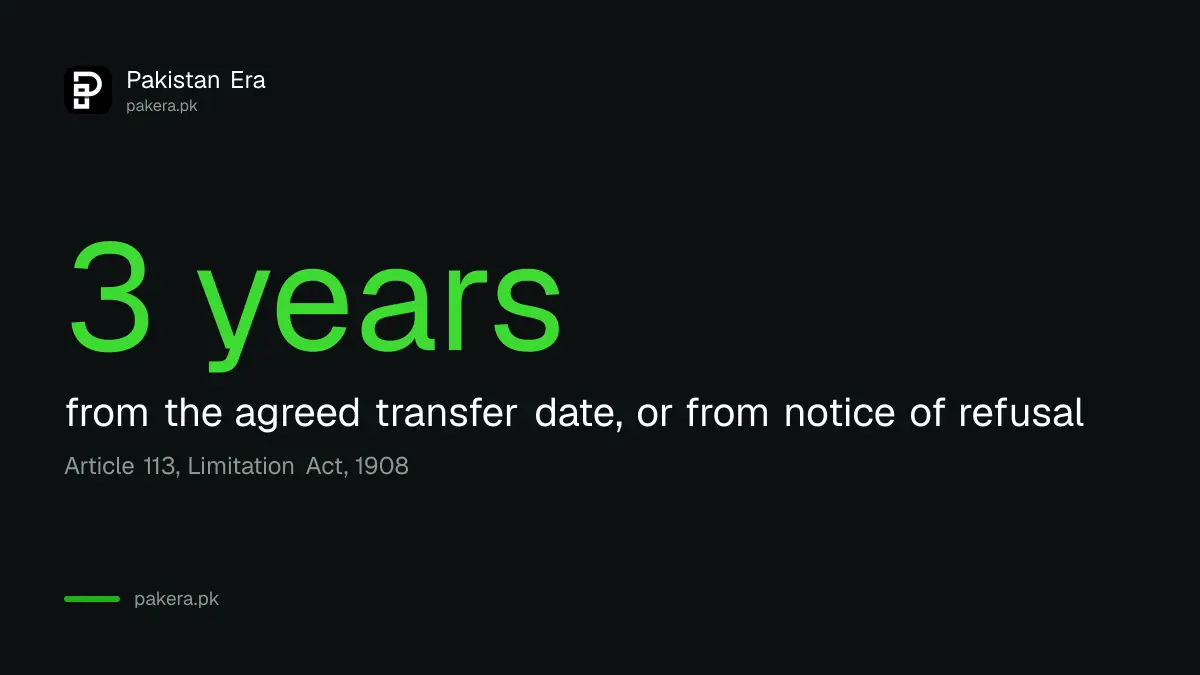
Article 113 of the Limitation Act gives 3 years. Time starts on the date fixed for the transfer in your agreement. If the agreement fixed no date, it starts when you have notice that the seller refuses to perform.
Miss this window and section 3 of the Limitation Act requires the court to dismiss the suit, even if nobody raises the point. So the most useful thing a buyer can do is write down the date in the agreement today and count forward.
| Your agreement says | Your 3 years start from | Example |
|---|---|---|
| Transfer by a fixed date | That date | Date 30 June 2026, last day about 30 June 2029 |
| No date fixed | When you learn the seller refuses | Refusal letter on 1 March 2026, last day about 1 March 2029 |
A refusal is easiest to prove when it is in writing. That is one reason buyers send a legal notice first. Other civil time limits sit in the full Limitation Act schedule.
You must show you were ready to pay the balance
Section 24 bars specific performance for a buyer who has violated an essential term or cannot perform their own side. In practice, the buyer must show readiness to pay the remaining price on the agreed terms.
Keep proof of that readiness: a bank statement, a pay order you offered, or a reply to the seller. Courts look hard at a buyer who paid a small advance and then went silent for years. Section 24 also stops a buyer who has already chosen another remedy and been paid for the breach.
Your agreement itself must be clear. Section 21 says a contract cannot be enforced if the court cannot find its terms with reasonable certainty. A note on plain paper that names no plot number or price is weak. Registering the agreement helps, and the Punjab process is set out in how to register an agreement to sell.
Filing a specific performance suit takes five steps
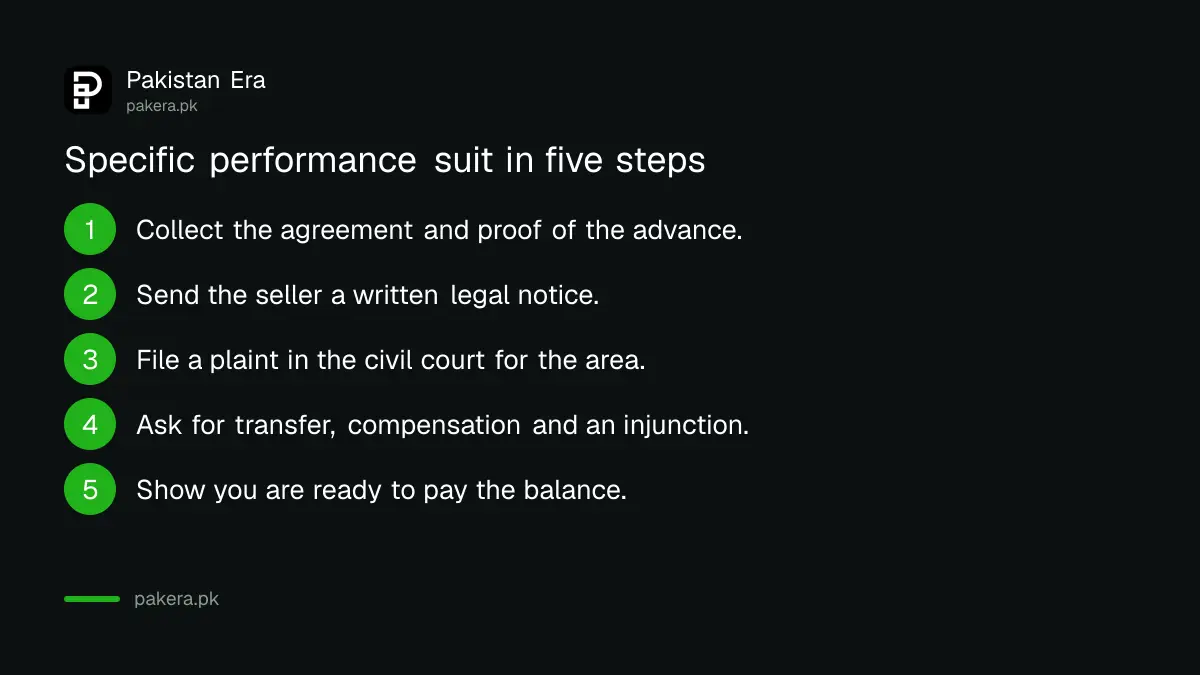
Gather the agreement and payment proof, send a legal notice, then file a plaint in the civil court where the property sits. Ask for specific performance and, in the same suit, compensation in the alternative.
- Collect the signed agreement to sell, receipts or bank records for the advance, and the property papers you have, such as a fard or registry copy.
- Send the seller a written legal notice asking them to complete the transfer by a set date, and keep the courier receipt.
- File a plaint in the civil court with jurisdiction over the property. A lawyer drafts it and works out the court fee.
- Ask in the plaint for specific performance, plus compensation under section 19, and seek a temporary injunction to stop the seller selling to someone else.
- Show the court you are ready to pay the balance. Some courts ask the buyer to deposit it.
Step 4 matters more than people think. Section 27 lets the court enforce the contract against a later buyer too, unless that buyer paid in good faith without notice of your agreement. Filing early, and making your claim public through the suit, narrows that escape route.
The court can order the sale, compensation or both
Section 19 lets a buyer ask for compensation in addition to, or in place of, the sale. If the court refuses the sale but finds a breach, it must still award compensation.
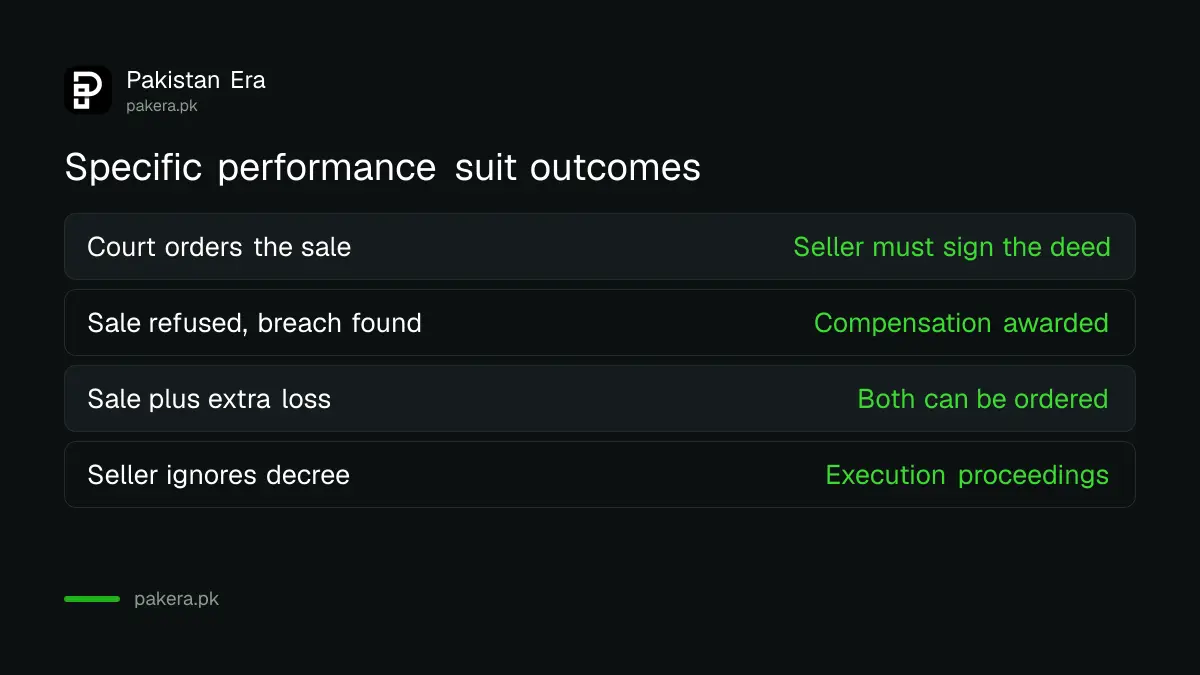
If you win, the decree orders the seller to execute the sale deed. If the seller still refuses, you go to execution, which is covered under how to enforce a civil court decree. If you lose, an appeal runs to the district court or High Court within the time limits set for civil appeals.
A seller can also defend. Common defences are that the buyer missed the payment deadline or that the agreement was never final. Title cuts both ways too: section 25 stops a seller who cannot give a clear title from forcing the sale on a buyer. If the seller never owned the plot, a transfer order may be impossible and compensation becomes the realistic remedy. Checking ownership before paying any advance costs far less than a suit.
Common questions
What is the time limit for a specific performance suit in Pakistan?
Three years under Article 113 of the Limitation Act, from the date fixed for the transfer or, if none, from notice of refusal.
Can I get my bayana back instead of the property?
Yes. Section 19 lets you ask for compensation in place of the sale, and you can ask for both in one suit.
Does the seller's later sale to someone else end my claim?
Not always. Section 27 lets the court enforce the agreement against a later buyer, unless that buyer paid in good faith without notice.
Must the agreement to sell be on stamp paper?
Stamp duty and registration rules are provincial. An unclear or unstamped agreement can weaken your case, so check the rules for your province.
Which court hears a specific performance suit?
The civil court with jurisdiction over the place where the property is located. Your lawyer chooses the right court by value.
Is the court bound to order the transfer?
No. Section 22 makes it discretionary, but the discretion must be sound and reasonable and can be corrected on appeal.
How we verified this
What we checked, where we read it, and what we could not confirm.
Last checked 20 October 2026. We read sections 12, 19, 21, 22, 23, 24, 25 and 27 of the Specific Relief Act, 1877 on the Pakistan Code, and section 3 and Article 113 of the Limitation Act, 1908 on the Pakistan Code, on 20 October 2026. The dates in the table are our own worked examples. We did not check court fees, provincial stamp duty or court case law, and outcomes in real cases turn on their facts. This is general information on the law, not advice on your case.
About the author

Senior Writer, Public Services and Technology
Shahid joined us in 2024 as an author. He is a senior contributor to Pakistan's leading technology websites. He writes detailed articles, mostly covering his expertise in the latest tech, mobiles, apps, gadgets, and step-by-step guides. His ideology is to help people understand the latest trends and explain complex methods through very easy-to-understand guides.