Pakistan Ends Sugar Price Controls: Cabinet Approves Deregulation Policy on 24 November 2026
Pakistan's cabinet approved sugar deregulation on 24 November 2026: price controls and export subsidies end, new mills allowed. Sugar averages Rs 139.85 a kilo.
یہ صفحہ اردو میں پڑھیں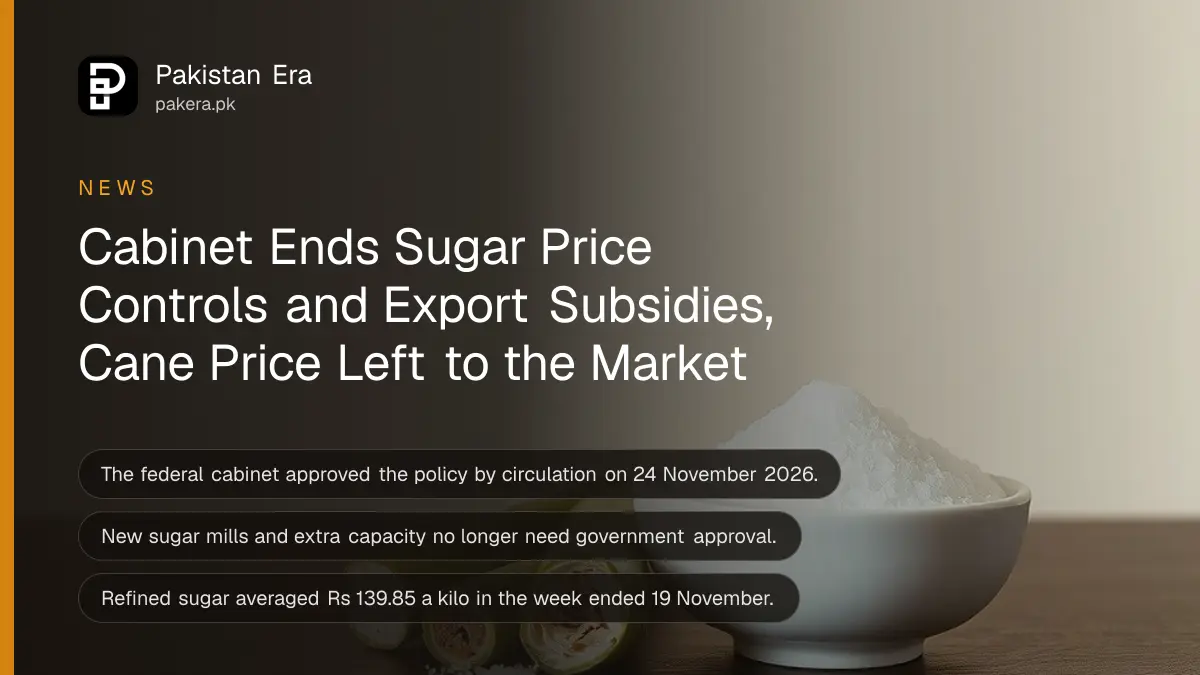
Short answer: Pakistan's federal cabinet approved the National Policy for Deregulation of the Sugar Sector on Tuesday 24 November 2026, by circulation. Government price controls on sugar end, export subsidies end, sugar can move freely between provinces, and new mills no longer need permission. Cane prices will be set by the market. The policy meets a condition of the IMF loan programme.
Sugar cost Rs 139.85 a kilo on average in the week ended 19 November, according to the Pakistan Bureau of Statistics (PBS) price survey. That is Rs 49.76 less than a year ago. Nothing in the policy changes that price overnight, but from now on the market, not the government, decides it.
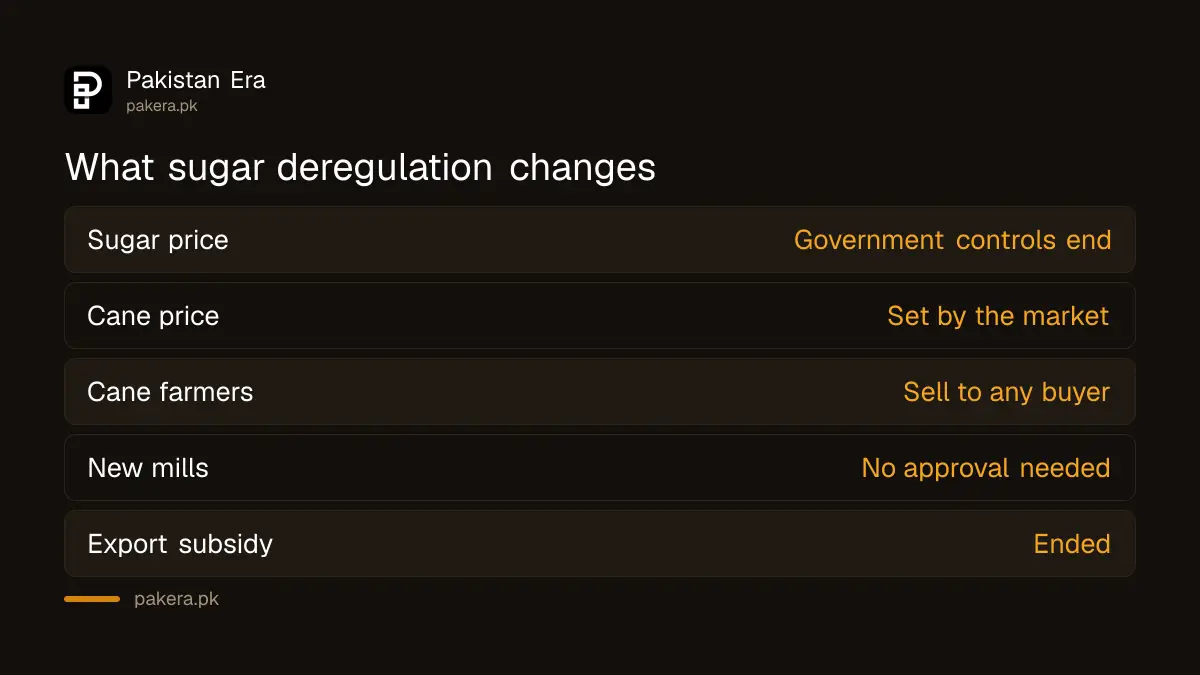
The cabinet approved sugar deregulation on 24 November 2026
The federal cabinet approved the sugar deregulation policy on 24 November 2026 through circulation, meaning ministers signed off on paper without a meeting. Prime Minister Shehbaz Sharif recused himself from sugar decisions because his family has interests in the sugar business.
A ministerial committee headed by Power Minister Sardar Awais Leghari drafted the policy. Punjab, Khyber Pakhtunkhwa and Balochistan had agreed earlier. Sindh cleared it on 21 November after its amendments were accepted. Those amendments have not been made public.
Price controls and export subsidies end
The policy removes the government from setting sugar and cane prices. Export subsidies end completely. Restrictions on moving sugar from one province to another are lifted. Mills can buy cane from where they choose and decide their own production.
| Area | Under the new policy |
|---|---|
| Cane farmers | Sell to any buyer; cane price set by the market |
| Varieties and planting | Zone and variety limits removed; a negative list of banned varieties stays |
| Sugar mills | No restriction on new mills or extra capacity; mills choose where to buy cane |
| Sugar price | Government price controls end |
| Exports | Subsidies end; a "predictable" trade mechanism promised |
| Movement between provinces | No restriction |
The government keeps two powers. It can hold buffer stocks of sugar, and it can collect information on cane crops, production and stocks. The policy also points towards a future rule requiring ethanol to be blended into fuel.
Farmers get weighing checks and interest on late payment
For the current crushing season, the policy adds three protections for growers: third-party checks of mill weighing scales, a system to test sucrose content in cane, and interest paid by mills when cane payments are late. These are transition rules.
Late payment has been a common complaint of cane growers for years. Under the new policy, a mill that pays late owes interest on top of the price. The exact rate and the date the transition rules end have not been published yet.
The policy also plans easier credit for growers, schemes to buy farm machines, and use of the sugarcane cess for research. Farmers asked for a cane rate of Rs 700 a maund before this season, as we reported in the sugarcane growers' demand for Rs 700. With deregulation, no official rate will settle that demand.
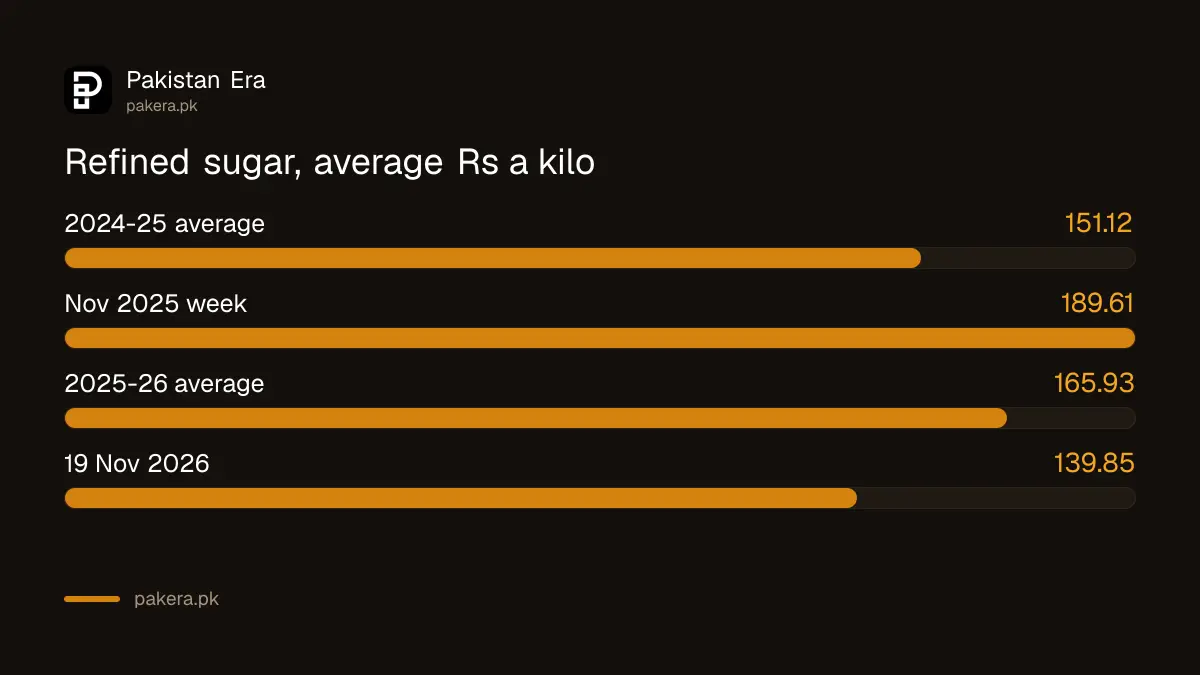
Sugar costs Rs 139.85 a kilo as the policy starts
PBS put the national average for refined sugar at Rs 139.85 a kilo in the week ended 19 November 2026, down from Rs 139.95 a week earlier and Rs 189.61 a year earlier. Sugar is about 26% cheaper than in November 2025.
| Week ended | Average price per kilo |
|---|---|
| 19 November 2026 | Rs 139.85 |
| 12 November 2026 | Rs 139.95 |
| Same week of 2025 | Rs 189.61 |
| Average of 2025-26 | Rs 165.93 |
| Average of 2024-25 | Rs 151.12 |
The country has surplus sugar this season. The government approved exports of more than 400,000 tonnes on 20 November, on top of about 200,000 tonnes allowed earlier this year. City by city prices are in our sugar price report, and the weekly basket is in the SPI for 19 November.
The IMF board meeting depends on this step
Sugar deregulation was an IMF structural benchmark due by 30 June 2026. Pakistan missed that date, so the cabinet's approval came nearly five months late. It was needed before the IMF Executive Board could take up Pakistan's review, which is reported to be set for 11 December.
Background on the review is in our report on the IMF fourth review of Pakistan. Board approval is what releases the next loan payment.
What this means for you
For most households, nothing changes at the shop this week. The bigger effect is over the next year, when prices will follow the crop and exports rather than official rates.
- Buyers: check the weekly PBS price before paying much above Rs 140 a kilo in your city. The SPI lists 17 cities.
- Cane growers: keep every weighing slip and payment receipt. Late payment now carries interest, but only if you can show when cane was delivered.
- Growers near more than one mill: compare offers. Zoning no longer ties you to one buyer.
- Shareholders of sugar companies: watch mill notices on the stock exchange for new export or capacity plans.
- Anyone tracking the policy: wait for the published text before acting on details such as the interest rate on late payments.
Earlier export decisions are in our report on the cabinet committee's sugar export review.
Common questions
When was the sugar deregulation policy approved?
The federal cabinet approved it on Tuesday 24 November 2026, by circulation, after Sindh cleared the draft on 21 November.
Will sugar prices go up after deregulation?
Not automatically. Prices will follow supply, demand and exports. In the week ended 19 November the average was Rs 139.85 a kilo, about 26% below last year.
Who will set the sugarcane price now?
The market. The government no longer fixes cane prices, and growers can sell to any buyer, not just the nearest mill.
Can new sugar mills be set up now?
Yes. The policy removes restrictions on new mills and on expanding the capacity of existing ones.
Is sugar export subsidy still available?
No. The policy ends export subsidies completely. The rules for future exports and imports have not been published yet.
Why did the IMF want sugar deregulated?
The IMF made it a structural benchmark of Pakistan's loan programme, to end government price controls along the sugar value chain.
How we verified this
What we checked and where we read it.
We checked this on 25 November 2026. The cabinet approval by circulation on 24 November, the Leghari committee, Sindh's clearance on 21 November, the list of changes, the transition rules, the export approvals and the 11 December board date are consistent across reliable reports published on 24 and 25 November. The government has not yet put the policy text on an official website. The sugar prices are from the PBS Sensitive Price Indicator for the week ended 19 November 2026, item 24, refined sugar, national average. The 26% yearly fall and the Rs 49.76 difference are our own arithmetic.
About the author

Global Affairs & Political Economy Writer
Muhammad Hatim is a book lover who started writing because he enjoys it. At Pakistan Era he writes about international relations, geopolitics and the global economy, with a particular interest in South Asia and the forces behind current events.