Supreme Court: Sindh Rent Controller Can Weigh a Rent Default Raised During the Case
Reports say the Supreme Court upheld the eviction of five Karachi firms and held a Sindh rent controller may weigh rent default during a case. See what it means
Short answer: The Supreme Court has upheld the eviction of five Karachi companies and held that a Sindh rent controller is not barred from looking at rent defaults that happen while the eviction case is running, if the record supports them. Reports of the judgment say the court called it "incorrect" to treat an unpleaded default as never usable.
A tenant pays on the 10th, a little short, for two months. The landlord files for eviction over something else. Can the controller count those two short months? A ruling reported on 11 October 2026 says the answer is yes, in the right case.
We could not find the judgment on the Supreme Court website on 12 October 2026. The account below is therefore reported, and we say so each time. The Sindh law it applies we did read at source, on the Sindh Laws site.
The court dismissed five appeals against eviction orders
A two-member bench of Chief Justice Yahya Afridi and Justice Muhammad Shafi Siddiqui refused leave to appeal, reports say. The five Karachi companies had challenged Sindh High Court judgments of 19 June 2026. Their landlord, Karachi Properties Investment Company, had sought eviction under the Sindh Rented Premises Ordinance, 1979.
The landlord's grounds were rent default, unpaid maintenance charges and harm to the building's value and use. "Leave to appeal" means the court's permission to argue an appeal. Refusing it ends the case at the top court.
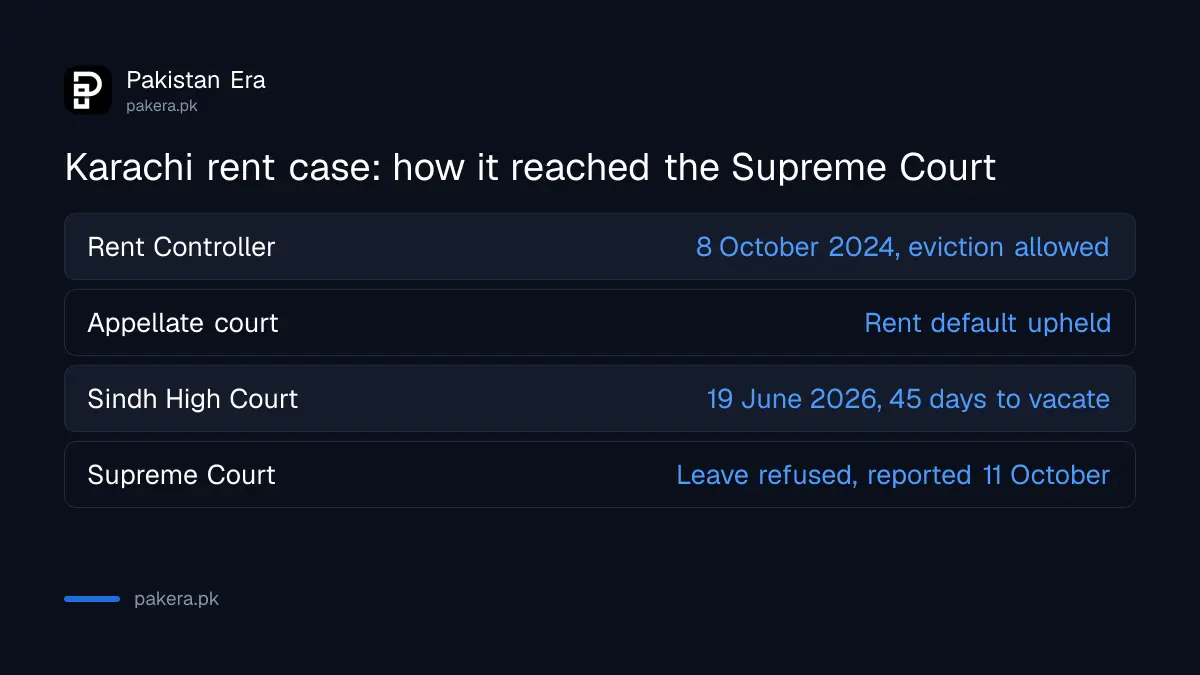
| Stage | What was reported |
|---|---|
| Rent Controller, 8 October 2024 | Allowed all five eviction applications |
| Appellate court | Upheld rent default and impairment, set aside maintenance default and one subletting finding |
| Sindh High Court, 19 June 2026 | Dismissed all five petitions, 45 days to vacate |
| Supreme Court, reported 11 October 2026 | Refused leave to appeal, orders stand |
The court said a rent controller may weigh events during the case
The nine-page judgment, written by Justice Siddiqui, holds that the law does not require a rent controller to ignore later events while an eviction case is pending, reports say. It relied on an earlier ruling of the court that allowed such events in suitable cases to avoid repeat proceedings.
The tenants argued the controller went beyond the pleadings. A "pleading" is the written case each side files. They said rent for May and June 2020 was never pleaded as a ground. The court, as reported, said it would be wrong to hold as an absolute rule that an unpleaded default can never be considered.
So the finding is narrow. It does not say a controller may invent a ground. It says the record the controller already has can include what happens along the way.
Advance rent and enhanced rent kept running because they were not objected to
Reports say the court noted that rent was payable in advance and that the tenants had paid the enhanced amount for January 2018. It also found no record that they had objected to the higher rent at the time. Short payments for February and March 2018 stayed unexplained.
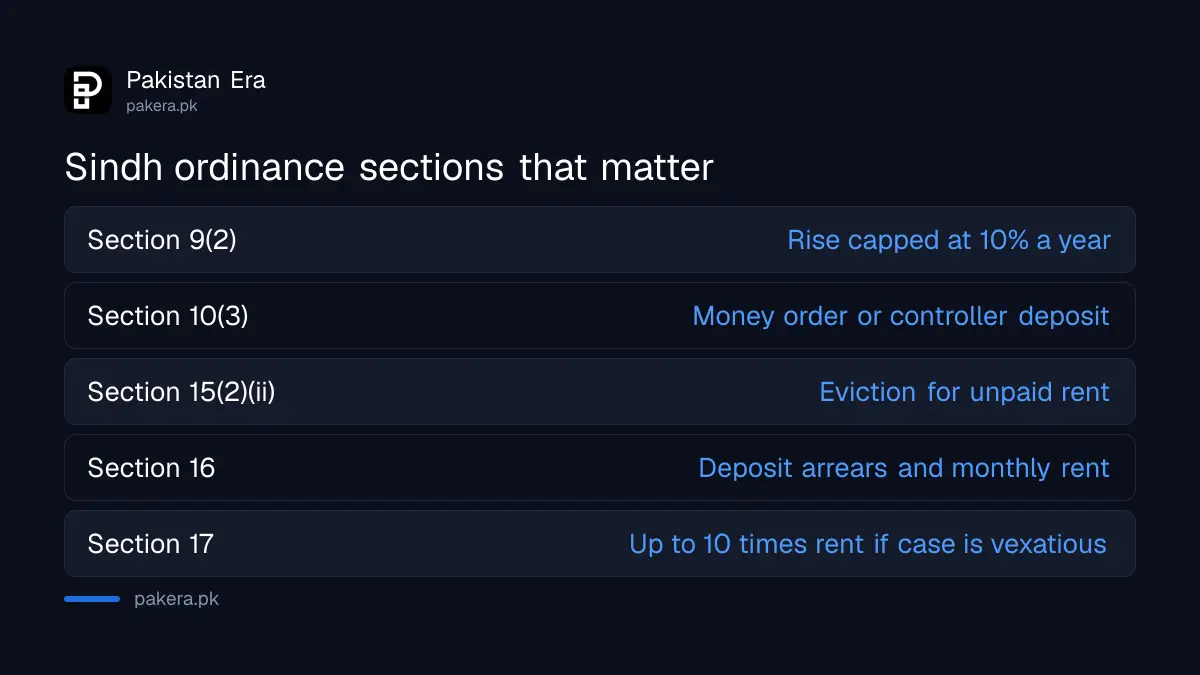
The judgment is quoted as saying terms not opposed by the ordinance would continue to operate, "whether it be of advance rent and/or enhanced rent (not exceeding 10%)". The ordinance itself caps a rise at ten per cent a year on the existing rent. We read section 9(2) of the official text and it says exactly that.
For tenants the lesson is practical. If you think a rise is unlawful, say so in writing at the time. Silence and part payment read badly later. Our explainer on rent increases and tenant rights in Pakistan covers the general rules.
What the Sindh ordinance says about default and deposit
Under section 15(2)(ii), a controller can order eviction if the tenant has not paid within fifteen days after the agreed period, or within sixty days after the rent is due where nothing was agreed. Section 16 lets the controller fix arrears and order monthly deposit, on or before the tenth of every month, until the case ends.
If the tenant fails to deposit, section 16(2) says the defence is struck off and the landlord is put in possession. The tenants in this case argued there was no "tentative rent order" under section 16(1). The court, as reported, still held the findings of default stood on the evidence.
When a landlord refuses rent, section 10(3) lets a tenant send it by postal money order or deposit it with the controller. That protects you on the dates that decide such cases. Keep every receipt. The tenant who can show a dated receipt is the tenant who answers a default claim.
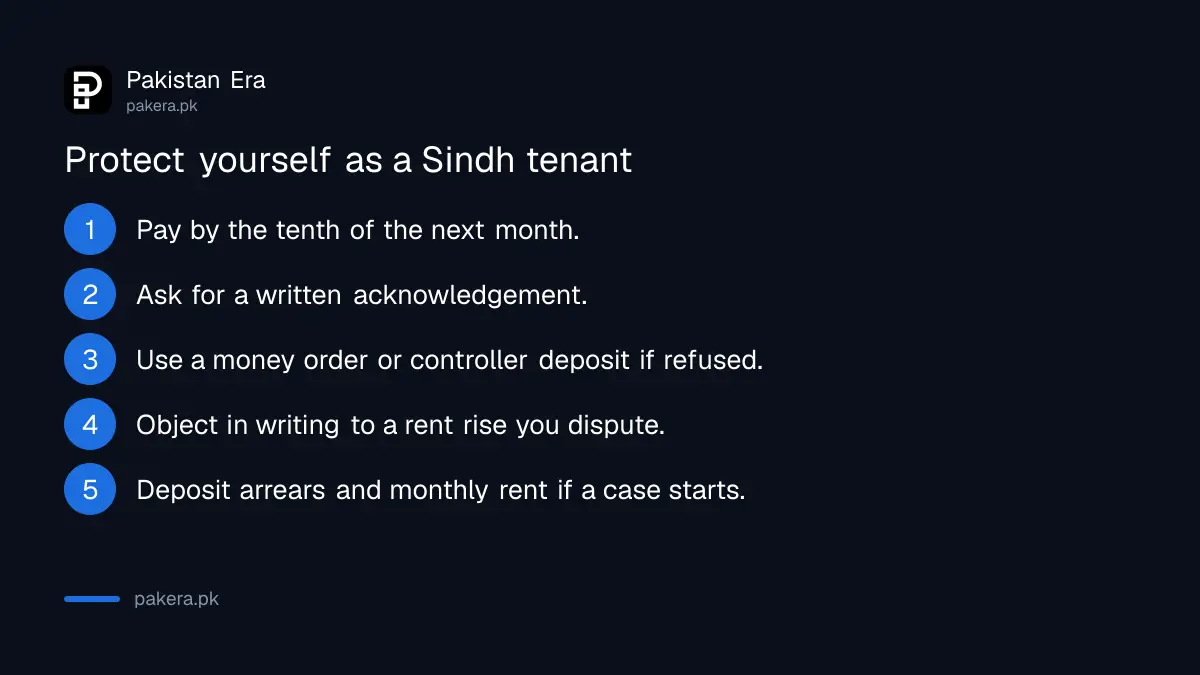
A tenant in Sindh who wants to stay protected can follow this order of steps.
- Pay rent by the tenth of the following month, or on the date in your agreement.
- Ask for a written acknowledgement of every payment.
- If the landlord refuses, send a postal money order or deposit with the rent controller.
- Object in writing the day a rent rise arrives, if you think it is unlawful.
- If a case is filed, deposit arrears and monthly rent as the controller orders.
What this does not change
This is a Sindh ruling under a Sindh law. Punjab and Islamabad have their own rent laws, and Islamabad's tenancy rules on registration and a yearly rent rise are separate from Sindh's. Our guide on tenant rights and eviction in Pakistan deals with a recent Lahore High Court ruling. A Supreme Court judgment binds the country on a point of law, but we have not read this one, so we do not claim how far its reasoning reaches outside Sindh.
It also does not remove the tenant's rights. Compensation of up to ten times the monthly rent is available under section 17 if a landlord's eviction application is frivolous or vexatious.
Common questions
Did the Supreme Court say landlords can add new grounds during a case?
No. Reports say it held a controller may consider later events that the record supports. It rejected an absolute rule that an unpleaded default can never be considered.
Which law applied to this Karachi eviction?
The Sindh Rented Premises Ordinance, 1979. Punjab and Islamabad are governed by their own rent laws.
How much can rent rise under the Sindh ordinance?
Section 9(2) says an increase must not exceed ten per cent a year on the existing rent. Section 9(1) bars a further increase for three years after a fair rent is fixed.
What if my landlord refuses to take the rent?
Section 10(3) allows a postal money order or a deposit with the rent controller. Keep the receipt, because section 10(4) makes it proof of payment.
Can I read the full judgment?
Not yet on the Supreme Court site, as far as we could find on 12 October 2026. We will treat the account as reported until the text is posted.
How we verified this
What we checked, where we read it, and what we could not confirm.
We read the Sindh Rented Premises Ordinance, 1979, on the Sindh Laws site on 12 October 2026. The text is the amended copy that site holds. The Supreme Court account is reported and unconfirmed against the judgment. Check the Supreme Court of Pakistan website for the full text.
About the author

Public Services and Education Journalist
Fajr Riaz is a journalist and content writer at Pakistan Era, based in Lahore. She covers the questions people meet in everyday life in Pakistan: how a public service works, what a change in the rules means, and where to find a reliable answer.