Check If You Are a Tax Resident of Pakistan: the 183-Day Rule, the 182-Day Abroad Test and How Days Are Counted
Check your Pakistan tax residency: 183 days in Pakistan, or a citizen not over 182 days in any other country. How rule 14 counts days, and what residence means.
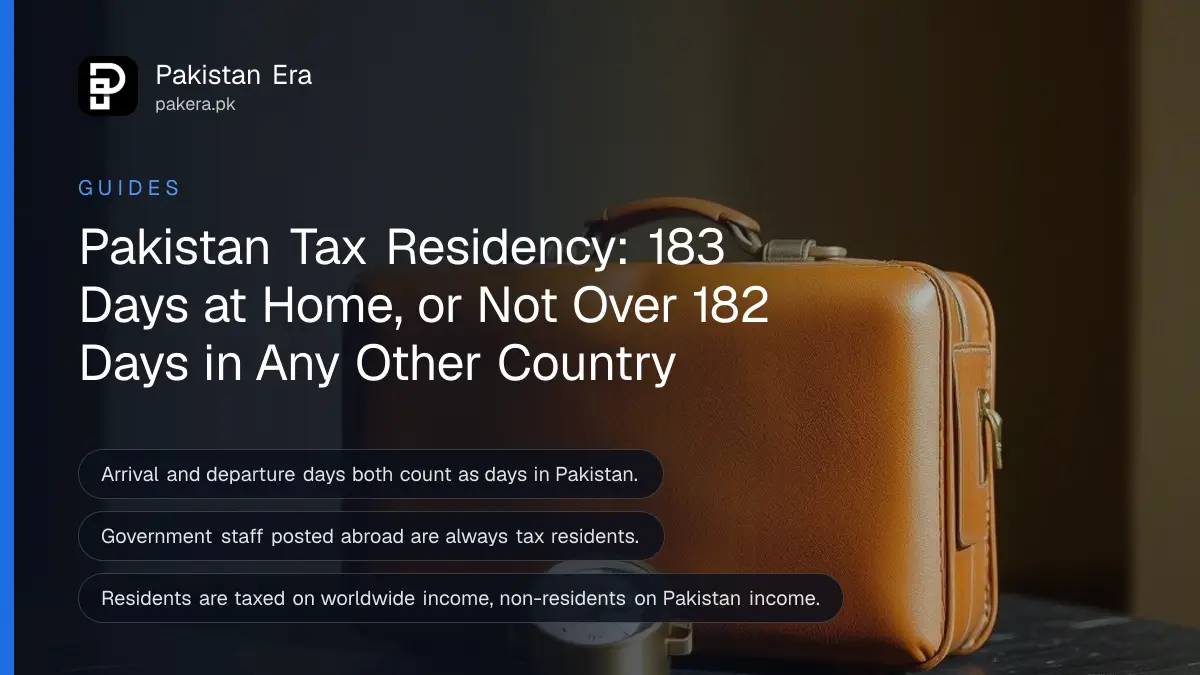
You are a tax resident of Pakistan for a tax year (1 July to 30 June) if you spend 183 days or more in Pakistan. A Pakistani citizen is also resident if they did not spend more than 182 days in any other single country that year, or are not a resident taxpayer anywhere else. Government employees posted abroad are always resident. Residents pay Pakistani tax on worldwide income; non-residents only on income from Pakistan.
These tests are in section 82 of the Income Tax Ordinance, 2001, and rule 14 of the Income Tax Rules, 2002 says how to count days. Overseas Pakistanis who split the year between countries are the people most often caught by the second test. Here is how each test works and what to keep as proof.
The four ways to become a resident individual
Section 82 has three live clauses, and the citizen test has two parts. Meeting any one makes you resident for that tax year. Residence is decided again each year. The old 120-day test, with 365 days over four years, was removed by the Finance Act, 2021.
| Test | Who it applies to | Law |
|---|---|---|
| Present in Pakistan 183 days or more in the tax year | Anyone, any nationality | Section 82(a) |
| Federal or provincial government employee or official posted abroad | Government staff | Section 82(c) |
| Not present in any other country for more than 182 days in the tax year | Pakistani citizens | Section 82(d) |
| Not a resident taxpayer of any other country | Pakistani citizens | Section 82(d) |
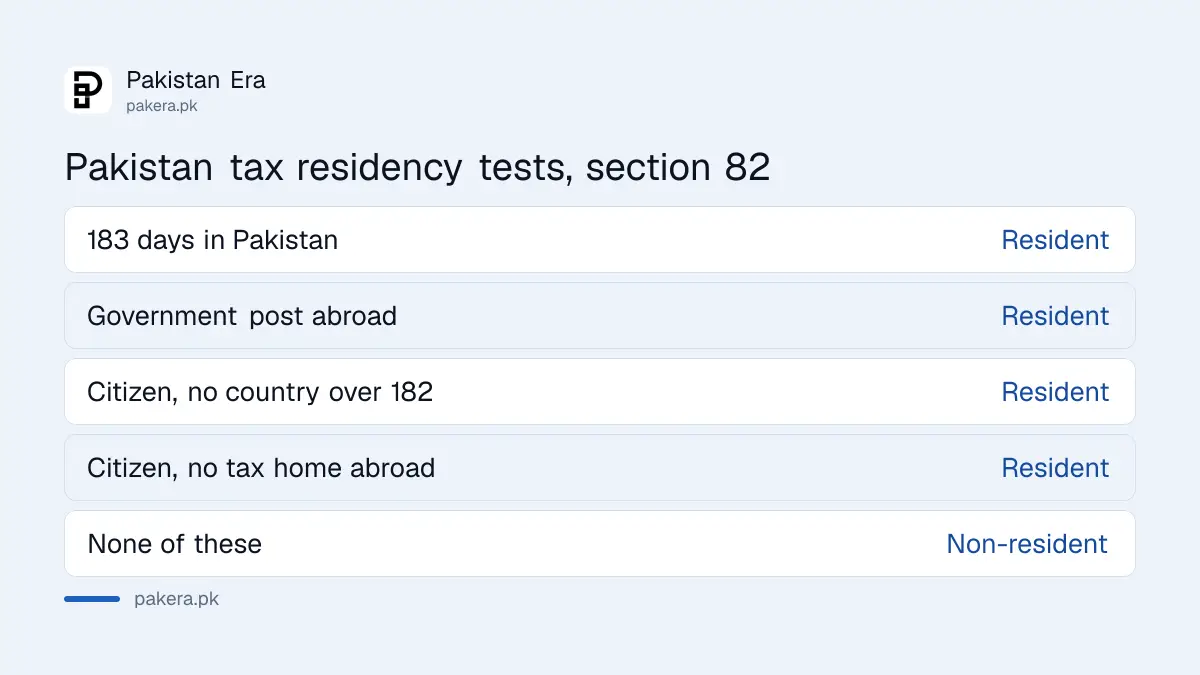
If none of these applies, you are a non-resident for that year under section 81(2). Companies and associations of persons have their own tests in sections 83 and 84, based mainly on where they are formed or managed.
How days in Pakistan are counted
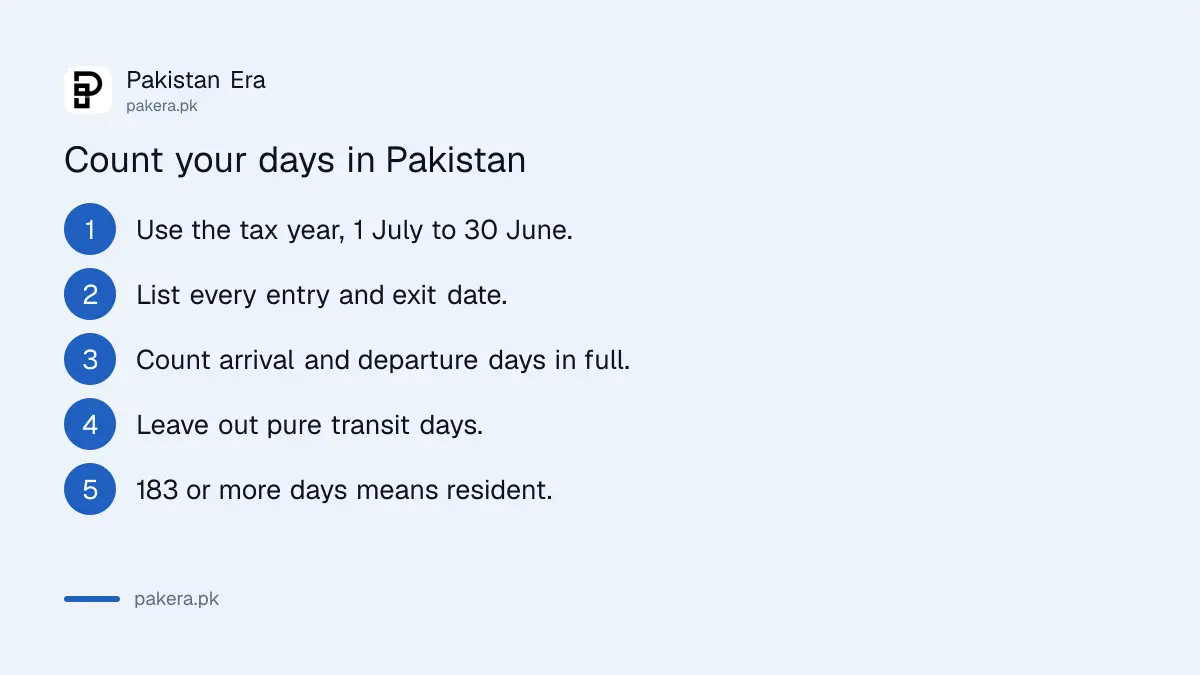
Rule 14 counts any part of a day in Pakistan as a whole day, including the day you arrive and the day you leave. Public holidays, leave days, sick days and holidays spent in Pakistan all count. Only days spent purely in transit between two foreign places are left out.
- Take the tax year: 1 July to 30 June. For tax year 2027 that is 1 July 2026 to 30 June 2027.
- List every entry and exit date from your passport stamps or travel tickets.
- Count each day you were in Pakistan for any part of the day, arrival and departure days included.
- Leave out days when you only changed planes in Pakistan between two foreign airports.
- If the total is 183 or more, you are resident. If not, check the citizen test below.
A short visit can tip the balance. Arriving on 1 January and leaving on 3 January counts as three days, not two. For someone close to 183, a few extra trips decide the result.
The 182-day test that catches overseas Pakistanis
Section 82(d), added by the Finance Act, 2022, makes a citizen resident if they were not in any other country for more than 182 days in the tax year. A Pakistani who moves between several countries, without settling in one, can be a Pakistani tax resident while spending little time at home.
Example: a Pakistani engineer spends 150 days in Saudi Arabia, 120 days in Qatar and 95 days in Pakistan in one tax year. He is under 183 days in Pakistan, but he was not in any other single country for more than 182 days. Under section 82(d) he is a resident of Pakistan for that year.
The second part works the same way. A citizen who is not a resident taxpayer of any other country is resident in Pakistan. So the strongest proof of non-residence for someone working abroad is a tax residency certificate from the country where they live, together with passport stamps showing more than 182 days there.
What residence means for your tax
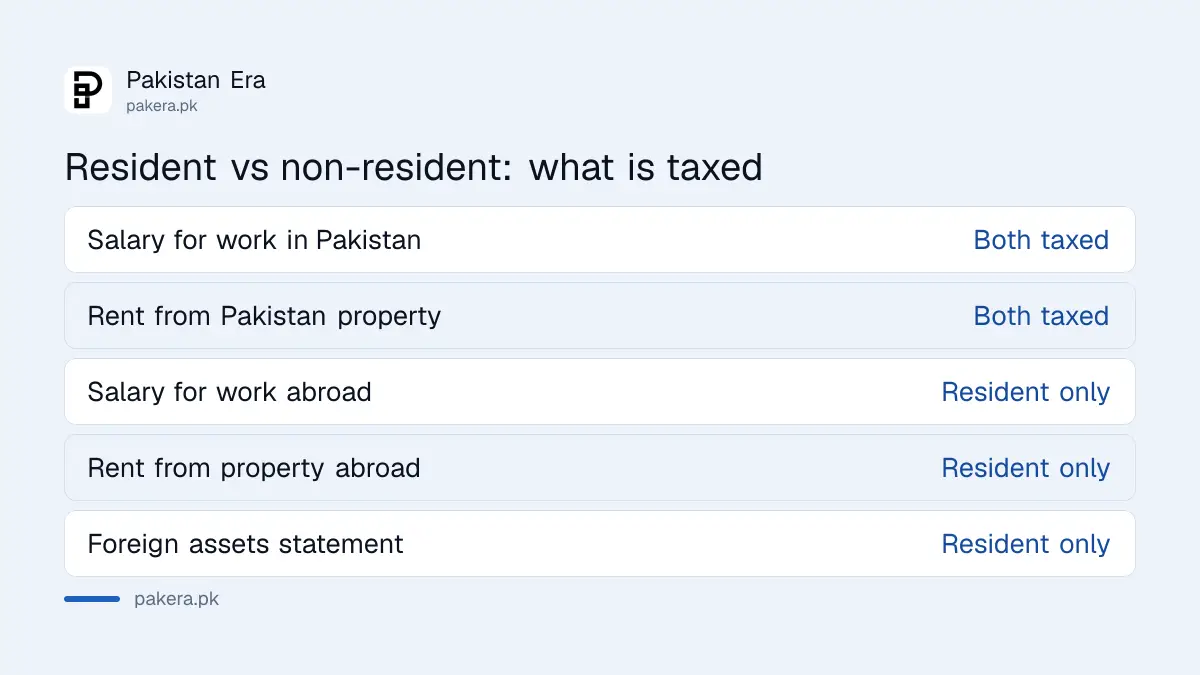
A resident is taxed on income from Pakistan and from abroad, under section 11(5). A non-resident is taxed only on Pakistan-source income, under section 11(6). So a resident with a job, rent or business abroad must declare it, and may claim credit for foreign tax already paid.
| Item | Resident | Non-resident |
|---|---|---|
| Salary for work in Pakistan | Taxed | Taxed |
| Rent from property in Pakistan | Taxed | Taxed |
| Salary for work abroad | Taxed, foreign tax credit possible | Not taxed |
| Rent from property abroad | Taxed, foreign tax credit possible | Not taxed |
| Foreign assets statement | Required if you hold foreign assets | Not required |
Residents with foreign income can claim the foreign tax credit, explained in the section 103 foreign tax credit guide, and must list foreign assets in the section 116A foreign assets statement.
Returning home: two tax-free years on foreign income
A citizen who was non-resident in all four tax years before returning gets section 51(1) relief. Foreign-source income is exempt in the year they become resident again and in the next tax year. Pakistani income is taxed as normal from the first year.
Leaving works the other way. Under section 51(2), if you leave Pakistan during a tax year and stay abroad for the rest of it, salary you earn abroad in that year is exempt. Returning with household goods? The transfer of residence rules for returning Pakistanis cover customs.
Whatever your status, an overseas Pakistani with Pakistani income still has to file a tax return as an overseas Pakistani to stay on the Active Taxpayers List.
Common questions
How many days make you a tax resident of Pakistan?
183 days or more in Pakistan during the tax year, from 1 July to 30 June, under section 82(a).
Do the days of arrival and departure count?
Yes. Rule 14 counts any part of a day in Pakistan as a full day, including arrival and departure days.
Can I be resident in Pakistan if I spent most of the year abroad?
Yes, if you are a citizen and were not in any other single country for more than 182 days, or are not a resident taxpayer elsewhere.
Are government officers posted abroad tax residents?
Yes. Section 82(c) makes any federal or provincial government employee or official posted abroad a resident individual.
Does the 120-day rule still apply?
No. The test of 120 days plus 365 days over four years was removed by the Finance Act, 2021.
What proof should a non-resident keep?
Passport entry and exit stamps, and a tax residency certificate from the country where you live and pay tax.
How we verified this
What we checked and where we read it.
We checked sections 11(5) and (6), 51, 81 and 82 in the Income Tax Ordinance, 2001 amended up to 30 June 2026, and rule 14 in the Income Tax Rules, 2002 amended up to 15 September 2026, both on FBR's download server, on 15 November 2026. The day counts and the engineer example are our own illustrations. The footnotes in the Ordinance record the removed 90-day and 120-day tests.
About the author

Tax, Bills and Technology Writer
Ali Akhtar is a young and curious voice here at Pakistan Era. He is currently pursuing his A-Levels and has a growing interest in Pakistan’s changing industrial landscape and educational trends. Ali likes to write in a way that helps him explain and explore the world around him. His writing reflects the perspective of the new generation navigating the evolving trends of Pakistan where technology, youth innovation, and shifting opportunities are reshaping the country’s future.