Claim Foreign Tax Credit on Your Pakistan Tax Return: How Section 103 Works
Pakistan residents who paid tax abroad can claim foreign tax credit under section 103. See the average rate formula, a worked example and the two-year rule.

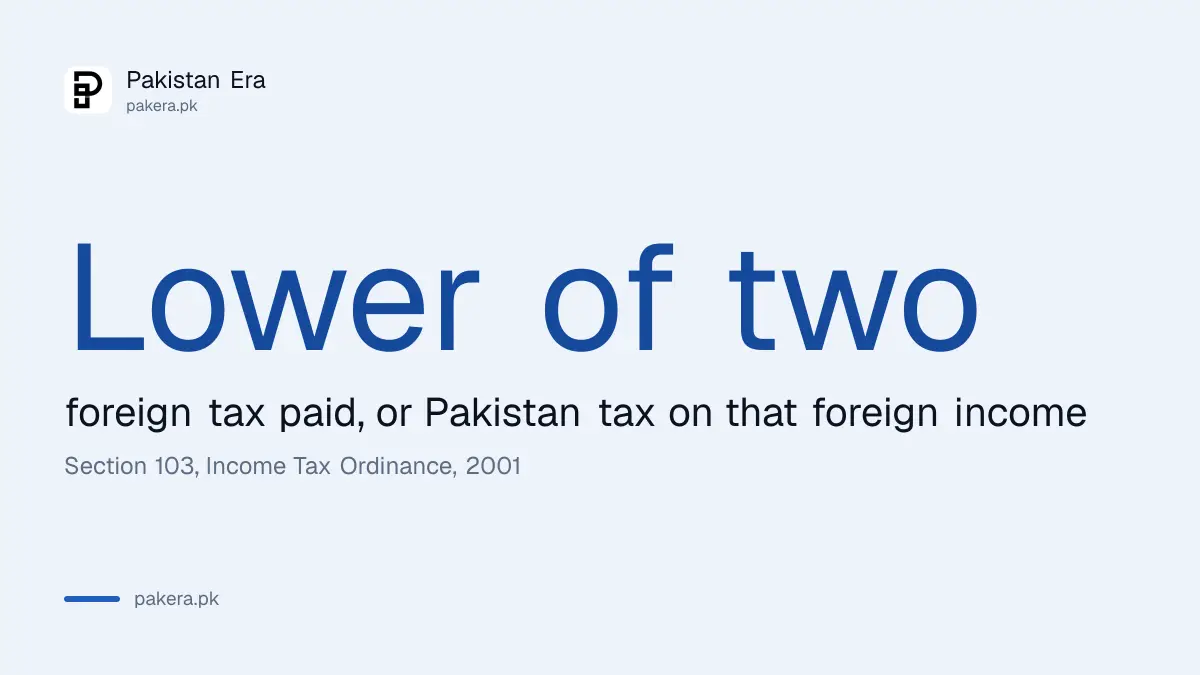
Short answer: If you are a Pakistan tax resident and you already paid tax abroad on foreign income, section 103 of the Income Tax Ordinance, 2001 lets you take that tax off your Pakistan bill. The credit is the lower of the foreign tax you paid or the Pakistan tax on that income. Anything left over is lost: it is not refunded or carried forward.
Foreign tax credit stops the same income being taxed twice in full, once abroad and once in Pakistan. We read sections 82, 102, 103, 104 and 107 in FBR's copy of the Ordinance as amended up to 30 June 2026. The tax year 2026 return is due by 31 October 2026, so this is the month to get it right.
Section 103 gives a credit for tax already paid abroad
A resident taxpayer who earns foreign-source income that Pakistan also taxes, and who paid foreign income tax on it, gets a tax credit under section 103. The credit equals the lower of the foreign tax paid or the Pakistan tax payable on that same income.
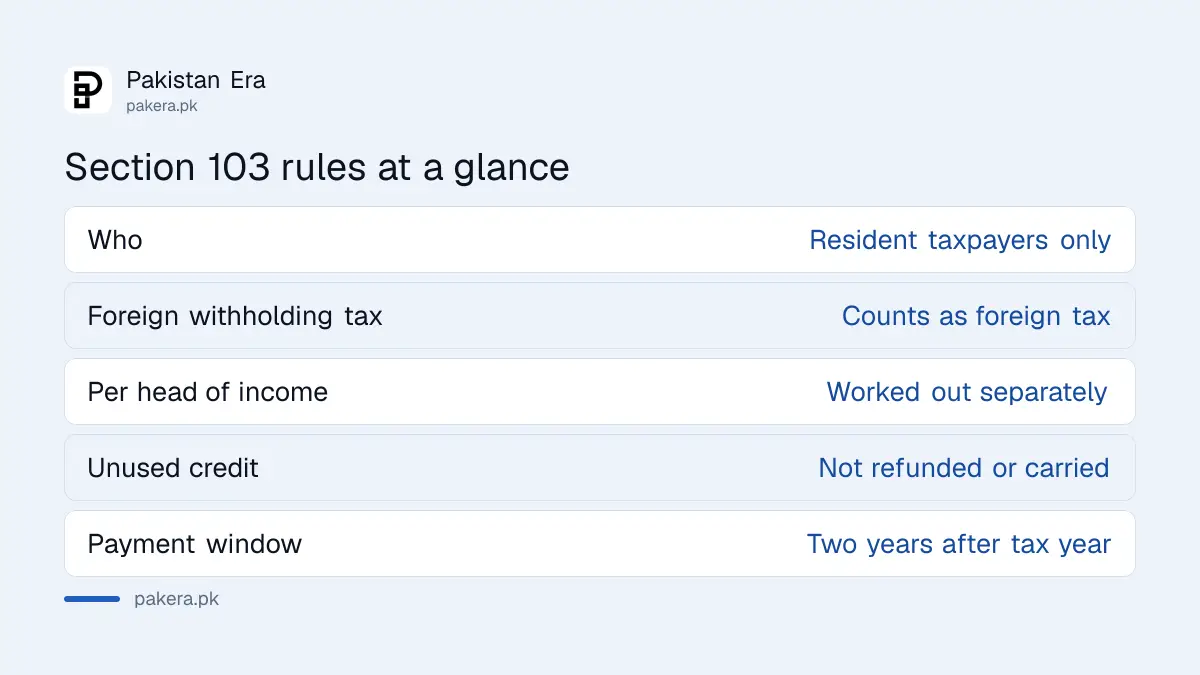
Foreign income tax includes tax withheld at source abroad. So tax a foreign bank or client deducted before paying you counts, as long as it was paid to the foreign tax authority. You need proof of it, such as a foreign tax certificate, a payslip or a statement from the payer.
The credit only reduces tax. It cannot create a refund. If the foreign tax is more than the Pakistan tax on that income, the extra cannot be refunded, carried back to last year or carried forward to next year. Section 103(6) says so in plain terms.
Only Pakistan residents can claim the credit
Section 103 is for resident taxpayers. An individual is resident for a tax year if present in Pakistan for 183 days or more in that year. A government employee posted abroad is resident too, and so is a citizen who stays under 183 days in any other country or is not a tax resident anywhere else.
Non-residents are taxed in Pakistan only on Pakistan-source income, so they have no foreign income here to claim a credit on. If you moved abroad for work, check your days first. The tax return rules for overseas Pakistanis explain the non-resident side.
One group does not need the credit at all. Under section 102, foreign salary of a resident individual is exempt from Pakistan tax if foreign tax was withheld from it by the employer and paid to the tax authority of the country where the work was done. Declare it as exempt income, with proof.
Work out the credit with your average rate of tax
The Pakistan tax on your foreign income is your average rate of Pakistan tax multiplied by your net foreign-source income. The average rate is your Pakistan tax before the credit divided by your taxable income. Compare that figure with the foreign tax paid and claim the lower one.
- Add up your taxable income for the year, foreign and Pakistani together.
- Work out your Pakistan tax on it before any foreign tax credit.
- Divide that tax by your taxable income. This is your average rate.
- Take your foreign income and subtract the expenses that relate to earning it. This is your net foreign-source income.
- Multiply the net foreign-source income by your average rate.
- Compare this with the foreign tax you paid. Your credit is the lower of the two.
Here is a worked example with made up numbers. It assumes the foreign income is taxed with the rest of your income at normal rates.
| Line | Case A | Case B |
|---|---|---|
| Taxable income, all sources | Rs 5,000,000 | Rs 5,000,000 |
| Pakistan tax before credit | Rs 900,000 | Rs 900,000 |
| Average rate | 18% | 18% |
| Net foreign-source income | Rs 1,000,000 | Rs 1,000,000 |
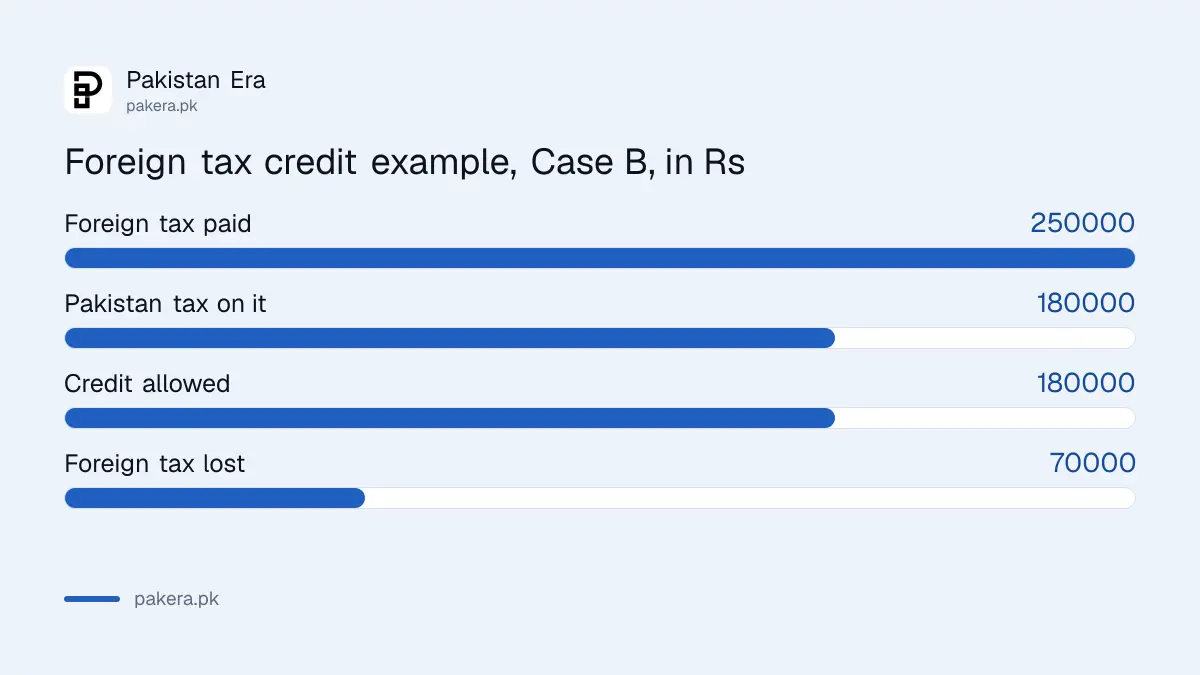
| Pakistan tax on that income | Rs 180,000 | Rs 180,000 |
| Foreign tax paid | Rs 150,000 | Rs 250,000 |
| Credit allowed | Rs 150,000 | Rs 180,000 |
| Tax left to pay in Pakistan | Rs 750,000 | Rs 720,000 |
| Foreign tax that is lost | Nil | Rs 70,000 |
Each head of income gets its own credit, and timing matters
If you have foreign income under more than one head, such as rent and business income, section 103 applies to each head separately. A speculation business counts as its own head. And the foreign tax must be paid within two years after the end of the tax year in which you earned the income.
The separate heads rule stops you using high foreign tax on one income to cover low foreign tax on another. Work out the credit head by head, then add the credits up.
For tax year 2026, which ran from 1 July 2025 to 30 June 2026, the foreign tax has to be paid by 30 June 2028 to count. If a foreign assessment is still open, you can claim once it is paid, through a revised income tax return.
Foreign losses follow a separate rule in section 104. Expenses of earning foreign income can only be set against foreign income under the same head. A foreign loss can be carried forward for up to six tax years, but only against foreign income of that head.
Treaty rates are reported missing from this year's IRIS return
Pakistan's tax treaties can lower the tax on some foreign income, such as dividends and profit on debt. Section 107 gives those treaties force of law. But tax advisers reported on 15 October 2026 that the IRIS return for tax year 2026 no longer has the tab used last year to apply treaty rates.
The report says filers are left with two choices: show such income as exempt, or tax it at normal rates. Neither fits a treaty case well. We could not check this ourselves, because it needs a taxpayer login with foreign income on it, and FBR has not said anything about it on its website.
If this affects you, keep your treaty working and the foreign payer's tax certificate in your file. Then write to your tax office through IRIS, or ask for a rectification under section 221 if an order later taxes you at the wrong rate.
Whatever you claim, declare the foreign assets that produce the income too. Residents with foreign income or assets must file a foreign income and assets statement under section 116A, and it should agree with your return.
Common questions
Who can claim foreign tax credit in Pakistan?
A resident taxpayer who has foreign-source income taxable in Pakistan and has paid foreign income tax on it, including foreign withholding tax.
How much foreign tax credit can I claim?
The lower of the foreign tax paid or the Pakistan tax on that income. The Pakistan tax is your average rate times your net foreign-source income.
Is unused foreign tax credit refunded?
No. Section 103(6) says unused credit is not refunded, carried back or carried forward.
Is my foreign salary taxed in Pakistan?
Not if you are a resident individual and foreign tax was withheld from it by your employer and paid abroad. Section 102 exempts it.
How long do I have to pay the foreign tax?
It must be paid within two years after the end of the tax year in which the income was earned.
Can I apply a tax treaty rate in IRIS this year?
Tax advisers report that the tab for treaty rates is missing from the tax year 2026 return. We could not confirm this, and FBR has not commented on its site.
How we verified this
What we checked, where we read it, and what we could not confirm.
Last checked 20 October 2026. We read sections 82, 102, 103, 104 and 107 in the Income Tax Ordinance, 2001 as amended up to 30 June 2026 on FBR's site. The worked example uses made up numbers and our own arithmetic. The missing treaty tab on IRIS is reported, not confirmed: we could not log in as a taxpayer with foreign income, and FBR has published nothing on it. Incomes taxed under a separate or final regime may work differently from the example. The 31 October 2026 deadline comes from FBR's Circular No. 04 of 2026-27.
About the author

Senior Writer, Public Services and Technology
Shahid joined us in 2024 as an author. He is a senior contributor to Pakistan's leading technology websites. He writes detailed articles, mostly covering his expertise in the latest tech, mobiles, apps, gadgets, and step-by-step guides. His ideology is to help people understand the latest trends and explain complex methods through very easy-to-understand guides.