How to Change the Investigation Officer in a Punjab Police Case
Change the investigation officer in a Punjab police case: apply to the DPO under Article 18A, 7 working days, then the RPO and IG Punjab, plus CCD cases.
To change the investigation officer in a Punjab police case, apply in writing to the Head of District Police (the DPO, or in Lahore the head of the District Investigation Branch). Under Article 18A of the Police Order 2002, he must decide within seven working days, after taking the opinion of the District Standing Board. If you are not satisfied, you can go to the Regional Police Officer, and then to the Provincial Police Officer, the IG Punjab.
Complainants ask for a new investigation officer when they feel the officer is siding with the other party. Accused people ask for the same thing when they think the case against them is being built unfairly. Article 18A gives both sides the same three-step route. It is a police procedure, and it runs alongside the court route under Section 22-A of the Code of Criminal Procedure.
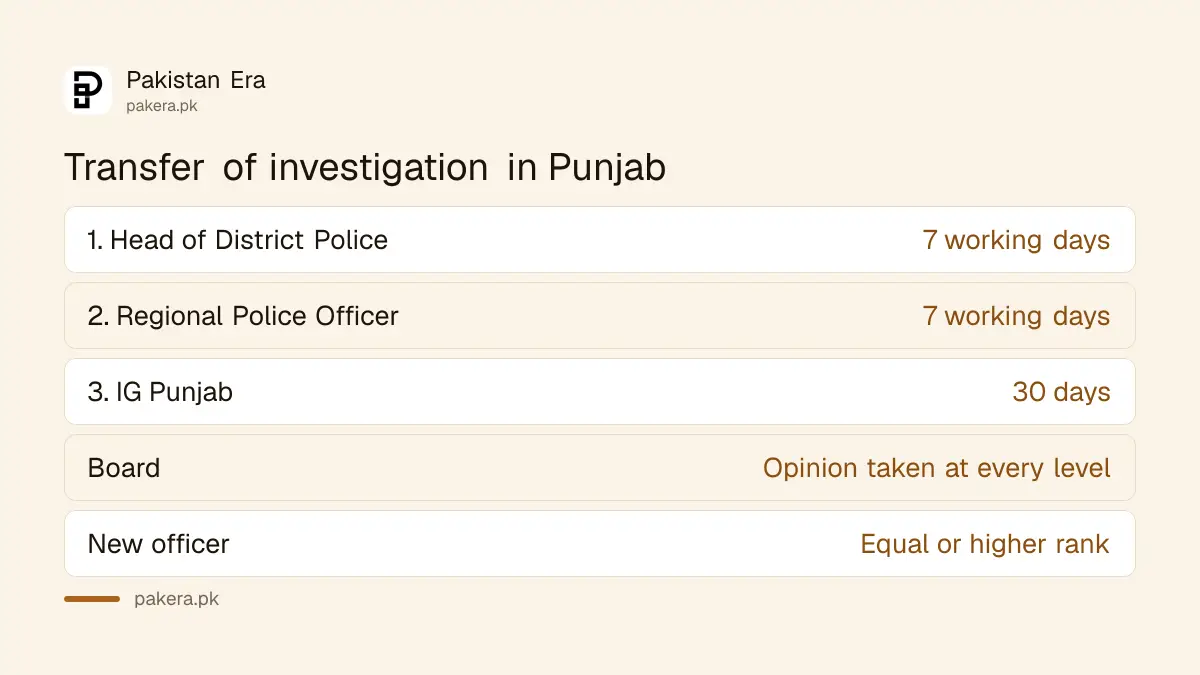
Article 18A sets three levels and fixed time limits
Article 18A of the Police Order 2002, inserted in Punjab by the Punjab Police Order (Amendment) Act 2013, lets the district, regional and provincial police heads transfer an investigation. Each decides after a board's opinion, with seven working days at the first two levels and thirty days at the top.
| Level | Who decides | Board consulted | Time limit |
|---|---|---|---|
| 1. District | Head of District Police | District Standing Board: an SP and two officers of at least DSP rank | 7 working days from filing |
| 2. Region | Regional Police Officer | Regional Standing Board: an SP and two SPs | 7 working days from filing |
| 3. Province | Provincial Police Officer (IG Punjab) | Standing Review Board: a DIG and two officers of at least SP rank | 30 days from filing |
The order at each level must give "reasons to be recorded in writing". The new investigation officer, or team of officers, must be of a rank equal to or higher than the previous one. So a case cannot be moved from an inspector down to an assistant sub-inspector through this route.
Lahore and other capital city districts
For a Capital City District, Article 18A says the Head of District Police means the Head of the District Investigation Branch, and the Regional Police Officer means the Capital City Police Officer. In Lahore your first application goes to the investigation head of the district, and the second to the CCPO.
How to apply for a change of investigation officer
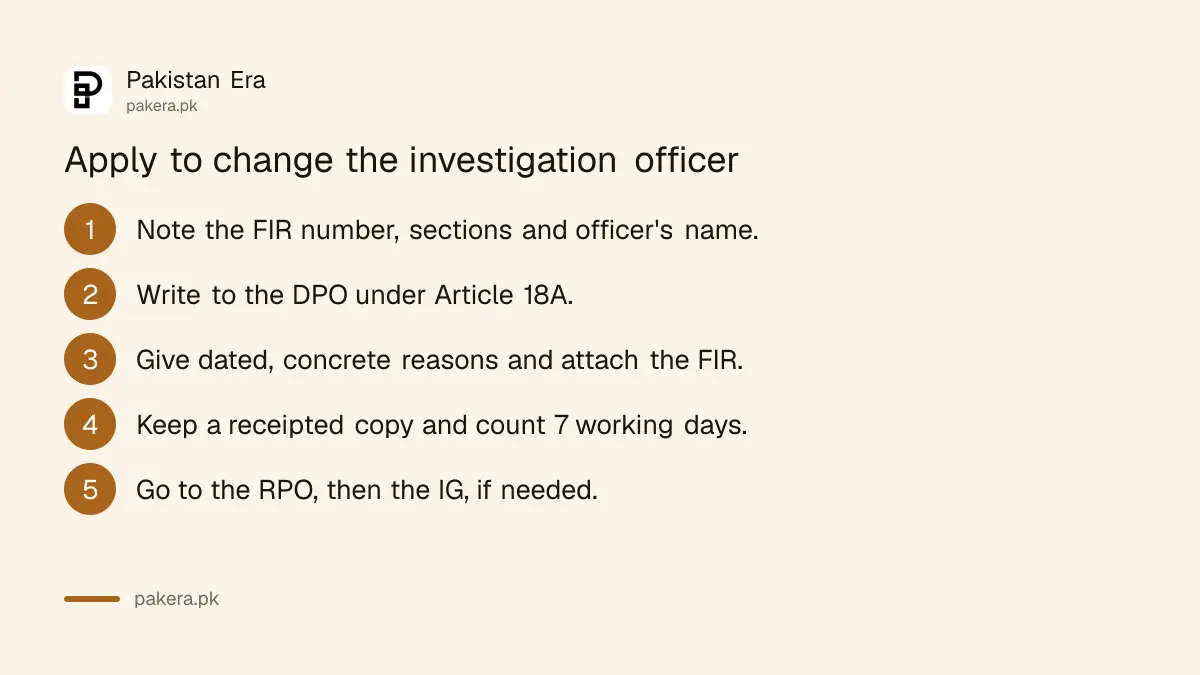
Write a short application to the Head of District Police, give it to his office, and keep a receipted copy. Clock the seven working days from the date of filing. If there is no decision or you disagree with it, move up one level.
- Get your case details. FIR number, date, police station, sections, and the name and rank of the current investigation officer.
- Write the application. Address it to the DPO (or the Lahore investigation head) and ask for transfer of investigation under Article 18A of the Police Order 2002.
- Give concrete reasons. For example, the officer refused to record your witnesses, did not collect a medico-legal report, or is related to the other party. Dates help.
- Attach copies. The FIR, your CNIC, and any earlier complaint about the investigation.
- File it and get a receipt. A diary number or a stamped copy proves the filing date.
- Attend if you are called. If the District Standing Board or the DPO's office calls you, bring the same papers and your witnesses' names.
- Go up a level if needed. Apply to the RPO (or CCPO), then to the IG Punjab, each with the earlier order attached.
You can get the FIR number and police station from the Punjab FIR check by CNIC if you do not have a copy. Copies of the FIR and police documents are also your right at trial, as free copies of the FIR and police report sets out.
Cases moved to the Crime Control Department follow their own route
The Punjab Police Order (Amendment) Act 2025 created a Crime Control Department (CCD) with its own police stations. The IG can send any district case to the CCD, and transfers inside the CCD go through its own district, regional and departmental heads.
The 2025 Act inserted Article 18C. Under it, the CCD registers and investigates the crimes listed in the Fourth Schedule to the Police Order. District police must hand over a case to the CCD within three days of its requisition, along with the case file, case property and any arrested accused. The same Act omitted the old Article 18B, which had set up the Organized Crime Unit, and its pending cases moved to the CCD.
If your case is with the CCD, write to the District Officer of the CCD first, then its Regional Officer, then the Head of the CCD. The first two levels again carry seven working days.
The court route under Section 22-A runs alongside
Section 22-A(6)(ii) of the Code of Criminal Procedure lets the Sessions Judge, acting as ex-officio Justice of the Peace, give directions to the police on a complaint about transfer of investigation. People usually use it after the police route under Article 18A gives no result.
A court petition takes longer and usually needs a lawyer. Attach your Article 18A applications and any orders on them, so the judge can see what the police already decided. If the problem is the police station's conduct in general rather than the investigation, the 1787 IGP complaint centre is quicker.
What a change of investigation can and cannot do
A new investigation officer re-examines the evidence and submits his own report under Section 173 of the Code. He cannot cancel the FIR on his own, and the court still decides guilt. Asking for repeated transfers can delay your own case.
- It can: get witnesses recorded, evidence collected, and a fresh view of the facts.
- It cannot: quash the FIR. That is for the courts, explained in cancelling a false FIR.
- Watch the clock: police must still send their report to court, and a long fight over who investigates slows that down.
Common questions
Who can change the investigation officer in Punjab?
The Head of District Police, then the Regional Police Officer, then the IG Punjab, under Article 18A of the Police Order 2002. Each decides after a standing board's opinion.
How long does a transfer of investigation application take?
Seven working days from filing at the district and regional levels, and thirty days at the IG level.
Can the case go to a junior officer?
No. Article 18A says the new officer or team must be of a rank equal to or higher than the previous investigation officer.
Can an accused person ask for a change of investigation?
Yes. Article 18A speaks of "an application" and does not limit it to the complainant.
Who decides in Lahore?
The head of the District Investigation Branch first, then the Capital City Police Officer, then the IG Punjab.
Does this apply in Sindh or Khyber Pakhtunkhwa?
No. Article 18A is in the Police Order 2002 as amended for Punjab. Other provinces have their own police laws, though the Section 22-A court route applies everywhere.
How we verified this
What we checked and where we read it.
Articles 18, 18A and 18C are from the Police Order 2002 as amended for Punjab, the PDF on the government's Punjab Code website, including the Punjab Police Order (Amendment) Act 2013 and the Police Order (Amendment) Act 2025 published in the Punjab Gazette on 30 May 2025. Section 22-A(6) is from the Code of Criminal Procedure on the Ministry of Law's Pakistan Code website. This page explains the procedure and is not legal advice.
Last checked 15 November 2026.
About the author

Global Affairs & Political Economy Writer
Muhammad Hatim is a book lover who started writing because he enjoys it. At Pakistan Era he writes about international relations, geopolitics and the global economy, with a particular interest in South Asia and the forces behind current events.