UAE Family Visa for Pakistanis: AED 4,000 Salary Rule and Who You Can Sponsor
UAE family visa for Pakistanis: sponsor on AED 4,000, or AED 3,000 plus housing. Who you can sponsor, papers from Pakistan, medical test and the 6 month rule.
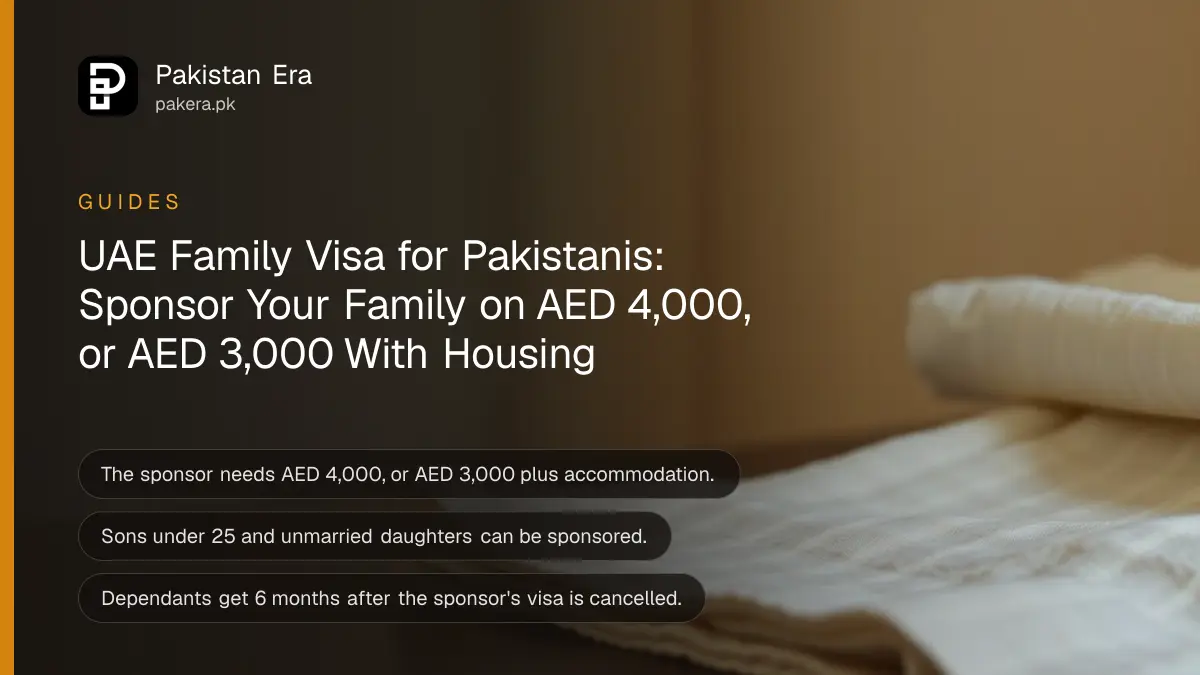
A Pakistani working in the UAE can sponsor a family residence visa with a salary of at least AED 4,000 a month, or AED 3,000 plus accommodation from the employer. You can sponsor your spouse, unmarried daughters, sons under 25 and children with special needs, whatever your job title.
Those rules come from the UAE government portal, u.ae, which we read on 4 November 2026. The portal sends readers to the Federal Authority for Identity, Citizenship, Customs and Port Security (ICP) and, in Dubai, to the General Directorate of Residency and Foreigners Affairs (GDRFA) for the current conditions and fees. This guide covers who qualifies, the papers you need from Pakistan, and the rules that catch families out later.
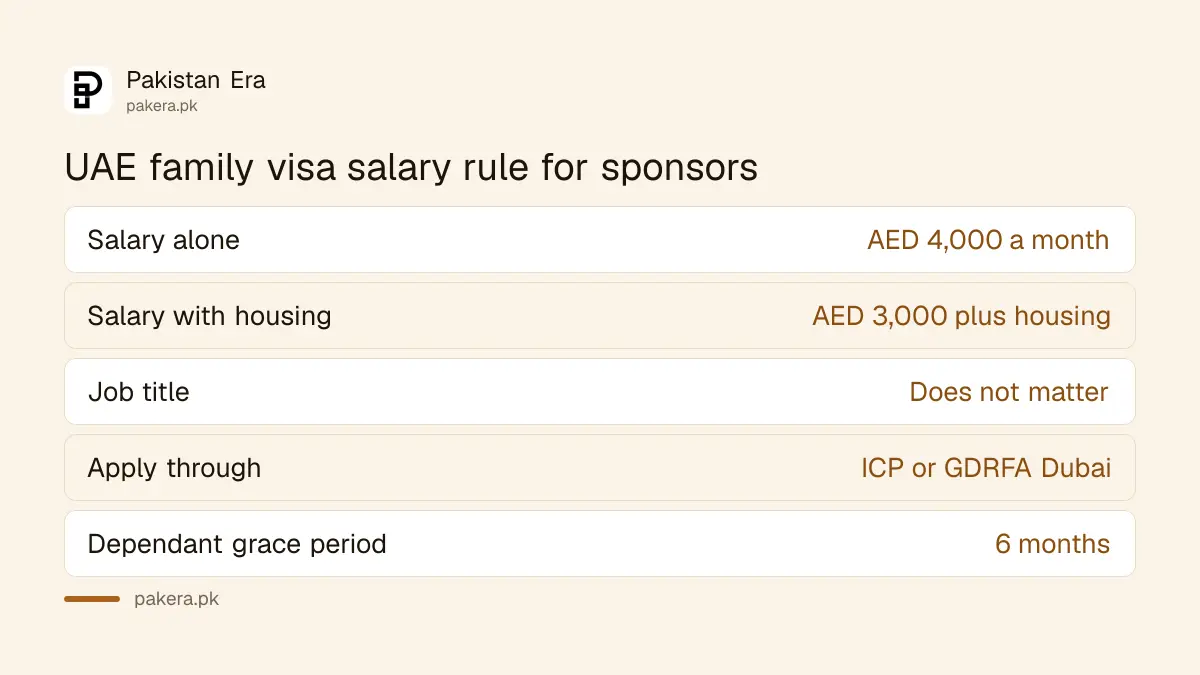
The salary rule is AED 4,000, or AED 3,000 with housing
The UAE sets one salary test for family sponsorship by expatriate employees: a minimum of AED 4,000 a month, or AED 3,000 a month plus accommodation. The portal says employees who meet it can sponsor family regardless of their job title, so a driver and an engineer face the same test.
Accommodation means housing your employer provides, usually written in your contract. If your contract shows AED 3,000 basic and a separate housing allowance, ask the typing centre or the authority which figure they will read, because the documents you submit decide it.
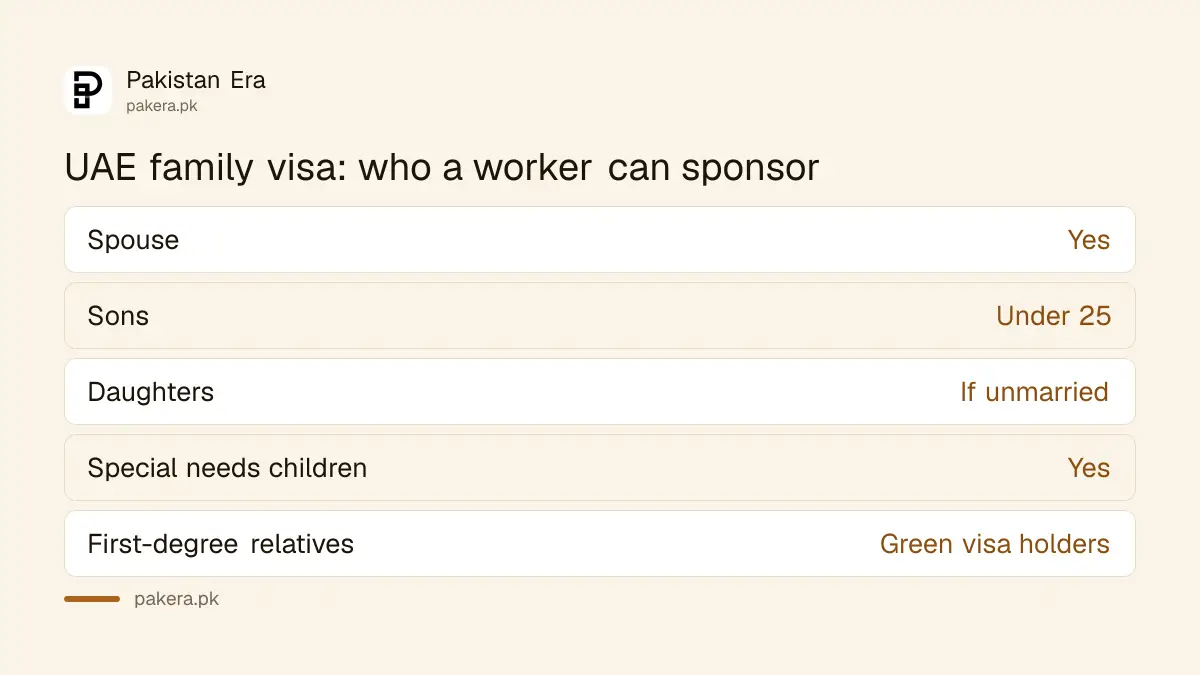
| Family member | Can an expatriate employee sponsor them? |
|---|---|
| Spouse | Yes |
| Sons | Yes, under 25 years old |
| Daughters | Yes, if unmarried |
| Children with special needs | Yes |
| Parents and other first-degree relatives | Green visa holders can sponsor first-degree relatives; the portal page does not set out a rule for other employees |
Papers you need from Pakistan before you apply
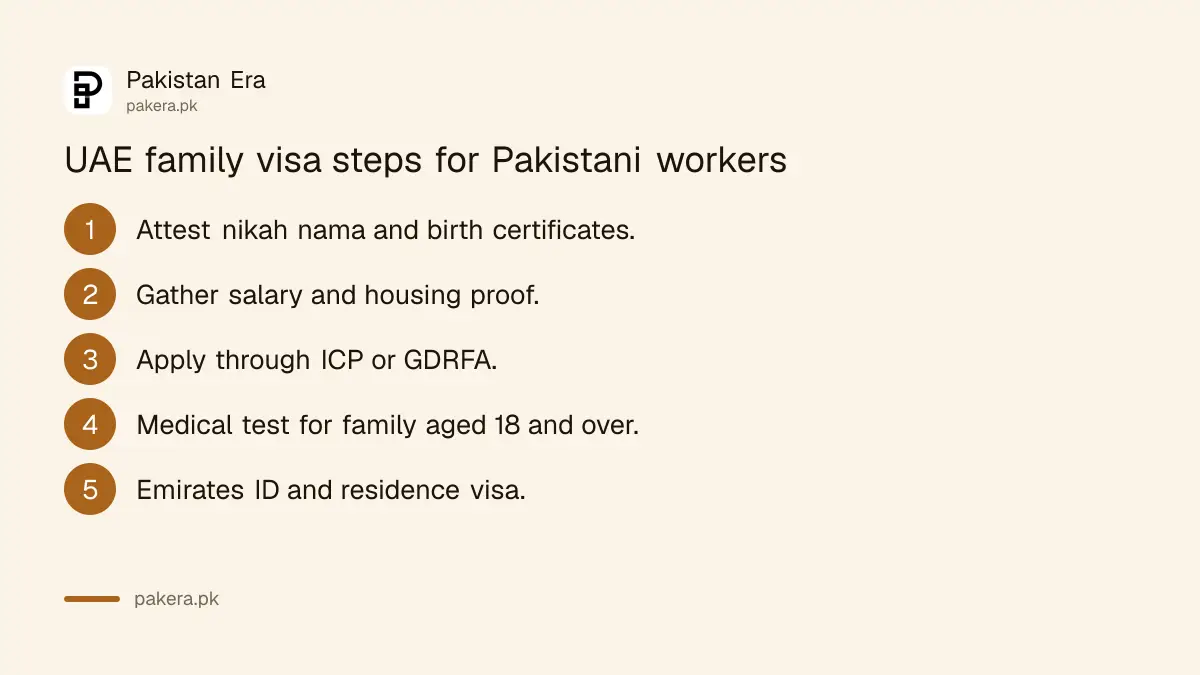
The UAE authority asks for proof of relationship, so prepare your nikah nama and children's birth certificates in Pakistan first. In practice these are attested by Pakistan's Ministry of Foreign Affairs and then by the UAE side, before the visa application is filed.
- Get a computerised NADRA marriage registration certificate and children's birth certificates, in English.
- Have them attested by the Ministry of Foreign Affairs in Pakistan.
- Complete the UAE attestation the authority asks for, then keep both originals and copies.
- Collect your own papers: passport, residence visa, Emirates ID, labour contract and salary certificate.
- If your salary is AED 3,000 to 4,000, include proof that your employer provides housing.
- Get passport copies and photos for each family member.
- Apply through ICP, or GDRFA if you live in Dubai, and pay the fees the system shows.
Already in the UAE and need a paper attested there? Our guide to the Pakistan Consulate Dubai attestation fee lists each document and its fee in dirhams.
After arrival: medical test and Emirates ID
Family members aged 18 and over must pass a medical fitness test at an approved centre in the UAE. The portal lists government centres: the Disease Prevention and Screening Center in Abu Dhabi, the Dubai Health Authority and Emirates Health Services. Then comes the Emirates ID.
The order is usually entry permit, arrival, medical test, Emirates ID biometrics and residence visa. Each step is tracked online. Our guides explain how to check a UAE visa status on ICP or GDRFA and how to track an Emirates ID application.
Family visas are tied to your own visa
Your family's residence permits are linked to yours. If your visa is cancelled, theirs must be cancelled too. Dependants get a 6-month grace period from expiry or cancellation to get a new permit, and a sponsor who fails to renew or cancel their visas may be fined.
That link matters when you change jobs. Before resigning, plan when your new visa will be issued and when the family's visas will move to it. Our guide to UAE unemployment insurance covers what you can claim if a job ends suddenly.
- Renew family visas with your own, not after them.
- Cancel them properly if the family leaves the UAE for good.
- Keep the grace period in mind if your visa ends: 6 months for dependants.
- Keep each family member's passport valid, because renewals need it.
Visit visa or family residence visa
A visit visa is for a short stay and has its own rules, including funds and a return ticket. A family residence visa lets your spouse and children live with you, go to school and get an Emirates ID. If you plan to keep your family in the UAE, the residence visa is the right route.
Bringing family on a visit visa first is common, but overstaying creates fines. Our guides list the UAE visit visa requirements for Pakistanis and the UAE overstay fine. For the work visa that makes you a sponsor in the first place, see our UAE work visa guide.
Frequently Asked Questions
What salary is needed for a family visa in the UAE?
At least AED 4,000 a month, or AED 3,000 a month plus accommodation, according to the UAE government portal. Job title does not matter.
Can I sponsor my son above 18 in the UAE?
Yes. Expatriate residents can sponsor sons under 25 years old. Unmarried daughters can be sponsored without that age limit.
Can a Pakistani worker sponsor parents in the UAE?
The portal says Green visa holders can sponsor first-degree relatives. It does not set out a parents rule for other expatriate employees, so check with ICP or GDRFA.
Does my wife need a medical test for a UAE family visa?
Yes. Family members aged 18 and over must pass a medical fitness test at an approved health centre in the UAE.
What happens to my family's visa if I lose my job?
Their permits are linked to yours, so they must be cancelled if yours is. Dependants get a 6-month grace period to get a new permit.
Where do I apply for a UAE family residence visa?
Through ICP, or through GDRFA if you live in Dubai. The u.ae portal refers sponsors to these authorities for current conditions and fees.
About the author

Global Affairs & Political Economy Writer
Muhammad Hatim is a book lover who started writing because he enjoys it. At Pakistan Era he writes about international relations, geopolitics and the global economy, with a particular interest in South Asia and the forces behind current events.