UAE Worker Insurance Pays Up to AED 20,000 if Your Employer Defaults: What It Covers
UAE private sector workers are covered up to AED 20,000 if an employer defaults. See what is paid, the AED 3,000 bank guarantee option and the open gaps.
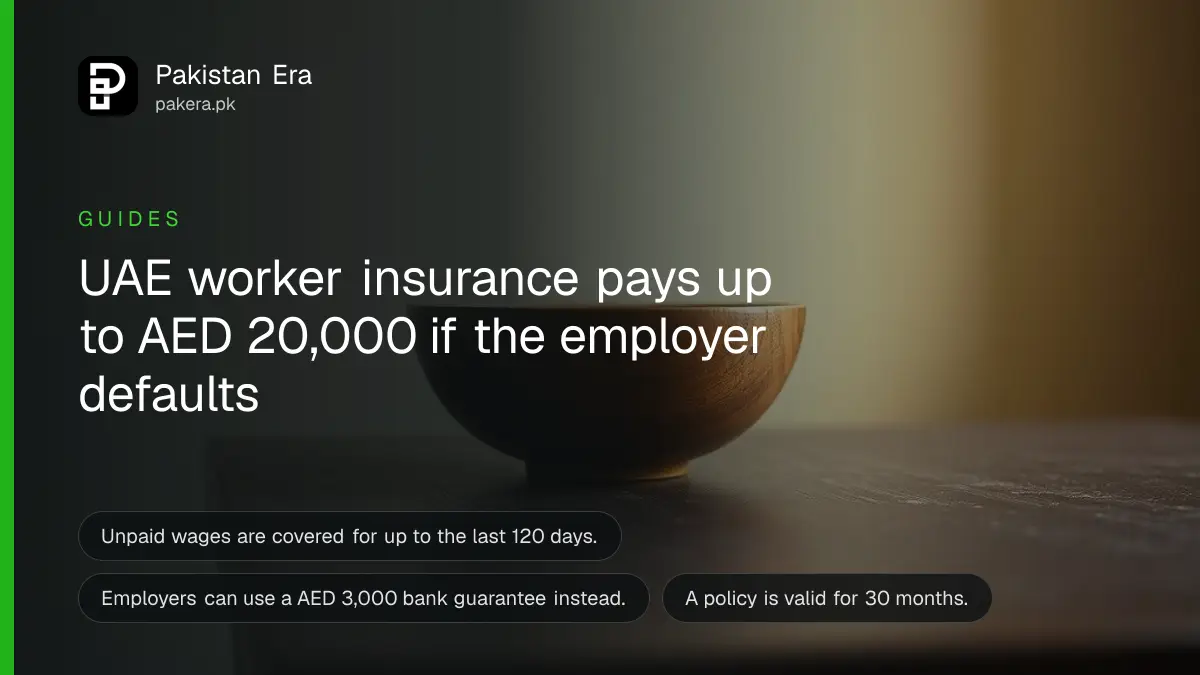
Short answer: UAE private sector workers are protected by an insurance policy the employer buys, or a bank guarantee the employer keeps. The UAE government page says the policy pays up to AED 20,000 per worker if the employer defaults, covering unpaid wages for up to 120 days, end-of-service benefits and the cost of going home.
A Pakistani worker in Abu Dhabi has not seen a salary for two months. The company is shutting down. The owner has stopped answering calls. In this exact case, the UAE has a safety net that many workers never hear about until it is too late.
We read the UAE government page on the insurance scheme for private sector employees on 12 October 2026. We did not file a claim, because that needs a real employer record. The numbers below come from that page.
The scheme protects private sector and domestic workers
The page says the worker insurance scheme is designed to protect the rights of private sector employees as well as domestic workers. The page describes it as a policy the employer buys. It protects workers from a company's bankruptcy or failure to pay their legitimate dues.
This is separate from the unemployment cover that a worker subscribes to. If you want that one, read our explanation of the UAE unemployment insurance scheme. The two work for different situations: one pays when you lose a job, the other pays when your employer fails you.
It pays up to AED 20,000 for six kinds of loss
The page says the policy provides a maximum coverage of AED 20,000 per worker. For general workers it lists six items. For domestic workers it lists a similar set of items, including unpaid end-of-service benefits and wages, repatriation, medical expenses and body repatriation.
| What is covered | Detail on the page |
|---|---|
| Unpaid wages | Up to a maximum of the last 120 days before the worker's last working day |
| End-of-service benefits | Covered |
| Repatriation costs | Covered |
| Body repatriation | Cost of bringing the body home in case of death |
| Medical expenses | Related to work injuries or occupational diseases |
| Airfare for absconding workers | If a report was filed |
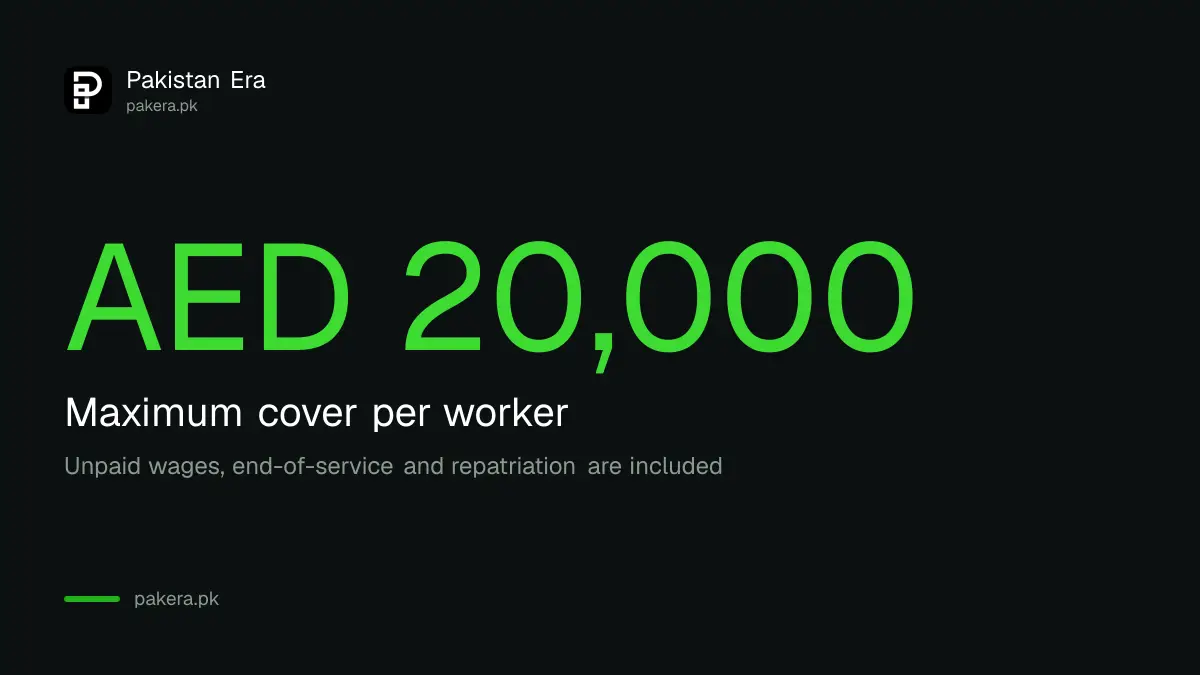
The AED 20,000 is a ceiling, not a promise of payment. Claims are capped at that amount per worker. How much end-of-service pay you are owed is a separate calculation, which our guide to UAE end-of-service gratuity at 21 days a year explains.
The employer can use a bank guarantee instead
The page says an employer may instead keep a bank guarantee issued by a bank operating in the UAE. The guarantee must not be less than AED 3,000 for each worker. So a worker's cover comes in one of two forms, and which one applies is the employer's choice.
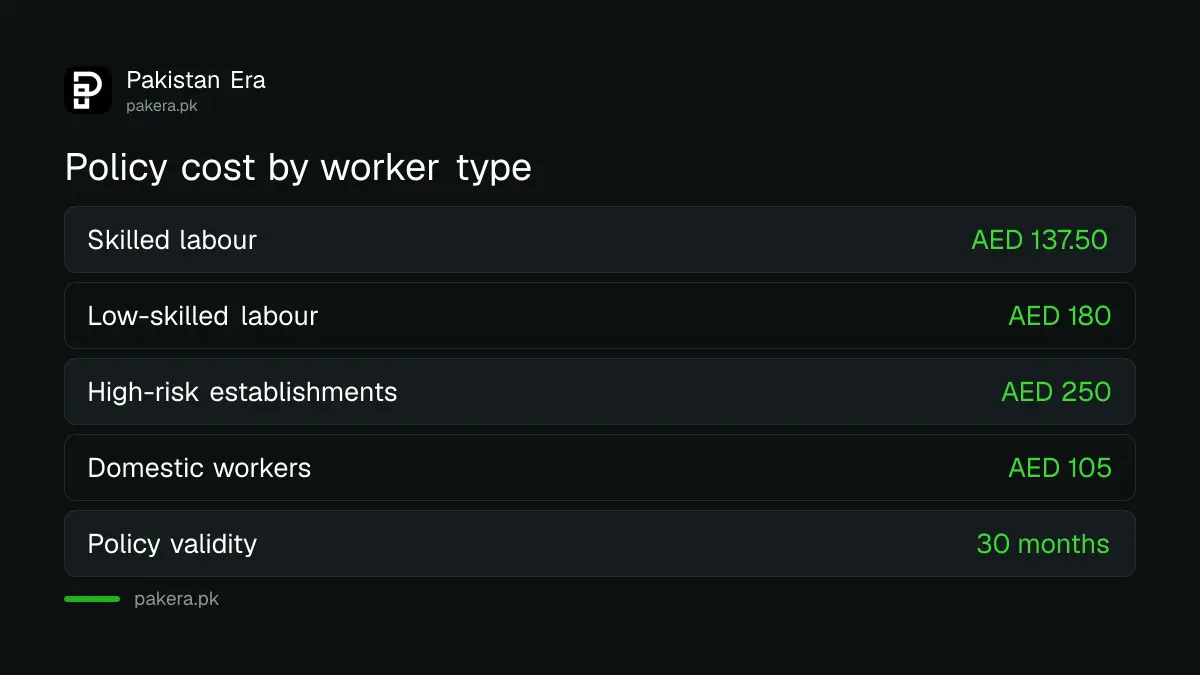
The page lists the cost of the insurance policy by type of worker: AED 137.50 for skilled labour, AED 180 for low-skilled labour, AED 250 for high-risk establishments and AED 105 for domestic workers. A policy is valid for 30 months. The employer buys it from the "Insurance pool" website or through a business service centre using the MoHRE app.
What a worker should do when wages stop
The page describes what the scheme covers and how the employer buys it. It does not set out a claim procedure for workers, and we could not confirm one from the pages we read. So the sensible first move is the dispute route, since that is how an unpaid wage becomes a case.
Do not wait for the company to close before you collect proof. A worker who can show a payslip, a bank record and a contract copy has a far easier case than one who relies on memory. The 120 day limit on unpaid wages also means that old, unclaimed months may fall outside the cover, so act early.
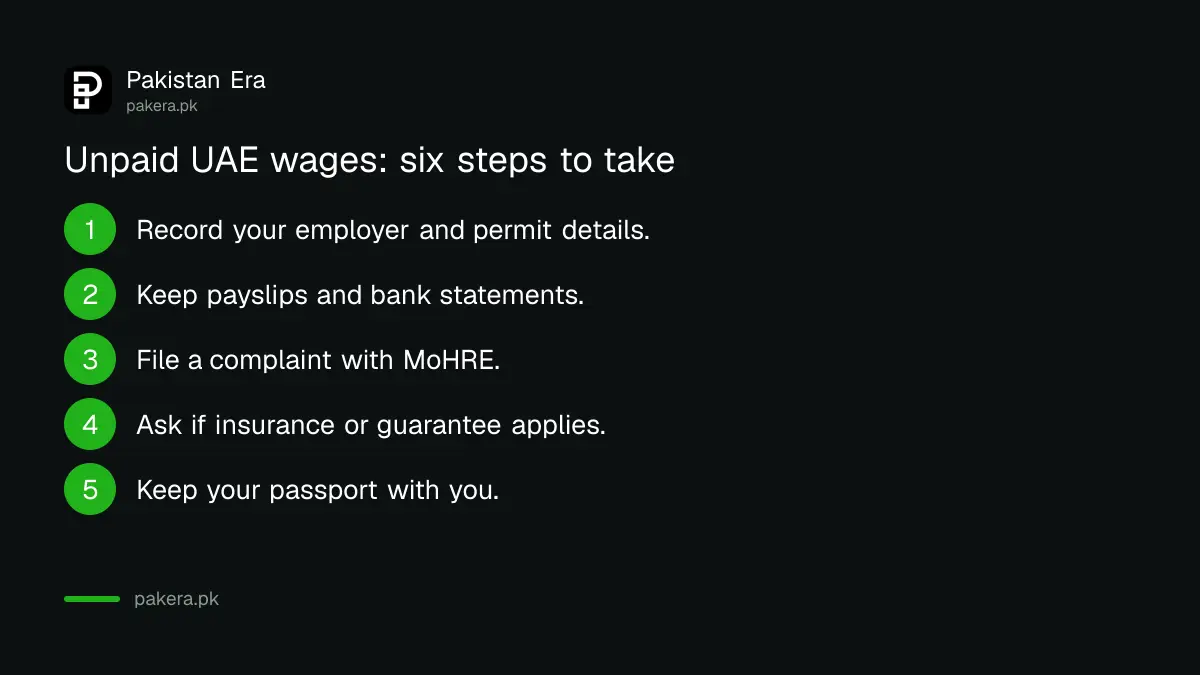
- Write down your employer's name, trade licence number if you know it, and your work permit number.
- Keep every payslip, bank statement and message about the unpaid wages.
- File a complaint with the Ministry of Human Resources and Emiratisation, MoHRE.
- Ask MoHRE staff whether the insurance or bank guarantee applies to your case.
- Keep your passport and Emirates ID with you at all times.
- Tell your embassy or consulate if the employer disappears.
The complaint steps, the 14 day settlement period and the court limits are in our guide on filing a MOHRE labour complaint for unpaid wages. If you are back home and owed money abroad, recovering unpaid salary through OPF is free.
Common questions
How much does the UAE worker insurance pay?
Up to AED 20,000 per worker, says the UAE government page. It covers unpaid wages for up to 120 days, end-of-service benefits and repatriation costs, among other items.
Do I pay for this insurance?
The page says the employer purchases the policy. It lists the premium by worker type, and does not describe any charge to the worker.
Does it cover domestic workers?
Yes. The page says the scheme protects domestic workers too, with a premium of AED 105 for that category.
What is the bank guarantee for?
It is an alternative to the policy. The guarantee must come from a UAE bank and be at least AED 3,000 for each worker.
How long does a policy last?
A policy is valid for 30 months, according to the page.
Does it pay if I abscond?
The page lists airfare for absconding workers, but only if a report was filed. Always keep proof of any report your employer made.
How we verified this
What we checked, where we read it, and what we could not confirm.
We read the UAE government page on the insurance system for employees in the private sector on 12 October 2026. The page calls it a "new policy", so premiums and limits may have changed. We could not verify the worker's claim steps. Confirm them with MoHRE before relying on this cover.
About the author

Global Affairs & Political Economy Writer
Muhammad Hatim is a book lover who started writing because he enjoys it. At Pakistan Era he writes about international relations, geopolitics and the global economy, with a particular interest in South Asia and the forces behind current events.