Check If Your Bottled Water Brand Is on PCRWR's Unsafe List
PCRWR tested 230 bottled water brands and marked 29 unsafe. We read the report and list every brand, its city, and what it actually failed on.
PCRWR tested 230 bottled water brands between April and June 2026 and marked 29 of them unsafe. We downloaded the report and read all 49 pages, so this is the list itself rather than a summary of somebody's summary.
Find your brand here.
| Brand | City | Failed on |
|---|---|---|
| HR Water Healthy Life | Faisalabad | Sodium |
| Mai Sial Bottled Drinking Water | Sialkot | Bacteria |
| JERS Safe Life Bottled Drinking Water | Daska, Sialkot | Bacteria |
| Natural Pure Life (not Nestle) | Pasroor, Sialkot | Bacteria |
| Natural Sip | Pasroor, Sialkot | Bacteria |
| Al Meer Bottled Drinking Water | Sambrial, Sialkot | Bacteria |
| Al Saha Drinking Water | Sialkot | Bacteria |
| Al Shifa Pure Life | Daska, Sialkot | Bacteria |
| Royal Fina Bottled Drinking Water | Sambrial, Sialkot | Bacteria |
| Aqua Nice Pure Life | Sialkot | Bacteria |
| Noor Aqua | Hyderabad | Bacteria |
| Aqua Pure | Tandojam | Bacteria |
| Drinkwell Pure Drinking Water | Sukkur | Bacteria |
| A2Z Pure Bottled Drinking Water | Sukkur | Sodium and TDS |
| Imperial Pure Drinking Water | Sukkur | TDS and bacteria |
| Pure Drinking Water | Sukkur | Sodium |
| Zalmi | Matli, Badin | Bacteria |
| Deep Blue Pure Drinking Water | Korangi, Karachi | Sodium and bacteria |
| Sip Nest Purified Drinking Water | Karachi | Sodium |
| Aab-e-Haram | Bin Qasim, Karachi | Sodium, TDS and bacteria |
| Aqua Life Bottled Drinking Water | Bahawalpur | Sodium |
| Drinkly | Sargodha | Sodium |
| Alpha H2O Bottled Drinking Water | Sargodha | Sodium and TDS |
| Vital Sip Bottled Drinking Water | Gilgit | Bacteria |
| Hunza Ulter Water | Karimabad, Hunza | Bacteria |
| Rehydr8 Drink Pure Water | Hayatabad, Peshawar | Bacteria |
| Moya Mineral Water | Gulberg, Peshawar | Bacteria |
| Tynant Aqua Bottled Drinking Water | Hayatabad, Peshawar | Bacteria |
| Aqua Pura Smart | Hayatabad, Peshawar | Bacteria |
If your brand is not on that list, PCRWR found it safe in this round. It tested 230 and cleared 201.
What the numbers actually say
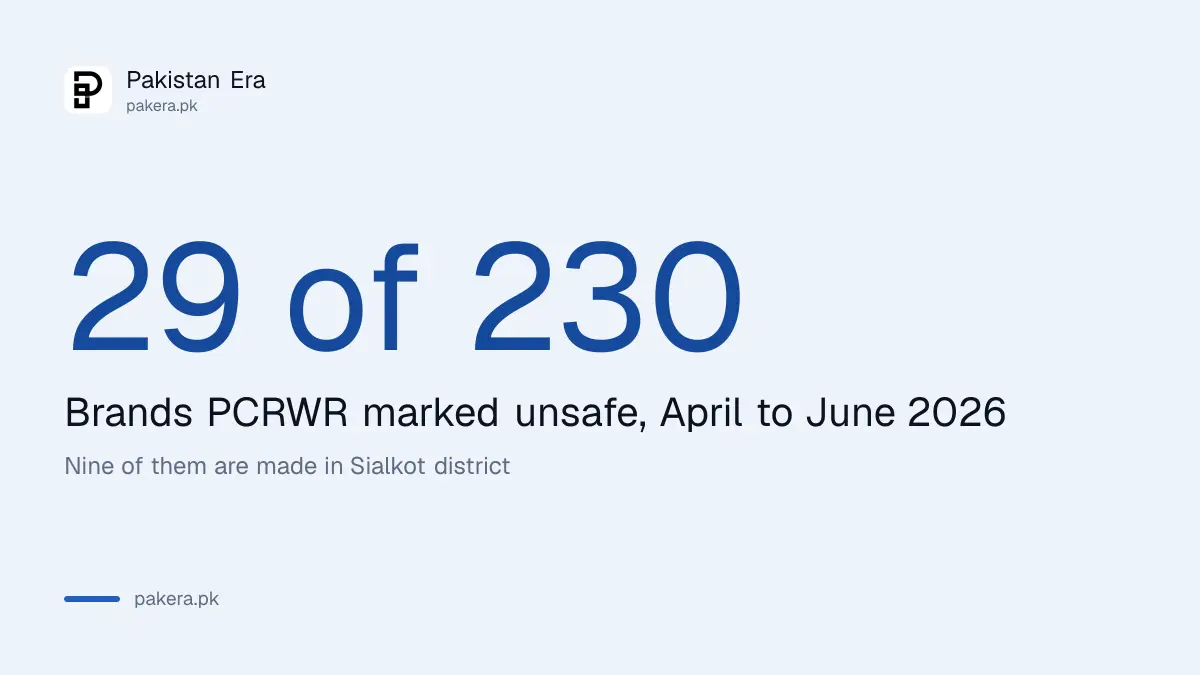
The result is better than the coverage makes it sound. 87 per cent of brands passed. Thirteen per cent did not.
Split the failures and they behave differently:
- 10 brands failed on chemistry, which is 4 per cent of the sample.
- 22 brands failed on bacteria, which is 10 per cent.
- 3 brands failed on both, which is why 10 and 22 make 29 rather than 32.
Those three are Imperial Pure from Sukkur, Deep Blue from Karachi and Aab-e-Haram from Karachi. They are the only names on the list that failed every kind of test PCRWR ran.
PCRWR sampled in 20 cities: Islamabad, Rawalpindi, Peshawar, D.G. Khan, Multan, Sargodha, Sahiwal, Faisalabad, Tando Jam, Gujranwala, Badin, Sialkot, D.I. Khan, Bahawalpur, Karachi, Lahore, Mianwali, Muzaffarabad, Gilgit and Sukkur.
The line most coverage leaves out
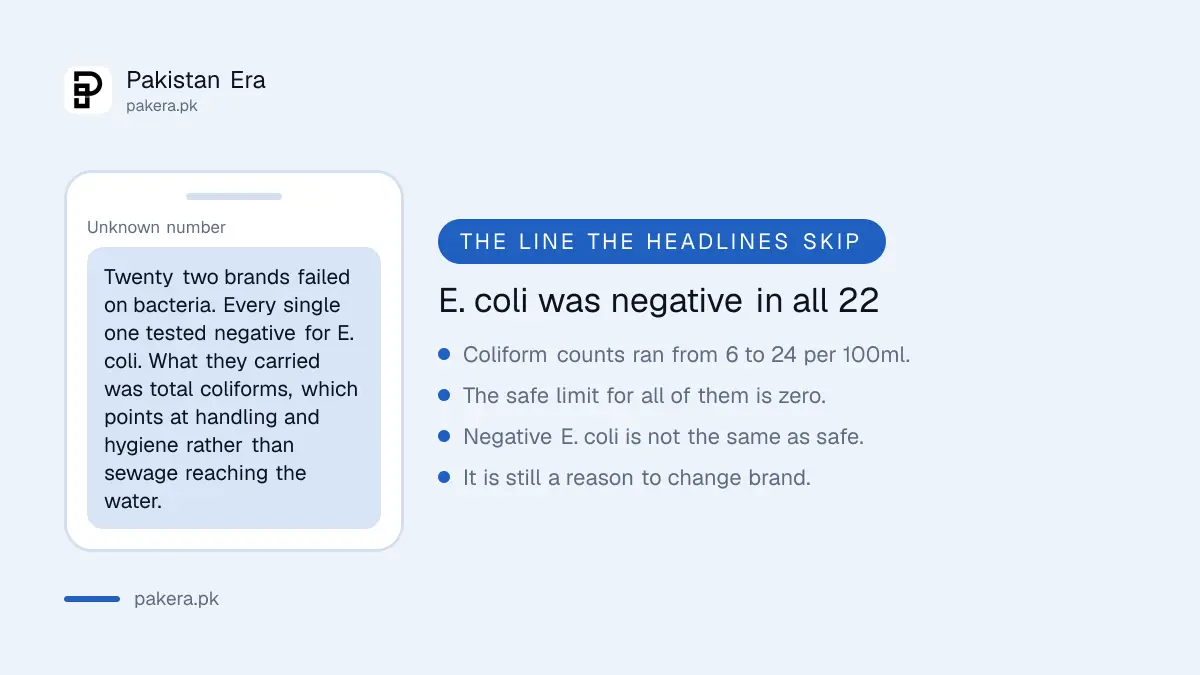
Twenty two brands failed the bacterial test. Every one of them tested negative for E. coli.
That matters, and it is worth being precise about why.
What those brands carried was total coliforms, at counts from 6 to 24 per 100ml against a safe limit of zero. Coliforms are a broad family of bacteria. Many live harmlessly in soil and on surfaces. They are used as an indicator because they are easy to detect and they show that something got in.
E. coli is the one that points specifically at faecal contamination, and it was absent throughout.
So the honest reading is a hygiene and handling failure somewhere in the line, in the bottles, the caps, the filling or the storage. It is not evidence that sewage reached the water. It is still a reason to stop buying that brand, because the safe limit is zero and these are sealed bottles sold as clean.
Nobody should be told their water has sewage in it when the regulator's own table says E. coli negative on every line.
What sodium and TDS mean on a water bottle
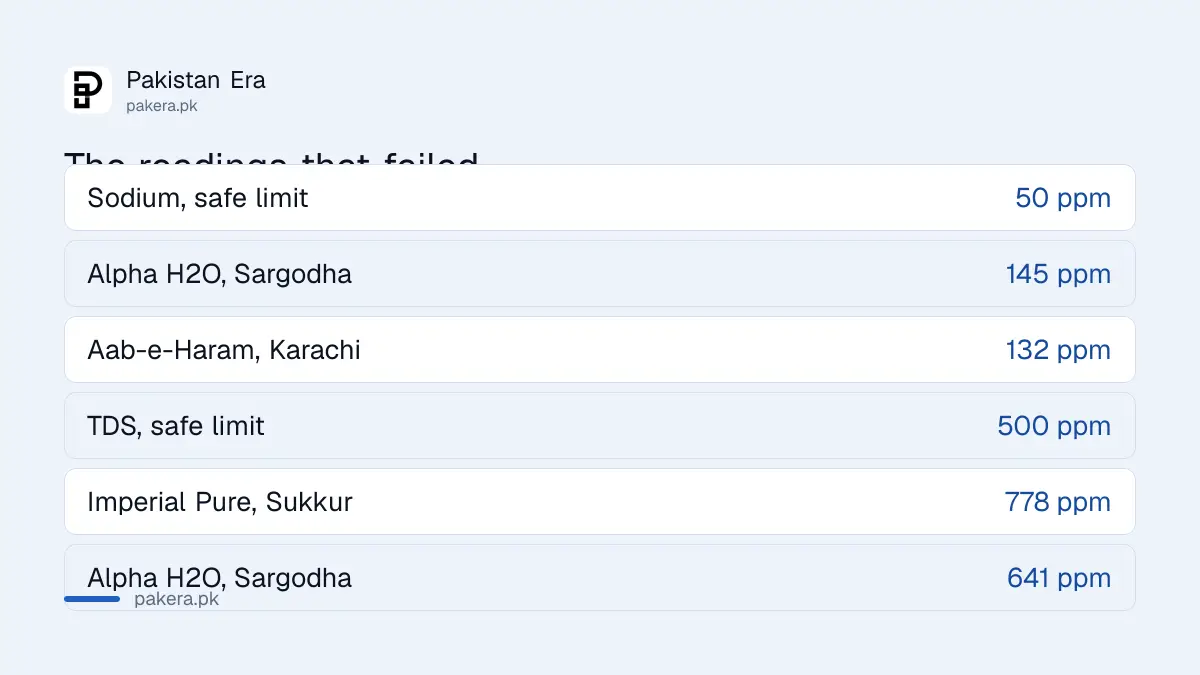
The chemical failures came down to two things.
Sodium, against a safe limit of 50 parts per million. This is salt. Too much of it matters most to people with high blood pressure, kidney disease or heart conditions, and to infants.
The readings, from the report: Alpha H2O of Sargodha at 145, Aab-e-Haram of Karachi at 132, Drinkly of Sargodha at 105, A2Z Pure of Sukkur at 95, HR Water Healthy Life of Faisalabad at 70, Pure Drinking Water of Sukkur at 69, Sip Nest of Karachi at 67, Aqua Life of Bahawalpur at 58 and Deep Blue of Karachi at 55.
TDS, total dissolved solids, against a safe limit of 500 ppm. This is everything dissolved in the water taken together, minerals included. High TDS usually means the treatment did not remove enough.
Four brands went over: Imperial Pure of Sukkur at 778, Alpha H2O of Sargodha at 641, A2Z Pure of Sukkur at 526 and Aab-e-Haram of Karachi at 520.
Alpha H2O and Aab-e-Haram appear in both lists.
Nine of the 29 come from one district
This is our own count from PCRWR's city column, not something the report comments on.
Sialkot district accounts for nine of the 29: Mai Sial, JERS Safe Life, Natural Pure Life, Natural Sip, Al Meer, Al Saha, Al Shifa, Royal Fina and Aqua Nice. Several come from the same three tehsils: Daska, Pasroor and Sambrial.
After that it thins out. Peshawar has four, all from Hayatabad and Gulberg. Sukkur has four. Karachi has three. Sargodha has two.
We are not going to explain that clustering, because we do not know the cause and the report does not offer one. It could be where the small unbranded plants happen to be, or how thoroughly PCRWR sampled that market. We are reporting the count and leaving it there.
One brand carries a warning from PCRWR itself
The report lists a brand as Natural Pure Life (not Nestle). That bracket is PCRWR's, printed in its own table, not something we added.
The regulator evidently expected the name to be confused with Nestle Pure Life, which is a different product from a different company and is not on the unsafe list.
It is a useful reminder for the shelf. Names in this market are built to look like each other, and a bottle called Pure Life, Aqua Pure, Pure Drinking Water or Aqua Pura Smart is not the same as the one beside it. Read the manufacturer line on the label, not the big word on the front.
What to do if your brand is on the list
Nothing dramatic. Some practical steps.
- Stop buying that brand and pick one that is not on the list. That is the whole fix, and it costs nothing.
- Check the manufacturer line, not just the brand name, because several names on this list are near copies of safe ones.
- Boil it if you already have a case at home and do not want to waste it. Boiling deals with bacteria. It does not reduce sodium or TDS, so for the chemical failures it does not help.
- Do not assume a sealed bottle is proof of anything. Every one of these was sealed and sold as drinking water.
- Check again next quarter. PCRWR publishes every three months, and brands move on and off the list.
- Keep the receipt if you were sold something unfit. A shop that sells water named on a regulator list is answerable, and you can take it to consumer court free of cost.
If the water is coming through a pipe rather than a bottle, that is a separate problem, and our guide to applying for a new water connection covers the supply side.
Where this comes from, and what we could not check
The source is PCRWR's Quarterly Report, Bottled Water Quality, April to June 2026, published on pcrwr.gov.pk. We downloaded the PDF and read it rather than working from news coverage.
PCRWR does this under a Cabinet instruction that the results be published every quarter and followed with legal action. So the list is meant to be public. Every fact above is theirs. The geographic count is ours.
The site refused nothing and needed no special handling, which is worth saying because plenty of Pakistani government portals do. If a link will not open for you, try it in a normal browser before assuming the page is gone. To raise this with a government body rather than a shop, the Pakistan Citizen's Portal is the general route.
We did not test any water ourselves.
We did not contact any of the named manufacturers, so nobody on this list has been given a chance to respond here.
We cannot tell you whether a brand has fixed the problem since the sample was taken, or whether the bottle in front of you came from the batch that was tested. A brand on this list may be clean today, and one not on it may have a bad batch tomorrow.
We have left out the personal mobile numbers the report prints for small manufacturers. The brand and the city are what you need to check a bottle.
Questions readers are asking
How many bottled water brands are unsafe in Pakistan?
29 out of 230 tested, in PCRWR's April to June 2026 quarter. That is 13 per cent, so 87 per cent passed.
Does unsafe mean there is sewage in it?
No. All 22 bacterial failures tested negative for E. coli. They failed on total coliforms, which indicates a hygiene or handling problem rather than faecal contamination.
Is Nestle Pure Life on the list?
No. A separate brand called Natural Pure Life is, and PCRWR's own table adds the words not Nestle beside it to prevent exactly that confusion.
Which brands failed the worst?
Imperial Pure, Deep Blue and Aab-e-Haram failed both chemical and bacterial testing. Alpha H2O had the highest sodium at 145 ppm and Imperial Pure the highest TDS at 778 ppm.
Can I boil it and drink it?
Boiling handles the bacterial problem. It does nothing for sodium or TDS, so it does not help with the ten chemical failures.
Why are so many from Sialkot?
Nine of the 29 are from Sialkot district. PCRWR does not say why and we are not going to guess.
How often is this updated?
PCRWR publishes every quarter. We will update this page when the July to September 2026 report is out.
About the author

Tax, Bills and Technology Writer
Ali Akhtar is a young and curious voice here at Pakistan Era. He is currently pursuing his A-Levels and has a growing interest in Pakistan’s changing industrial landscape and educational trends. Ali likes to write in a way that helps him explain and explore the world around him. His writing reflects the perspective of the new generation navigating the evolving trends of Pakistan where technology, youth innovation, and shifting opportunities are reshaping the country’s future.