How to Apply for a New Water Connection in Pakistan
Water is run by your city, not the government, so the office depends on where you live. Who to apply to, and what really decides the cost.
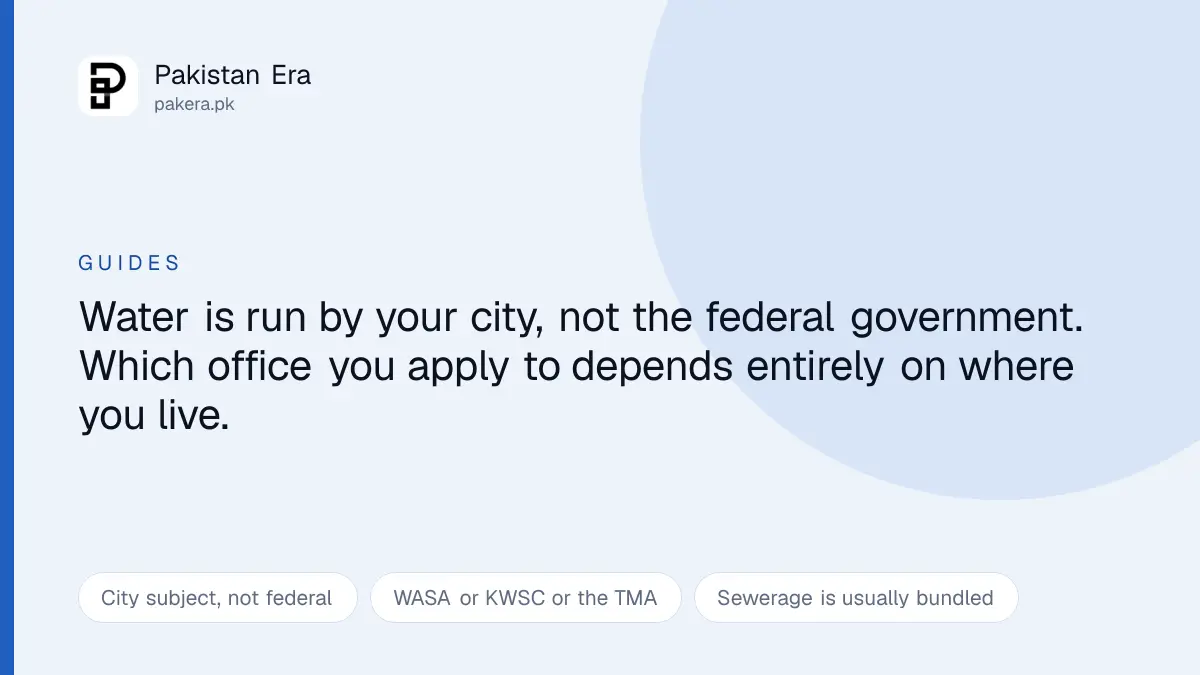
There is no national process for getting a water connection in Pakistan, and no national fee. Water is run by your city.
That single fact explains why searching for this is so frustrating. Every guide gives different steps and different numbers, and they are all describing a different city.
First, work out who supplies you
| Where you live | Who to apply to |
|---|---|
| Karachi | Karachi Water and Sewerage Corporation (KWSC) |
| Lahore, Faisalabad, Multan, Rawalpindi, Gujranwala | WASA, under the local development authority |
| Smaller Punjab towns | The Tehsil Municipal Administration |
| A private housing society | Usually the society's own supply, not a public utility at all |
| Rural areas | Local government schemes, or private boring |
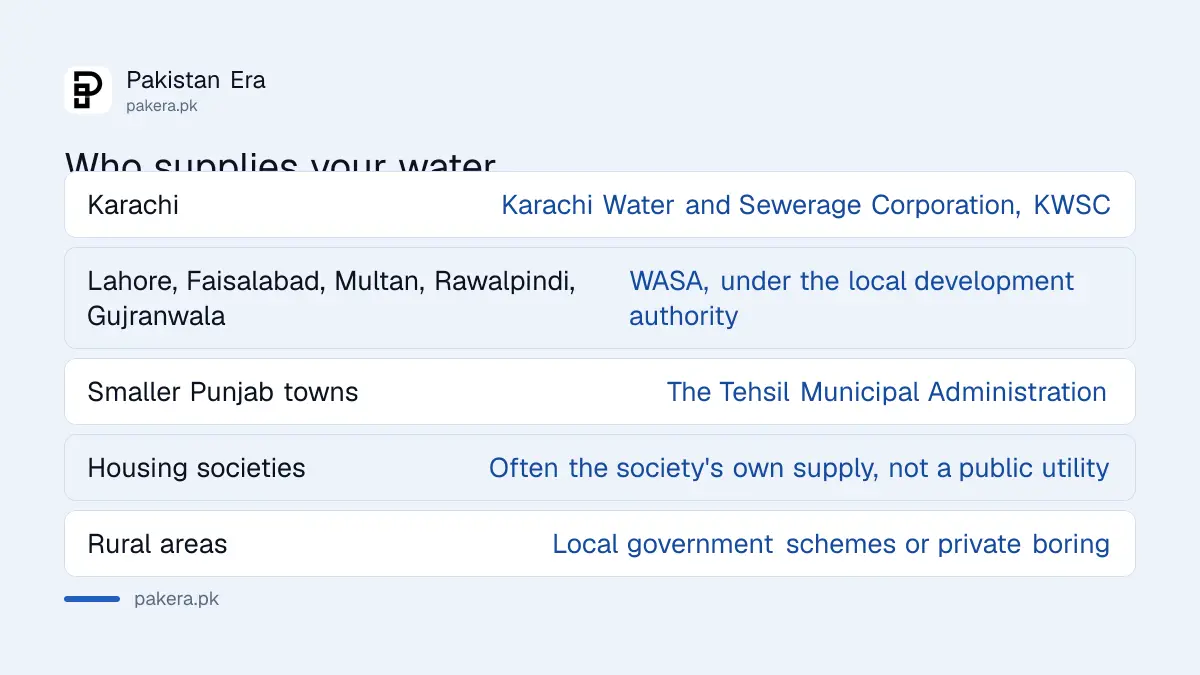
The housing society case catches people out. If you have bought in a private scheme, your water may never have been a public connection, and the office you need is the society's, not WASA's. Ask before you queue anywhere.
The application, in order
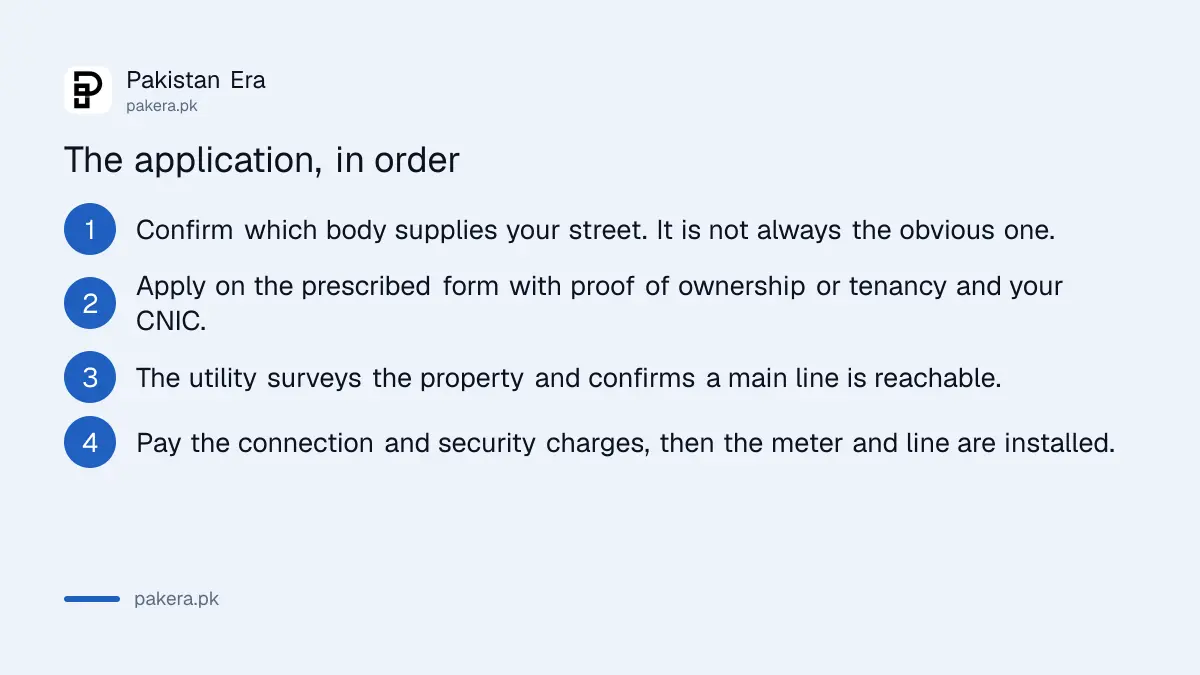
- Confirm which body serves your street. Not your city in general, your street. Boundaries between a WASA area and a TMA area are not always where you would expect.
- Get the prescribed application form from that office or its website.
- Submit it with your documents. Typically proof of ownership or tenancy, your CNIC, and details of the property.
- The utility surveys the property and confirms whether a main line is reachable.
- Pay the connection charges and any security deposit once the demand notice is issued.
- The line and meter are installed, and billing begins.
What you will be asked for
- Your CNIC, original and copy
- Proof of ownership, the registry, allotment letter or transfer letter
- Proof of tenancy and often the owner's consent, if you are renting
- A site plan or property details, including the size of the plot
- Clearance of any arrears attached to the property
The four things that decide the real cost
The application fee is rarely the number that matters. These are.
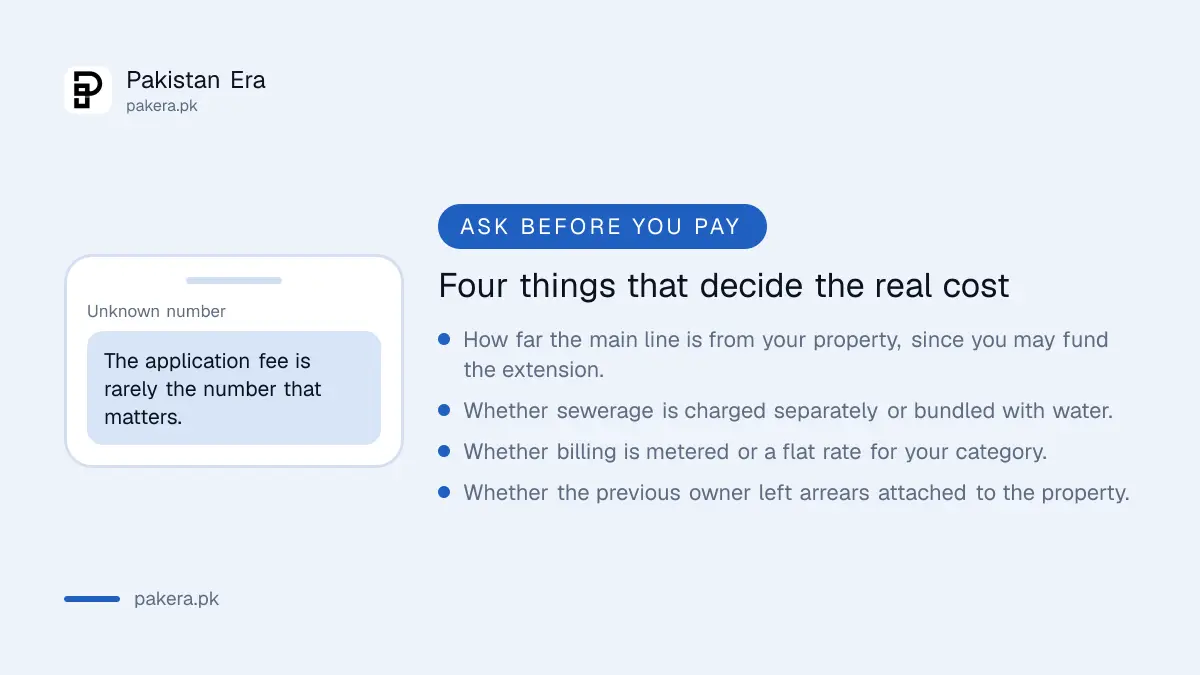
- How far the main line is. If it does not already run past your property, you may be funding the extension. This is the difference between a routine charge and a large one, and it is the first question to ask.
- Whether sewerage is separate. Many utilities bill water and sewerage together, some charge separately, and the connection charges can be separate too.
- Metered or flat rate. Much of Pakistan is billed at a flat rate by property category rather than by consumption. Which one applies changes what a large household pays enormously.
- Arrears attached to the property. Unpaid water dues generally follow the property, not the person who ran them up. If you have just bought, ask for a clearance certificate before you pay anything.
We are not publishing a fee table, and that is deliberate. Charges vary by city, property category and connection size, and we could not read a current schedule for any single utility. One city's numbers presented as national would send most readers to the counter with the wrong figure.
If your area has no supply at all
Large parts of Pakistan are not connected, and no application changes that on its own. Where there is no main line, the realistic options are a bore, a shared community scheme, or tanker supply, and each has costs the utility does not charge you.
It is worth knowing the same pattern holds for gas, where new connections reopened only on the more expensive imported supply and the waiting list runs into hundreds of thousands. We set that out in the guide to applying for a new gas connection.
When the utility will not move
Water utilities sit under provincial and local government, which puts them outside the Wafaqi Mohtasib's federal jurisdiction but well inside the reach of the Prime Minister's portal, which takes complaints against government organisations at every level.
That route, and how to write a complaint somebody can act on, is in our guide to using the Pakistan Citizen's Portal. Provincial ombudsman offices are the other formal option.
If your problem is a bill rather than a connection, the same principle applies as with electricity: dispute the reading, not the total. We explained why that distinction decides most utility complaints in the guide to complaining about a wrong electricity bill.
Questions readers are asking
Who do I apply to for a water connection in Pakistan?
It depends on your city. KWSC in Karachi, WASA in the larger Punjab cities, the Tehsil Municipal Administration in smaller towns, and often the society itself in private housing schemes.
How much does a water connection cost?
There is no national fee. Charges vary by city, property category and connection size, and the biggest variable is usually how far the main line is from your property.
Can a tenant apply?
Usually, with proof of tenancy and often the owner's written consent. Requirements vary by utility.
Do unpaid water bills transfer with the property?
Generally yes. Arrears tend to attach to the property rather than the previous owner, so ask for a clearance certificate before buying.
Is water billing metered in Pakistan?
Not everywhere. Much of the country is billed at a flat rate by property category rather than by consumption. Ask which applies to you before assuming a meter will save money.
What if there is no main line in my area?
An application will not create one. The practical options are a bore, a community scheme or tanker supply, and the utility may quote you for extending the main at your cost.
About the author

Public Services and Education Journalist
Fajr Riaz is a journalist and content writer at Pakistan Era, based in Lahore. She covers the questions people meet in everyday life in Pakistan: how a public service works, what a change in the rules means, and where to find a reliable answer.