Piped Gas or LPG: Which Is Actually Cheaper Now
New connections are RLNG only, and RLNG costs more than the old system gas. Which one wins depends on something most people never check.
For decades this was not a question. Piped gas was cheap, cylinders were what you used until the connection came.
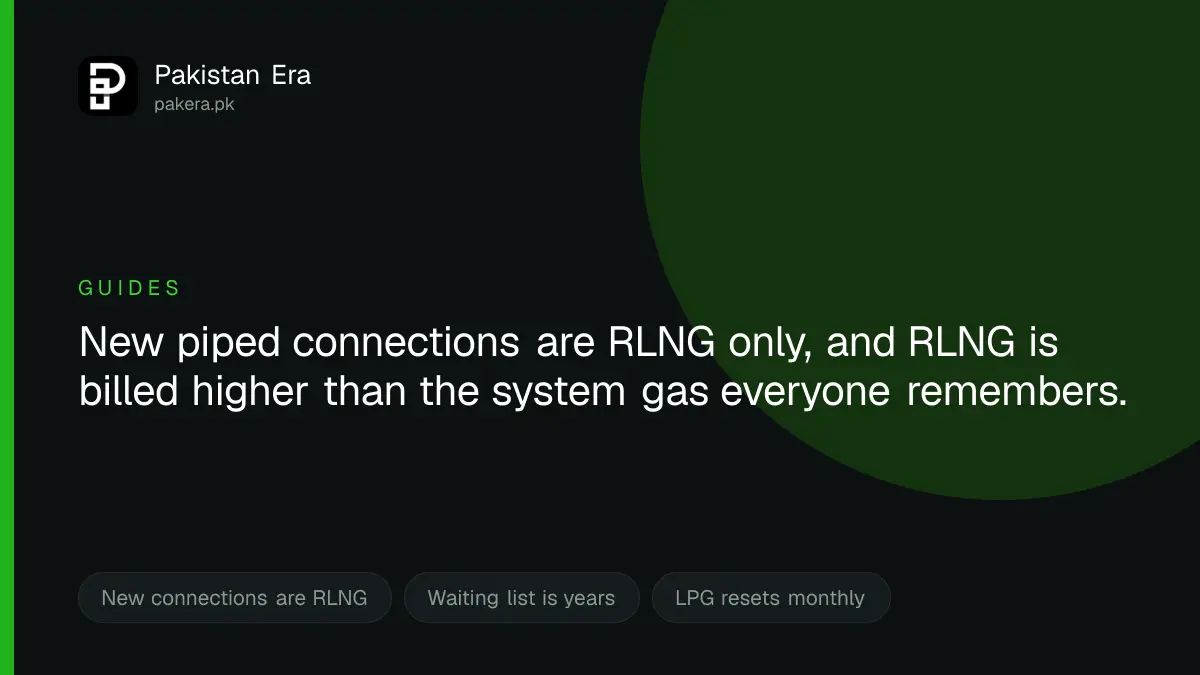
That has changed, and most people have not noticed. New piped connections are being given on RLNG only, and RLNG is imported and billed higher than the system gas everyone is remembering when they say piped gas is cheaper.
The answer for most people is availability, not price
Before comparing anything, check whether a main line actually reaches your street.
If it does not, there is no decision to make. An application does not create a network, and the reported backlog runs beyond 700,000 applications with normal processing at two to three years.
That is the honest starting point, and it settles the question for a large share of Pakistani households.
What you would actually be getting
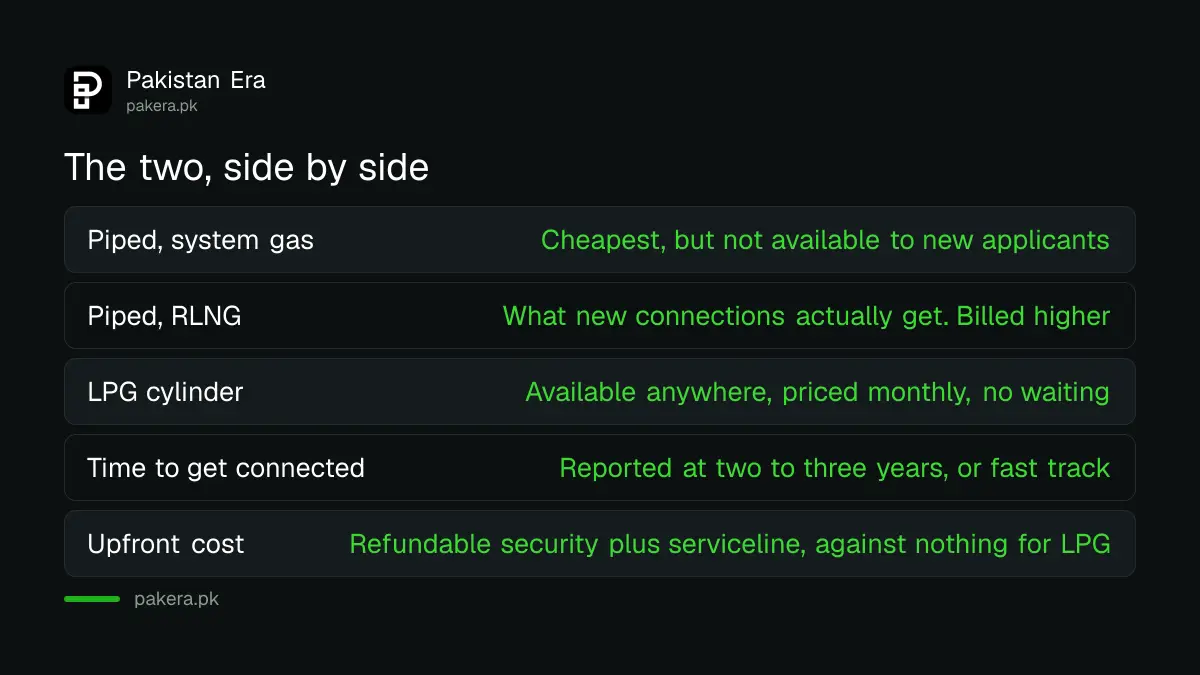
| Piped gas | LPG cylinder | |
|---|---|---|
| What new applicants get | RLNG, the imported supply | Not applicable |
| Upfront | Rs 20,000 security (refundable) plus Rs 1,500 to Rs 3,000 serviceline | Nothing beyond the cylinder deposit |
| To apply | Free. Fast track is Rs 25,000 | No application |
| Wait | Reported at two to three years | Same day |
| Price changes | By tariff determination | Monthly, notified by OGRA |
The full charge schedule, taken from SNGPL's own notice, is in our guide to applying for a new gas connection.
The assumption worth dropping
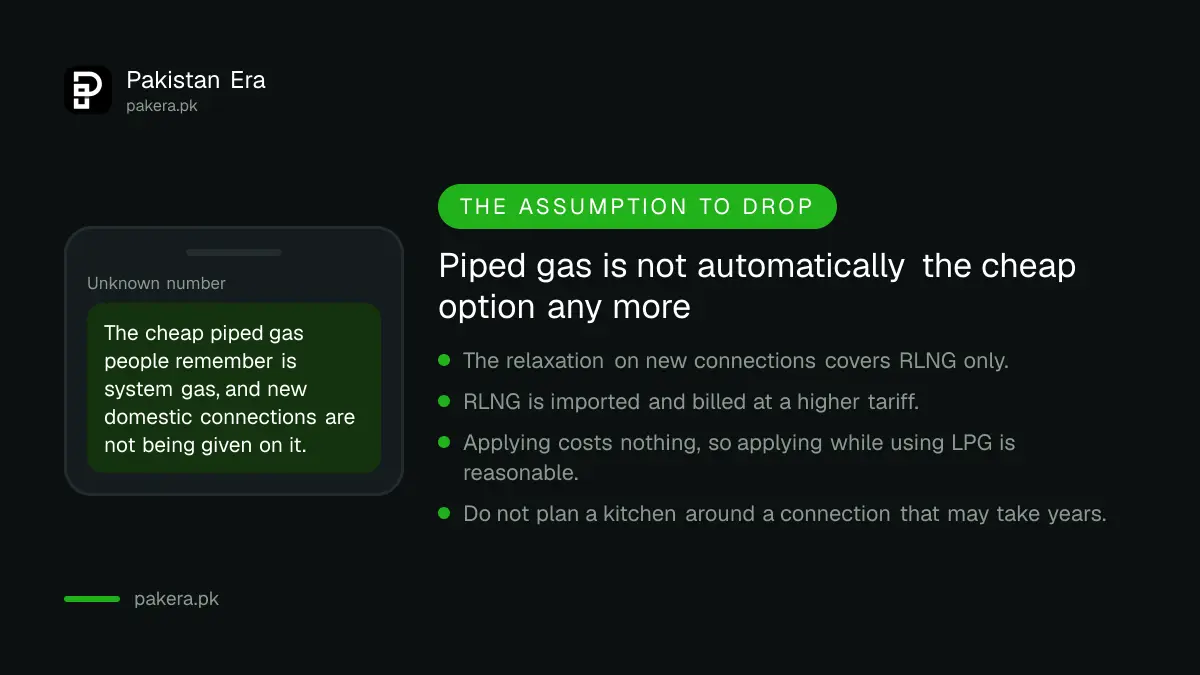
When people say piped gas is cheaper, they mean system gas, the locally produced supply that older connections run on. That is genuinely cheap.
It is also not what you will be offered. The government relaxed the ban on new domestic connections only on the RLNG tariff. RLNG is regasified imported gas, and it is billed higher. Transmission and distribution tariffs for it rose sharply again in July, by over 32 per cent for both SNGPL and SSGC, although those are wholesale figures rather than what a household is billed.
So a neighbour paying very little on a connection from fifteen years ago is not a guide to what you would pay on a new one.
Why we are not giving you a rupees per unit comparison
You will find pages that do. We are not going to, and the reason is worth explaining because it also tells you how to judge those pages.
To compare properly you need the current domestic RLNG consumer tariff. OGRA's price pages render through JavaScript and would not open for us, so we could not read it. Setting a verified LPG price per kilogram against an unverified gas slab rate would produce a confident number that is probably wrong, on a decision worth hundreds of thousands of rupees over a decade.
What we can give you is the method, which is better anyway because it uses your actual usage rather than an average household's.
How to work it out for yourself
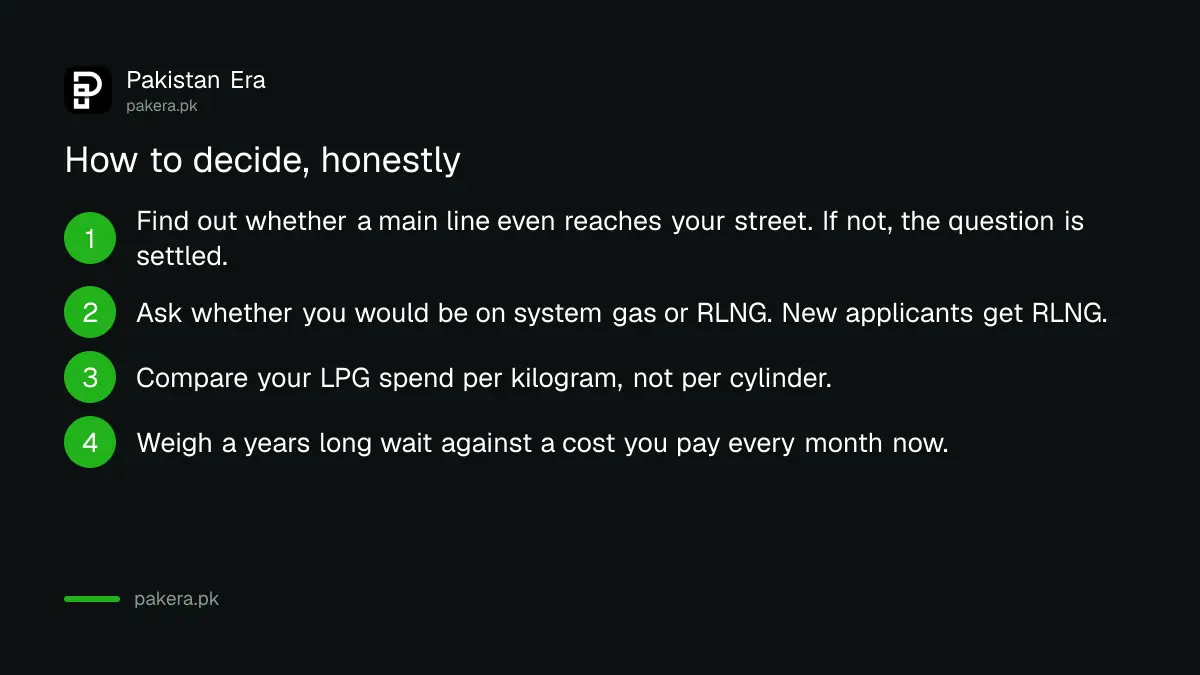
- Check whether a main line reaches your street. Ask SNGPL or SSGC, or ask neighbours who have a connection.
- Ask which supply you would be on. New applicants get RLNG. Confirm it rather than assuming.
- Work out your LPG cost per kilogram. Divide what you pay by the cylinder weight, not by the cylinder. Our LPG guide explains why that distinction matters and how short filling hides in it.
- Count your cylinders per month across a normal month, not a light one.
- Ask the utility for the domestic rate that would apply to you, in writing.
- Compare like with like, monthly cost against monthly cost, and add the wait to the piped side.
Where each one genuinely wins
Piped gas wins if a line already reaches you, if your household is large enough that carrying and swapping cylinders is a real burden, and if you are staying in the property long enough for the refundable security to be irrelevant.
LPG wins if there is no line, if you rent and may move, if your usage is low, or if you simply cannot wait years. It also wins on control: you know exactly what you spent because you handed over the money.
And there is a sensible middle position. Applying costs nothing. There is no fee to submit an application, so applying while continuing on LPG is a reasonable thing to do, as long as you do not plan a kitchen or a budget around a connection that may take years to arrive.
One thing to check either way
Whichever you use, safety habits matter more than the price difference. Check for leaks with soapy water rather than a flame, store cylinders upright and never below ground level, and replace perished hoses rather than taping them. LPG is heavier than air, so a leak collects at floor level rather than dispersing.
If you already have a piped connection and are trying to understand the bill rather than the choice, the slabs and the meter reading are covered in our guide to checking and paying a Sui gas bill.
Questions readers are asking
Is piped gas cheaper than LPG in Pakistan?
It depends which piped gas. System gas is cheap, but new domestic connections are being given on RLNG only, which is imported and billed higher. The old comparison no longer holds automatically.
What do new gas connections actually get?
RLNG. SNGPL's own notice states the ban was relaxed only on the basis of the RLNG tariff.
How long is the wait for a piped connection?
Reported at two to three years on normal processing, against a backlog beyond 700,000 applications. Fast track costs Rs 25,000 and is reported at six to twelve months.
Should I apply even if I use LPG?
There is no fee to apply, so it is reasonable. Just do not plan a kitchen or a budget around a connection arriving soon.
How do I compare the two costs properly?
Work out your LPG cost per kilogram and your monthly usage, then ask the utility in writing for the domestic rate that would apply to you. Compare monthly cost against monthly cost.
Why will you not just tell me which is cheaper?
Because we could not read the current domestic RLNG consumer tariff from the regulator, and a confident number built on an unverified rate would mislead you on a long term decision.
About the author

Tax, Bills and Technology Writer
Ali Akhtar is a young and curious voice here at Pakistan Era. He is currently pursuing his A-Levels and has a growing interest in Pakistan’s changing industrial landscape and educational trends. Ali likes to write in a way that helps him explain and explore the world around him. His writing reflects the perspective of the new generation navigating the evolving trends of Pakistan where technology, youth innovation, and shifting opportunities are reshaping the country’s future.