Pakistan's Commercial Used Car Imports Hit 2,276 in September, Carmakers Say
Commercial used car imports in Pakistan rose from 48 in May to 2,276 in September 2026. PAMA wants the new EDB rules suspended. What it means for buyers.
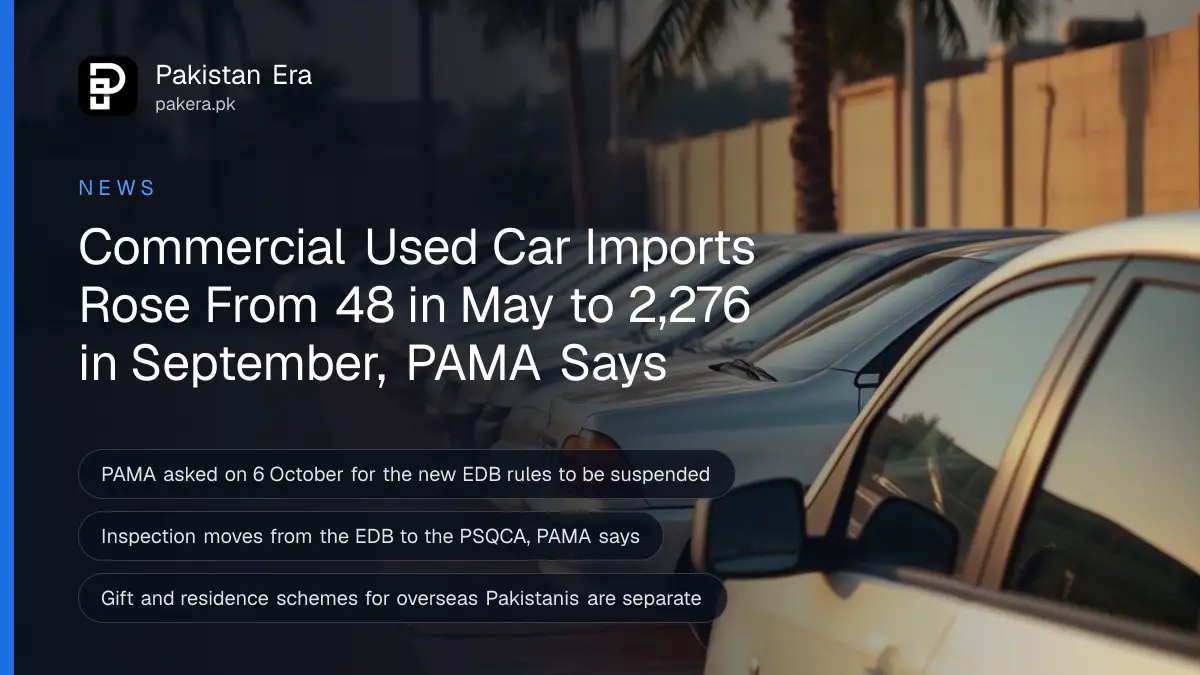
Commercial imports of used vehicles into Pakistan reached 2,276 units in September 2026, up from just 48 in May, according to Ministry of Commerce figures quoted by the country's car assemblers. The Pakistan Automotive Manufacturers Association (PAMA) has now asked the government to suspend a new Engineering Development Board notification that, it says, makes these imports easier still.
We read PAMA's letter of 6 October 2026, which the association posted on its own website on 8 October. Here is what it says, what the new rules change for traders and car buyers, and what is still unconfirmed.
Carmakers asked the government on 6 October to suspend the new used car rules
PAMA wrote to the Prime Minister's Adviser on Industries and Production, Haroon Akhtar Khan, on 6 October 2026. It asked the government to review the Engineering Development Board's notification of 30 September 2026 and suspend it until the car industry is consulted.
The Engineering Development Board, or EDB, is the federal body under the Ministry of Industries and Production that sets technical rules for the vehicle and engineering sector. Its new notification replaces the one it issued on 30 September 2025, which first set rules for commercial imports of vehicles.
The letter is signed by PAMA's Director General, Razi ur Rahman, and copied to the Ministry of Commerce, the Ministry of Industries and Production and the EDB's chief executive. PAMA estimates its members and their parts suppliers could lose more than Rs 50 billion if imports return to the levels of 2025-26. That is the association's own estimate, not an official one.
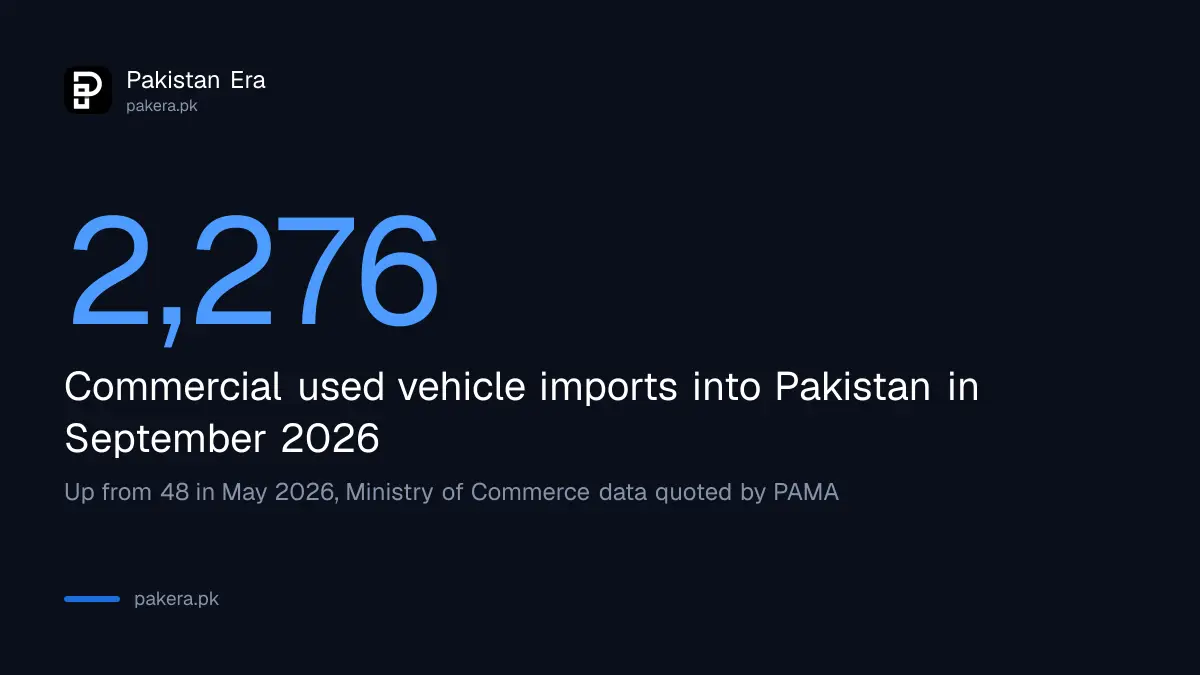
Commercial used car imports rose from 48 to 2,276 in four months
PAMA says commercial imports of used vehicles were 48 units in May 2026, 843 in June, 1,938 in July, 1,445 in August and 2,276 in September. It cites the Ministry of Commerce for these numbers. We could not find them published on the ministry's own website.
| Month (2026) | Commercial used vehicle imports |
|---|---|
| May | 48 |
| June | 843 |
| July | 1,938 |
| August | 1,445 |
| September | 2,276 |
| June to September | 6,502 |
The June to September total is our own sum of PAMA's figures. "Commercial" means vehicles brought in by traders to sell. It does not include cars that overseas Pakistanis bring under the gift or transfer of residence schemes.
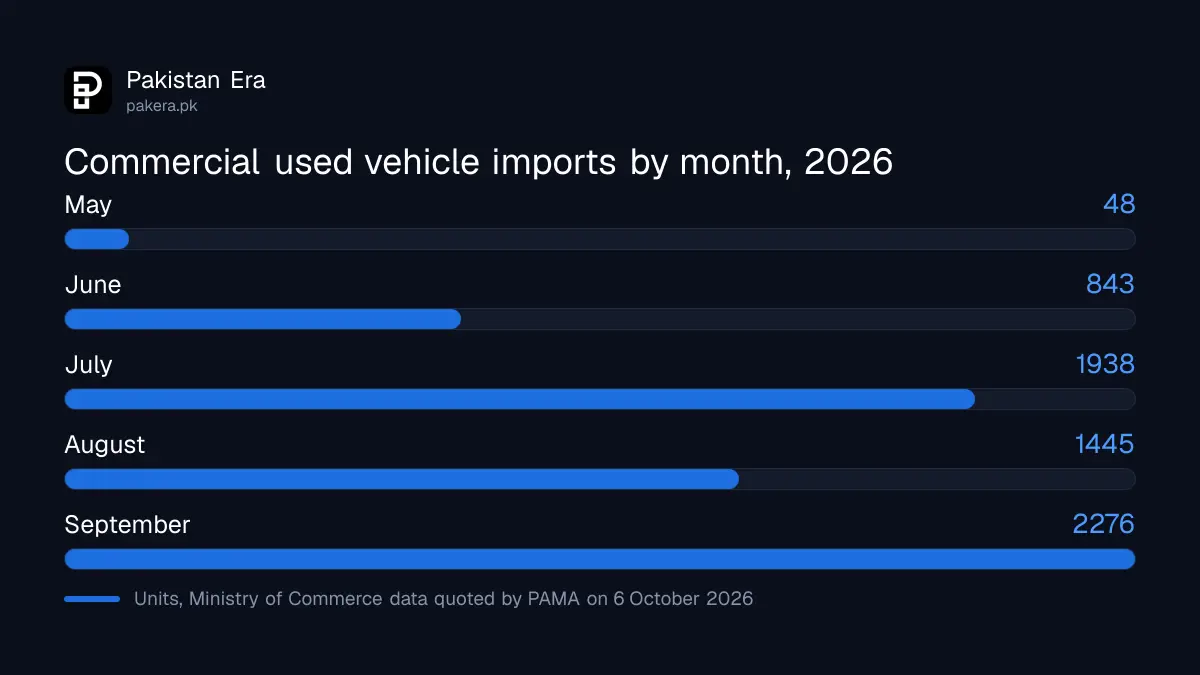
The rise began before the new notification. Almost all of September's imports arrived before the 30 September rules were issued. PAMA's worry is that the new rules will push it higher.
PAMA says the notification removes four safeguards
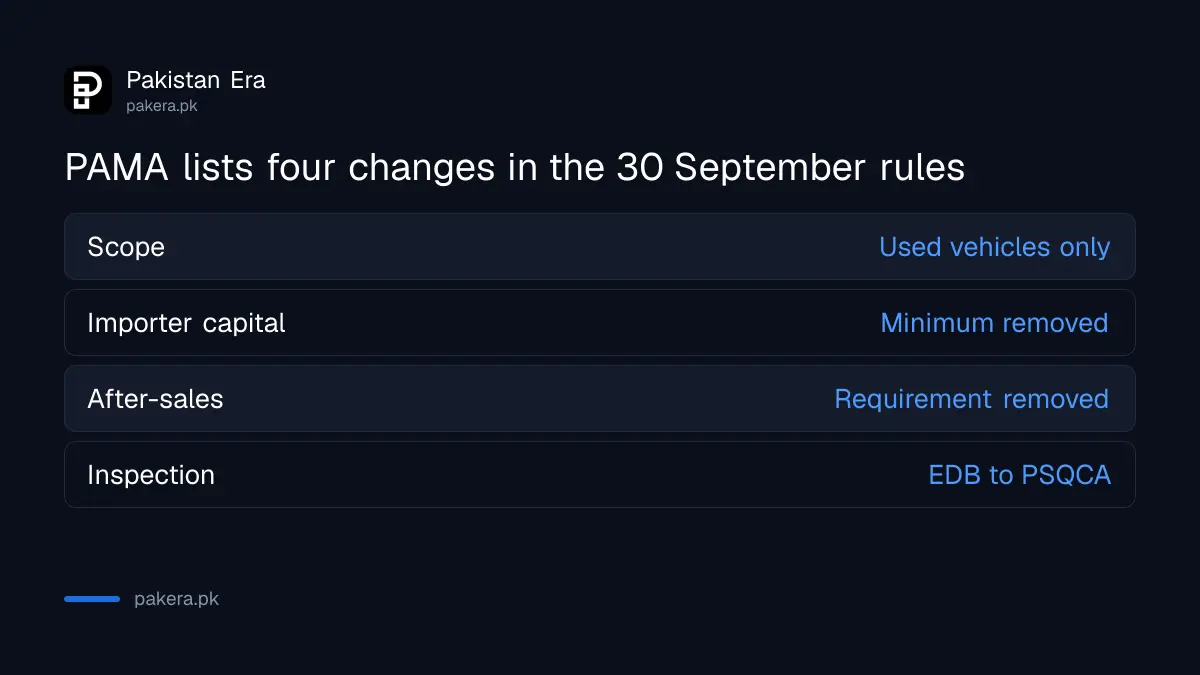
According to PAMA's letter, the 30 September 2026 notification covers only used vehicles, drops the minimum capital and after-sales service rules for importers, and moves inspection from the EDB to the Pakistan Standards and Quality Control Authority (PSQCA).
The letter lists four changes:
- The rules now cover used vehicles only. The 2025 notification covered both new and used fully built cars.
- Importing companies no longer need a minimum capital or proper after-sales service. PAMA says there is also no working product recall system.
- Pre-shipment and post-shipment inspection moves from the EDB to the PSQCA, the federal standards body.
- Imports under SRO 2443(I)/2025 become easier, because PSQCA-registered companies can now inspect the vehicles.
The EDB has not posted the notification on its website, so we could not read the text ourselves. Reports in the business press say it also lets sole traders and partnership firms with a tax number import used vehicles, where the 2025 rules allowed only registered companies. Treat that point as reported until the notification is published.
PAMA also says commercially imported used cars get a cost advantage from depreciation allowances of up to 36 per cent. Depreciation here means customs values an older car lower, so less duty is paid on it.
Car buyers may see more imported used cars, with fewer checks on the seller
For buyers, more commercial imports mean more choice of recent imported used cars in dealer showrooms. The trade-off, if PAMA's reading is right, is that the importer may not have to offer after-sales service or meet a minimum size.
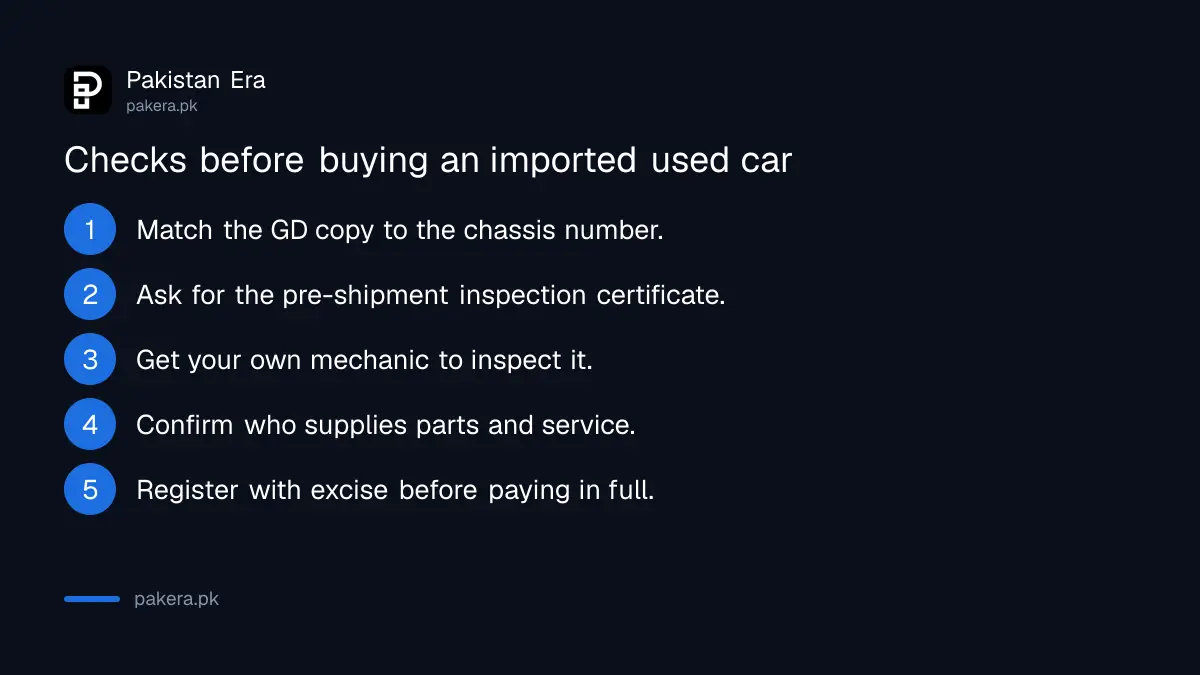
That shifts more checking onto you. Before paying for an imported used car from a dealer, do these five things:
- Ask for the customs Goods Declaration (GD) copy and check that the chassis number matches the car.
- Ask for the pre-shipment inspection certificate and the name of the inspection company.
- Have the car checked by your own mechanic. A full inspection of the used car before buying catches most hidden faults.
- Confirm who supplies parts and service for that model in Pakistan.
- Register it with your province's excise department before you pay the full price.
If you are an overseas Pakistani bringing in your own car, the commercial route is separate. The rules for importing a used car under the gift or residence schemes are unchanged by this notification.
The government has not answered, and the auto policy is still pending
We found no public reply to PAMA from the Ministry of Industries and Production or the EDB as of 9 October 2026. The new Auto Policy 2026-31 is also still unpublished, and PAMA asked on 29 September to see its draft before it reaches the Prime Minister.
PAMA says it fears the draft policy may set steep export targets with penalties, including higher tariffs or cancelled manufacturing licences for companies that miss them. That too is PAMA's account of reports it has heard. The draft is not public. The state of that policy for buyers is set out in what Auto Policy 2026-31 changes for car buyers.
Separately, news reports from 1 October said the Federal Investigation Agency had sought EDB records linked to the 30 September notification. Neither the FIA nor the EDB has published a statement on this that we could find, and no wrongdoing has been established.
Common questions
How many used cars were imported commercially in September 2026?
2,276 units, according to Ministry of Commerce figures quoted by PAMA. We could not find the figure on the ministry's own website.
What did the EDB notification of 30 September 2026 change?
PAMA says it limits the rules to used vehicles, drops minimum capital and after-sales requirements for importers, and moves inspection from the EDB to the PSQCA. The EDB has not published the text.
Is the new used car import rule suspended?
No. PAMA has asked for it to be suspended, but we found no government decision on that request as of 9 October 2026.
Does this change the gift or transfer of residence scheme?
No. The notification is about commercial imports by traders. Personal schemes for overseas Pakistanis follow separate rules.
Will used car prices fall in Pakistan?
Nobody has published a forecast. More supply can push prices down, but duties, the dollar rate and the pending auto policy also matter.
How we verified this
What we checked, where we read it, and what we could not confirm.
Last checked on 9 October 2026. The monthly import figures, the four changes, the Rs 50 billion estimate and the request for suspension are from PAMA's letter of 6 October 2026, posted on the association's website. The auto policy concern is from PAMA's letter of 29 September 2026 to the Ministry of Industries and Production, on the same site. We checked the Engineering Development Board's website for the notification and did not find it. The four-month total is our arithmetic.
About the author

Tax, Bills and Technology Writer
Ali Akhtar is a young and curious voice here at Pakistan Era. He is currently pursuing his A-Levels and has a growing interest in Pakistan’s changing industrial landscape and educational trends. Ali likes to write in a way that helps him explain and explore the world around him. His writing reflects the perspective of the new generation navigating the evolving trends of Pakistan where technology, youth innovation, and shifting opportunities are reshaping the country’s future.