Auto Policy 2026-31: What Changes for Car Buyers in Pakistan
Pakistan's Auto Policy 2026-31 has in-principle approval but is not in force. See the proposed car duty cuts, used import rules, EV and safety targets and when.
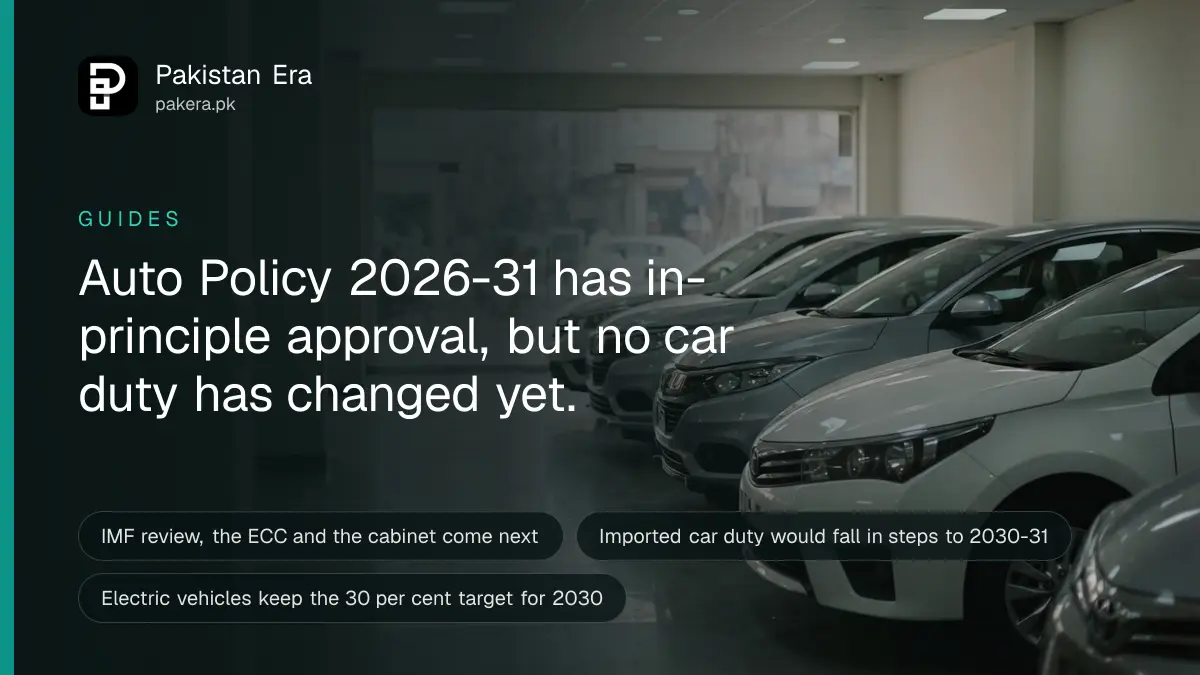
Nothing in the Auto Policy 2026-31 changes the price of a car in Pakistan yet. Prime Minister Shehbaz Sharif gave it in-principle approval on 9 September 2026, as reported, but it still needs an IMF review, the Economic Coordination Committee and the federal cabinet. No duty, tax or import rule from it has been notified.
Once it takes effect, the draft would change a lot: cheaper duty on imported new cars in steps to 2030-31, a used car import route through dealers, and tighter local content and safety rules.
On 26 September 2026 we checked the Ministry of Industries and Production website. Its policies page still lists the Auto Industry Development and Export Policy 2021-26 as the latest auto policy, and that policy's own text says its period ended on 30 June 2026. The new policy text is not published, so every figure from it below is reported, not read by us.
The auto policy is approved in principle, not in force
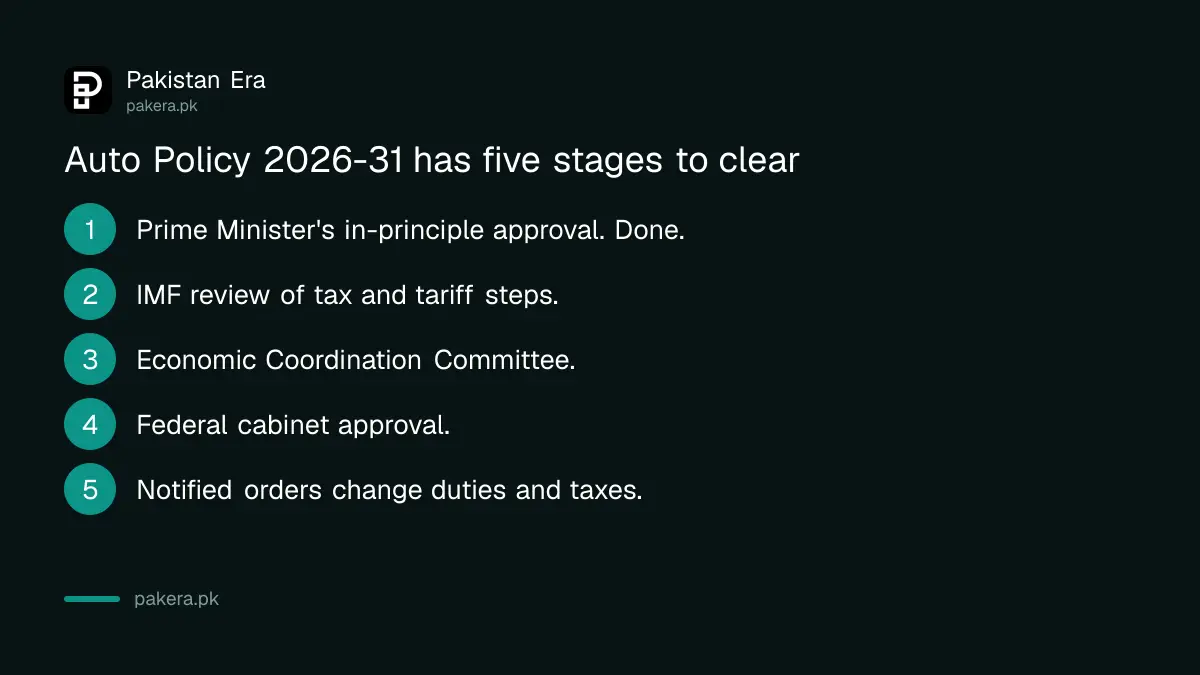
The Prime Minister approved the Auto Policy 2026-31 in principle at a meeting on 9 September 2026, according to reports. It now goes to the IMF, then the Economic Coordination Committee (ECC), then the federal cabinet. Only notified orders after that change what you pay.
The ministry's own statement of 18 September 2026 confirms the policy is not out. In it, the Adviser to the Prime Minister on Industries and Production, Haroon Akhtar Khan, said at the Pakistan International Auto Show in Lahore that the government "would unveil new Auto Policy shortly". We read that on the Ministry of Industries and Production site. It gives no date.
Talks with the IMF on the policy's tax and tariff measures were reported to be set for October. The IMF has reportedly pushed back on lower sales tax for new energy vehicles. The policy already missed its 1 July start date, and its steering committee agreed the framework only in August.
Imported new cars would get cheaper duty in steps to 2030-31
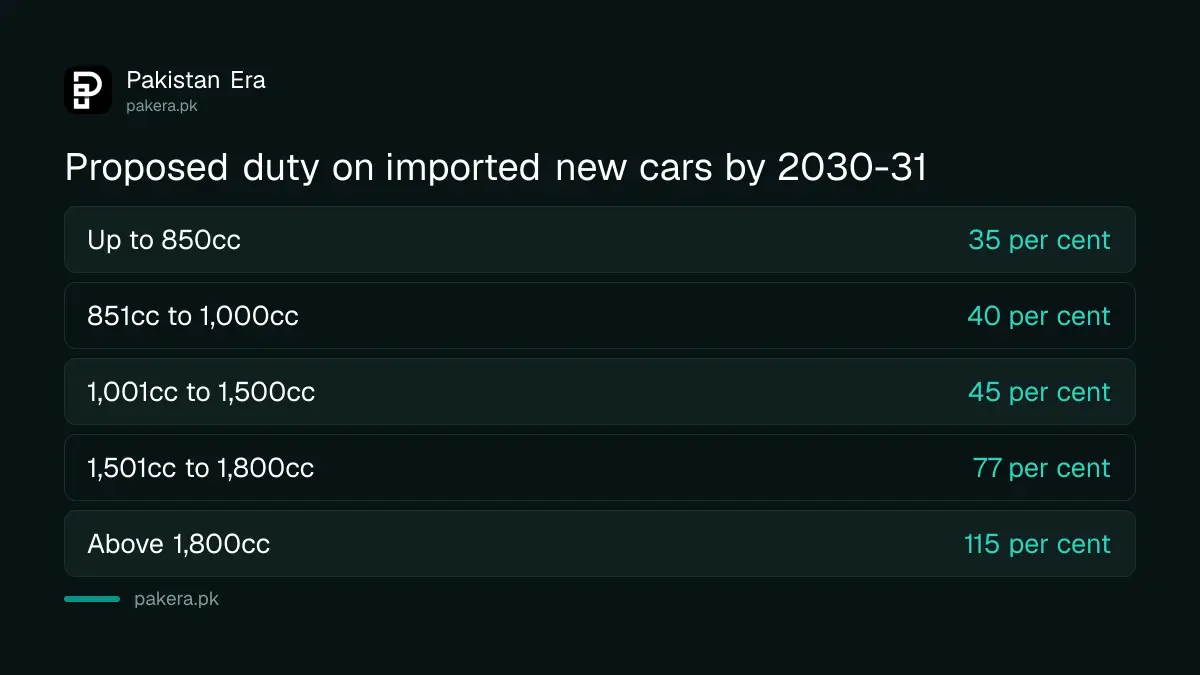
The reported draft cuts customs duty on completely built-up (CBU) cars, meaning cars imported whole, in stages until 2030-31. It also ends regulatory and additional customs duty on them by then. These rates are proposals and could change before the cabinet signs off.
| Engine size, imported new car | Proposed customs duty by 2030-31 |
|---|---|
| Up to 850cc | 35 per cent |
| 851cc to 1,000cc | 40 per cent |
| 1,001cc to 1,500cc | 45 per cent |
| 1,501cc to 1,800cc | 77 per cent |
| Above 1,800cc | 115 per cent |
The same draft sets four customs duty slabs of 0, 5, 10 and 15 per cent, and cuts the average import tariff for the sector from 15.7 per cent to 5.99 per cent by 2030.
Big engines face a new cost as well. Reports say an environmental levy of 10 per cent is proposed on vehicles of 2,001cc to 3,000cc, and 19.5 per cent above 3,000cc. The government expects it to raise about Rs 142.79 billion over five years.
Reports differ on hybrids. One version says duty on imported hybrids falls to 15 per cent. Another says it falls from 50 to 30 per cent over five years. A third says hybrids will be treated like petrol cars for duty and sales tax. We cannot tell which version reached the Prime Minister.
Used car imports would open to dealers with a service network
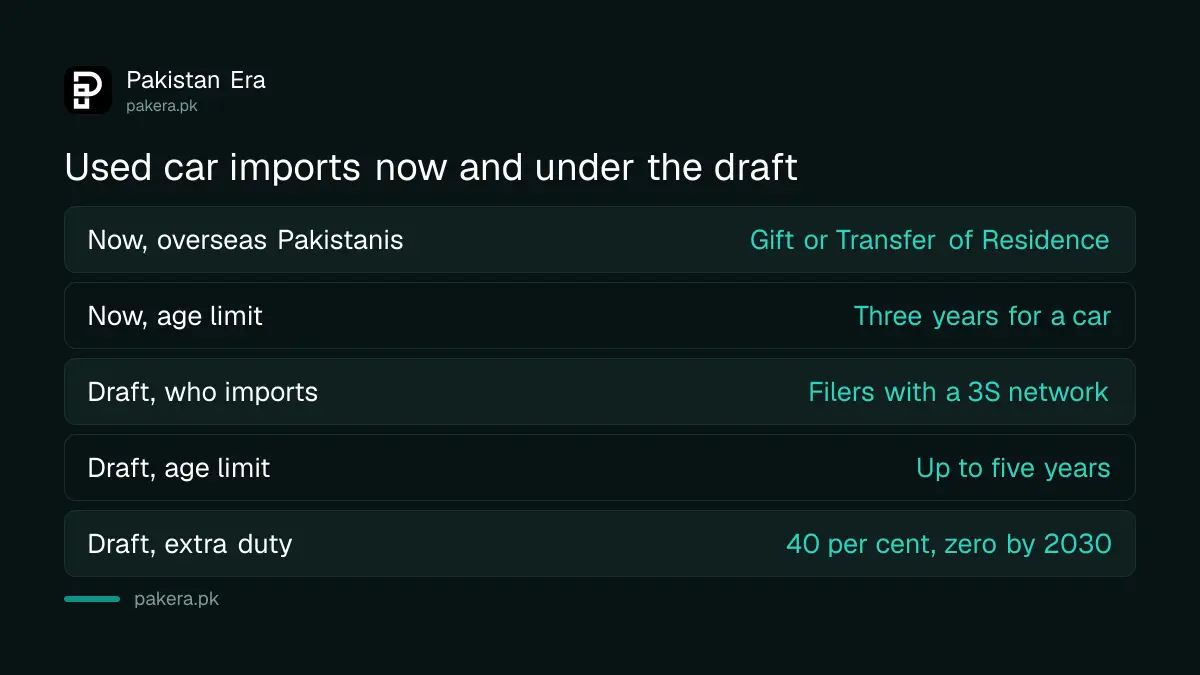
The draft reportedly allows commercial imports of used vehicles up to five years old, but only by active corporate tax filers with sales, service and spare parts networks. A 40 per cent regulatory duty would apply at first and fall to zero by 2030.
For a buyer, that means a used import would come through a registered dealer with a workshop. It would not be cheap in the first years, while the 40 per cent extra duty applies.
Today's rules are different and still in force. An overseas Pakistani can send a car under the Gift or Transfer of Residence schemes, with a three year age limit. How those schemes work, and the duty on a car under them, is set out in importing a used car to Pakistan. Nothing in the new policy has replaced them yet.
Electric cars keep the 30 per cent target and tax breaks
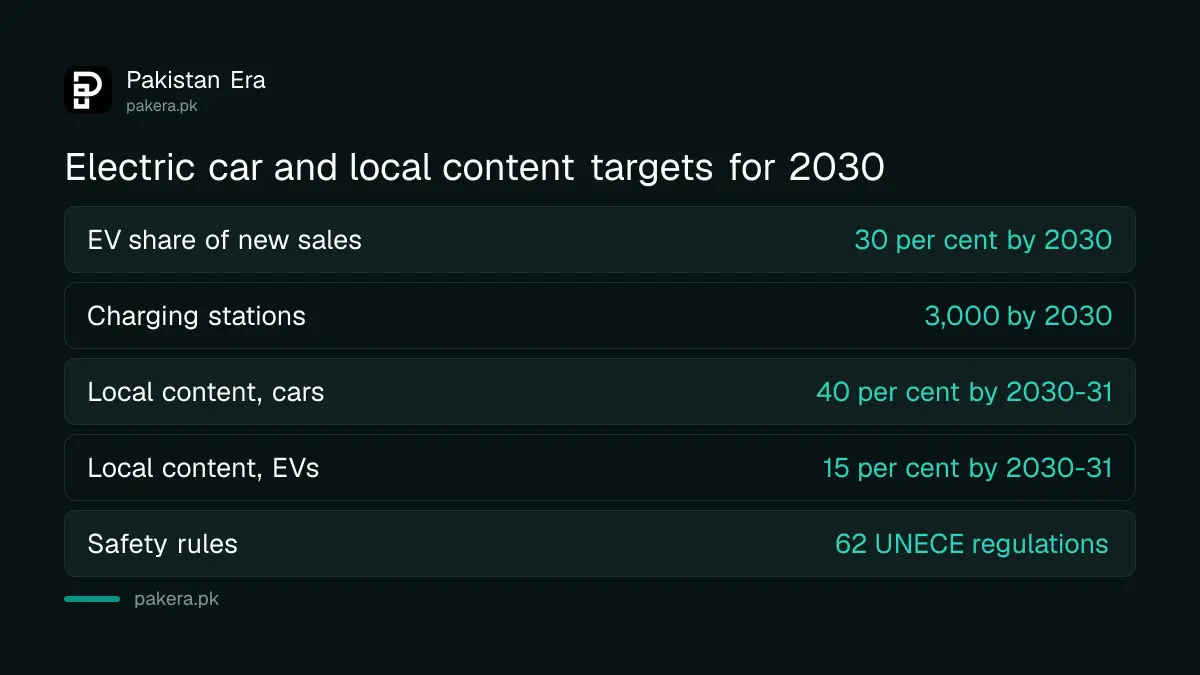
The 30 per cent target is already official. The New Energy Vehicles Policy 2025-30 on the ministry's site aims for 30 per cent of new vehicle sales to be electric or other new energy vehicles by 2030, with 3,000 charging stations. The auto policy works alongside it.
The auto policy adds, as reported, equal treatment for battery electric cars, range extended electric cars and plug-in hybrids. They would keep a 1 per cent sales tax and stay exempt from federal excise duty, capital value tax and withholding tax. Charging equipment would pay 1 per cent customs duty.
Car loans for these vehicles would get bigger. Reports say the limit rises from Rs 3 million to Rs 10 million. Reports differ on the term, one saying five years and one saying seven. Subsidies would come through the PAVE programme, the same one behind the electric bike scheme.
One tax change for hybrids has already happened, separate from the auto policy. The sales tax on locally made hybrids up to 2,000cc was reported cut from 25 to 18 per cent from 13 September 2026, under SRO 1525(I)/2026. It had risen to 25 per cent in July, when the old hybrid tax concession ended. Some assemblers have since cut hybrid prices, as reported.
Local content and safety rules aim at better built cars
The draft sets minimum local value addition targets that the Engineering Development Board would enforce, and requires 62 UNECE vehicle safety regulations. For buyers, the safety rules matter most, because they decide what features a new car must have.
The reported local content targets for 2030-31 are 40 per cent for passenger cars, 45 per cent for light commercial vehicles, 80 per cent for tractors, 90 per cent for motorbikes and rickshaws, and 15 per cent for new energy vehicles.
UNECE is the United Nations Economic Commission for Europe, whose vehicle rules many countries use. Pakistan joined its WP.29 rules forum under the old policy. Which 62 rules the new draft enforces, and from when, has not been published.
Car buyers can plan around five checks
Plan on today's prices and today's rules, because nothing from the auto policy has a start date. The duty cuts are spread over five years, so waiting for them could mean waiting until 2030. Five checks help you decide now.
- Ask the dealer for the current price list and its date. Hybrid prices moved after the 13 September sales tax cut.
- Ask whether the price is locked on booking. Today that depends on the booking terms, not on the draft policy.
- If you plan an import, use the current Gift or Transfer of Residence rules. The dealer import route is only proposed.
- For an electric car, compare the loan terms at your bank. Current car loan limits apply until any change is notified.
- Watch for the ECC and cabinet decisions, then the notified orders. Only those change a duty or tax.
Common questions
Has the Auto Policy 2026-31 been approved?
Only in principle. The Prime Minister approved it on 9 September 2026, as reported. It still needs IMF review, the ECC and the federal cabinet, and then notified orders.
Will car prices in Pakistan fall now?
Not because of the auto policy. None of its duty cuts are in force. Hybrid prices have moved because of a separate sales tax cut on 13 September.
What duty would an imported 1,300cc car pay?
By 2030-31, 45 per cent customs duty under the reported draft, with regulatory and additional duty removed. Today's rates apply until then.
Can I import a used car under the new policy?
Not yet. The dealer import route is only proposed. Today's schemes for overseas Pakistanis, Gift and Transfer of Residence, still apply.
What is the electric vehicle target?
30 per cent of new vehicle sales by 2030. That target is in the New Energy Vehicles Policy 2025-30 published by the Ministry of Industries and Production.
When will the new auto policy take effect?
No date has been given. The ministry said on 18 September that it would be unveiled "shortly". IMF talks on it were reported for October.
How we verified this
What we checked, where we read it, and what we could not confirm.
Last checked on 26 September 2026.
On 26 September 2026 we read, on the Ministry of Industries and Production website, its policies page, the 2021-26 auto policy (period ending 30 June 2026, WP.29 membership as E-64), the New Energy Vehicles Policy 2025-30 (30 per cent target, 3,000 charging stations) and the ministry's statement of 18 September 2026. Everything else about the new policy is reported, including the approval, the next stages, every duty rate, the levy, the used car terms, the targets and the loan limits, because the draft has not been published. Reports differ on hybrid duty and loan terms, and we say so above. The hybrid sales tax cut to 18 per cent under SRO 1525(I)/2026 is also reported, because we could not open the order on the Federal Board of Revenue site.
About the author

Tax, Bills and Technology Writer
Ali Akhtar is a young and curious voice here at Pakistan Era. He is currently pursuing his A-Levels and has a growing interest in Pakistan’s changing industrial landscape and educational trends. Ali likes to write in a way that helps him explain and explore the world around him. His writing reflects the perspective of the new generation navigating the evolving trends of Pakistan where technology, youth innovation, and shifting opportunities are reshaping the country’s future.