Vani, Swara and Forced Marriage in Pakistan: 3 to 7 Years and Rs 500,000 Fine Under 310A and 498B PPC
Vani, swara and forced marriage in Pakistan: 310A and 498B PPC carry 3 to 7 years and a Rs 500,000 fine, cannot be settled by compromise, and how to report.
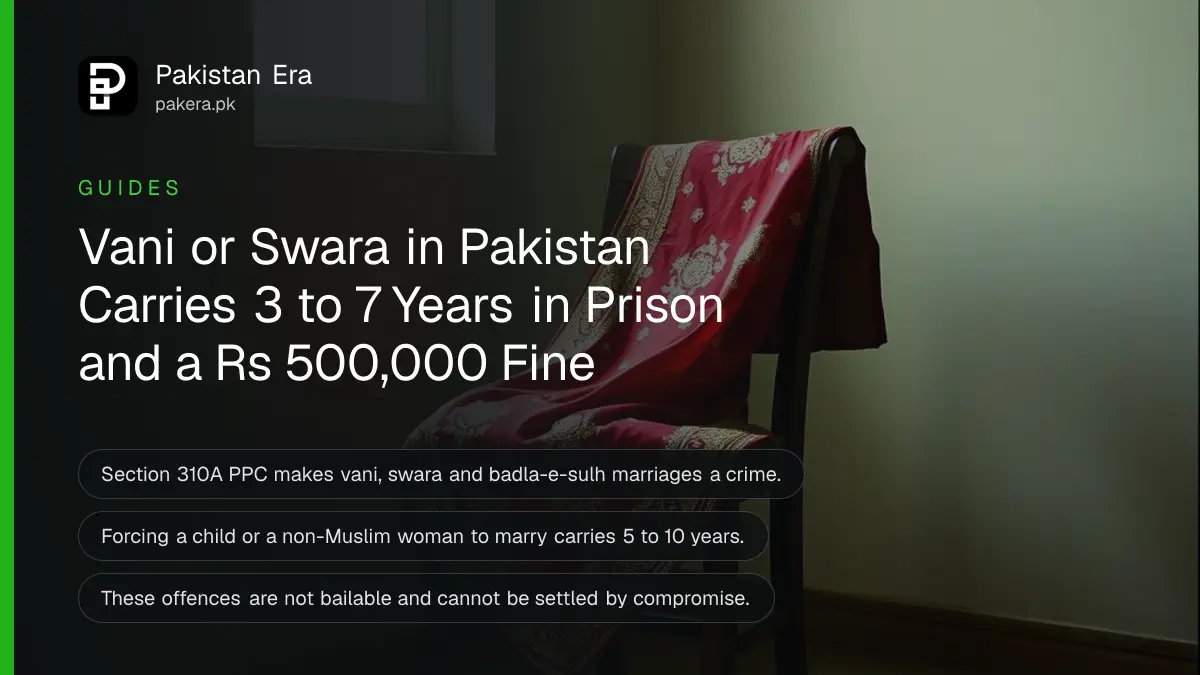
Short answer: Giving a girl or woman in marriage as vani, swara or badla-e-sulh to settle a dispute is a crime in Pakistan under Section 310A of the Pakistan Penal Code (PPC). The punishment is 3 to 7 years in prison and a Rs 500,000 fine. Forcing any woman to marry carries the same under Section 498B, and up to 10 years if she is a child or a non-Muslim woman.
These customs settle a feud or a murder case by handing over a female relative of the accused family. We read the PPC and the Code of Criminal Procedure (CrPC) on the Ministry of Law's Pakistan Code website. This guide sets out the four sections that protect women from forced and customary marriages, how the police and courts treat them, and how to report a case.
Section 310A makes vani and swara a crime
Section 310A punishes "whoever gives a female in marriage or otherwise compels her to enter into marriage, as badla-e-sulh, wanni, or swara or any other custom or practice under any name, in consideration of settling a civil dispute or a criminal liability".
Three things in that wording matter:
- Any name counts. The section names badla-e-sulh, wanni and swara, then adds "any other custom or practice under any name". Calling it something else does not help.
- Civil or criminal disputes. It covers a land or money dispute as well as a murder or injury case.
- Giving or compelling. Both the person who gives her and anyone who compels her can be charged.
The punishment is imprisonment "for a term which may extend to seven years but shall not be less than three years", and the offender "shall also be liable to fine of five hundred thousand rupees".
A woman cannot be part of a murder settlement either
Section 310 of the PPC lets a victim's heir settle a murder case by accepting compensation, called badal-i-sulh. Its proviso says: "a female shall not be given in marriage or otherwise in badal-i-sulh". So a court cannot accept a compromise that hands over a woman. Our guide to 302 PPC compromise explains how a lawful settlement works.
Forced marriage, inheritance and marriage with the Quran
The PPC has a separate chapter, "Of offences against women", with three more sections. The chapter was inserted by Act XXVI of 2011, according to the Pakistan Code footnotes.
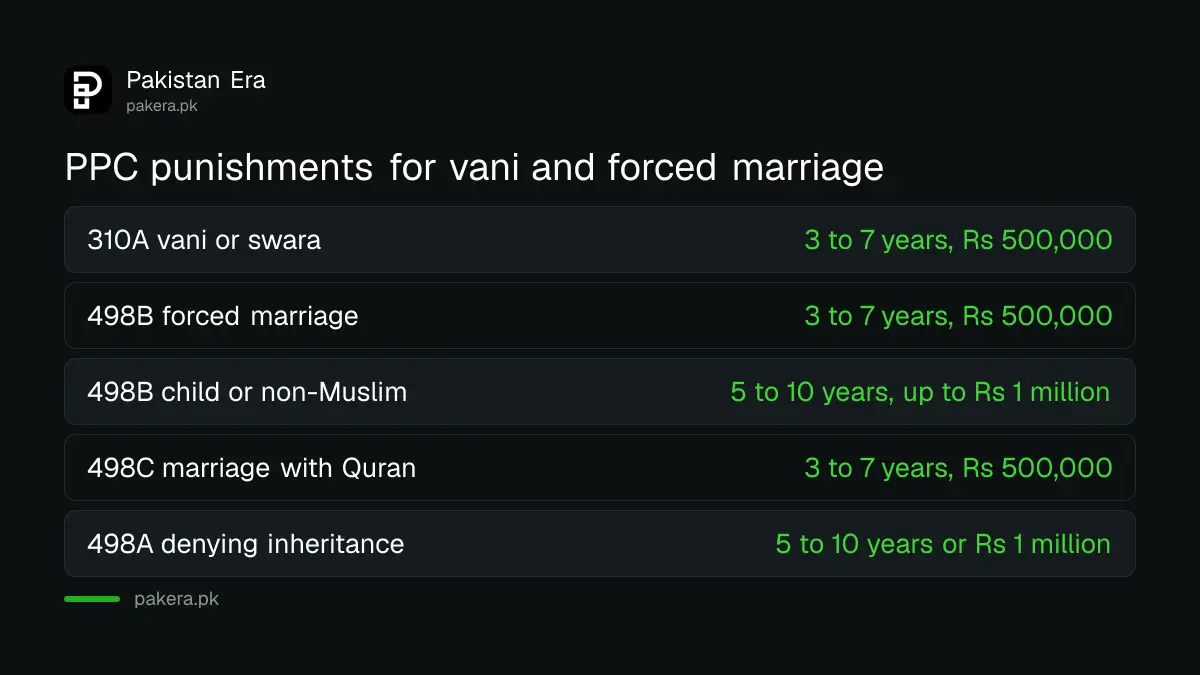
| Section | Offence | Punishment |
|---|---|---|
| 310A | Giving a female in marriage as vani, swara or badla-e-sulh | 3 to 7 years and Rs 500,000 fine |
| 498A | Depriving a woman of her inheritance by deceit or illegal means | 5 to 10 years, or Rs 1 million fine, or both |
| 498B | Forcing a woman to marry | 3 to 7 years and Rs 500,000 fine |
| 498B proviso | Forcing a female child or a non-Muslim woman to marry | 5 to 10 years and fine up to Rs 1 million |
| 498C | Marriage of a woman with the Holy Quran | 3 to 7 years and Rs 500,000 fine |
Section 498C has an explanation. An oath by a woman on the Holy Quran to stay unmarried for life, or not to claim her share of inheritance, is treated as marriage with the Holy Quran. That custom is often used to keep land in the family.
For inheritance, our guide to who gets what under Pakistani inheritance law sets out a daughter's share.
Police cannot arrest without a warrant, but bail is not a right
The CrPC schedule classifies these offences in a way that surprises many families.
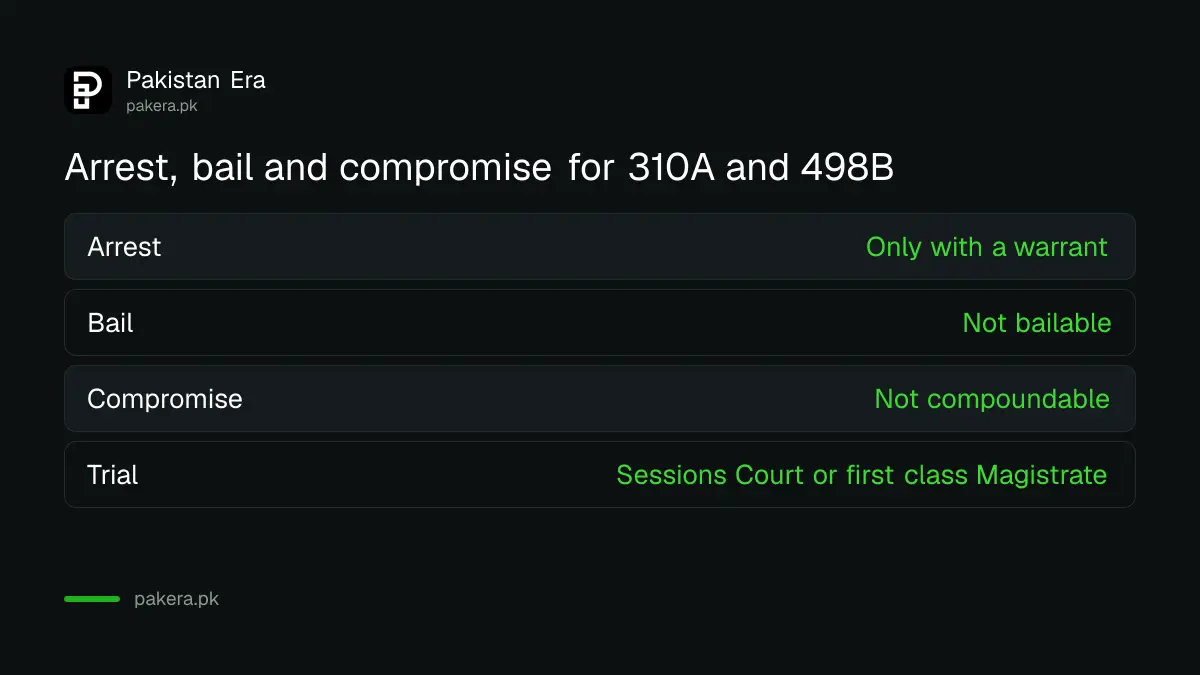
- Sections 310A, 498B and 498C: the police "shall not arrest without warrant", a warrant is issued, the offence is not bailable and not compoundable. They are tried by a Court of Session or a Magistrate of the first class.
- Section 498A: the same rules on arrest, bail and compromise, but it is tried only by the Court of Session.
"Not compoundable" is the key point. The families cannot end the case by agreeing among themselves, because the offence is against the woman and the state. "Not bailable" means the accused has to apply and the court decides. Because police need a warrant for all four sections, a complaint usually goes before a Magistrate.
How to report vani, swara or a forced marriage
Act before the marriage takes place if you can. A planned vani or a forced marriage can often be stopped before the nikah.
- If someone is in danger now, call police emergency on 15.
- Write down who arranged it, the dispute it settles, the date and place, and any witnesses.
- Go to the police station or to the court of the area Magistrate with a written complaint. For all four sections, ask for the complaint to be placed before the Magistrate, since a warrant is needed.
- If the girl is under the legal age, also report it as a child marriage. In Islamabad, our guide to stopping a child marriage in Islamabad explains the 2025 Act.
- For free legal help, call the Supreme Court's legal aid helpline 1818.
If a jirga or panchayat ordered the marriage, that does not make it lawful. Section 310A applies to the person who gives or compels, whatever body decided it.
Honour crimes and these customs are linked in the law
The same set of amendments that protect women from vani also deal with honour crimes. Section 299 names karo kari and siyah kari as honour customs, and an honour killing carries life imprisonment even after a pardon under Section 311. Read our explainer on the honour killing law in Pakistan.
The Senate's Law and Justice Committee is due to consider a Criminal Laws (Amendment) (Honour Killings Prevention) Bill, 2026 on 10 November 2026. We could not read its text, so we cannot say if it touches these sections. Until any change is passed and published, the sections above are the law.
Common questions
What is the punishment for vani in Pakistan?
Imprisonment of 3 to 7 years and a fine of Rs 500,000 under Section 310A of the PPC, for giving a female in marriage to settle a dispute.
What is swara?
Swara is a custom of giving a girl or woman in marriage to the other side to settle a feud or a crime. Section 310A names it, with wanni and badla-e-sulh, as an offence.
Is forced marriage a crime in Pakistan?
Yes. Section 498B punishes forcing a woman to marry with 3 to 7 years and Rs 500,000 fine. For a female child or a non-Muslim woman it is 5 to 10 years.
Can the families settle a vani case by compromise?
No. The CrPC schedule lists Section 310A as not compoundable. The families cannot end the case by agreement.
Is vani bailable?
No. Section 310A is listed as not bailable, so the accused must apply for bail and the court decides on the facts.
What is marriage with the Quran under Section 498C?
Compelling or arranging a woman's "marriage" with the Holy Quran, including an oath to stay unmarried or give up inheritance. It carries 3 to 7 years and Rs 500,000 fine.
About the author

Global Affairs & Political Economy Writer
Muhammad Hatim is a book lover who started writing because he enjoys it. At Pakistan Era he writes about international relations, geopolitics and the global economy, with a particular interest in South Asia and the forces behind current events.