Honour Killing Law in Pakistan: Life Imprisonment Under Section 311 PPC, Even After the Family Forgives
Honour killing law in Pakistan: Section 311 PPC means life imprisonment even after a pardon, the killer cannot act as heir, and attempts carry 5 years minimum.
Short answer: In Pakistan, a murder in the name of honour carries imprisonment for life even if the victim's family forgives the killer. Section 311 of the Pakistan Penal Code (PPC) sets that minimum, and Section 305 stops the killer from acting as the victim's heir to pardon himself. Most of these honour rules were written into the PPC by amendments in 2005 and 2016.
The honour killing law is back before Parliament. The Senate Standing Committee on Law and Justice is due to consider the Criminal Laws (Amendment) (Honour Killings Prevention) Bill, 2026 on 10 November 2026. We read the current PPC and the Code of Criminal Procedure (CrPC) on the Ministry of Law's Pakistan Code website. This guide sets out what the law already says, section by section, so you can judge any change against it.
The PPC defines an honour crime by custom
Section 299 of the PPC defines "offence committed in the name or on the pretext of honour" as an offence committed under karo kari, siyah kari or similar customs or practices. The label does not depend on what the accused calls it. The custom is what counts.
The same section widens "fasad-fil-arz", which means a crime that harms society as a whole. Its definition now includes an offence committed in the name or on the pretext of honour. That matters, because several later sections give the court less room once fasad-fil-arz applies.
Both changes were inserted by Act XLIII of 2016, the Criminal Law (Amendment) (Offences in the name or pretext of Honour) Act. The PPC on Pakistan Code shows the footnote against each amended clause.
Forgiveness by the family no longer frees the killer
Under Pakistan's qisas and diyat law, the heirs of a murder victim (the "wali") can forgive the killer or settle for compensation. Before 2016, that often ended honour killing cases, because the killer and the heirs were from the same family. The law now closes that route in three ways.
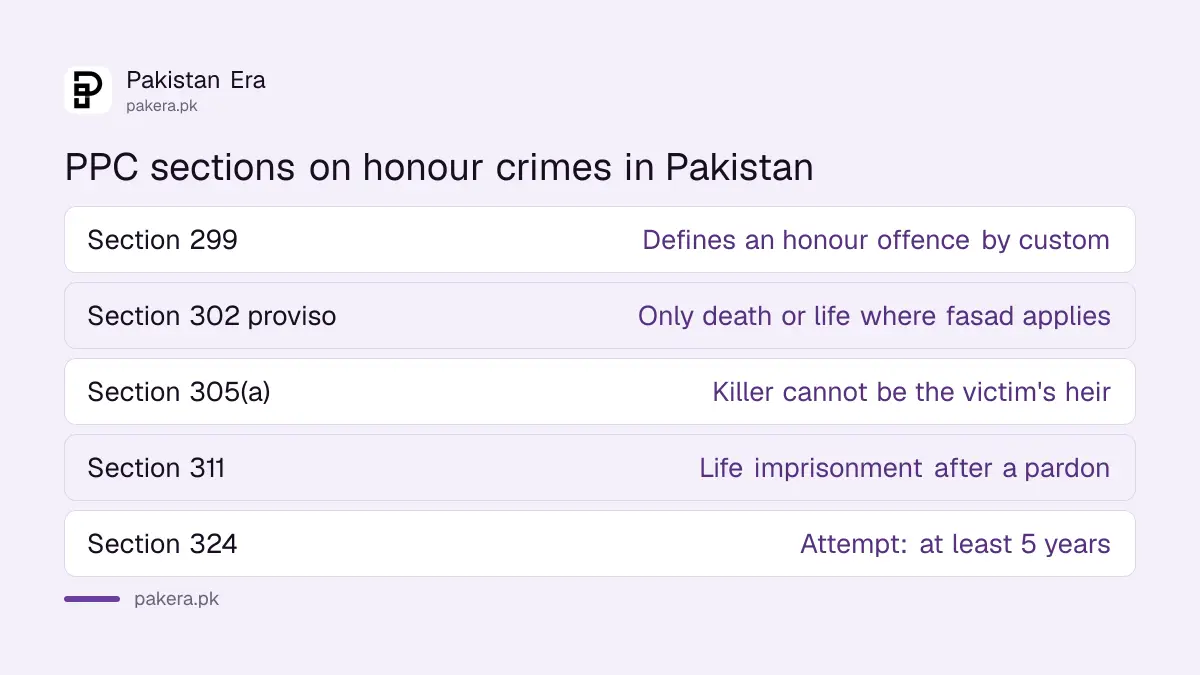
| Section | What it says for honour killings |
|---|---|
| 299(ii) and 299(ee) | Defines an honour offence and treats it as fasad-fil-arz |
| 302 proviso | Where fasad-fil-arz applies, only death or life imprisonment can be given, not the lower 302(c) term |
| 305(a) | The accused or convict is not a wali in an honour killing, so he cannot pardon himself |
| 310 proviso | A woman cannot be given in marriage as part of a settlement; compounding is subject to Section 311 |
| 311 proviso | If the killing was in the name of honour, the punishment is imprisonment for life |
Section 311 sets life imprisonment after a pardon
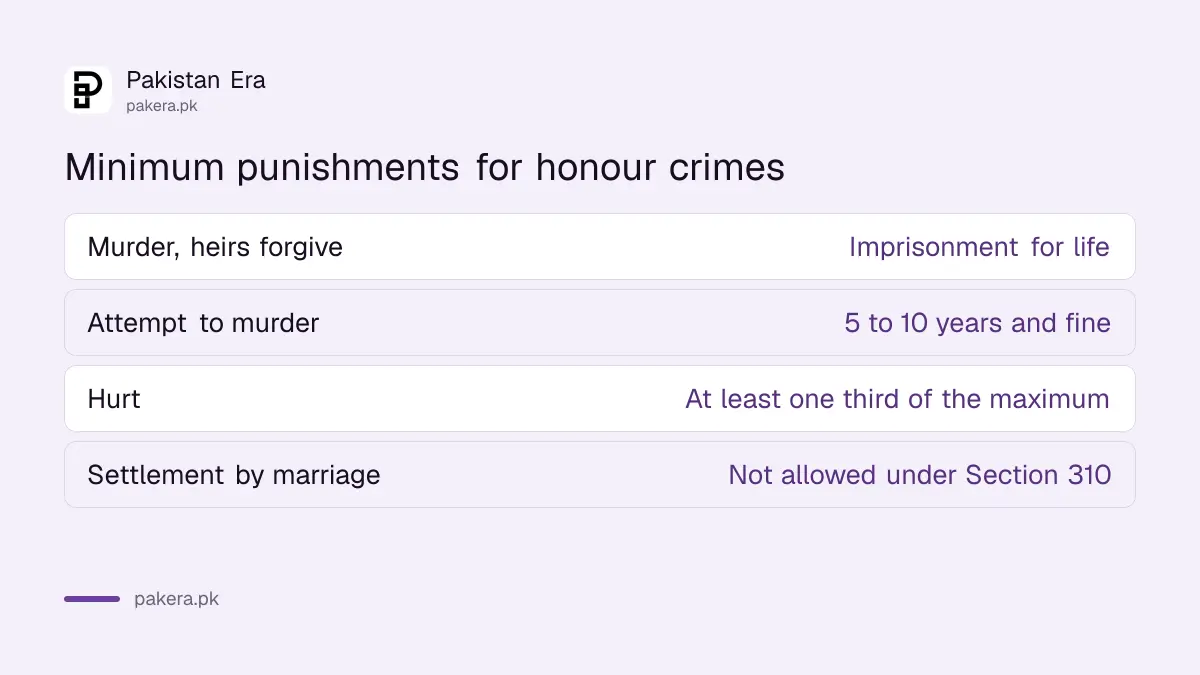
Section 311 deals with cases where the heirs waive or compound their right of qisas. The court may still punish the offender as ta'zir, which means a punishment set by the state rather than by the heirs. It can give death, life imprisonment or up to 14 years. Its proviso then adds: "if the offence has been committed in the name or on the pretext of honour, the punishment shall be imprisonment for life."
So a pardon may save an honour killer from the death penalty, but not from prison. The CrPC's schedule of offences repeats the same rule against Section 311.
Section 305 removes the killer from the list of heirs
Section 305(a) names the victim's heirs, under their personal law, as the wali. It adds that the wali "shall not include the accused or the convict in case of qatl-i-amd if committed in the name or on the pretext of honour". A father who kills his daughter cannot forgive himself as her heir. Read our guide to 302 PPC punishment and compromise for how qisas and settlement work in an ordinary murder case.
Attempts and injuries carry higher minimum terms
The law also sets higher punishments where the victim survives. The Section 324 rule dates from a 2005 amendment, Act I of 2005; the hurt and waiver rules carry the 2016 changes.
- Attempted murder, Section 324: up to 10 years and a fine, "but shall not be less than five years" if committed in the name of honour. Our guide to 324 PPC attempted murder covers the rest of this section.
- Hurt, Section 337N(2): the court may add ta'zir to arsh (compensation for injury). For an honour offence, that ta'zir cannot be less than one-third of the maximum term for the injury caused.
- Waiver of hurt cases, Section 338E: where fasad-fil-arz applies, the court "shall punish" the offender with the term or fine set for the offence, even after a compromise.
The 337 PPC hurt sections guide lists the punishment for each kind of injury.
How to report an honour crime or a threat
Murder and attempted murder are cognizable offences, which means the police can arrest without a warrant and must register a First Information Report (FIR). If you know of a threat or an attack, act early.
- Call police emergency on 15 if someone is in danger now.
- Go to the police station for the area and give a written statement. Ask for an FIR to be registered and take a copy.
- Write down names, dates, places and witnesses while you remember them.
- If the police refuse to register a case, apply to the Justice of the Peace (the Sessions Judge) under the CrPC.
- For free legal help, call the Supreme Court's legal aid helpline 1818.
Bail is not automatic in these cases. Our guide on bailable and non-bailable offences explains how a court decides.
What the 2026 Senate bill could change
Senator Samina Mumtaz Zehri moved the Criminal Laws (Amendment) (Honour Killings Prevention) Bill, 2026 in the Senate on 19 October 2026. The Law and Justice Committee lists it for "further consideration" on 10 November, which means it has been discussed before and not yet reported back.
We could not read the bill's text on the Senate website on 10 November, so we cannot tell you which sections it amends. Read our report on the Senate committee meetings of 10 November for the agenda. Until a bill is passed by both Houses, signed by the President and published in the Gazette, the sections above are the law.
Common questions
What is the punishment for honour killing in Pakistan?
Death or imprisonment for life under Section 302. If the heirs forgive the killer, Section 311 still requires imprisonment for life when the murder was in the name of honour.
Can the family forgive an honour killing in Pakistan?
The heirs can forgive the right of qisas, which removes the death penalty. They cannot stop a prison term: Section 311 makes it life imprisonment for an honour killing.
Can a father pardon himself for killing his daughter?
No. Section 305(a) says the accused or convict is not a wali in an honour killing, so he cannot act as her heir to forgive himself.
When did Pakistan change the honour killing law?
In 2016, through Act XLIII of 2016. The Pakistan Code footnotes credit it with the honour definition in Section 299 and the honour wording in later sections, including the CrPC schedule entry for Section 311.
What is karo kari?
Karo kari and siyah kari are customs of killing in the name of family honour. Section 299 names both, and any similar custom, as the basis of an honour offence.
Is the Honour Killings Prevention Bill 2026 law yet?
No. It is before the Senate's Law and Justice Committee. It must pass the Senate and National Assembly and get presidential assent before it becomes law.
About the author

Global Affairs & Political Economy Writer
Muhammad Hatim is a book lover who started writing because he enjoys it. At Pakistan Era he writes about international relations, geopolitics and the global economy, with a particular interest in South Asia and the forces behind current events.