324 PPC in Pakistan: Attempt to Murder Punishment, Bail and Compromise Explained
324 PPC attempt to murder in Pakistan: up to 10 years and fine plus the hurt punishment, 5 years minimum for honour, non-bailable, compoundable by the victim.
Short answer: Under Section 324 of the Pakistan Penal Code (PPC), attempt to murder carries up to 10 years in prison and a fine. If anyone is hurt, the punishment for that injury is added on top. An attempt in the name of honour carries at least 5 years. The offence is non-bailable, but the victim can compromise it.
Section 324 is one of the most common sections in a Pakistani FIR, often charged after a shooting or stabbing where the victim lives. We read the PPC and the Code of Criminal Procedure (CrPC) on the Ministry of Law's Pakistan Code website. Below is the exact punishment, how injuries are added, what "non-bailable" means in practice, and how a compromise works.
What Section 324 PPC says
Section 324 covers anyone who does an act with the intention or knowledge that, if it caused death, it would be qatl-i-amd (intentional murder). The person does not have to cause any injury. Firing at someone and missing can be enough, if the intent to kill is proved.
The punishment has three parts:
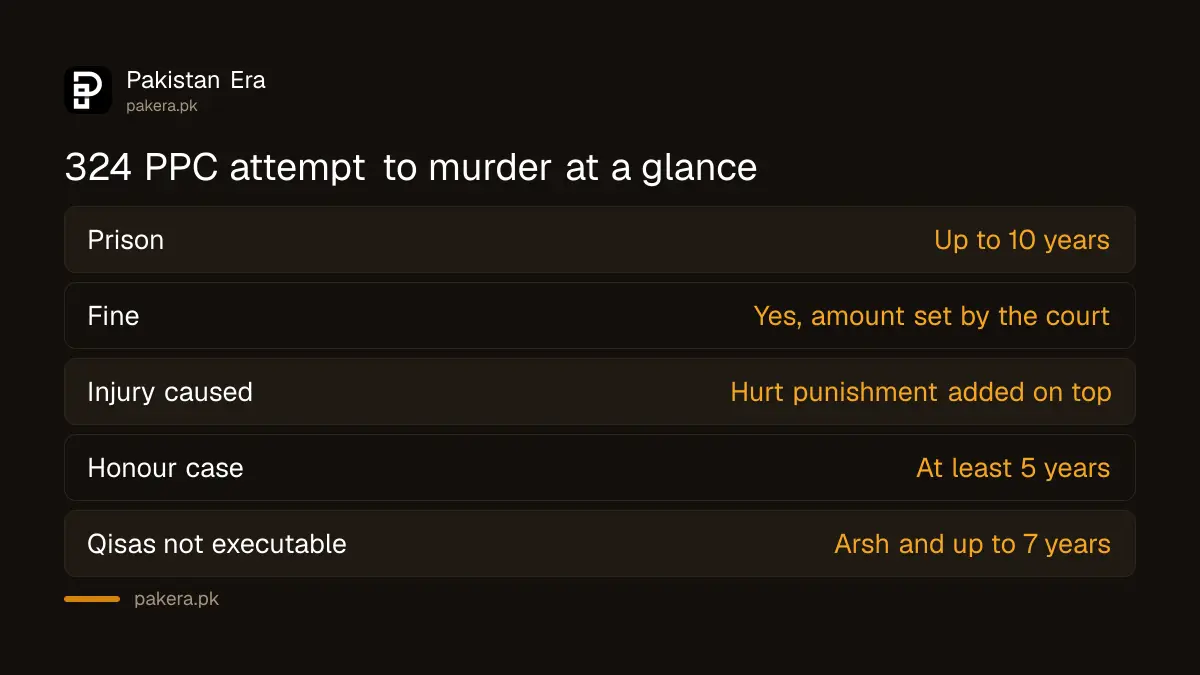
- Prison: imprisonment of either description (simple or rigorous) for up to 10 years.
- Fine: the offender "shall also be liable to fine". The section does not set an amount, so the court decides.
- Injury on top: if hurt is caused to any person by the act, the offender is also liable to the punishment for that hurt.
A proviso adds that where the punishment for the hurt is qisas and qisas cannot be carried out, the offender pays arsh (compensation for the injury) and may get up to 7 more years in prison.
How injuries add to the 324 sentence
A 324 case almost always comes with a hurt section, because the court punishes the attempt and the injury separately. Hurt sections start at 337 in the PPC. The injury decides how much extra punishment applies.
| Situation | What the court can give |
|---|---|
| Attempt, nobody hurt | Up to 10 years and fine |
| Attempt, victim injured | Up to 10 years and fine, plus the punishment for that hurt |
| Hurt liable to qisas, qisas not executable | Arsh, and up to 7 years more |
| Attempt in the name of honour | At least 5 years, up to 10, and fine, plus hurt |
Our guide to 337 PPC hurt sections lists the punishment and arsh for each kind of injury, from a head wound (shajjah) to an injury to the body (jurh).
The honour minimum of 5 years
Section 324 says the term "shall not be less than five years if the offence has been committed in the name or on the pretext of honour". The PPC footnote credits this to Act I of 2005. Section 299 defines an honour offence as one committed under karo kari, siyah kari or similar customs. See our explainer on the honour killing law in Pakistan.
Section 324 is non-bailable and cognizable
The CrPC's second schedule classifies every PPC offence. For Section 324 it says:
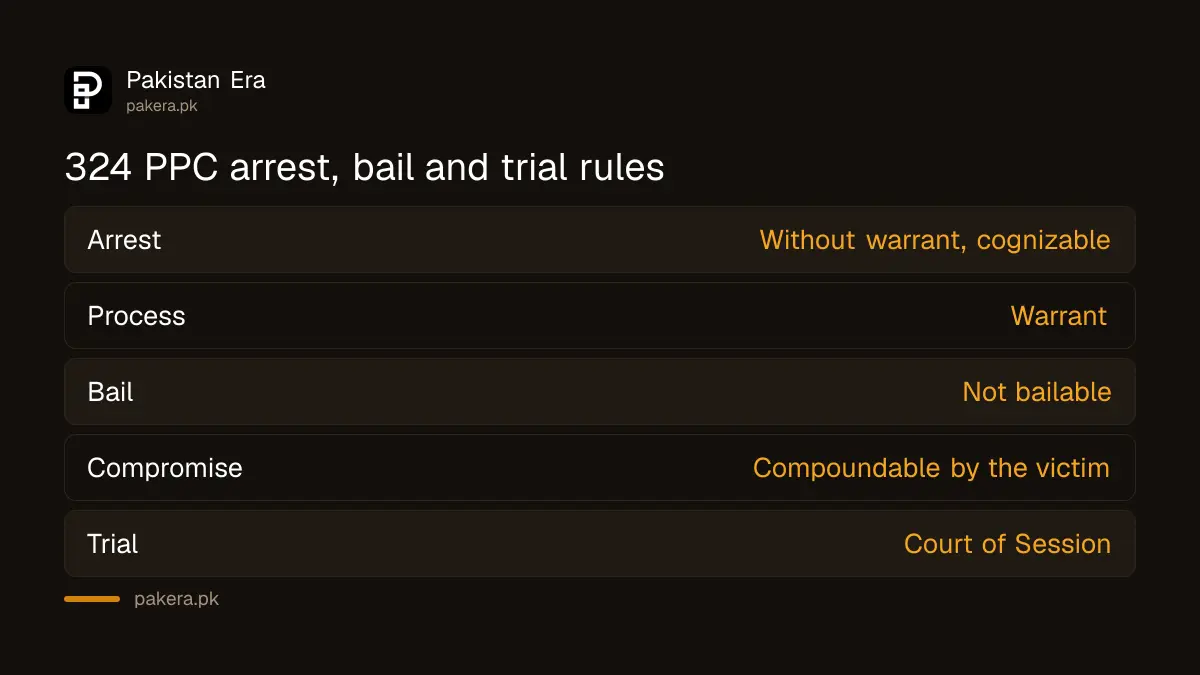
- Cognizable: police may arrest without a warrant.
- Warrant case: a summons is not the normal process.
- Not bailable: bail is not a right, so the accused must apply and the court decides.
- Compoundable: the case can be settled by compromise.
- Court of Session: a Sessions Judge tries it, not a Magistrate.
"Non-bailable" does not mean bail is never granted. It means the accused must apply, and the court weighs the facts of the case before it decides. Our guide on bailable and non-bailable offences explains how pre-arrest and post-arrest bail are decided.
How a 324 compromise works
Section 324 is in the table of compoundable offences under Section 345 of the CrPC. The person who may compound it is "the person against whom the offence was committed", which means the victim of the attempt.
- The victim and the accused agree terms, often in the presence of elders or lawyers.
- They put the compromise in writing and sign it.
- The compromise is filed in the trial court, or in the appeal court if a sentence has already been given.
- The court records statements from the victim to confirm the compromise is free and real.
- The court decides whether to accept it and acquit, or still award a ta'zir punishment.
The last step matters. Section 338E of the PPC lets the court acquit or award ta'zir after a waiver or compromise of a hurt offence, and where fasad-fil-arz applies (for example an honour crime), it "shall punish". So a compromise is not always the end of the case. Our guide to settling a criminal case by compromise covers Section 345 in full.
What to do if a 324 FIR is registered against you or your family
If you are the victim, get a medical examination at a government hospital as soon as you can. The medico-legal report fixes the type of injury, and that decides which hurt section is added. Keep copies of the FIR and the report.
If you are accused, speak to a criminal lawyer before you go to the police station. Ask about pre-arrest bail if you have reason to fear arrest. For free legal help, the Supreme Court's legal aid helpline is 1818. The PPC sections list shows how 324 sits next to the other common offences.
Two other sections often appear with 324. Section 302 is murder, used if the victim later dies; see our guide to 302 PPC punishment. Section 34 is common intention, used when several people act together.
Common questions
What is the punishment for 324 PPC in Pakistan?
Up to 10 years in prison and a fine. If anyone is hurt, the punishment for that injury is added. In an honour case the minimum is 5 years.
Is 324 PPC bailable?
No. The CrPC schedule lists it as not bailable, so bail depends on the court's view of the facts. It is often sought as pre-arrest or post-arrest bail.
Is 324 PPC compoundable?
Yes. Section 345 CrPC lets the person against whom the offence was committed compound it. The court can still award ta'zir in some cases, such as honour crimes.
Which court hears a 324 PPC case?
The Court of Session. A Sessions Judge or Additional Sessions Judge tries it, because the CrPC schedule names the Court of Session for Section 324.
Can 324 be charged if nobody was injured?
Yes. Section 324 punishes the act done with intent or knowledge that it would cause murder. No injury is needed, though proof of intent is.
What is the difference between 324 and 302 PPC?
Section 302 applies when the victim dies, and carries death, life or up to 25 years. Section 324 applies when the victim survives, and carries up to 10 years.
About the author

Global Affairs & Political Economy Writer
Muhammad Hatim is a book lover who started writing because he enjoys it. At Pakistan Era he writes about international relations, geopolitics and the global economy, with a particular interest in South Asia and the forces behind current events.