302 PPC in Pakistan: Punishment Under 302(a), (b) and (c), Compromise and Bail Explained
302 PPC punishment in Pakistan: death as qisas, death or life as ta'zir, or up to 25 years. How heirs compromise, when courts still punish, and the bail rules.
Section 302 of the Pakistan Penal Code is the murder section: qatl-i-amd is punishable with death as qisas, death or life imprisonment as ta'zir, or up to 25 years where qisas does not apply. It is non-bailable but compoundable, so the heirs of the victim can forgive or settle, though the court can still punish in some cases. The three punishment routes, the compromise rules, honour killings and bail are explained below.
We read sections 299 to 312 and 338-E of the Pakistan Penal Code (PPC), and the matching rows and section 497 of the Code of Criminal Procedure (CrPC), on Pakistan Code on 1 November 2026.
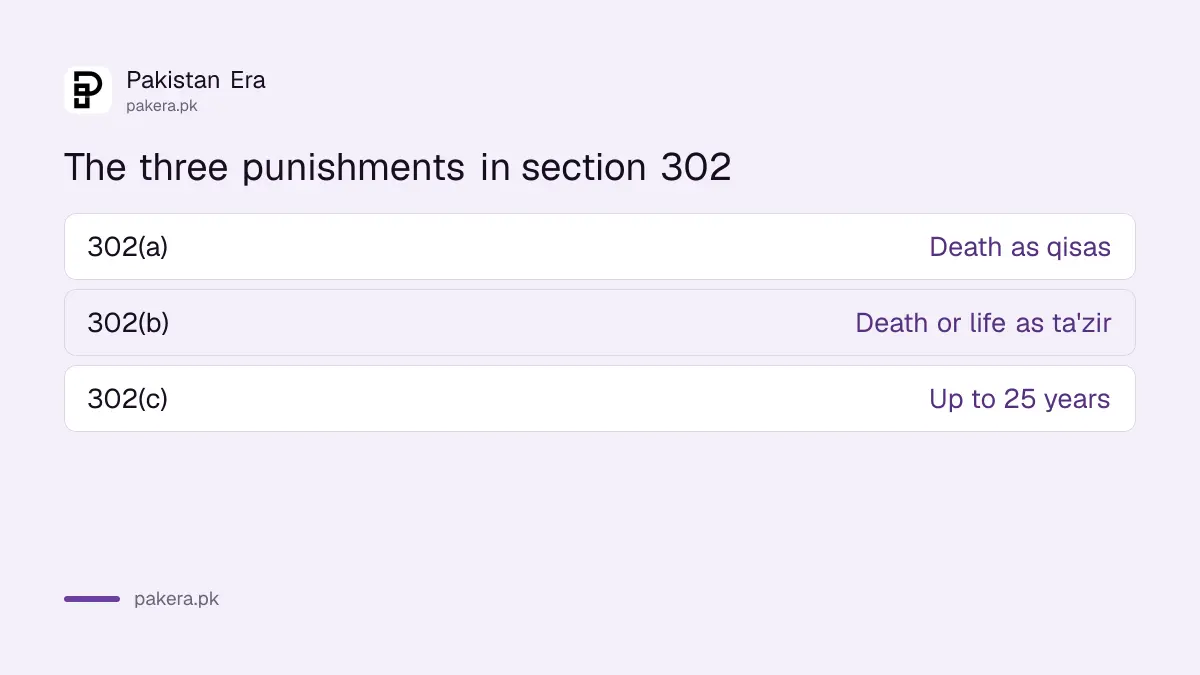
Section 302 has three punishments: 302(a), 302(b) and 302(c)
Clause (a) is death as qisas, which needs the special proof in section 304. Clause (b) is death or life imprisonment as ta'zir, used when that proof is not available. Clause (c) is up to 25 years, where Islamic law says qisas does not apply.
| Clause | Punishment | When it applies |
|---|---|---|
| 302(a) | Death as qisas | Proof under section 304: a true confession in court, or evidence under Article 17 of the Qanun-e-Shahadat |
| 302(b) | Death or life imprisonment as ta'zir | Guilt proved, but not in the form section 304 requires |
| 302(c) | Up to 25 years | Where, under Islamic law, qisas is not applicable |
Clause (c) cannot be used where fasad-fil-arz applies. In those cases only (a) or (b) is available. The FIR usually just says "302", and the clause is decided by the court at the end of the trial.
302(b) applies when the strict qisas proof is missing
Qisas proof under section 304 is narrow: a voluntary confession before the trial court, or evidence meeting Article 17 of the Qanun-e-Shahadat. Where the court is satisfied of guilt on other evidence, it convicts under 302(b) and chooses death or life.
Life imprisonment is the usual alternative to death. The court weighs the facts and circumstances, as the section says, including motive and any mitigating features. The appeal routes after a conviction are set out in appealing a criminal conviction.
The heirs can waive or compound, but the court keeps a say
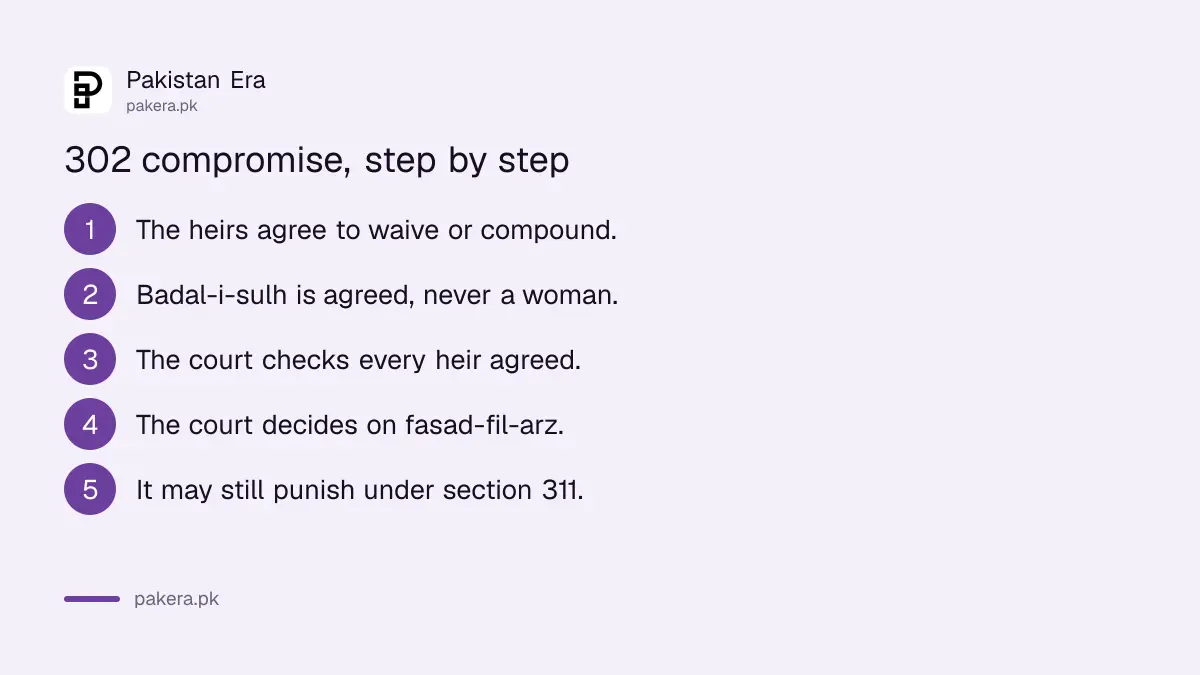
The wali, meaning the victim's heirs, can waive qisas for nothing (section 309) or compound it for badal-i-sulh, an agreed payment (section 310). For a minor wali, the payment cannot be less than diyat. Giving a woman in marriage as part of a settlement is banned.
Waiver or compromise is not always the end. Under section 311, if not all heirs agree, or if fasad-fil-arz is attracted, the court can still punish with death, life or up to 14 years as ta'zir. For a killing in the name of honour, the punishment after a compromise is life imprisonment.
Fasad-fil-arz lets the court punish despite a compromise
Section 299(ee) defines fasad-fil-arz. It includes the offender's past conduct or previous convictions, a brutal or shocking killing that outrages public conscience, an offender seen as a danger to the community, and any killing in the name or on the pretext of honour.
This definition, honour clause included, was inserted by a 2016 amendment (Act XLIII of 2016). In an honour killing, the killer cannot be a wali (section 305), so family members cannot pardon a relative who killed in the name of honour. And section 310A punishes giving a woman in badal-i-sulh, wanni or swara with 3 to 7 years and a Rs 500,000 fine.
Bail in a 302 case is rare before trial
The CrPC Second Schedule marks section 302 as cognizable, non-bailable and compoundable. Section 497 bars bail where there are reasonable grounds to believe the accused committed an offence punishable with death, life or ten years, and 302 is all three.
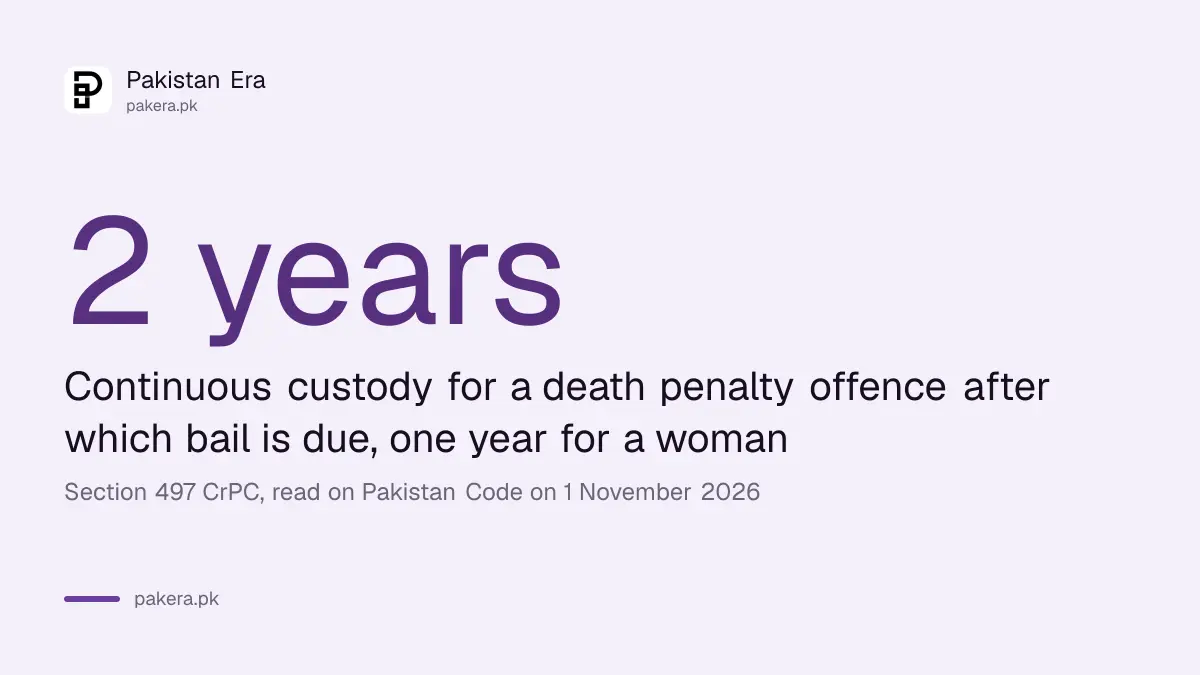
Bail is still possible in narrower situations. The court may bail a woman, a child under 16, or a sick or infirm accused. Where the evidence leaves room for doubt, the court can order bail pending further inquiry under section 497(2). And if a trial for a death penalty offence has not ended after two years in custody (one year for a woman), without the delay being the accused's fault, the court shall grant bail, unless the accused is a previous offender or "hardened, desperate or dangerous".
- Get a copy of the FIR and check every section, including add-ons like 34 or 109.
- Find out each accused's role, because bail is weighed person by person.
- Collect any evidence of age, illness or alibi early.
- File bail before the trial court first, then the High Court if refused.
- Keep a record of custody dates for the delay rule.
How bail and sureties work in general is set out in getting bail in Pakistan. Other FIR sections, and their bail status, are in the PPC sections list.
Related sections people confuse with 302
Section 324 is attempted murder, up to ten years. Section 316 is qatl shibh-i-amd, a death caused by a hurt not meant to kill, with diyat and up to 25 years. Section 319 and 320 cover death by mistake and by bad driving. Section 308 covers cases where qisas cannot apply, such as a minor offender, with diyat and up to 25 years.
A road death is almost never 302. It is usually 320, explained in the 320 PPC accident death case.
Common questions
What is the punishment for 302 PPC?
Death as qisas, death or life imprisonment as ta'zir, or up to 25 years where qisas does not apply, under clauses (a), (b) and (c).
Is 302 bailable?
No. It is non-bailable and falls inside the section 497 bar. Bail is possible only in narrower cases, such as for women, children under 16, the sick, doubtful evidence or long trial delay.
Can a 302 case be compromised?
Yes. It is compoundable, and the heirs can waive or settle. The court can still punish under section 311 if not all heirs agree or fasad-fil-arz applies.
What does 302/34 mean?
Murder by two or more people acting with a common intention. Each person is charged as if they had done the act alone.
What is the punishment for honour killing in Pakistan?
It is treated as fasad-fil-arz. The killer cannot be a wali, and if the heirs compound, the court must still impose life imprisonment.
How we verified this
What we checked, where we read it, and what we could not confirm.
We read sections 299, 302 to 312 and 338-E of the Pakistan Penal Code, and the section 302 and 311 rows of the CrPC Second Schedule and section 497 of the CrPC, on pakistancode.gov.pk on 1 November 2026. Pakistan Code marks both laws "Under Review". We did not read Article 17 of the Qanun-e-Shahadat. This page is a reference, not legal advice.
About the author

Global Affairs & Political Economy Writer
Muhammad Hatim is a book lover who started writing because he enjoys it. At Pakistan Era he writes about international relations, geopolitics and the global economy, with a particular interest in South Asia and the forces behind current events.