How to Check If a Government Scheme Message or Website Is Real in Pakistan
Check if a laptop, solar, Eidi or BISP scheme message is real in Pakistan: read the .gov.pk address, confirm it on the official site, act if you shared data.
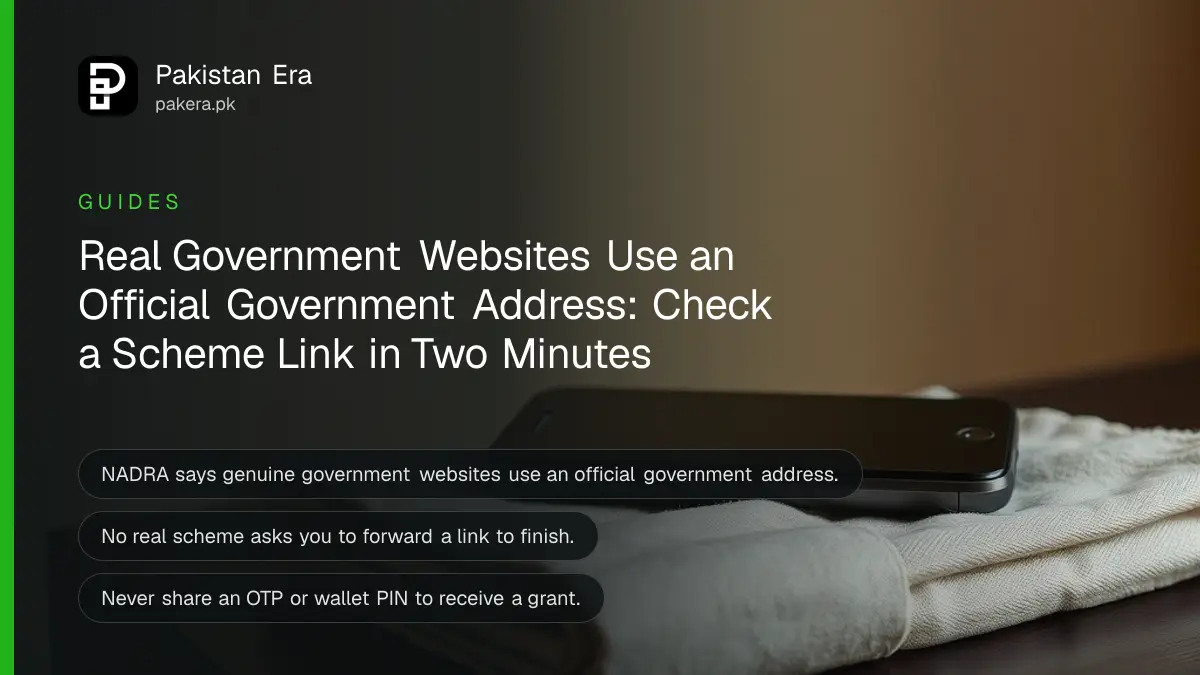
To check if a government scheme message in Pakistan is real, look at the link: official federal and provincial websites end in .gov.pk, and NADRA has said genuine government sites always do. Then find the scheme on the department's own website, typed in yourself. Never enter your CNIC, wallet number or OTP on a link that arrived by WhatsApp, SMS or Facebook.
Before every Eid, budget and school season, the same kind of message spreads: "Free laptop for students, register now", "Rs 5,000 Eidi from the Chief Minister", "Free solar panels, last date today". Some schemes are real. Many links that share them are not. The checks below take two minutes.
Official Pakistani government websites end in .gov.pk
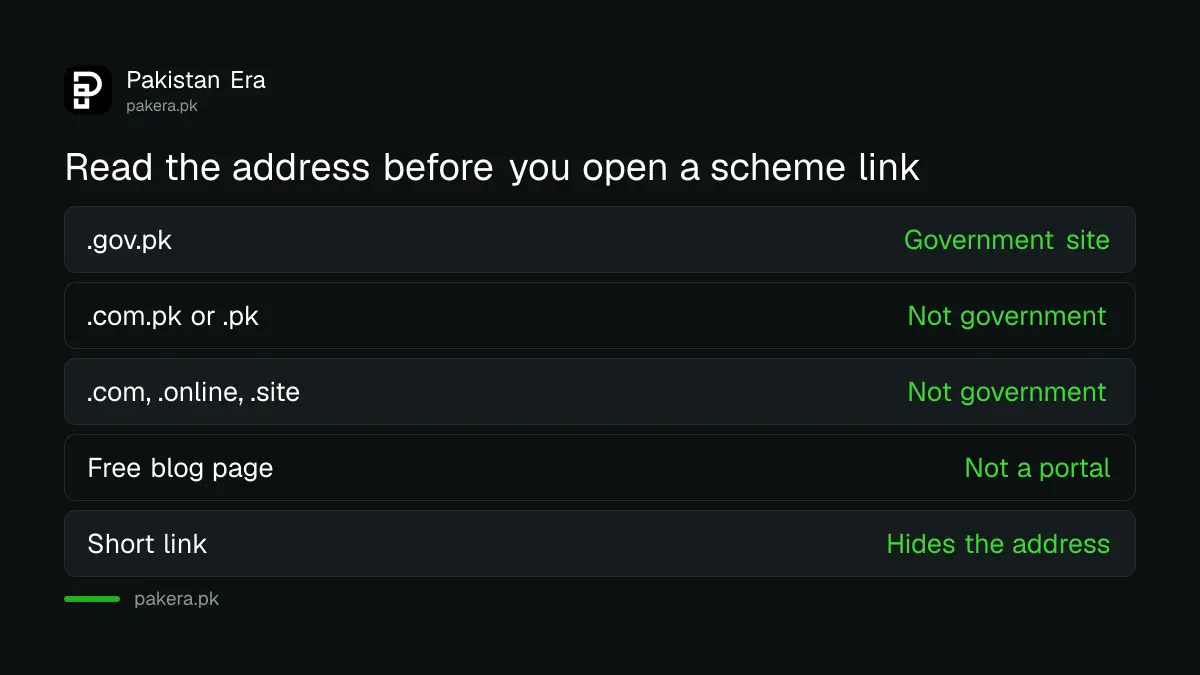
NADRA warned in April 2026 that genuine government websites in Pakistan always end with ".gov.pk". Fake scheme sites use look-alike addresses ending in .com, .pk, .com.pk, .online or a free blog address, often with words like "govt", "punjab" or "scheme" in the name to look official.
Read the address from right to left. In a real address the last part is .gov.pk, for example bisp.gov.pk or punjab.gov.pk. An address such as "punjab-scheme-gov.com" ends in .com, so it is not a government site, whatever it shows on the page.
| Address ends in | What it means |
|---|---|
| .gov.pk | Government website; still type it yourself rather than tapping a forwarded link |
| .com.pk or .pk | Not a government site, even if "govt" is in the name |
| .com, .online, .site, .xyz | Not a government site |
| A free blog or site-builder address | A free personal page, not a government portal |
| A shortened link | Hides the real address; do not open it |
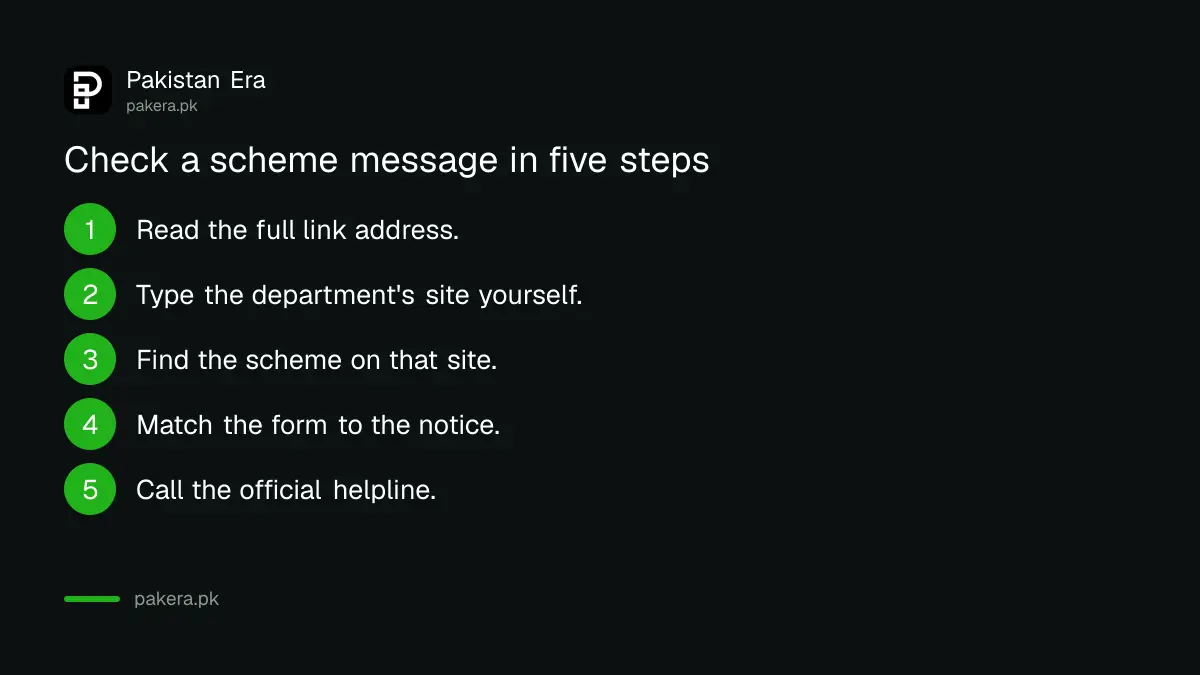
Check any scheme message in five steps
Do not judge the message by its pictures. Fake pages copy the photos of the Prime Minister, Chief Ministers and department logos. Judge it by where it sends you, and confirm the scheme on the department's own site, reached without the forwarded link.
- Long-press the link and read the full address. Stop if it does not end in .gov.pk.
- Open your browser and type the department's address yourself, for example bisp.gov.pk or punjab.gov.pk.
- Look for the scheme on that site's home page or news section, with its dates.
- Check that the form asks only for what the official notice lists.
- If you still cannot find it, call the department's helpline listed on its own website.
Fake scheme pages in 2026 asked for CNIC, wallet details and forwards
Fake schemes this year followed a few clear patterns. Knowing them helps you spot the next one, because the scheme name changes while the method stays the same.
- A fake Rs 5,000 "Eidi" scheme in the Chief Minister of Punjab's name spread in March 2026. It asked for CNIC or B-Form numbers, mobile numbers and JazzCash or Easypaisa details. The Punjab government had announced no such scheme.
- Free laptop pages asked students for their details, then said the application was "approved" but had to be shared with WhatsApp contacts or groups first. NCCIA said one such site in 2026 showed the signs of a phishing scam and advised people not to enter personal or financial details on unverified websites.
- Free solar panel portals used the Chief Minister's photos on addresses that were not government sites.
Your CNIC number, mobile number and wallet details together are enough for a criminal to try a SIM swap or a wallet takeover. That is why these pages ask for them, even when they promise nothing real.
A real scheme never asks for these things
Government schemes do not ask you to pay a fee to a mobile wallet to "release" a grant, share a link with ten contacts, or tell anyone your OTP or wallet PIN. Any one of these is a sign of a scam, whatever name or photo is on the page.
| Request in the message | Real scheme? |
|---|---|
| Share this link with 10 contacts or 5 groups to finish | No |
| Pay a small "registration" or "release" fee to a wallet number | No |
| Tell us the OTP sent to your phone | No |
| Enter your wallet PIN or banking password | No |
| Apply on a .gov.pk site, with your CNIC, as the notice says | Can be real; confirm on the department's site |
For BISP, the only official SMS number is 8171. The full list of BISP fake-message tricks is in the guide to spotting fake BISP 8171 messages. For laptops, the real programmes are compared in free laptop schemes in Pakistan.
Official addresses for the schemes people search most
Save these addresses and type them yourself. All of them opened for us on 25 November 2026. A scheme that is real will be listed or linked on its department's own site.
| Scheme or office | Official address |
|---|---|
| BISP (Benazir Income Support) | bisp.gov.pk, SMS 8171 |
| Prime Minister's Youth Programme | pmyp.gov.pk |
| Prime Minister's Office | pmo.gov.pk |
| Government of Punjab | punjab.gov.pk |
| Chief Minister Punjab | cm.punjab.gov.pk |
| Pakistan Citizen's Portal (complaints) | citizenportal.gov.pk |
If you already entered your details, act now
If you gave a CNIC and phone number only, watch for OTP messages you did not ask for and never share them. If you gave a wallet number, PIN or OTP, call your wallet or bank helpline at once and change your PIN. Then report the page to NCCIA on 1799.
- Report the number that sent the message to PTA, using the steps to report a scam number to PTA.
- File a complaint with the National Cyber Crime Investigation Agency through its online complaint form, with a screenshot of the page and its address.
- Warn the group or person who forwarded it, so it stops there.
Common questions
How do I know if a government website is real in Pakistan?
The address should end in .gov.pk. NADRA has said genuine government websites in Pakistan always do. Type the address yourself instead of tapping a forwarded link.
Is the Rs 5,000 Eidi scheme of CM Punjab real?
The Rs 5,000 Eidi scheme that spread in March 2026 was fake. The Punjab government had announced no such scheme, and the page collected CNIC and wallet details.
Why do fake scheme pages ask me to share the link?
Sharing spreads the scam to your contacts, who trust you. No real government scheme makes you forward a link to finish an application.
Can a website with "govt" in its name be fake?
Yes. Anyone can put "govt" or a province name into a .com or .com.pk address. Only the ending, .gov.pk, marks a government site.
Where can I complain about a fake scheme website?
Report it to NCCIA online or on 1799, and report the sender's number to PTA. You can also tell the department the scheme claims to be from.
How we verified this
What we checked and where we read it.
Checked on 25 November 2026. We opened bisp.gov.pk, pmyp.gov.pk, pmo.gov.pk, punjab.gov.pk, cm.punjab.gov.pk and citizenportal.gov.pk and all loaded. NADRA's April 2026 warning that genuine government websites end in .gov.pk, the March 2026 fake Eidi scheme, the 2026 fake laptop page and NCCIA's comment on it, and the fake solar portals are consistent across reports when each appeared. Official sites: BISP and Government of Punjab.
Free on WhatsApp
Get last dates and rule changes on WhatsApp
We post new last dates, fee changes and fixes for common problems, a few short posts a day.
Follow Pakera on WhatsAppOther followers cannot see your number.
Pakera Solves It
Which online process wasted your time this week?
A portal that will not load, a form nobody explains, a complaint that went nowhere. Tell us. Every week we pick one, solve it step by step and publish the answer.
About the author

Technology Journalist & Multimedia Producer
Ahmad Ali is a technology journalist and multimedia producer at Pakistan Era, joining the team in October 2026. He covers consumer technology and digital life for Pakistani readers, combining research with hands-on product testing.