How to Stop or Report a Child Marriage in Islamabad Under the 2025 Act
Islamabad's Child Marriage Restraint Act 2025 sets 18 as the age for both sexes. See penalties, how to ask the court to stop a marriage and how to report one.
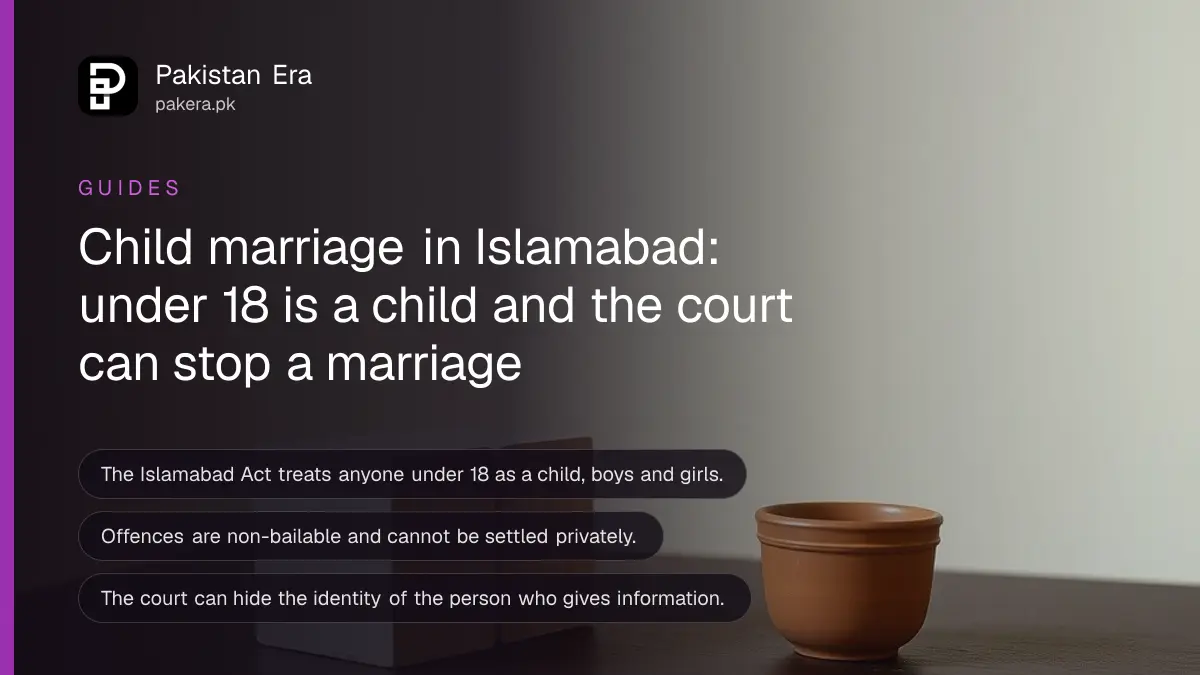
Short answer: In Islamabad, anyone under 18 is a child, and a marriage with a child is a crime. You can report it to the police, because the offence is cognizable and non-bailable, or apply to the Court of the District and Sessions Judge for an order stopping a marriage that is about to happen. The court can hide your identity.
The news reaches a neighbour or a teacher first: a girl of 15 is to be married next week. Many people stay silent because they do not know whether the law is on their side. Since June 2025, in Islamabad, it clearly is.
We read the Islamabad Capital Territory Child Marriage Restraint Act, 2025 (Act No. XI of 2025) as published in the Gazette of Pakistan on 3 June 2025. The President assented on 29 May 2025. This page covers the Islamabad Capital Territory only. Other provinces have separate laws. We did not test any reporting channel ourselves.
Under 18 is a child for boys and girls
The Act defines a child as any person under eighteen years, male or female. A child marriage is a marriage or nikah in which either party is a child. It repeals the old Child Marriage Restraint Act, 1929, for Islamabad.
The earlier 1929 law set different ages for girls and boys. The 2025 Act uses one age for both. The Act came into force at once, so it applies to any marriage solemnised in Islamabad after that date.
It also treats a child marriage, or taking part in one, as child abuse under the ICT Child Protection Act, 2018. Cohabitation before the age of 18 that results from a child marriage is child abuse, with or without the child's consent.
The nikah registrar must check the CNIC and date of birth
A nikah registrar may not register a marriage where one or both parties are under 18. The registrar or whoever solemnises the nikah must make sure both parties hold a valid NADRA CNIC that shows the date of birth.
A registrar who breaks this rule can face simple imprisonment of up to one year, a fine of Rs 100,000, or both. The only defence is proof that he had reason to believe it was not a child marriage. In practice, the CNIC or a birth certificate is the evidence. The steps for the document are in how to register a birth in Islamabad, and the general rules are in the guide to nikah registration in Pakistan.
Penalties fall on adults, parents and those who move a child
The Act punishes the adult husband, parents or guardians, anyone who forces a child, and anyone who takes a child out of Islamabad to avoid the law. A parent is presumed to have failed to prevent the marriage unless proved otherwise.
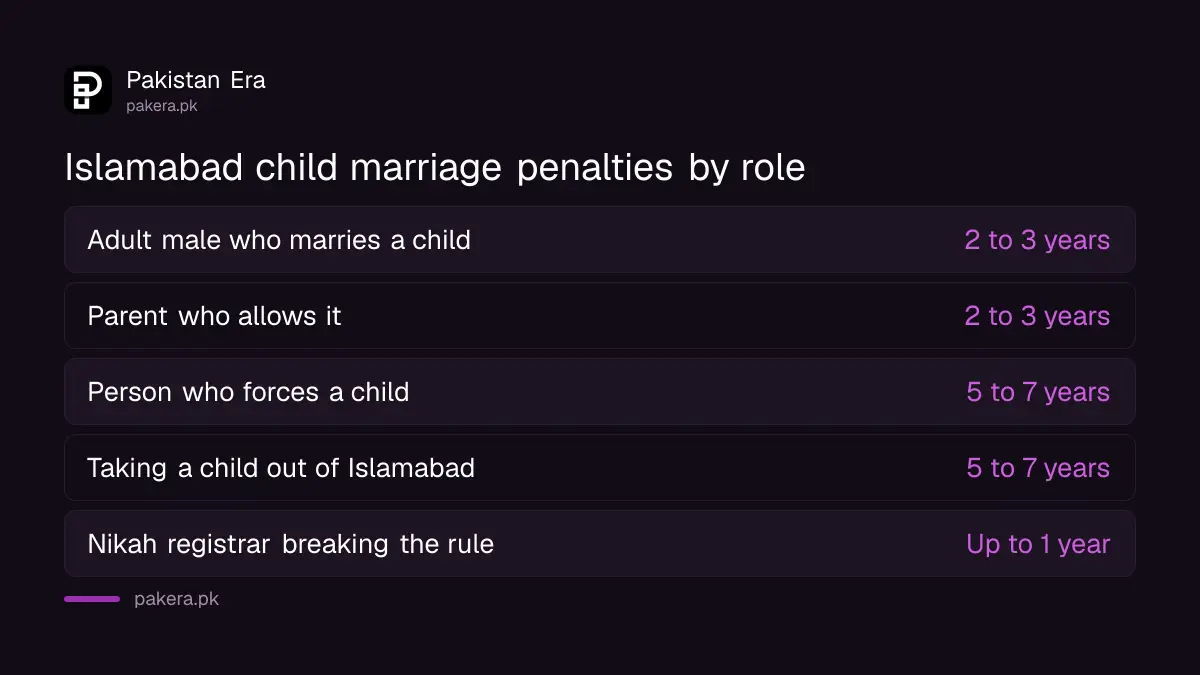
| Who | What the Act says |
|---|---|
| Adult male above 18 who marries a child | Rigorous imprisonment of 2 to 3 years, and fine |
| Parent or guardian who promotes or allows it | Rigorous imprisonment of 2 to 3 years, and fine |
| Person who induces or forces a child (child abuse) | 5 to 7 years, and fine of at least Rs 1 million, or both |
| Person who takes a child out of Islamabad to evade the law | 5 to 7 years, and fine |
| Person who recruits, harbours or transports a child for marriage | 3 years, and fine |
| Nikah registrar or officiant who breaks the CNIC rule | Up to 1 year, fine of Rs 100,000, or both |
You can stop a marriage before it happens
If a child marriage is about to be arranged, anyone can apply to the Court of the District and Sessions Judge. The court can issue an injunction forbidding the marriage. It must hear the other side first, unless it decides notice is not needed.
Disobeying that injunction is itself punishable, with up to one year or a fine or both. A parent or a third party who gives the information can ask the court to hide their identity, and the court must adopt appropriate measures to do so.
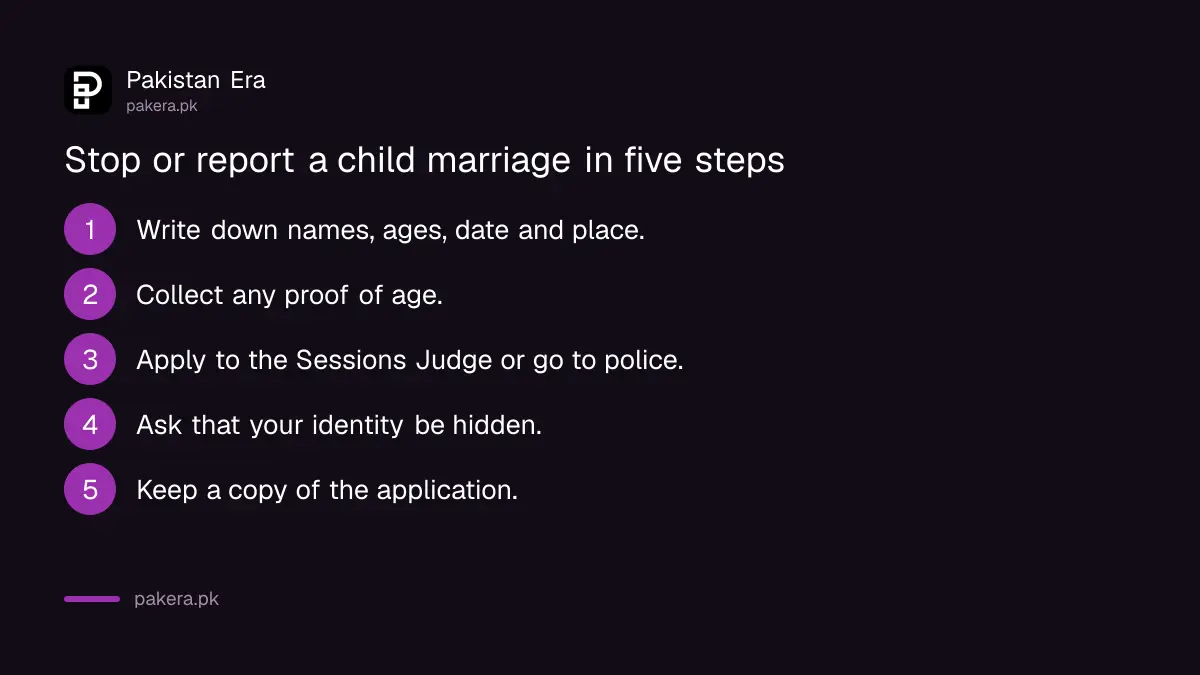
- Write down what you know: names, ages, the date and place of the nikah.
- Take any proof of age, such as a school record, Form B or birth certificate.
- Apply to the District and Sessions Judge, or go to the police if the marriage has happened.
- Ask that your identity be kept hidden.
- Keep a copy of the application and the receipt.
If a marriage has already taken place, the offence is cognizable, so the police can register a case without a court order. Offences under the Act are non-bailable and cannot be compounded, which means the families cannot settle them privately. The court must conclude the trial within 90 days.
For a police complaint, see how to file a complaint with Islamabad Police online. For a forced marriage claim that is not about age, the rules in court marriage in Pakistan are different.
Common questions
What is the legal age of marriage in Islamabad?
It is 18 for both boys and girls. Anyone under 18 is a child under the 2025 Act, and a nikah with a child is a child marriage.
Can a nikah registrar still register a marriage if parents consent?
No. The Act bars registration where either party is under 18. Parental consent does not change that, and the registrar must check each CNIC.
Who can ask the court to stop a child marriage?
Anyone who has information. A parent or a third party can apply to the District and Sessions Judge, and ask that their identity is kept hidden.
Can the families settle the case privately?
No. Offences under the Act are cognizable, non-bailable and non-compoundable. The parties cannot compromise them.
Does this Act cover Punjab, Sindh or KP?
No. It extends only to the Islamabad Capital Territory. Each province has its own law on this subject.
What if the couple was married before June 2025?
The Act came into force at once and does not say it reaches back. A marriage solemnised earlier would fall under the old law, so seek a lawyer's advice.
How we verified this
What we checked, where we read it, and what we could not confirm.
Last checked on 13 October 2026, Pakistan time. We read the Act's text as published in the Gazette of Pakistan, Extraordinary, 3 June 2025 on the National Assembly website. We did not verify any helpline or police desk number, and we have not checked for rules made under section 12. This page is general information, not legal advice.
About the author

Public Services and Education Journalist
Fajr Riaz is a journalist and content writer at Pakistan Era, based in Lahore. She covers the questions people meet in everyday life in Pakistan: how a public service works, what a change in the rules means, and where to find a reliable answer.