Court Marriage in Pakistan: The Legal Procedure and Age Rules
Court marriage in Pakistan is a nikah with a licensed registrar and union council registration. Minimum ages by province, consent, and fake agent warnings.
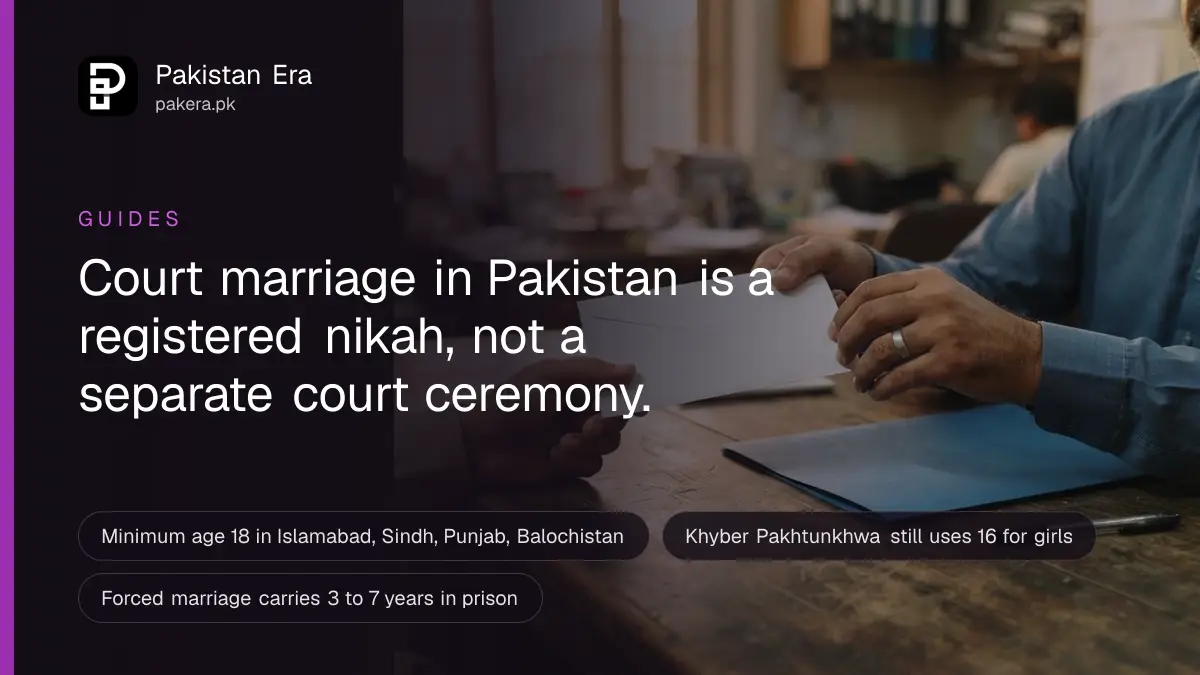
Pakistani law has no separate "court marriage". A marriage between two Muslims becomes legal and provable through a nikah with a licensed Nikah Registrar and two witnesses, then registration at the union council. The affidavit many couples sign is an extra sworn statement. It does not replace the nikah.
When people say "court marriage in Pakistan", they usually mean a quick nikah near a district court, without a family wedding. That can be lawful. It goes wrong when an agent skips registration, or one party is under age.
We read the Muslim Family Laws Ordinance, 1961, the Child Marriage Restraint Act, 1929, the Islamabad, Sindh, Punjab and Balochistan child marriage laws, and the Pakistan Penal Code on the official statute portals on 27 September 2026. Everything below comes from those texts.
What court marriage means under Pakistani law
No statute we read creates a court marriage. The Muslim Family Laws Ordinance says every marriage under Muslim law must be registered under that Ordinance, and that Muslim marriages are registered only in that way. A judge does not perform or register it.
Section 3 of the Ordinance is blunt about it. Its provisions apply "notwithstanding any law, custom or usage", and "the registration of Muslim marriages shall take place only in accordance with those provisions". Section 5 then says every marriage solemnized under Muslim law "shall be registered".
That leaves three pieces in a so-called court marriage, and only two of them are legally required:
| Piece | Required by law? | Who handles it |
|---|---|---|
| Nikah, with consent and witnesses | Yes | Nikah Registrar or the person who performs it |
| Registration of the nikah nama | Yes, under section 5 of the 1961 Ordinance | Nikah Registrar, recorded at the union council |
| Affidavit of free will before an oath commissioner | No statute we read requires it | Oath commissioner, notary or magistrate |
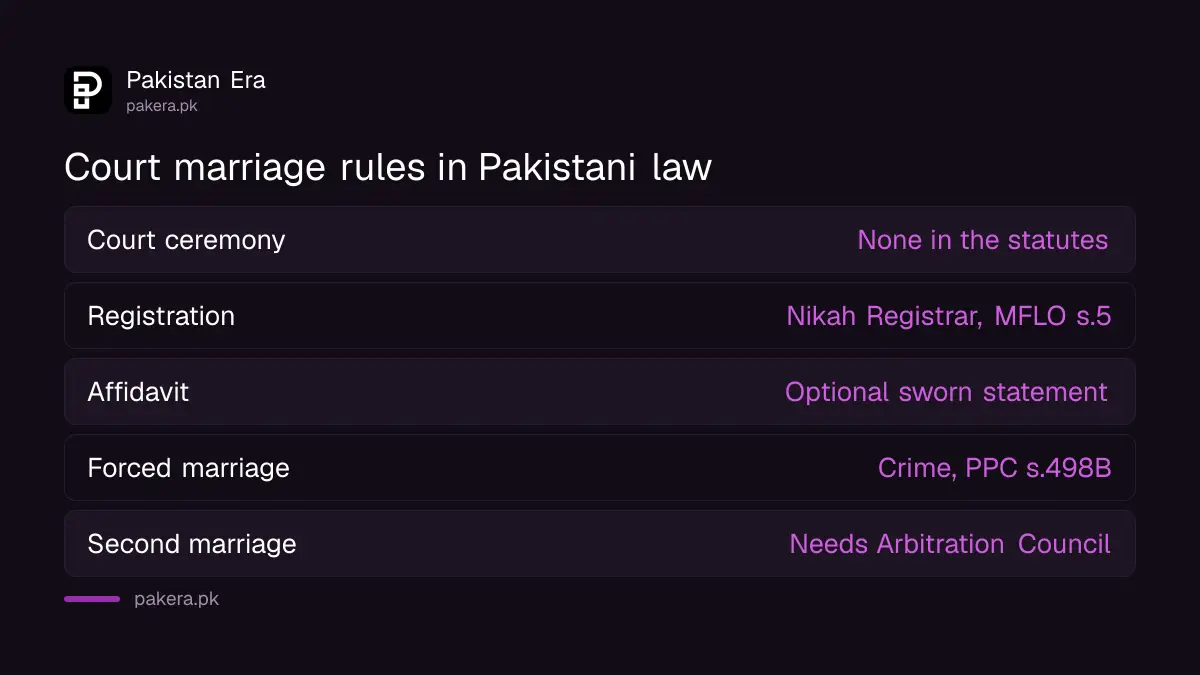
The affidavit is still worth having. It is a sworn record that both of you are adults marrying of your own free will, which helps if a family later claims force.
The minimum marriage age is 18 in four of five regions
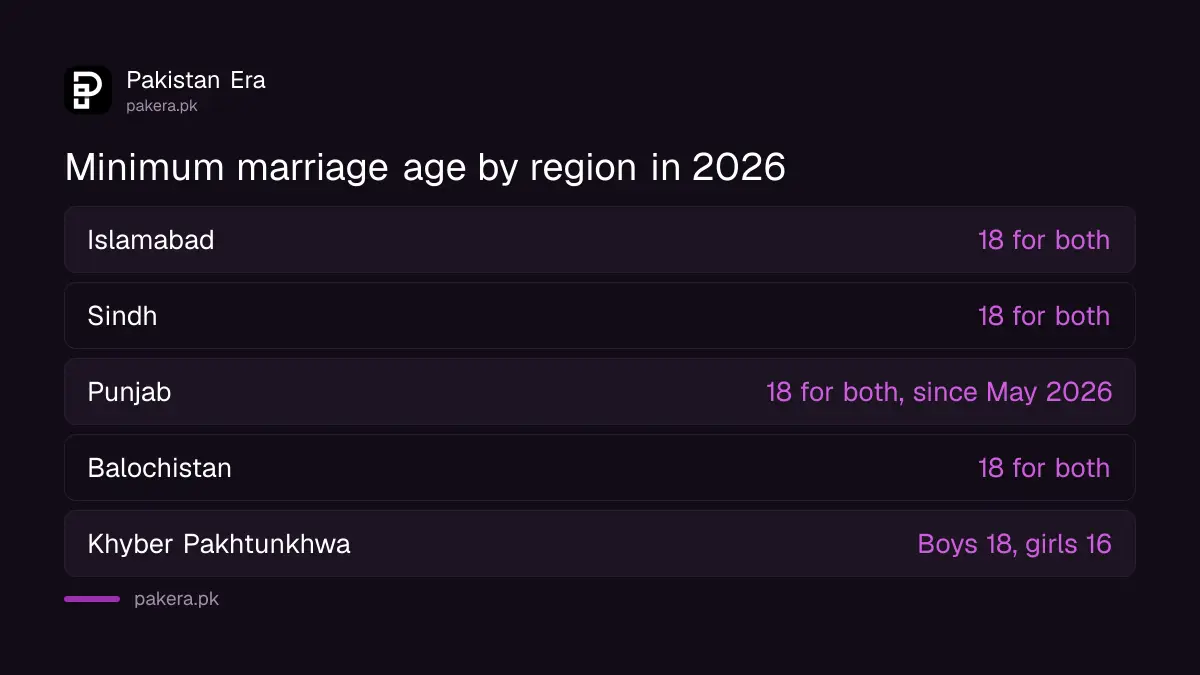
Islamabad, Sindh, Punjab and Balochistan now treat anyone under 18, male or female, as a child for marriage. Khyber Pakhtunkhwa still runs on the 1929 federal Act, which sets 18 for boys and 16 for girls.
Two of these laws are less than a year old, so older advice that girls can marry at 16 is now wrong everywhere except Khyber Pakhtunkhwa.
| Region | Law in force | Minimum age |
|---|---|---|
| Islamabad Capital Territory | ICT Child Marriage Restraint Act, 2025 | 18 for both |
| Sindh | Sindh Child Marriages Restraint Act, 2013 | 18 for both |
| Punjab | Punjab Child Marriage Restraint Act, 2026, in force 11 May 2026 | 18 for both |
| Balochistan | Balochistan Child Marriages Restraint Act, 2025 | 18 for both |
| Khyber Pakhtunkhwa | Child Marriage Restraint Act, 1929 | 18 for boys, 16 for girls |
One detail on Balochistan. In the copy on the Balochistan Code portal, the clause defining "child" is misprinted. But the Act defines an adult as a person of either sex aged 18 or above, and it repeals the 1929 Act in Balochistan, so the lower age for girls no longer applies there.
The Punjab change is covered in full in the marriage age in Punjab rising to 18. We searched the Khyber Pakhtunkhwa Code for a provincial child marriage law and found none, so the 1929 Act still governs there.
How to do a legal court marriage, step by step
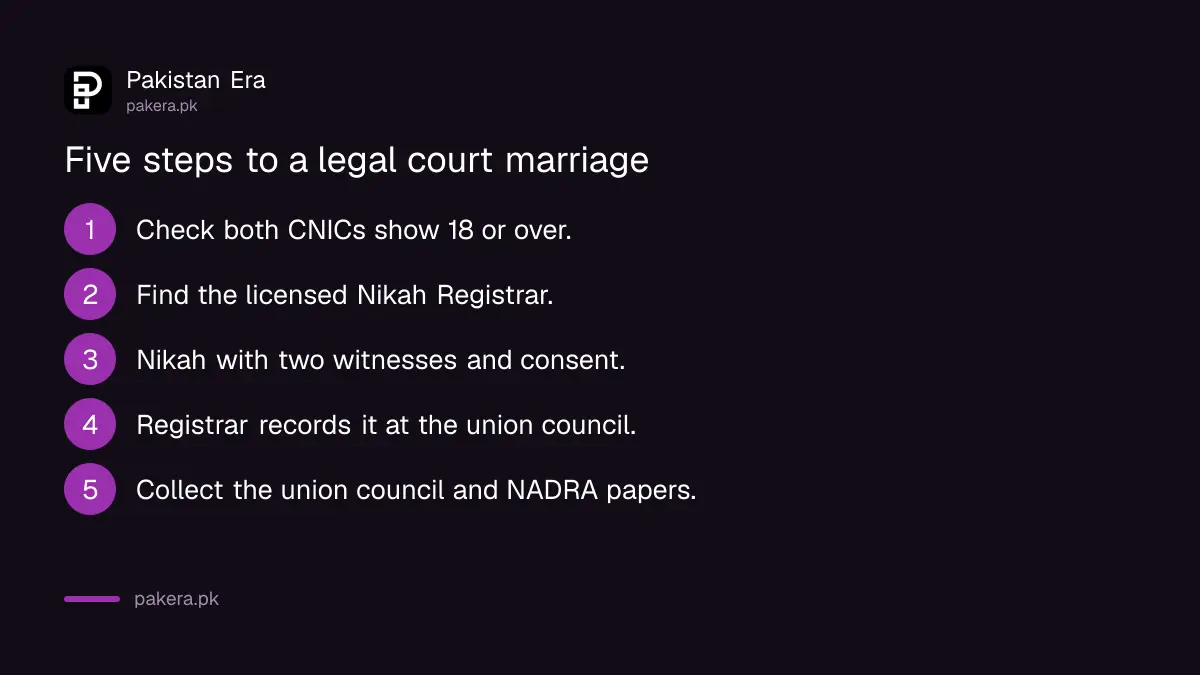
Confirm both of you are old enough, find the licensed Nikah Registrar, perform the nikah with two witnesses and real consent, and make sure the nikah nama is registered. Then collect the union council certificate and, if needed, the NADRA certificate.
- Check both CNICs. The Islamabad Act says the registrar must make sure both of you hold valid CNICs showing your dates of birth. The Balochistan Act makes him take a copy of both. Bring originals and copies wherever you marry.
- Find the licensed Nikah Registrar. Under section 5(2), the union council licenses Nikah Registrars. Ask the union council office who holds the licence for your ward, rather than trusting a card handed to you outside a court.
- Perform the nikah with two witnesses. Both of you must say yes yourselves. Read every column of the nikah nama before signing, including mehr and the right of divorce.
- Swear the affidavit, if you want one. Do it before an oath commissioner or notary, on stamp paper. See issuing an e-stamp paper for how that paper is bought now.
- Confirm registration. If someone other than the registrar performed the nikah, section 5(3) says that person must report it to the registrar. Then get your registration certificate from the union council.
Punjab is stricter than the federal text. Since a 2015 amendment, a registrar who fails to report a nikah faces up to three months and a fine of one hundred thousand rupees there, against a fine of up to one thousand rupees in the federal text.
Registration is the step people skip. The detail of how the union council records it is in registering a nikah in Pakistan, and the computerised certificate that follows is explained under the NADRA marriage certificate.
Consent is required, and forcing a marriage is a crime
A nikah needs the free consent of both parties. The Pakistan Penal Code makes forcing a woman to marry a crime, with three to seven years in prison and a fine of five hundred thousand rupees for anyone who does it.
Section 498B of the Penal Code covers anyone who "coerces or in any manner whatsoever compels a woman to enter into marriage". Where the woman is a child under the 1929 Act, or is not Muslim, the range rises to five to ten years and a fine of up to one million rupees.
In Islamabad and Punjab, a registrar who registers a child marriage faces up to one year and a fine of one hundred thousand rupees. An adult man who marries a child faces two to three years.
A court marriage does not get around the rule on a second marriage. Section 6 of the 1961 Ordinance says a married man needs written permission from the Arbitration Council first, or the marriage "shall not be registered".
Fake court marriage agents and how to spot them
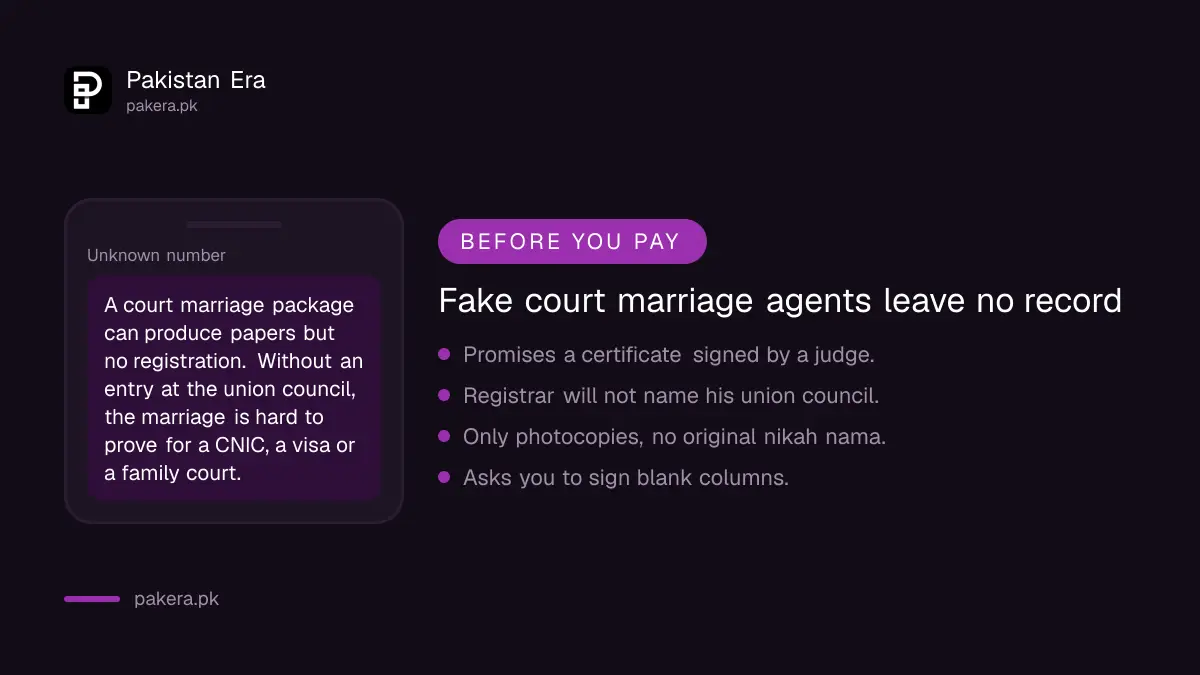
The risk is a "package" that produces papers but no registration. An unlicensed registrar, a nikah nama never filed at the union council, or a stamp paper sold as a "court marriage certificate" can all leave you with no legal record.
Section 496 of the Penal Code punishes anyone who goes through a marriage ceremony fraudulently, knowing it is not a lawful marriage, with up to seven years.
- An agent promising a "court marriage certificate" from a judge. No statute we read creates one.
- A registrar who will not say which union council he is licensed by.
- No original nikah nama handed to you, only photocopies.
- Pressure to sign blank or half-filled columns.
The best check is free and simple. Section 5(6) lets any person inspect the union council's marriage record, or get a copy of an entry, on paying the prescribed fee. A few weeks after the nikah, go and look for your own entry.
Common questions
Is court marriage legal in Pakistan?
Yes, if it is a valid nikah that is registered. The law does not know a separate court ceremony. What makes it legal is the nikah with consent and witnesses, and registration under section 5 of the Muslim Family Laws Ordinance, 1961.
What is the minimum age for court marriage in Pakistan?
18 for both men and women in Islamabad, Sindh, Punjab and Balochistan. In Khyber Pakhtunkhwa, the 1929 Act still sets 18 for boys and 16 for girls.
Is an affidavit enough to prove a marriage?
No. An affidavit is a sworn statement. The legal record of a Muslim marriage is the registered nikah nama at the union council, and the NADRA certificate is issued from that record.
Do I need my parents' permission for a court marriage?
The statutes we read do not add a parental signature as a condition of registration. They do require real consent from both parties, and forcing a woman to marry is a crime under section 498B.
Can a married man do a court marriage without telling his wife?
No. Section 6 of the 1961 Ordinance requires written permission from the Arbitration Council first. A marriage without it cannot be registered, and he must pay his existing wife's full dower at once.
How do I check whether my nikah was registered?
Visit the union council where it was registered. Under section 5(6), anyone can inspect the record or get a copy of an entry on paying the prescribed fee.
How we verified this
What we checked, where we read it, and what we could not confirm.
Last checked on 27 September 2026. Sections 3, 5 and 6 of the Muslim Family Laws Ordinance, 1961, the Child Marriage Restraint Act, 1929, the Islamabad Capital Territory Child Marriage Restraint Act, 2025 (Act XI of 2025), and sections 496 and 498B of the Pakistan Penal Code are read on the Pakistan Code, published by the Ministry of Law and Justice. The Punjab Child Marriage Restraint Act, 2026 and the Punjab text of the 1961 Ordinance, with the 2015 amendment to section 5, are read on the Punjab Code. The Sindh Child Marriages Restraint Act, 2013 (Sindh Act XV of 2014) is read on the Sindh Code at sindhlaws.gov.pk. The Balochistan Child Marriages Restraint Act, 2025 (Act XXXIII of 2025) is read on the Balochistan Code at balochistancode.gob.pk. We searched the Khyber Pakhtunkhwa Code for a provincial child marriage law and found none. We did not check Gilgit-Baltistan or Azad Jammu and Kashmir. Nothing here is legal advice.
About the author

Public Services and Education Journalist
Fajr Riaz is a journalist and content writer at Pakistan Era, based in Lahore. She covers the questions people meet in everyday life in Pakistan: how a public service works, what a change in the rules means, and where to find a reliable answer.