Pakistan Power Companies Seek Rs 23.3 Billion QTA for July to September, NEPRA Hears It on 17 November
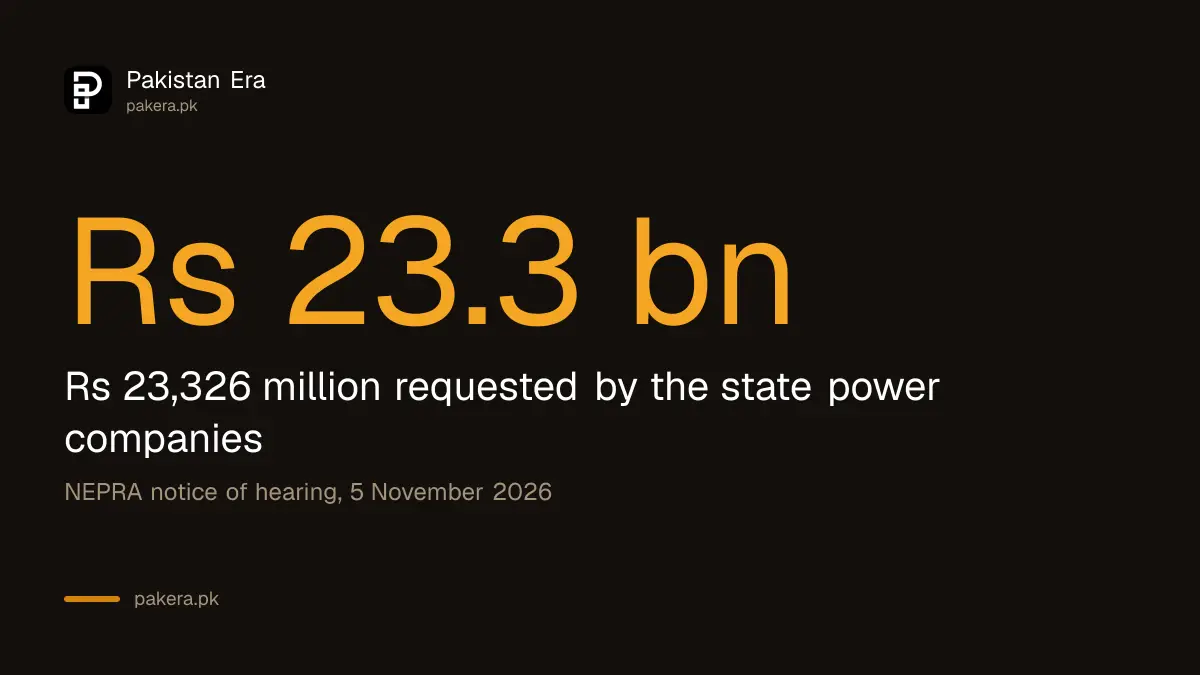
Pakistan's power companies ask NEPRA for a Rs 23,326 million quarterly adjustment for July to September 2026. Hearing 17 November, K-Electric included.
یہ صفحہ اردو میں پڑھیں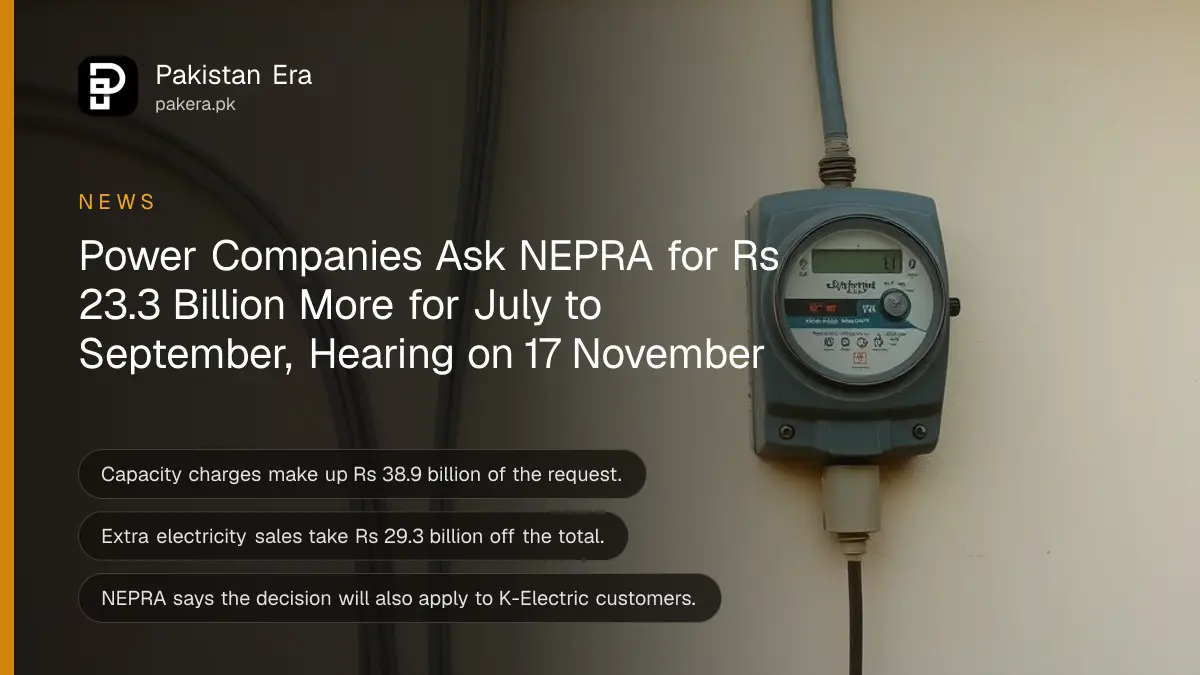
Pakistan's state power companies have asked NEPRA for a quarterly adjustment of Rs 23,326 million, about Rs 23.3 billion, for July to September 2026. NEPRA will hear the request on 17 November 2026 at 2 pm, at NEPRA Tower in Islamabad and online. NEPRA's notice says whatever it decides will also apply to K-Electric customers in Karachi.
NEPRA, the National Electric Power Regulatory Authority, posted the notice of hearing on its website on 5 November 2026. We read the notice and its table the same week. This is the next QTA, the quarterly tariff adjustment line on your bill. The current one, a charge of Rs 0.5194 a unit, runs on bills from September to November. Our QTA list for 2026 has every quarter so far.
The companies want Rs 23.3 billion more for July to September
The eleven ex-WAPDA distribution companies, called XWDISCOs, filed their requests under the notified tariff. Taken together, the requests add up to Rs 23,326 million for the third quarter of calendar year 2026. That is a request, not a decision. NEPRA can cut it, and it often does.
Last quarter shows how far a request can move. For April to June 2026 the companies asked for about Rs 33.7 billion. NEPRA allowed Rs 12,669 million, which became the Rs 0.5194 a unit now on bills. So the final figure for July to September may be well below Rs 23.3 billion.
Capacity charges drive the request, extra sales pull it down
The request has five parts. Capacity charges, the fixed payments to power plants, are the biggest at Rs 38,917 million. NEPRA's notice says this line includes the impact of net metering and net billing units, the power that solar users send back to the grid.
| Part of the request | Rs million | What it means |
|---|---|---|
| Capacity charges, including net metering impact | 38,917 | Fixed payments to power plants |
| Impact of T&D losses on the fuel charge | 7,790 | Fuel cost of power lost in wires |
| Variable operation and maintenance | 5,597 | Running costs of power plants |
| Use of system charges and CPPA agency fee | 272 | Grid and market operator costs |
| Impact of incremental units | (29,252) | Extra sales that lower the charge |
| Total | 23,326 | Net amount asked for |
The last line is a credit. When people use more electricity, fixed costs are spread over more units, so the cost per unit falls. That effect takes Rs 29,252 million off the total. Our page on fuel and capacity costs in a unit explains why capacity payments weigh so heavily on bills.
T&D means transmission and distribution. NEPRA's notice adds a caution here. The fuel charge for September 2026 has not been notified yet. So the companies used the fuel charge that CPPA-G, the power market operator, requested for September when they worked out this line.
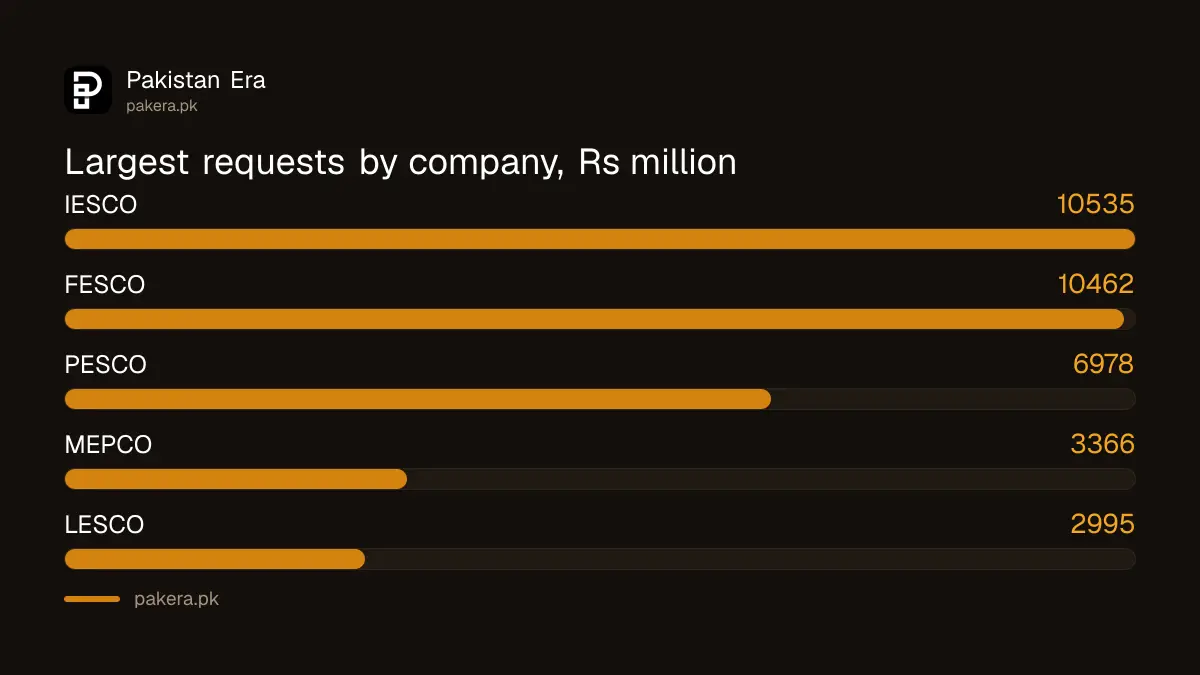
FESCO and IESCO ask for the most, four companies show a credit
Each company files its own request. Seven companies ask for money. Four show a negative figure, which means their part of the adjustment would be a credit.
| Company | Area | Request, Rs million |
|---|---|---|
| IESCO | Islamabad, Rawalpindi | 10,535 |
| FESCO | Faisalabad | 10,462 |
| PESCO | Peshawar | 6,978 |
| MEPCO | Multan | 3,366 |
| LESCO | Lahore | 2,995 |
| GEPCO | Gujranwala | 1,637 |
| HAZECO | Hazara | 521 |
| SEPCO | Sukkur | (1,051) |
| HESCO | Hyderabad | (2,154) |
| QESCO | Quetta | (4,088) |
| TESCO | Tribal districts | (5,875) |
Your own company's figure does not decide your bill. The federal government's policy is a uniform quarterly adjustment for the whole country. NEPRA's notice says the decision will apply to K-Electric consumers too. So one rate a unit is expected for every company, as with the last three quarters.
The charge would likely reach bills from December
NEPRA has not said when the new adjustment will be billed. Our reading of the pattern is this. The April to June adjustment was heard on 12 August, notified on 7 September and billed from September to November. If the same timing holds, the July to September adjustment would be billed over three months from December 2026, after the current Rs 0.5194 ends.
We can give a rough size, but treat it as our arithmetic, not a NEPRA figure. The current adjustment spreads Rs 12,669 million at Rs 0.5194, which implies about 24.4 billion units over three months. If NEPRA allowed the full Rs 23,326 million over the same units, it would come to about Rs 0.96 a unit. Winter sales are usually lower, which would push a per-unit figure up. A cut by NEPRA would bring it down.
Earlier quarterly notifications did not apply the charge to lifeline consumers, to units under the incremental consumption package, or to prepaid consumers. We will check whether the new notification keeps those exceptions when NEPRA issues it.
How to take part in the 17 November hearing
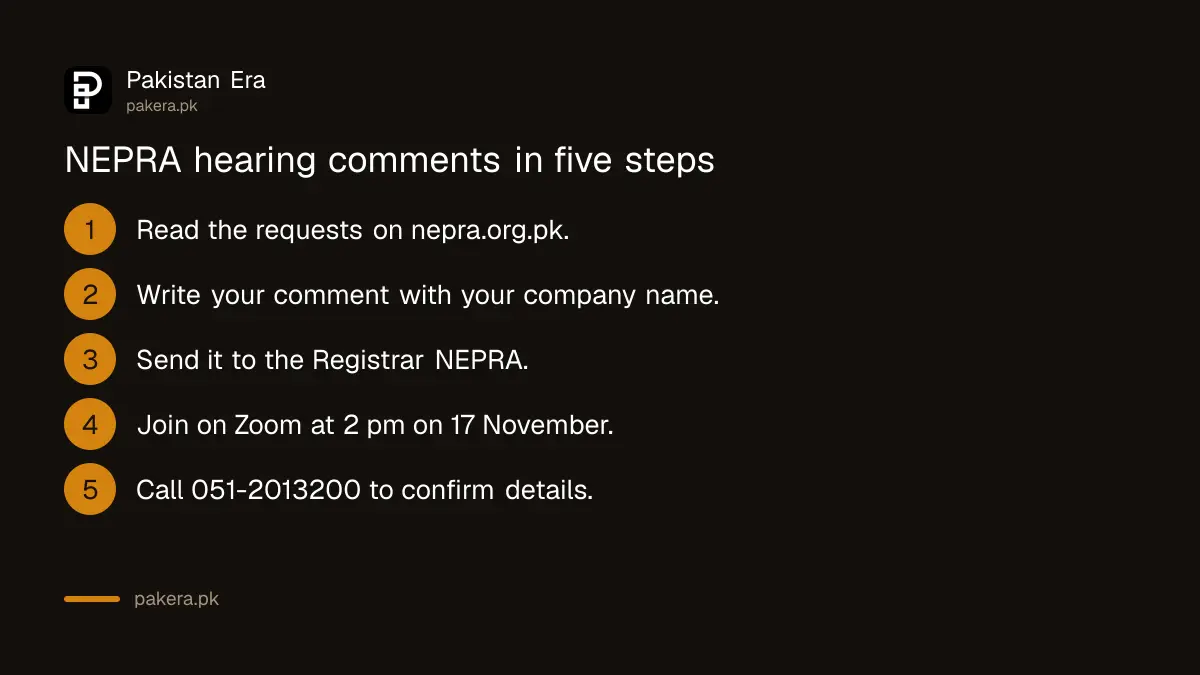
Anyone affected can send written comments or speak at the hearing. NEPRA's notice gives these details.
- Read the companies' adjustment requests on nepra.org.pk, which the notice says are posted there.
- Write your comment or objection, with your name and your electricity company.
- Send it to the Registrar NEPRA, NEPRA Tower, Attaturk Avenue (East), G-5/1, Islamabad, or email registrar@nepra.org.pk.
- To join online on 17 November at 2 pm, use the Zoom meeting ID 87414351434 given in the notice.
- Call 051-2013200 if you need to confirm anything with NEPRA's office.
Our guide to taking part in a NEPRA public hearing explains what a useful comment looks like.
The September fuel charge is still pending
The QTA is separate from the monthly fuel charge. CPPA-G asked for Rs 2.56 a unit for September, to be billed in November, and NEPRA heard that on 29 October. NEPRA's 5 November notice says the September fuel charge "has not been notified by the Authority". Our page on the September fuel charge request has that story, and our FCA list for 2026 tracks each month.
So a November or December bill can carry three moving parts at once: the base tariff, the monthly fuel charge and the quarterly adjustment. K-Electric customers can match each line on their bill using our guide to reading a K-Electric bill.
Common questions
What is the QTA on an electricity bill?
It is the quarterly tariff adjustment. NEPRA sets it every three months to cover capacity payments, plant running costs and grid charges that differ from what the tariff assumed.
How much have power companies asked for July to September 2026?
Rs 23,326 million in total, about Rs 23.3 billion, according to NEPRA's notice of hearing posted on 5 November 2026.
When is the NEPRA hearing on the new QTA?
On 17 November 2026 at 2 pm, at NEPRA Tower in Islamabad and online through Zoom, meeting ID 87414351434.
Will the new QTA apply to K-Electric customers?
Yes. NEPRA's notice says the third quarter adjustment it decides for the state companies shall also apply to K-Electric consumers.
How much will the new QTA add per unit?
NEPRA has not set a rate. Our rough arithmetic puts the full request near Rs 0.96 a unit, but NEPRA cut the last request by more than half.
Does the QTA apply to lifeline consumers?
Earlier quarterly notifications in 2026 excluded lifeline consumers. The rule for this quarter will be in NEPRA's final notification.
What we checked and sources
We read NEPRA's notice of hearing on nepra.org.pk, dated 5 November 2026, including the request table by company, the note on the September fuel charge, the K-Electric clause, and the hearing date, time, Zoom details and Registrar address. The April to June figures come from NEPRA's notification S.R.O. 1501(I)/2026 of 7 September 2026, as published on K-Electric's tariff page. The per-unit estimate is our own arithmetic and is labelled as such. We have not read the companies' individual filings.
About the author

Tax, Bills and Technology Writer
Ali Akhtar is a young and curious voice here at Pakistan Era. He is currently pursuing his A-Levels and has a growing interest in Pakistan’s changing industrial landscape and educational trends. Ali likes to write in a way that helps him explain and explore the world around him. His writing reflects the perspective of the new generation navigating the evolving trends of Pakistan where technology, youth innovation, and shifting opportunities are reshaping the country’s future.