Read Your K-Electric Bill in Karachi: Fixed Charges, FCA, QTA and the 5% and 10% Surcharge
Read your K-Electric bill line by line: fixed charges above 300 units, FCA, QTA, taxes and the 5% then 10% late surcharge, as KE explains them on its own pages.
Short answer: A K-Electric (KE) bill has five parts: variable charges for the units you used, fixed charges if you use more than 300 units a month, FCA and QTA adjustments approved by NEPRA, taxes KE collects for the government, and a late payment surcharge of 5 percent, then 10 percent, if you pay late. KE explains each on its own Know Your Bill page.
A Karachi family opens its KE bill and sees a total far above what the units alone would cost. The extra lines have short names: FCA, QTA, MUCT. Most people pay without knowing what any of them mean.
We read KE's Know Your Bill page and its tariff structure page on 13 October 2026. The words in quotation marks below are KE's own. We did not check any individual customer's bill, so we do not say whether a particular bill is right.
Variable and fixed charges follow your units
KE says variable charges are the cost of the units you use, and the rate per unit varies by the approved tariff slabs. Fixed charges apply when residential use goes above 300 units in a month. KE says they cover the cost of maintaining the network whatever you consume.
That 300 unit line is the one to watch. A home at 290 units and one at 310 units can see a clear jump. Our guide to electricity unit prices and fixed charges in Pakistan shows the national slab picture.
The tariff structure page lists the latest applicable tariff as SRO 150, dated 7 September 2026, and links a consumer tariff document dated 12 February 2026. The page did not show the slab rates in the text we could read, so we do not quote a rate per unit.
FCA and QTA are NEPRA adjustments
FCA stands for Fuel Charge Adjustment. KE says NEPRA approves it, and it reflects changes in fuel prices and the mix of fuels used to make power. QTA stands for Quarterly Tariff Adjustment. KE says it is applied every three months and reflects changes in generation and running costs.
Neither is set by KE alone. If an FCA line looks large, look for the NEPRA decision behind it. We cover the latest federal decisions in our page on the October 2026 electricity bill FCA increase.
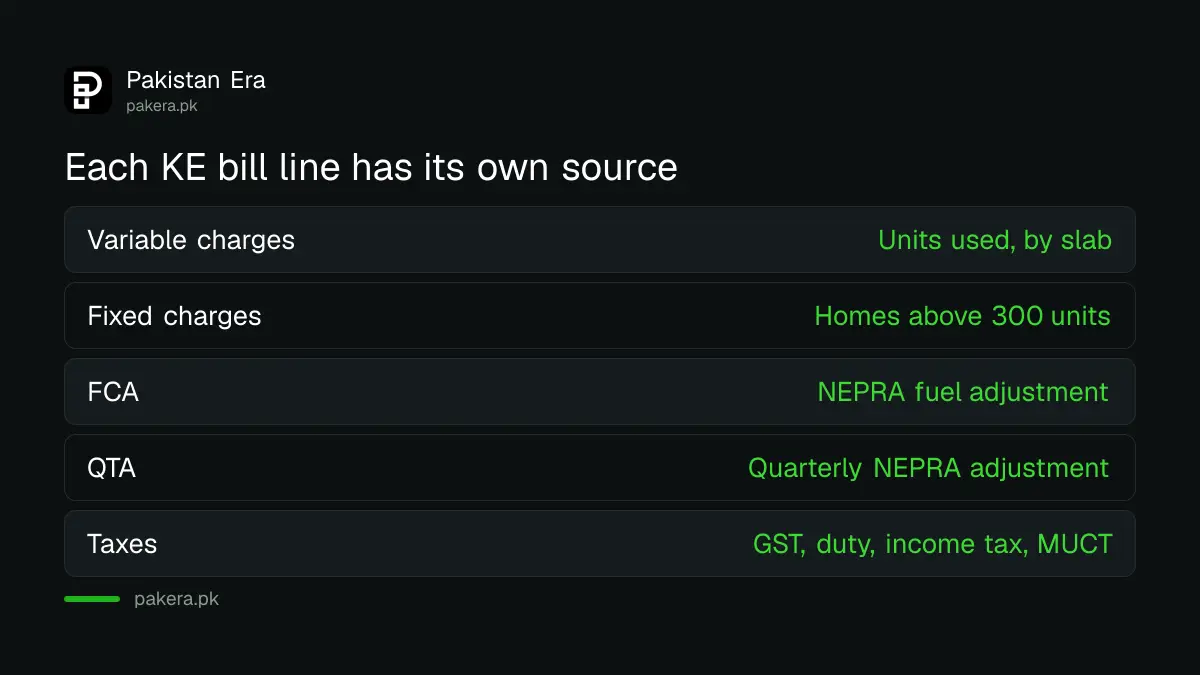
| Bill line | What KE says it is | Who sets it |
|---|---|---|
| Variable charges | Cost of units used, by slab | Approved tariff |
| Fixed charges | Network cost, above 300 units for homes | Approved tariff |
| FCA | Fuel price and fuel mix change | NEPRA |
| QTA | Change in generation and running cost, every 3 months | NEPRA |
| Taxes and duties | GST, income tax, electricity duty, MUCT | Government |
Taxes on the bill go to the government, not to KE
KE says it collects GST, income tax, electricity duty and MUCT on behalf of the federal and provincial governments and pays them over. KE says it does not keep this money.
The tariff structure page names three rates. GST is 18 percent. Electricity duty is 1.5 percent for domestic customers. Income tax is 7.5 percent for residential bills of Rs 25,000 or more. The page describes that last tax as applying to customers not on the FBR's active taxpayer list.
- If you file tax returns, update your CNIC on your account. See how to update your CNIC on your KE account.
- For the MUCT line, read our page on the MUCT charge on a KE bill.
Late payment costs 5 percent, then 10 percent
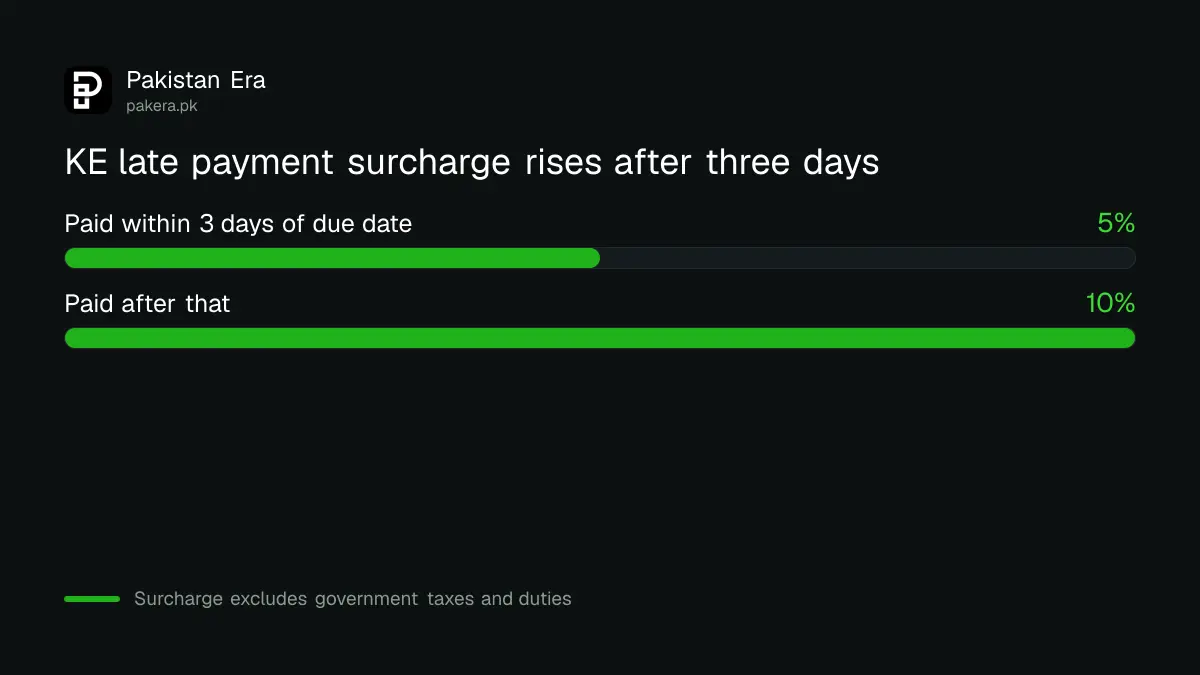
KE says a surcharge of 5 percent applies if you pay within three days after the due date, and 10 percent after that. The surcharge excludes government taxes and duties. In other words, it is worked out on the KE part of the bill and not on the taxes.
Pay on or before the due date to avoid it. The national rules for late payment are in our guide to the electricity bill late payment surcharge.
Read a new format bill in five steps
KE says it introduced a new bill format in August 2025 with a breakup of the billed amount, current and outstanding dues, and a breakdown of charges and taxes. Use that breakup to check your bill.
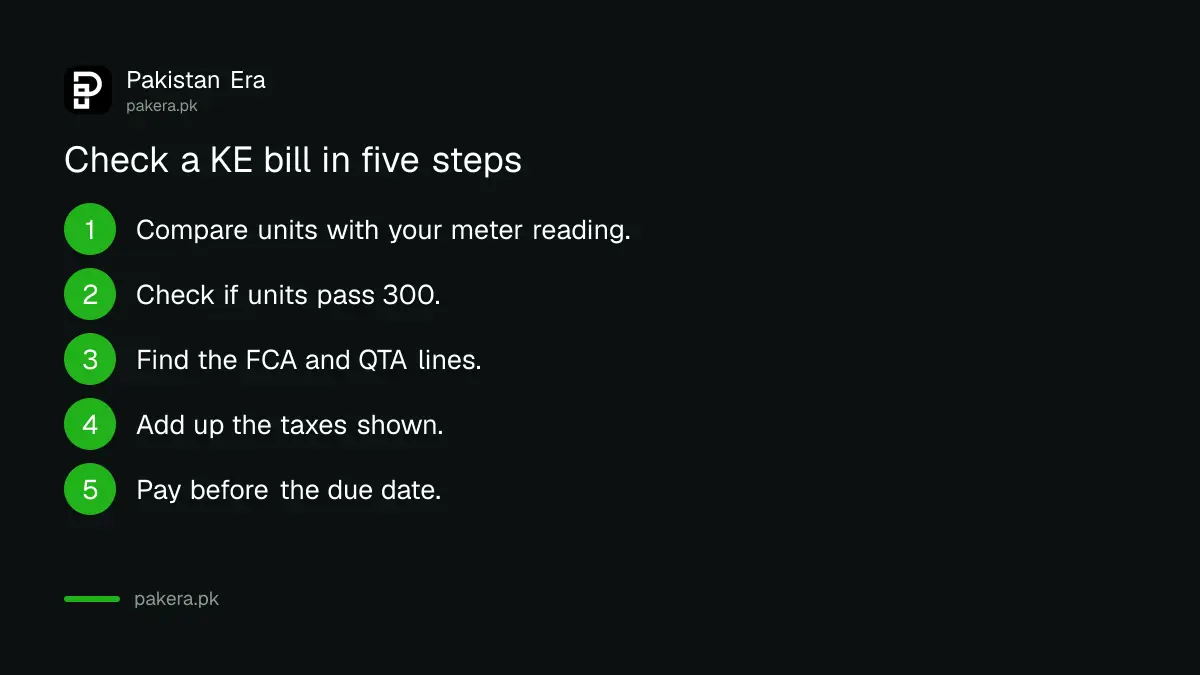
- Find the units used and compare them with your meter reading.
- Check whether the units pass 300 for fixed charges.
- Find the FCA and QTA lines and note the month they refer to.
- Add up the taxes and compare them with the breakup on the bill.
- Check the due date, and pay before it passes.
To download a duplicate bill, use the steps for checking a K-Electric bill online. If a line still looks wrong, follow how to complain to K-Electric and NEPRA.
Common questions
When does KE charge fixed charges to homes?
KE says fixed charges apply when monthly residential use goes above 300 units.
What is the difference between FCA and QTA?
FCA follows fuel price and fuel mix changes. QTA is applied every three months for generation and running costs. NEPRA approves both.
Does KE keep the taxes on my bill?
No. KE says it collects them for the federal and provincial governments and pays them over.
How much is the late payment surcharge?
KE says 5 percent if paid within three days of the due date and 10 percent after that, excluding taxes.
Can I avoid the 7.5 percent income tax?
KE's page ties it to bills of Rs 25,000 or more for customers not on the active taxpayer list. Update your CNIC on your account if you are a filer.
How we verified this
What we checked, where we read it, and what we could not confirm.
Last checked on 13 October 2026, Pakistan time. We read KE's Know Your Bill page and its tariff structure page. We could not read the slab rates in the text of the tariff page, so we quote none. We did not check any customer's bill.
About the author

Public Services and Education Journalist
Fajr Riaz is a journalist and content writer at Pakistan Era, based in Lahore. She covers the questions people meet in everyday life in Pakistan: how a public service works, what a change in the rules means, and where to find a reliable answer.