Youm-e-Istehsal on 5 August: What the Day Marks and Why Pakistan Observes It
Universities and offices observe Youm-e-Istehsal tomorrow. What happened on 5 August 2019, what the day means, and how it is marked.
Tomorrow is 5 August, and if you work at a university, a government office or a school in Punjab, you have probably seen the circular: observe Youm-e-Istehsal. Searches for what the day actually is spike every year at exactly this point, so here is the plain answer.
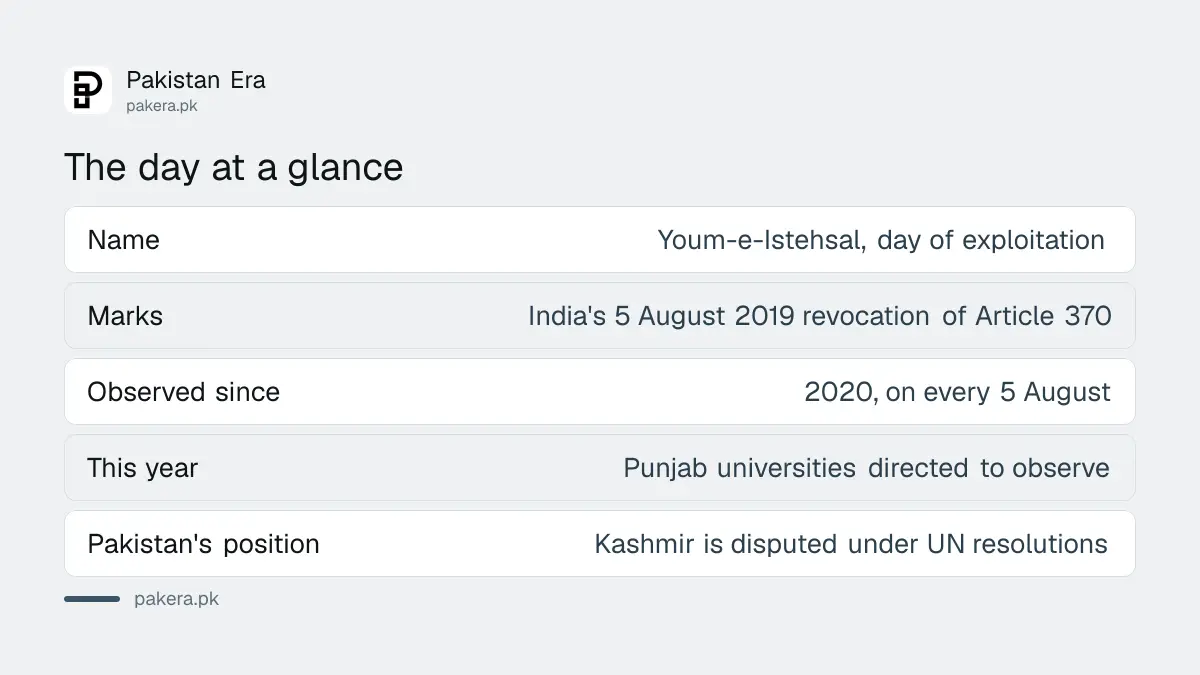
Youm-e-Istehsal, the day of exploitation, marks the anniversary of 5 August 2019, when India revoked Article 370 of its constitution and ended the special status of occupied Jammu and Kashmir.
What happened on 5 August 2019
Article 370 was the constitutional provision that gave Jammu and Kashmir a special status within India's system: its own flag, its own constitution, and restrictions on outsiders buying land, the last of these through the related Article 35A.
On 5 August 2019, India's government revoked that status and split the territory into two centrally administered units. What followed in the valley was a communications lockdown of extraordinary length, with internet and phone links cut, alongside detentions of political leaders, including ones who had worked within India's own system.
India's stated position is that the change was an internal constitutional matter. Pakistan's position is that Jammu and Kashmir is disputed territory whose future is to be decided under United Nations Security Council resolutions, so no unilateral change to its status is valid. Those two positions have not moved since, and the anniversary exists in the space between them.
Why Pakistan marks it, and how
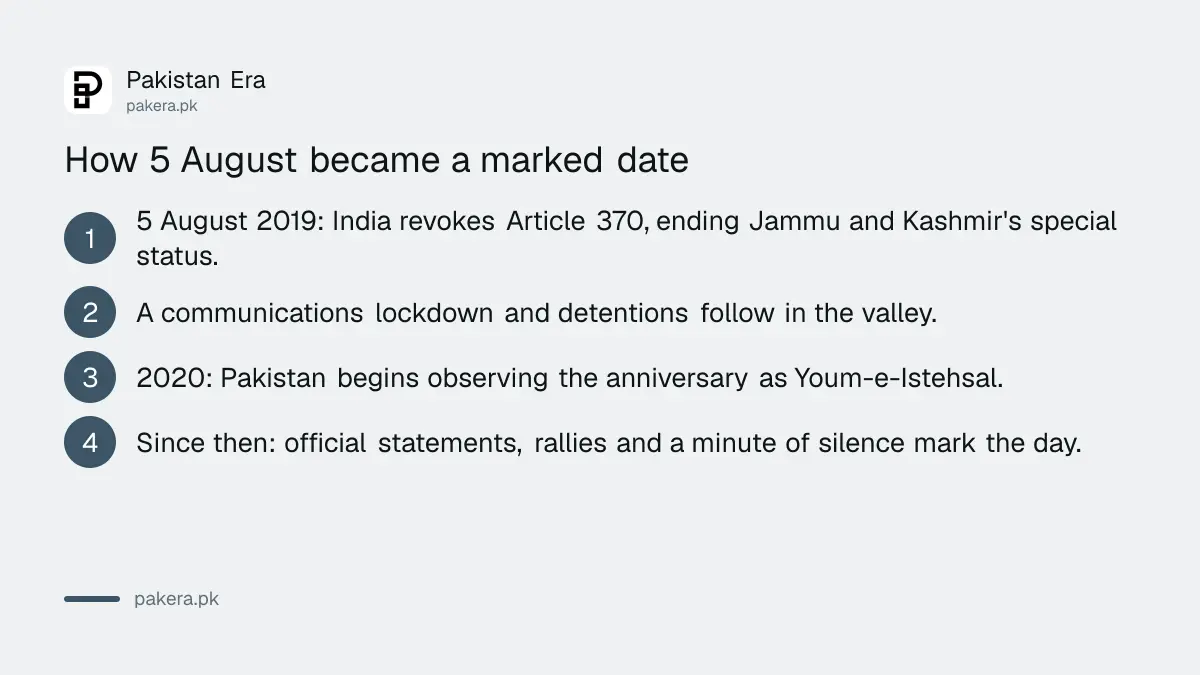
Pakistan began observing the anniversary in 2020, one year on, and has marked every 5 August since. The name does the arguing: istehsal means exploitation, and the day is framed as solidarity with Kashmiris living under the changed arrangement.
The shape of the day is consistent year to year even as the programmes vary: official statements from the government and military, rallies and seminars, documentaries and special transmissions, and a minute of silence observed at a fixed time in offices and institutions. This year the directive to Punjab's universities to observe the day is what has put the term back into search.
It sits in a pair with Kashmir Solidarity Day on 5 February, the older observance, which predates 2019 by decades. The two days are easy to confuse and worth separating.
| Kashmir Solidarity Day | Youm-e-Istehsal | |
|---|---|---|
| Date | 5 February | 5 August |
| Observed since | 1990 | 2020 |
| Marks | The dispute as a whole | The 2019 revocation specifically |
| Public holiday | Yes | No, observed while working |
That last row answers the most-asked practical question about tomorrow: offices, universities and schools open, and the observance happens inside the working day, which is exactly why the circulars directing institutions to mark it exist at all. A holiday needs no circular.
The question underneath the question
When people search "what is Youm-e-Istehsal", part of what they are asking is whether anything has changed, seven years on.
The honest answer is that the constitutional revocation has not been reversed, and the dispute itself is where it was: on the agenda of the UN Security Council, in the standing positions of both governments, and in the lives of the people the day is named for. Elections have since been held in the territory under India's arrangement, which India presents as normalisation and Pakistan rejects as consolidation of the change. Both of those characterisations are positions, and we report them as such.
What has changed is the region around the dispute. The conflicts of this year, which we have covered from their effect on energy prices to the defence arrangements forming across the Gulf, have made every South Asian flashpoint more watched, not less. Kashmir remains the oldest of them.
Reading the day online, carefully
Anniversary days in this region come with information noise, and 5 August is no exception. Two habits serve a reader well.
Treat unattributed viral claims about events in the valley the way we suggested treating the 11 August Balochistan posts: check what actually changed, check who is amplifying, and remember that both countries' information machines work hardest on anniversaries.
And expect connectivity restrictions to feature in coverage, as they have in Kashmir since 2019 at sensitive moments, a pattern whose Pakistani domestic counterpart we documented in the internet shutdowns piece. Communication blackouts are part of how this dispute is administered, which is itself part of what the day protests.
Questions readers are asking
What does Youm-e-Istehsal mean?
Day of exploitation. It is observed in Pakistan every 5 August, marking the anniversary of India's 2019 revocation of occupied Jammu and Kashmir's special constitutional status.
What was Article 370?
The provision of India's constitution giving Jammu and Kashmir special status, including its own constitution and, through Article 35A, restrictions on outsiders acquiring land. It was revoked on 5 August 2019.
When did Pakistan start observing the day?
In 2020, on the first anniversary, and every year since. Official statements, rallies, and a minute of silence are the standard shape of the observance.
Is it a public holiday?
No. Offices and institutions observe it while working, which is why circulars direct universities and departments to mark the day rather than close.
How is it different from Kashmir Solidarity Day?
Kashmir Solidarity Day, on 5 February, is the older observance and concerns the dispute as a whole. Youm-e-Istehsal marks the specific act of 5 August 2019.
Has Article 370 been restored?
No. The revocation stands, India treats the matter as internal and settled, and Pakistan maintains the territory is disputed under UN Security Council resolutions. The anniversary is observed in that unresolved space.
About the author

Public Services and Education Journalist
Fajr Riaz is a journalist and content writer at Pakistan Era, based in Lahore. She covers the questions people meet in everyday life in Pakistan: how a public service works, what a change in the rules means, and where to find a reliable answer.